How Fast a Pronghorn Runs
One of the most thrilling and, frankly, humbling experiences for any hunter setting foot on Nebraska's vast plains is encountering a pronghorn. Often called "antelope" (though they're not true antelope), these creatures are the undisputed speed kings of North America. Many new hunters, or even seasoned veterans from timbered areas, dramatically underestimate just how quickly a pronghorn can cover ground, turning what looked like a promising stalk into a blur of tan and white disappearing over the horizon. This guide will delve into the incredible speed of the pronghorn and, more importantly, explain why understanding this vital trait is absolutely critical for anyone hoping to successfully hunt them in Nebraska.
The Pronghorn's Unmatched Speed on the Plains
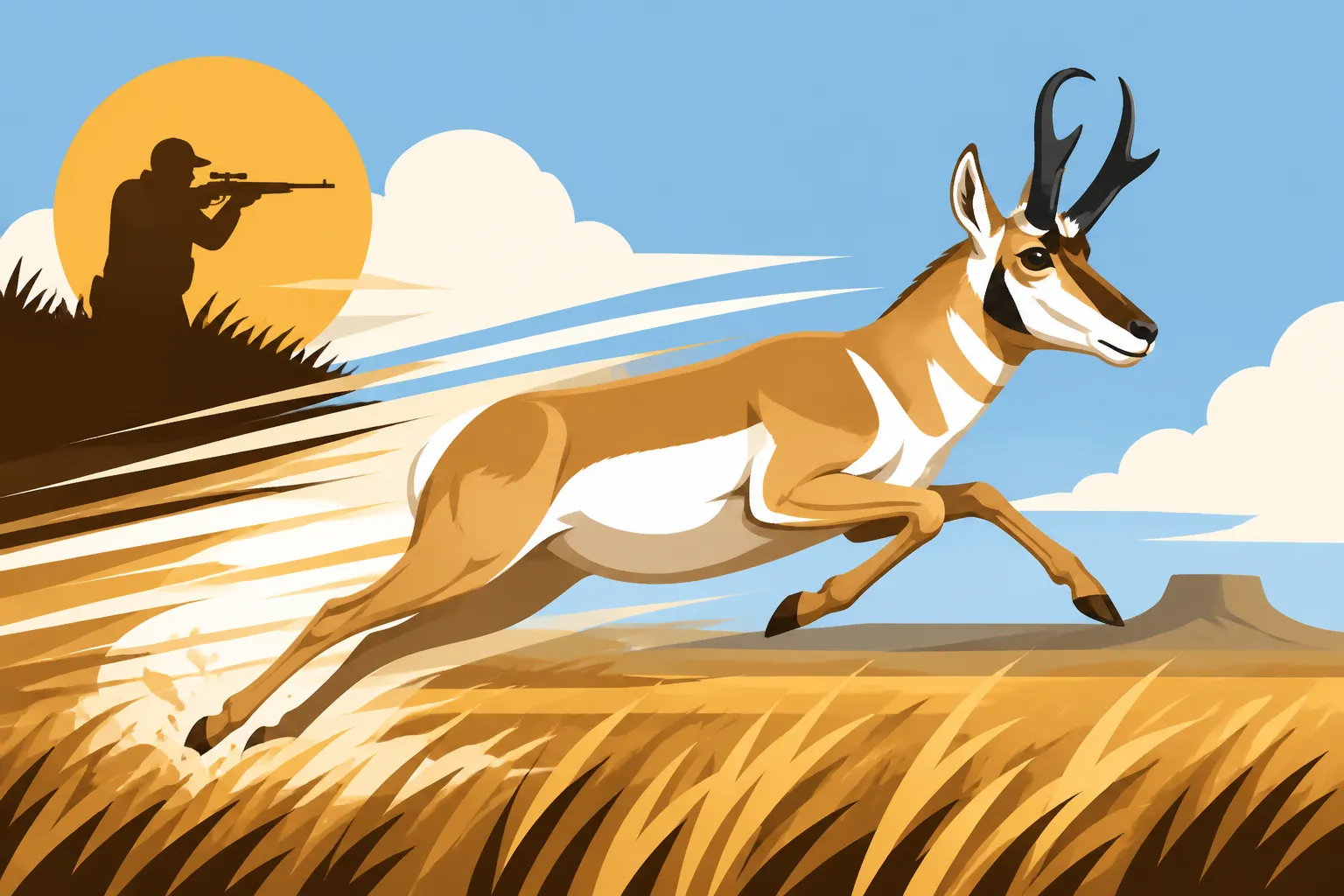
When you see a pronghorn bolt across the open plains, it's not just a quick burst; it's an exhibition of pure, sustained speed that truly sets them apart. They aren't just fast; they are literally built for speed and endurance in a way few other animals on earth can match. Their entire physiology is a testament to natural selection favoring a creature that can outrun the fastest predators.
Built for Blazing Trails
Think about an Olympic sprinter, but then imagine that sprinter being able to maintain their top speed for miles. That's essentially what a pronghorn is engineered to do. Their bodies are remarkably lightweight, with hollow hair that provides insulation without excess bulk. Their skeletal structure is also optimized for running, with long, slender legs and specialized hooves designed for hard, fast impacts on often uneven terrain. These aren't hooves for climbing mountains or slogging through deep mud; they are precision instruments for high-speed travel.
But the real secret sauce lies within. Pronghorns possess incredibly large lungs and a powerful heart, disproportionately large compared to their body size. This cardiovascular system allows them to process oxygen with remarkable efficiency, fueling their muscles for prolonged, high-speed chases. It's like having a V8 engine in a sports car – every component is designed for maximum output and endurance. When you're glassing a herd in the Sandhills and they suddenly decide to shift, it's not a casual trot; it's a fluid, almost effortless glide that eats up ground faster than you can believe. Pronghorn Antelope on the Nebraska Plains are truly unique animals.
Sustained Speed vs. Burst Speed
Many animals are known for their incredible burst speed. A whitetail buck can explode from a bedding area, reaching impressive speeds for a short dash. But a pronghorn is a different beast entirely. While they can certainly hit exhilarating top speeds, what truly makes them remarkable is their ability to sustain those speeds over vast distances. They don't just sprint; they marathon. Imagine trying to chase one with an ATV – you'd quickly realize that while the ATV might have a higher top end, the pronghorn can maintain a pace that makes closing the distance incredibly difficult without cutting corners or anticipating their route.
This endurance is a holdover from a time when the North American plains were home to predators like the American cheetah, which could match or even exceed the pronghorn's burst speed. To survive, pronghorns evolved to out-endure rather than simply out-sprint their pursuers. For a hunter, this means that even if you spot them at a distance, thinking you have time to make a move, that distance can be eaten up by the pronghorn in mere minutes if they decide to relocate. This is why having tools like GoHunt's mapping features can be so helpful; knowing the terrain for a potential cut-off route is crucial because you simply can't outrun them in a straight line.
Top Speed Estimates and What They Mean
While it's difficult to get an exact speed measurement in the wild, estimates generally place a pronghorn's top speed in a range that would make most Olympic athletes weep with envy. They are often cited as the second-fastest land animal on Earth, right behind the cheetah, but as mentioned, their endurance is superior. What this means for a hunter is that "fast" isn't just a casual description; it's a fundamental characteristic that dictates every aspect of a successful hunt.
Even their cruising speed, the pace at which they travel across the landscape when not actively fleeing danger, is significantly faster than almost any other game animal you'll encounter in Nebraska. This constant state of quick movement, combined with their incredible eyesight, makes approaching them in open country a monumental challenge. They're constantly covering ground, making static setups far less effective unless you've perfectly predicted their movement to a specific, irresistible resource like water.
Why Understanding Pronghorn Speed Matters for Hunters
Ignoring a pronghorn's speed is like ignoring the wind on the prairie—it's a critical factor that will inevitably lead to frustration and empty hands. Every decision, from scouting to stalking to shot placement, must be made with their velocity in mind.
Closing the Distance Challenges
Picture this: You're belly-crawling for what feels like an hour across a sagebrush flat, trying to get within range of a nice buck feeding calmly. You look up, heart pounding, only to see the buck has decided to move two hundred yards further down the prairie, seemingly without even breaking stride. This is the reality of hunting pronghorn. Their ability to cover ground quickly means that the "safe" distance you might allow a whitetail to maintain will be eaten up by a pronghorn in no time flat.
The open landscapes Where Nebraska Pronghorn Herds Are Largest offer little in the way of cover, making a direct, fast approach nearly impossible without being spotted. You're constantly playing a game of chess against an animal that can move its pieces at lightning speed. This means long, tedious stalks are often required, and even then, one wrong move, one gust of wind shifting your scent, or one moment of impatience can send them flying across the landscape, turning your hard-earned progress into a distant memory. This is where patience truly becomes a hunter's best friend, often outlasting the sun itself.
Shot Opportunities and Reaction Time
When you finally do get a shot opportunity, it often happens fast. A pronghorn that was standing still can, in a heartbeat, decide to bolt. This means that a hunter needs to be proficient with their rifle or bow, capable of quick target acquisition and an accurate shot under pressure. Unlike a whitetail that might jump at the sound of the shot, a pronghorn will often be in full flight before the bullet or arrow even reaches its mark if there's any delay.
Furthermore, estimating lead on a running pronghorn is a skill that takes considerable practice and a deep understanding of ballistics and the animal's speed. Many hunters opt to wait for a standing shot precisely because the margin for error on a running pronghorn is so incredibly small, even at moderate distances. Their speed demands precision, not just in shooting, but in anticipating their movements and being ready for a fleeting window of opportunity. It's a true test of a hunter's skill and composure.
Anticipating Evasion
A pronghorn's incredible speed means they have an innate, almost instinctive ability to evade danger from what might seem like a safe distance. You might spot a herd a half-mile away, thinking you have plenty of time to formulate a plan. However, a slight shift in the wind, the glint of sun off your binoculars, or even just your silhouette against the horizon can trigger their flight response. Once they decide to run, they don't just run away; they often run smart, using subtle terrain features to put more obstacles between themselves and perceived threats.
They might run parallel to a ridge, disappearing over the top only to reappear far down the line, having used the cover to their advantage. They can also use their speed to gain ground rapidly and then stop, turning to evaluate the threat from a new, safer vantage point. This constant awareness and quick-response evasion strategy makes them incredibly difficult to predict. Successful hunters learn to not just react to pronghorn movement, but to anticipate it, cutting off escape routes before the pronghorn even commits to one.
Tactics for Hunting Nebraska Pronghorn in Light of Their Speed
Hunting pronghorn in Nebraska is a masterclass in patience, strategy, and respect for an animal designed for speed. You can't beat them at their own game of speed, so you have to play a different game entirely.
The Art of the Stalk in Open Country
Given their speed and exceptional eyesight, direct confrontation is almost always a losing battle. The most common and often most rewarding method is the stalk. This involves using every subtle dip, rise, and patch of vegetation the Nebraska plains offer to your advantage. It requires excruciatingly slow, deliberate movement, often on hands and knees, or even belly-crawling for extended periods.
The wind is your absolute best friend here, as their sense of smell is keen, especially in the open. Always approach with the wind in your face or quartering. Wind and Thermals in the Sandhills play a huge role. You'll spend more time glassing than walking, studying the terrain and the animals' movements, waiting for them to feed into a favorable position near a creek bed, a patch of tall grass, or even a deep erosion cut. Tools like advanced mapping apps, perhaps integrated with GoHunt, can show you subtle contour lines that might offer just enough cover for those critical last few hundred yards. Stalking Pronghorn Across Open Nebraska Ground is a true test of a hunter's stealth and determination.
Decoying as a Counter-Strategy
Sometimes, you simply can't get close enough to a wily pronghorn buck using traditional stalking methods. The terrain might be too flat, the cover too sparse, or the wind just not cooperating. This is where a pronghorn decoy can be a game-changer, especially during the rut. Pronghorns are naturally curious, and a well-placed decoy, mimicking another buck or a lone doe, can sometimes pique their interest enough to draw them closer.
The key is timing and placement. You need to identify a buck that's interested, set up the decoy quickly while staying hidden, and then often hide behind the decoy itself as the buck approaches. This strategy directly leverages their territorial nature and curiosity against their speed. Instead of you trying to close the distance, you're enticing them to come to you, effectively negating their inherent advantage. Decoying a Rutting Pronghorn Buck can be a heart-pounding experience when it works right.
Waterhole Ambushes
In the arid landscapes of western Nebraska, especially during the warmer early archery season, water is a precious commodity. Pronghorns, like all animals, need to drink, and this necessity often overrides their usual caution and speed. Setting up a ground blind near a known water source – a windmill tank, a natural spring, or a stock pond – can be an incredibly effective tactic.
The beauty of this method is that when a pronghorn commits to coming to water, their speed becomes much less relevant. They are focused on quenching their thirst, making them momentarily vulnerable. You'll need to scout diligently to find active water sources and ensure your blind is well-concealed and set up well in advance to allow animals to get used to its presence. Archery Antelope From a Water Blind requires immense patience, sometimes waiting all day, but when a big buck walks into bow range, it's absolutely worth it.
Utilizing Technology for Advantage
While traditional hunting skills are paramount, modern technology can significantly level the playing field when dealing with such a fast and visually acute animal. High-quality optics are non-negotiable. Optics for Glassing the Nebraska Sandhills – powerful binoculars and spotting scopes – allow you to locate and evaluate pronghorn herds from extreme distances, often miles away, without alerting them. This allows you to plan your stalk before they even know you're there.
Rangefinders are also critical in open country where judging distance can be incredibly deceptive. Knowing the exact yardage is vital for precise shot placement, especially with a rifle at longer distances. Rangefinders in Open Nebraska Country take the guesswork out of those crucial moments. Additionally, detailed mapping applications, like those found on platforms such as GoHunt, are invaluable. They can reveal subtle elevation changes, drainage features, and vegetation pockets that simply aren't visible from your vantage point but could provide the critical cover needed for a successful stalk. These tools help you strategize against their speed, allowing you to choose the path of least resistance or the most advantageous approach.
Here's a quick look at how common hunting methods stack up against the pronghorn's speed advantage:
| Hunting Method | Pronghorn Speed Challenge | Hunter's Counter-Strategy | Key Gear |
|---|---|---|---|
| Spot & Stalk | Pronghorn can quickly move out of range or evade detection. | Extreme patience, using all available terrain and wind. | High-power binoculars, spotting scope, rangefinder, quiet clothing |
| Waterhole Ambush | Speed less of a factor, but prone to spotting movement near water. | Well-concealed ground blind, set up in advance, good scent control. | Ground blind, comfortable chair, scent eliminator, bow/rifle |
| Decoying | Bucks can approach quickly, requiring fast setup and reaction. | Realistic decoy, quick setup, hide behind decoy, call effectively. | Pronghorn decoy, calls, bow/rifle, rangefinder |
| Driving (Limited) | Nearly impossible to "drive" them due to speed and open country. | Not a recommended primary tactic for typical pronghorn hunting. | N/A |
The Role of Endurance: More Than Just a Sprint
While their burst speed is impressive, a pronghorn's true superpower lies in its stamina. This endurance factor adds another layer of complexity for hunters.
Outlasting Predators, Not Outrunning Them for a Moment
The pronghorn's evolutionary history is fascinating. Their incredible speed and endurance are often attributed to a predator that no longer exists in North America: the American cheetah. Unlike modern predators like coyotes, which can be fast in short bursts, the American cheetah was built for sustained high-speed pursuit. To survive, the pronghorn developed the physiological adaptations mentioned earlier – massive lungs, an oversized heart, and an efficient stride – that allowed them to simply run longer and faster than their ancient predators.
This means that a pronghorn isn't just trying to put a quick 100 yards between itself and a threat; it's capable of putting miles between itself and danger without significantly slowing down. For a hunter, this implies that if you bump a herd, they aren't likely to stop just over the next rise. They might keep running for a mile or more before settling down, making a follow-up stalk incredibly difficult and often fruitless unless you have a vehicle and a lot of open ground to cover.
The Hunter's Patience vs. Pronghorn Stamina
This endurance directly challenges a hunter's own stamina and patience. Trying to chase down a pronghorn on foot is usually an exercise in futility and exhaustion. They will simply outlast you. This is why tactics that involve waiting, ambushing, or carefully planned stalks are so crucial. You have to let the pronghorn's natural behavior, their need for food, water, or social interaction, bring them into your sphere of influence.
Instead of trying to match their speed, you're trying to outwit them. This might mean watching a herd for hours from a distant ridge, waiting for them to move into a position where a fence line or a hidden drainage provides enough cover for an approach. Or perhaps spending days scouting potential bedding areas and travel corridors, anticipating where they'll be at first light or last light. Nebraska Antelope Rifle Season Tactics often revolve around this kind of long-game strategy, leveraging observation and planning over raw physical exertion.
Observing and Learning Their Habits
To truly hunt pronghorn effectively, you need to become a student of their daily lives. Understanding their habits – where they like to feed, when they typically water, their preferred travel routes, and even how they react to different kinds of pressure – can help you circumvent their speed advantage. Using a Fence Line to Close on Antelope is a perfect example of this. Pronghorns are notorious for going under fences rather than jumping them. If you know their typical crossing points, you can use a fence line as a natural funnel, waiting for them to commit to a crossing, thus reducing the distance and controlling their movement.
This deep observation often starts well before the season. Scouting with good optics, even without a weapon, to understand the local herds and their routines is invaluable. Programs like GoHunt often offer detailed analytics and mapping that can help identify potential hotspots and travel corridors based on historical data or satellite imagery. By learning their rhythms, you can put yourself in a position where their speed is less of a factor, allowing your hunting skills and knowledge of the terrain to shine through. The fastest animal on the plains can still be outsmarted by a patient and knowledgeable hunter.
Disclaimer
This article is for general informational purposes only and does not constitute professional advice. Laws, prices and regulations vary by location and change over time. Consult a qualified professional for guidance on your specific situation.