Wind and Thermals in the Sandhills
Ah, the Nebraska Sandhills. It's a place of breathtaking beauty, vast openness, and quite often, a hunter's biggest headache: the wind. You've planned your stalk, you've pinpointed a trophy buck, and then that relentless prairie breeze shifts, swirling your scent directly into their nostrils. This guide is all about tackling that exact frustration, unraveling the mysteries of wind and thermals in this unique landscape, and giving you actionable strategies to keep your scent out of a big buck's nose, even when Mother Nature seems to be working against you.
Understanding the Sandhills Wind Machine
The Nebraska Sandhills is a dynamic environment, far from the predictable, timber-bound hunting most of us are used to. Here, the wind isn't just a factor; it's often the defining element of your hunt. Forget about dense forests breaking up air currents; in the Sandhills, the wind has an unobstructed playground, constantly changing directions and speeds. This relentless movement of air is what makes scent control and wind awareness paramount.
The Unpredictable Nature of Prairie Winds
Unlike areas with heavy timber or dramatic elevation changes, the Sandhills presents a relatively uniform landscape of rolling dunes and vast grasslands. This means prevailing winds often dominate, typically from the north or northwest during the hunting seasons, but cold fronts can sweep through with dizzying speed, bringing sudden shifts from the south or east. The challenge isn't just knowing the forecast, but understanding how the terrain, even subtle changes, can eddy and funnel that wind. A deep blowout might create a calm pocket one moment, then turn into a swirling vortex the next. When you're trying to figure out the best approach, you can’t just assume the wind will hold steady from one direction. It’s a constant chess match, and the wind is always making the first move. Trying to understand Wind Direction on Open Nebraska Prairie Stands is a constant learning curve.
How Wind Carries Scent Over Vast Distances
In the open country of the Sandhills, scent can travel an incredible distance. A slight breeze carrying your human odor can alert game hundreds of yards away, sometimes even further if the conditions are right. This is especially true when you're dealing with pronghorn or mule deer that rely heavily on their sense of smell and occupy large, open territories. Even a gentle ripple of air over a ridge can carry enough scent to put every deer in a basin on high alert. That's why simply knowing the general wind direction isn isn't enough; you need to anticipate how it will behave in specific micro-terrains. Many seasoned hunters will check their trusted weather apps, like those often integrated into hunting platforms such as GoHunt, to get detailed, hourly wind forecasts. But even with the best digital tools, ground-truthing with a wind checker is always essential.
The Dance of Thermals in Rolling Terrain
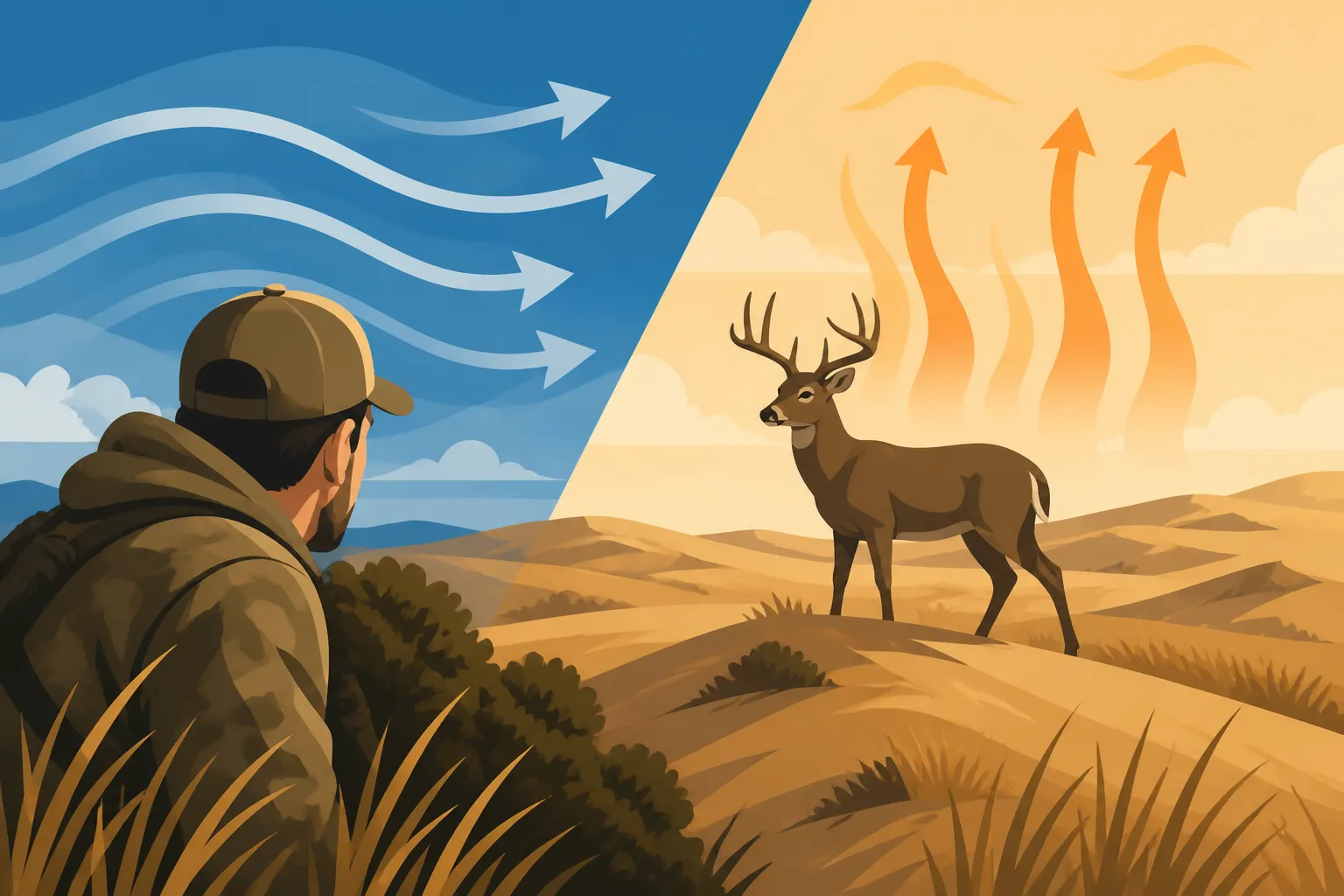
While the wind is often the most obvious force at play, thermals are a subtler, yet equally critical, component of scent movement in the Sandhills, especially during morning and evening hours. Thermals are essentially localized air currents caused by temperature changes, and they can completely override or interact with the broader wind patterns.
Morning and Evening Thermal Shifts
Thermals work on a simple principle: warm air rises, and cool air sinks. As the sun begins to warm the landscape in the morning, the ground heats up, and the air directly above it starts to rise. This creates an "upslope" thermal, pulling air (and your scent) up the hillsides and out of the valleys. Conversely, as the sun sets and the landscape cools, the air above the higher ground cools faster, becoming denser and sinking into the lower elevations. This creates a "downslope" thermal, pushing air down into the valleys and draws. These thermal shifts are most pronounced during the first and last two hours of daylight, which, coincidentally, are often the best times to hunt. If you don't account for these changes, an otherwise perfect approach could be ruined by your scent being carried directly to a bedded animal.
How Topography Influences Thermal Movement
The rolling, often dramatic topography of the Sandhills plays a significant role in how thermals behave. A deep "blowout"—a natural depression carved by wind—can act like a bowl, holding cooler air in the morning and channeling it downslope in the evening. Ridges and natural benches, on the other hand, become key areas where the rising and falling air currents can be felt most strongly. Imagine a deer bedded on a north-facing slope in the morning. As the sun rises and warms the south-facing slopes, the rising air might pull your scent up and over the ridge, completely missing the deer below. However, if you're approaching from above, that same upslope thermal could carry your scent directly to them. This nuanced understanding is vital for successful Glassing Sandhills Blowouts for Mule Deer or stalking game. Knowing when and where these thermal currents will flow is like having a secret roadmap for your scent.
Navigating the Wind/Thermal Interplay for Hunting Success
Successfully hunting the Sandhills means mastering the complex interaction between wind and thermals. It's not enough to know about them; you need a strategy to use this knowledge to your advantage. This means thoughtful planning, smart approach routes, and adapting in real-time.
Strategies for Different Times of Day
The key is to always position yourself so that your scent is being carried away from where you expect game to be.
- Early Morning (Sunrise to Mid-Morning): As the sun warms the eastern slopes first, thermals will begin to rise out of the valleys and up the hillsides. If you're hunting deer or antelope that have been feeding in the valleys overnight, this is the time to approach them from above their expected bedding areas, keeping the upslope thermal carrying your scent away. You might hike along a ridge crest, using the rising air to your advantage. Conversely, if you're stalking game still in a low-lying feeding area, you need to approach from downwind and below them.
- Mid-Day (Late Morning to Afternoon): This is when the prevailing wind usually takes over, and thermals are less distinct due to more uniform heating. This is often a good time for a longer-range glassing session from a high point, allowing you to locate animals and plan an afternoon stalk. Use a reliable app, like GoHunt, to check real-time wind speeds and directions before you commit to a move. When walking, always try to keep the wind directly in your face or quartering into it.
- Late Afternoon to Evening (Sunset): As the landscape cools, downslope thermals become dominant. This means air will be sinking into valleys, draws, and blowouts. If deer or antelope are moving out of bedding areas on ridges to feed in lower elevations, you want to approach from below them, with the downslope thermal pushing your scent down and away. Hunting a creek bottom or a valley? Be aware that any scent from above will settle right into those low areas. This is particularly important when considering Hunting a Creek Crossing in the Sandhills.
Optimal Approach Routes and Stand Placement
Your approach route is just as critical as your stand location. Always plan to use terrain features to hide your movement and keep the wind and thermals in your favor. This might mean making a longer, circuitous route to get to the downwind side of a target animal or bedding area. For ground blinds, situate them where the wind is consistently blowing your scent away from expected game travel routes. If you're on a saddle or ridge, consider how the wind might swirl over it. It's rarely a straight line in the Sandhills. Using binoculars or a spotting scope from a distance to observe animal movement and simultaneously check your wind direction with a wind indicator can give you the advantage. Remember, Closing the Last Hundred Yards on Sand requires extreme caution and impeccable scent control.
Stalking Tactics and Real-Time Adjustments
Stalking in the Sandhills is an art form, demanding constant vigilance of wind and thermals. As you move, frequently check your wind. Carry a small bottle of powder or a milkweed pod to see how the air currents are behaving right where you are. If the wind swirls or shifts unexpectedly, be prepared to stop, reassess, and even back out if necessary. Pushing forward with a bad wind will almost always result in an educated deer. Pay close attention to subtle terrain changes – a small knoll, a gully, or even a different type of grass can create micro-eddies that influence scent dispersal. This is especially true when you're trying to figure out Where Mule Deer Feed at First Light, as they often utilize terrain features for cover.
Here's a quick summary table of how to think about your strategy:
| Time of Day | Dominant Scent Movement | Ideal Approach/Stand Position | Key Consideration |
|---|---|---|---|
| Early Morning | Upslope thermals, rising air | Approach from above (ridge, higher ground), keeping scent away from valleys/lows. | Sun warming eastern slopes first, pulls scent up. |
| Mid-Day | Prevailing wind dominates | Downwind of bedding/feeding areas. Use terrain for cover. | Less thermal influence, but wind can still be tricky. Stay hidden, glassing. |
| Late Afternoon | Downslope thermals, sinking air | Approach from below (valley, draw), keeping scent away from ridges. | Cooling ground pushes scent down into low areas. Deer moving to feed. |
Practical Tips and Tools for Sandhills Scent Management
Even with a perfect understanding of wind and thermals, you still need to actively manage your scent. The Sandhills air is unforgiving, and a single mistake can blow your hunt.
The Importance of Scent Elimination and Clothing
Scent elimination isn't a silver bullet, but it's a crucial layer of defense. Start by washing your hunting clothes in scent-free detergent. Store them in airtight bags or containers, away from household odors, gasoline, or camp smoke. Shower with scent-free soap before a hunt. While you can't eliminate all human odor, reducing it significantly makes a huge difference. Think of it as minimizing the "cloud" of scent you're emitting, making it harder for the wind to carry a detectable amount to a deer's nose. Consider specialized activated carbon clothing or ozone treatments, but never rely on them as a substitute for playing the wind correctly. Your goal is to be as invisible as possible, not just visually, but olfactorily. This is especially vital when Stalking Pronghorn Across Open Nebraska Ground, as their vision and sense of smell are legendary.
Essential Wind Indicators and Glassing Gear
You absolutely need reliable wind indicators. Powdered wind checkers are great for quick puffs to see immediate air currents, but milkweed seeds or even a small piece of lightweight string tied to your bow or rifle can show more sustained patterns. Never go into the Sandhills without one. Beyond scent, high-quality optics are your best friend. Binoculars with 10x or 12x magnification, and often a good spotting scope on a tripod, are indispensable for Optics for Glassing the Nebraska Sandhills. They allow you to survey vast expanses, locate game, and watch their movements without having to move yourself and risk spooking them with a poor wind. Glassing from a vehicle, with a window mount for your optics, can be a great way to cover ground and check conditions before stepping out. Companies like GoHunt provide mapping overlays that can help you identify key topographical features from a distance, which is invaluable for planning your approach given the wind. Understanding Reading Sign on a Nebraska Sandhills Two-Track often involves observing from a distance.
Patience and Adaptation in Challenging Conditions
Hunting the Sandhills often demands a level of patience and adaptability that can test even the most seasoned hunter. There will be days when the wind simply won't cooperate, or it will swirl in ways that defy logic. On those days, it's often best to scale back your approach, focus on longer-range glassing, or even reconsider your hunting area. Trying to force a stalk in bad wind is usually a recipe for frustration. Instead, use these times for Scouting Nebraska Public Ground Before Opening Day, finding fresh sign, or simply enjoying the vastness of the landscape. Remember, the Sandhills reward those who respect its elements and adapt to its challenges. And while it can be frustrating, that's also part of what makes hunting this incredible region so rewarding when you finally get it right.
Disclaimer
The information provided in this guide is for general educational and informational purposes only and does not constitute professional hunting advice. Hunting regulations, seasons, and conditions can change rapidly. Always consult the latest Nebraska Game and Parks Commission regulations and local ordinances before engaging in any hunting activities. Safety should always be your top priority.