Rangefinders in Open Nebraska Country
Hunting in the vast, open expanses of Nebraska can be incredibly rewarding, but it also presents a unique challenge: judging distance. What looks like a chip shot across a short canyon can often be a 400-yard endeavor, and misjudging that distance by even a little bit can mean the difference between an ethical harvest and a frustrating miss. This guide will walk you through everything you need to know about choosing and effectively using rangefinders to conquer the deceptive distances of open Nebraska country, ensuring you make accurate and responsible shots every time.
Why Rangefinders are Essential in Open Nebraska Country
The rolling hills of the Sandhills, the wide-open plains of the Panhandle, and even the sprawling agricultural fields of eastern Nebraska all share a common characteristic: they mess with your depth perception. Without trees or other consistent landmarks to act as visual cues, judging distances accurately can feel like an impossible task. This is where a quality rangefinder becomes not just a helpful tool, but an absolute necessity for ethical hunting.
The Deceptive Nature of Open Terrain
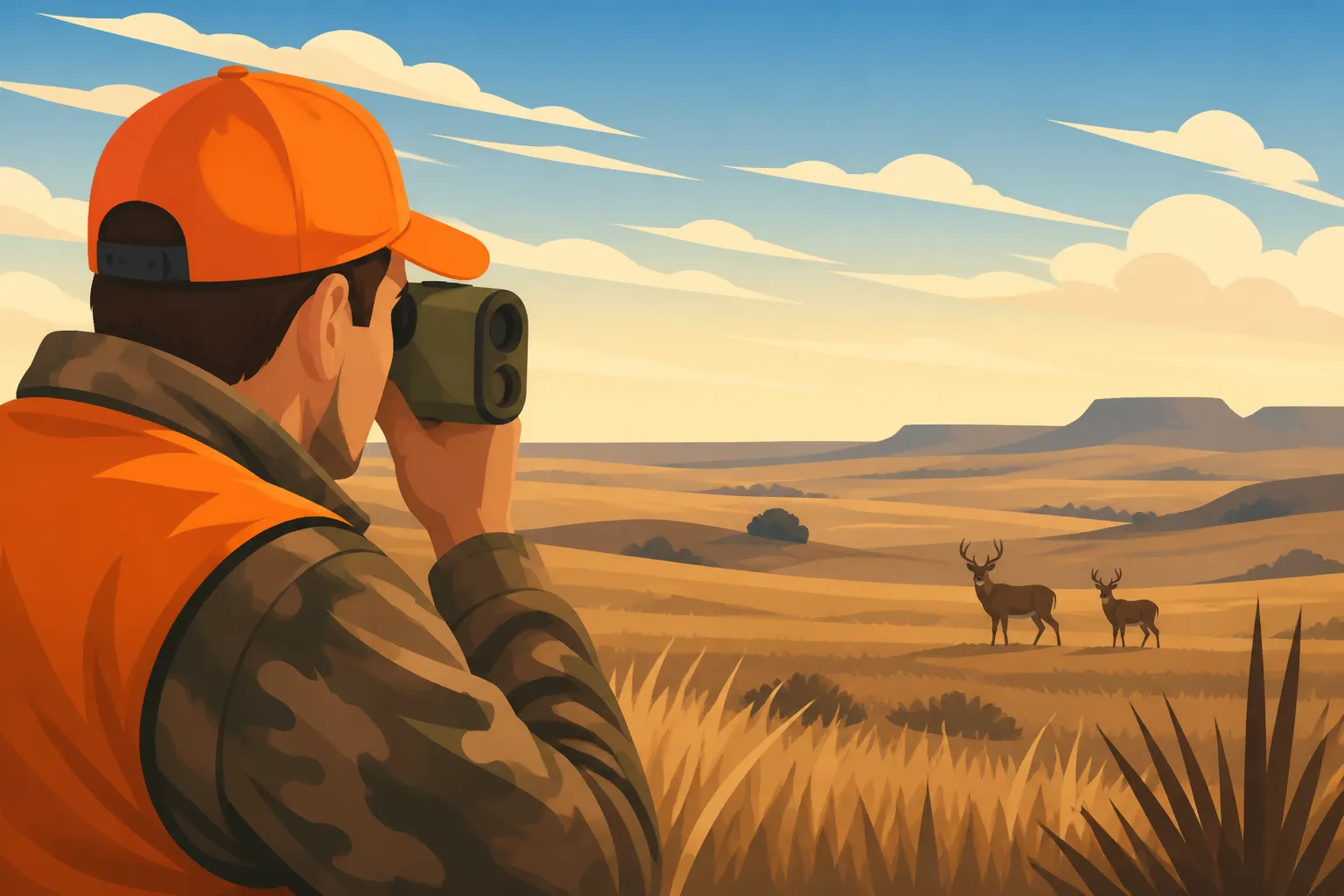
When you're out in the Sandhills, glassing for mule deer across a wide basin, or stalking pronghorn on the Oglala National Grassland, everything tends to look closer than it actually is. There's a phenomenon often called "prairie optics" where the lack of vertical elements and the consistent horizontal lines of the landscape compress distances. A deer that appears to be 200 yards away might, in reality, be pushing 350 or even 400 yards. This optical illusion can lead to serious misjudgments, especially when you're caught up in the excitement of a stalk or a stand-off. It’s a frustration every hunter out here has felt, believing they had a certain shot dialed only to find out, post-shot, how far off their estimation was.
Variable Distances and Ethical Shots
Unlike hunting in dense timber where shots might consistently be within a narrow 50 to 150-yard window, open country hunting in Nebraska demands precision across a much wider range. You might have a 50-yard shot at a pheasant flushing from a cattail slough, a 250-yard shot at a whitetail buck moving across a CRP field, or a 400-yard opportunity at a mule deer standing on a far ridge. Each of these scenarios requires a different hold or ballistic calculation, and guessing is simply not an option for an ethical hunter. A rangefinder removes the guesswork, giving you the exact distance needed to make an informed decision about taking the shot and applying the correct hold or turret adjustment. This ensures you're always within your effective range and confident in your ability to make a clean kill.
Legal Requirements and Safety
While Nebraska doesn't require you to carry a rangefinder, responsible hunting practices certainly encourage their use, especially with modern rifle calibers capable of extending ethical ranges. Furthermore, understanding your target's distance is paramount for safety. Knowing how far your bullet will travel beyond your target and what lies behind it is a critical aspect of firearm safety, especially when hunting across vast, undulating terrain where a missed shot can travel much further than anticipated. A rangefinder, coupled with a good mapping app like the one available from GoHunt, helps you visualize the terrain and potential hazards beyond your target, promoting safer hunting for everyone.
Types of Rangefinders and Their Features
Not all rangefinders are created equal. Depending on what you're hunting and the type of terrain you frequent in Nebraska, certain features will be more beneficial than others. Understanding the different categories will help you pick the right tool for your specific needs.
Standard Laser Rangefinders
These are the most common and often the most affordable type of rangefinder. They work by emitting a laser pulse, measuring the time it takes for the pulse to bounce off a target and return, and then calculating the distance. They are generally straightforward to use: point, press a button, and get a distance reading. For many hunters, especially those primarily hunting whitetails in river bottoms or pheasants in crop fields where shots are typically under 300 yards and on relatively flat ground, a standard laser rangefinder is perfectly adequate. They are a reliable workhorse and a significant upgrade from guessing. Their simplicity is often their greatest asset, allowing you to quickly get a read and focus on the shot.
Angle Compensating Rangefinders
Hunting in the Nebraska Pine Ridge or along deep creek drainages in the Sandhills often means shooting up or down hill. A standard laser rangefinder will give you the "line of sight" distance, which is the actual straight-line distance to the target. However, gravity acts differently on a bullet traveling at an angle compared to one traveling horizontally. This is where an angle compensating rangefinder shines. It calculates the "horizontal equivalent distance" or "shoot-to-range," which is the distance your bullet actually "feels" as it travels. For example, a 300-yard shot straight uphill might have a horizontal equivalent distance of 275 yards. If you hold for 300, you'll likely shoot high. Many hunters have made this mistake, especially when hunting from a high perch or into a deep ravine, and an angle-compensating unit eliminates that variable entirely. This feature is crucial for accuracy when hunting any kind of broken terrain that Nebraska offers, from the bluffs of the Niobrara to the draws of the Panhandle.
Ballistic Rangefinding Models
Taking things a step further, ballistic rangefinding models don't just give you the distance; they integrate with your rifle's ballistic data to provide actual holdover points, windage corrections, or even display the number of clicks you need to dial on your scope. These advanced units often have onboard sensors for atmospheric pressure, temperature, and angle, and allow you to input your specific cartridge, bullet weight, muzzle velocity, and scope height. Some can even pair wirelessly with a separate Kestrel weather meter for real-time wind data. While they come with a higher price tag, for serious long-range hunters targeting mule deer or antelope in the vast Sandhills, a ballistic rangefinder can be a game-changer. Imagine ranging a pronghorn at 500 yards, and your rangefinder immediately tells you to hold "2.5 mils high" or "14 MOA up" for your specific rifle setup. This level of precision removes virtually all external guesswork, allowing you to focus purely on executing a perfect shot. Ballistic Rangefinders for Long Shots are an investment that pays dividends in confidence and accuracy.
Key Features to Look for in a Nebraska Rangefinder
When you're out in the elements, the right gear makes all the difference. Choosing a rangefinder isn't just about how far it ranges, but how effectively it performs under real-world hunting conditions in Nebraska.
Maximum Range and Reflectivity
One of the most critical specifications is the maximum advertised range. While a rangefinder might claim to hit 1,200 yards on a "reflective target," that doesn't mean it will consistently range a deer-sized object at that distance. Always look for the stated range on a "deer" or "non-reflective" target, as this is a much more realistic indicator of performance in the field. For most Nebraska big game hunting, especially in open country, you'll want a rangefinder that can reliably hit deer out to at least 600-800 yards. This gives you a buffer, ensuring that even if you're comfortable shooting at 400, your rangefinder can acquire targets at even greater distances, making it easier to track and plan approaches. Having that extra capacity means less frustration when trying to range a distant buck silhouetted against a ridge line.
Optical Clarity and Low-Light Performance
Just like binoculars, the quality of the optics in your rangefinder matters. You want a clear, bright image that allows you to pinpoint your target precisely, especially in low light conditions common at dawn and dusk. Look for fully multi-coated lenses and decent objective lens size (e.g., 20mm to 25mm). An illuminated reticle is also a huge plus, as it prevents the reticle from getting lost against a dark background, ensuring you can clearly see where you're aiming your laser. This is especially important during those critical minutes around legal shooting light when deer are often most active. Being able to confidently range a deer in fading light can make or break an evening sit in a Cottonwood Bottoms and Deer Density area.
Scan Mode and Target Priority
A "scan mode" is incredibly useful in Nebraska. Instead of just a single reading, scan mode provides continuous distance updates as you pan the rangefinder across a landscape. This is fantastic for ranging moving animals, or for quickly getting readings on multiple objects to confirm distances around your stand or during a stalk. Imagine a deer walking through a CRP field; scan mode allows you to track its distance as it moves, giving you real-time data. Target priority modes are also beneficial. "First target priority" will give you the distance to the closest object in the beam, useful for ranging an animal in front of brush or fence posts. "Last target priority" will range the furthest object, ideal for ensuring you hit the deer standing behind a few blades of tall grass, not the grass itself. These modes enhance your ability to acquire the correct target in complex open environments.
Durability, Ergonomics, and Battery Life
Nebraska weather can be unpredictable, from driving rain to biting wind and dust. You need a rangefinder that can handle it. Look for rugged, waterproof or at least weather-resistant construction. Rubber armor not only protects against drops but also provides a better grip. Ergonomics are important too; can you comfortably hold and operate the rangefinder with one hand? Is the button easy to press, even with gloves? Finally, battery life is crucial. A dead rangefinder is useless. Most units use common CR2 or CR123 batteries, but having a long-lasting battery or carrying spares is a smart move, especially on multi-day hunts in remote areas of Nebraska National Forest and Grasslands Hunting.
Mastering Rangefinder Techniques on the Plains
Simply owning a rangefinder isn't enough; knowing how to use it effectively in the challenging environment of open Nebraska is key to maximizing its benefits.
Steadying Your Shot: Tripods and Bipods
Trying to hold a rangefinder steady, especially at longer distances, can be a real challenge, leading to inaccurate readings. The slightest wobble can cause the laser to miss your target entirely or hit something behind or in front of it. This is particularly true when you're trying to range a small target at 400+ yards. Using a shooting stick, bipod, or even a small, lightweight tripod can dramatically improve your accuracy and consistency. Many rangefinders have a built-in tripod adapter, which is a feature worth looking for. By steadying the unit, you ensure the laser hits exactly where you intend, giving you a precise distance every single time. This is especially useful when Glassing the Nebraska Sandhills for Mule Deer from a vantage point, as it also aids in reducing fatigue.
Scanning for Accurate Readings
As mentioned earlier, scan mode is your friend. Instead of trying to pinpoint a static deer, which might be partially obscured, use scan mode to sweep the general area. This continuous reading can often pick up the deer even if it's momentarily hidden or partially camouflaged, giving you a distance when a single pulse might fail. Additionally, when ranging an animal at a distance, it's often helpful to range objects immediately around it – a fence post, a distinctive bush, a rise in the terrain – to get a sense of the actual distances in that area. This cross-referencing can help confirm the accuracy of your primary target reading, giving you added confidence before preparing for a shot.
Ranging Known Objects vs. Target Acquisition
A great strategy for open country hunting is to "pre-range" known objects around your hunting position. If you're set up in a ground blind or a treestand, take the time to range prominent landmarks – a distant tree line, a power pole, a specific rock – and note their distances. You can even mark these on a simple sketch or your GoHunt app map. That way, if an animal appears near one of those pre-ranged points, you already have a very close approximation of its distance, saving precious seconds. When an animal does appear, and you need to acquire it quickly, aim for the densest part of the animal's body (the chest area) for the best chance of a solid return. Avoid aiming for thin legs or antlers, especially at long distances, as the laser might pass right through or glance off, giving you an inaccurate or no reading.
| Rangefinder Feature | Benefit in Open Nebraska Country | Ideal Use Case |
|---|---|---|
| High Max Range (Deer) | Reliable readings on distant game in vast plains and Sandhills. | Stalking Pronghorn Across Open Nebraska Ground, Long-range mule deer. |
| Angle Compensation | Accurate "shoot-to" distances on sloped terrain. | Hunting the Pine Ridge, river breaks, or deep Sandhills basins. |
| Optical Clarity | Clear target acquisition in varying light conditions. | Dawn/Dusk hunting for whitetails or mule deer. |
| Scan Mode | Continuous readings for moving animals or multiple targets. | Tracking deer or antelope moving through open fields. |
| Target Priority | Discriminating between foreground/background obstacles. | Ranging an animal partially obscured by tall grass or small brush. |
| Rugged/Waterproof | Withstands harsh Nebraska weather and accidental drops. | All seasons, especially late fall and winter hunts. |
| Illuminated Reticle | Clear aim point in low light. | Low-light conditions, dense cover, or against dark backgrounds. |
| Ballistic Integration | Provides precise holdover/turret adjustments for long shots. | Extreme long-range hunting for antelope or trophy mule deer. |
Common Pitfalls and How to Avoid Them
Even with a top-notch rangefinder, specific environmental factors and user errors can lead to inaccurate readings. Being aware of these challenges is the first step to overcoming them.
Dealing with Angles and Slopes
As touched on earlier, the difference between line-of-sight distance and horizontal equivalent distance is a common trap. If your rangefinder doesn't have angle compensation, and you find yourself shooting uphill or downhill, you need to manually compensate. A general rule of thumb is that for every 10 degrees of angle, you subtract a small percentage from your line-of-sight distance. For serious angled shots, consulting a ballistics chart that includes angle compensation data or using a separate ballistic calculator app on your phone becomes crucial. Many hunters have missed high on what they thought was a long shot, only to realize the significant angle made it a much shorter "effective" distance. Always be mindful of the topography, especially in areas like Hunting the Wildcat Hills Rimrock or deep river canyons.
Mirage and Heat Haze Interference
Anyone who's spent time glassing across open fields on a hot summer day knows about mirage. That shimmering, wavy distortion can make it incredibly difficult to get a clear image through any optic, and it can also interfere with laser rangefinders, especially at longer distances. The laser beam can be refracted or scattered by the heat waves, leading to inconsistent or incorrect readings. When mirage is bad, try to range objects that are slightly elevated off the ground, or wait for a lull in the heat waves. Sometimes, ranging something next to your target, which might be higher off the ground, and then estimating the difference can be more accurate than trying to punch through heavy mirage directly. Patience is key when dealing with these conditions.
Acquiring Small or Distant Targets
Trying to range a single prairie chicken at 500 yards or a pronghorn at 700 can be tough. Small targets simply don't offer much surface area for the laser to reflect off. At extreme distances, even a deer can be a challenging target. This is where a few things become critical: a steady rest (tripod!), excellent optics in your rangefinder, and sometimes, a bit of patience. If your rangefinder struggles to get a reading, try pressing the button multiple times, or slowly panning the rangefinder across the target area in scan mode. If all else fails, try ranging a larger object directly behind or in front of the target and estimate the slight difference. This is also where high-quality Rangefinding Binoculars Worth the Cost can make a huge difference, offering superior stability and optical performance for spotting and ranging.
Integrating Your Rangefinder with Other Gear
A rangefinder isn't a standalone tool; its effectiveness multiplies when integrated with other essential hunting gear and technology. Think of it as one crucial piece of a larger, well-tuned system.
Pairing with Ballistic Calculators
For hunters stretching their ethical range in open Nebraska country, a ballistic calculator is almost as important as the rifle itself. Many modern rangefinders, especially the ballistic models, can wirelessly pair with smartphone apps or handheld devices that run sophisticated ballistic software. You input your rifle, bullet, and environmental data (temperature, barometric pressure, humidity), and the calculator provides precise drop and windage solutions. When your rangefinder gives you a distance of 475 yards, that ballistic app can tell you exactly how many clicks to dial on your scope or where to hold on your reticle. This synergy is what allows for extremely confident and ethical long-range shooting, especially vital when Rifle Ranges Realistic in Open Country extend beyond simple point-and-shoot scenarios.
Using GoHunt or Other Mapping Apps for Waypoints
A rangefinder gives you the "now" distance, but mapping apps like GoHunt provide critical context and planning tools. When you get a range on a distant animal or a potential stand location, you can often save that precise location as a waypoint in your app. This is invaluable for several reasons. First, it helps you visualize the terrain and potential approaches. Second, if you harvest an animal, having its exact coordinates makes recovery much easier, especially in featureless terrain like parts of the Oglala National Grassland Hunting. Third, by marking key features or areas you've ranged, you build a mental map that's overlaid with real-world distances, improving your overall understanding of the hunting area. This type of detailed spatial awareness is particularly beneficial when scouting or planning a hunt on Scouting Nebraska Public Ground Before Opening Day.
Complementary Optics: Binoculars and Spotting Scopes
While some rangefinders have decent magnification (often 6x or 8x), they are not a substitute for quality binoculars or a spotting scope. Think of your optics system as a hierarchy:
- Binoculars (10x or 12x magnification, like those recommended in Optics for Glassing the Nebraska Sandhills) are for initial spotting and general glassing, covering wide areas to locate animals.
- Spotting Scopes (20-60x or more) are for thoroughly evaluating a distant animal – judging antler size, confirming species, and determining if it's a shooter.
- Rangefinders are then used to get the precise distance to that animal once you've decided to pursue it.
Often, you'll spot an animal with your binoculars, then use a spotting scope to determine if it's worth a stalk. Only then, or perhaps simultaneously with the spotting scope, will you use your rangefinder to get the critical distance. Some hunters opt for Tripods and Glassing From a Vehicle to stabilize all three, which greatly enhances glassing efficiency and reduces fatigue during long days in the field. Having these tools work together ensures you have the complete picture – finding the animal, evaluating it, and then knowing exactly how far away it is for an ethical shot.
Disclaimer
This article is for general informational purposes only and does not constitute professional advice. Laws, prices and regulations vary by location and change over time. Consult a qualified professional for guidance on your specific situation.