Arrow Weight for Windy Conditions
There’s nothing quite like the feeling of drawing back on a big Nebraska buck, but if you've spent any time with a bow and arrow in our beautiful state, you know one thing is almost guaranteed: the wind. That relentless, swirling, often unpredictable breeze can turn a perfectly executed shot into a heart-wrenching miss. It's a frustrating reality, and often, the key to battling those gusts isn't just better form, but optimizing a crucial piece of your setup: arrow weight. This guide is all about helping you understand why your arrow's mass matters so much in a crosswind and how to dial in your setup for success in the heart of the Central Flyway.
Understanding the Nebraska Wind: A Bowhunter's Nemesis
Nebraska is known for its wide-open spaces, whether it's the sprawling Sandhills, endless cornfields, or vast prairie. While this landscape offers incredible hunting opportunities, it also means hunters are often exposed to significant wind. This isn't just a minor inconvenience; it's a constant variable that can profoundly impact your arrow's flight path. Many bowhunters spend countless hours perfecting their form and tuning their bows, only to overlook the critical role arrow weight plays in combating wind drift.
The Silent Thief: How Wind Affects Arrow Flight
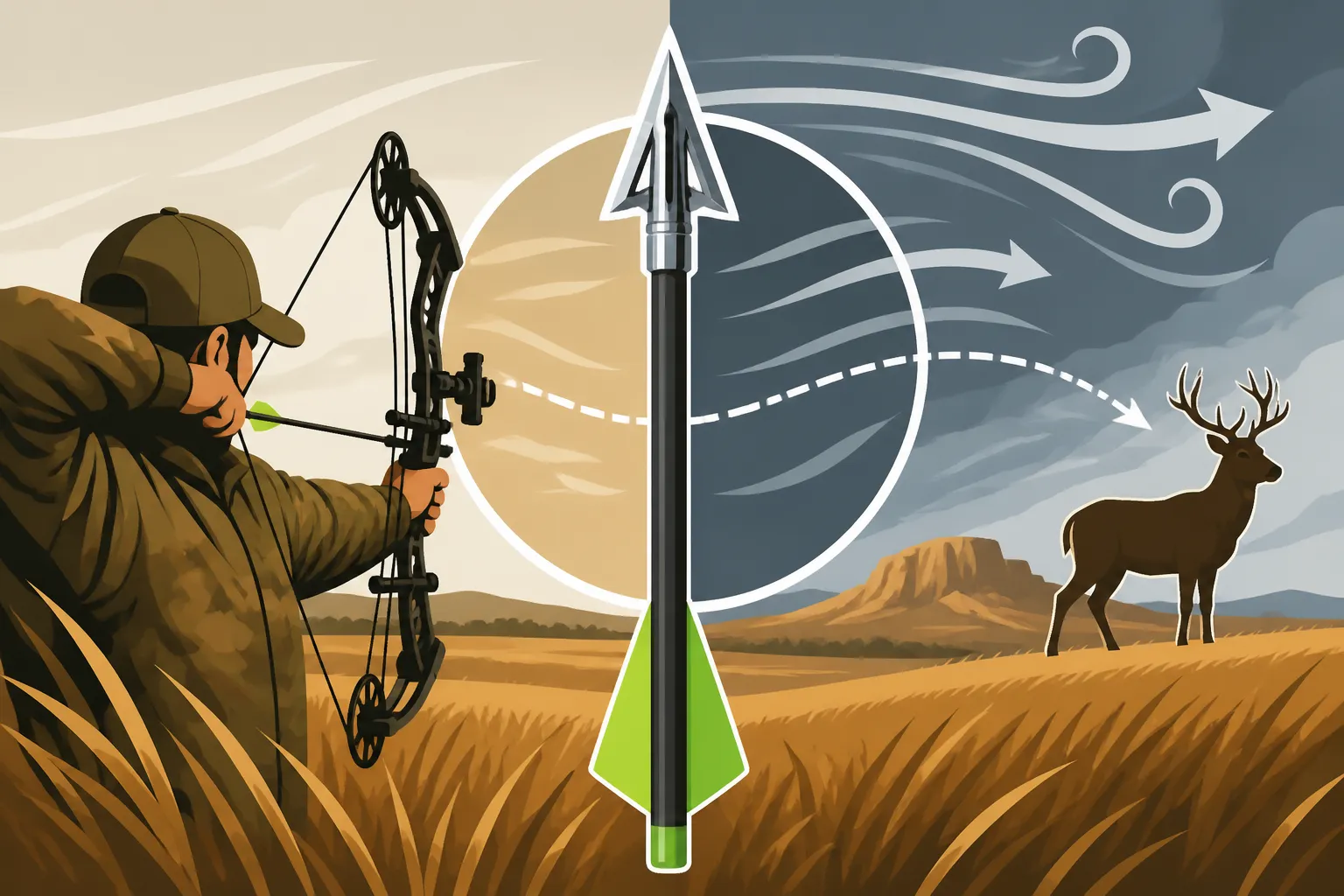
Think of an arrow in flight. It's a projectile, and like any projectile, it's subject to external forces. Wind, particularly a crosswind, applies lateral pressure to the arrow shaft and its fletching. A lighter arrow, with less kinetic energy and momentum, is simply pushed around more easily by this force. It's like trying to push a feather versus a rock in a strong current – the feather gets carried away with much less effort. The longer the shot, the more time the wind has to act on the arrow, and the more pronounced the drift becomes. It's not just about how fast your arrow leaves the string; it's about how well it maintains its intended course.
This phenomenon is especially noticeable when you're perched in a Choosing a Treestand Site on Nebraska Farmland or tucked into a Ground Blinds in Open Nebraska Country. You might feel the wind gusting, but it's hard to visualize the invisible hand pushing your arrow. The frustration often comes from a "miss" that felt perfect, yet the deer walked away unscathed, or worse, wounded. It leaves you questioning everything, when often, it's just physics at play.
Why Heavier Arrows Fight Back Better
Simply put, a heavier arrow carries more momentum and kinetic energy downrange. This isn't just about punching through hide and bone for better penetration; it's also about inertia. An arrow with greater mass has more resistance to change in its flight path. When a crosswind hits a heavier arrow, it has to work harder to push it off course. The increased mass acts like a natural stabilizer, helping the arrow maintain a straighter trajectory.
Consider a scenario where you're set up on a Hunting a Creek Crossing in the Sandhills on a blustery November afternoon. You’ve got a buck coming in at 30 yards. If you're shooting a super light arrow, that slight crosswind can push your arrow inches off target, turning a vitals shot into a gut shot, or worse. A heavier arrow will still be affected, yes, but to a lesser degree, giving you a wider margin for error in those tough Nebraska conditions. It might not be as "flat" shooting in perfect conditions, but in the real world of wind, flatter isn't always better if it means more drift.
The Weight Debate: Light vs. Heavy Arrows
The arrow weight conversation is one that often sparks lively debates in archery shops and hunting camps. There's a persistent myth that "faster is always better," and while speed certainly has its advantages, it often comes at the cost of other crucial performance factors, especially in windy environments. Understanding the trade-offs is key to making an informed decision for your Nebraska hunts.
The Lure of Speed: When Lighter Arrows Seem Appealing
For many bowhunters, the allure of a lightweight arrow is strong. Faster arrows mean a flatter trajectory, which in turn means less pin gap at various distances. This can simplify aiming, especially when a deer steps out at an unknown yardage between your 20 and 30-yard pins. A flatter trajectory also means the arrow reaches the target quicker, theoretically reducing the time an animal has to "jump the string" – reacting to the sound of the bow and dropping or moving before the arrow arrives.
However, this perceived advantage often comes with significant downsides, particularly in a state like Nebraska. While a light arrow might shoot incredibly flat on a calm day at the archery range, those perfect conditions are rare in the field. The moment a gust of wind picks up, that same light arrow becomes a kite, easily pushed and pulled, making accurate shot placement a significant challenge. For those long-range Spot-and-Stalk Mule Deer in the Nebraska Sandhills shots, speed alone won't get you there if your arrow is drifting several inches off course.
The Momentum Advantage: The Case for Heavier Arrows
On the other side of the spectrum are heavier arrows. These arrows sacrifice a bit of initial speed for substantial gains in momentum and kinetic energy. Think about it this way: a heavier arrow, while slower, acts like a mini-battering ram. It's more efficient at carrying energy through its target, leading to deeper penetration and often, a better exit wound for blood trailing. In our experience, especially when chasing bigger deer or even Archery Antelope Over Water in Nebraska, that penetration can be the difference between a quick recovery and a long, difficult search.
But beyond penetration, heavier arrows are inherently more stable in flight. They're less susceptible to wind drift because of their increased mass. The energy they carry helps them power through air resistance and crosswinds more effectively. This stability means greater accuracy in less-than-ideal conditions – which, let's be honest, is most of the time you're actually hunting in Nebraska. It might mean a slightly more arced trajectory, but with a rangefinder and good practice, adjusting for drop is often more manageable than compensating for unpredictable wind drift.
The Crucial Balance: Speed, Momentum, and Wind Drift
The real art of arrow tuning lies in finding a balanced setup that maximizes the advantages of both speed and momentum while minimizing wind drift. There's no magic number for "perfect" arrow weight, as it depends on your bow's draw weight, draw length, and your personal hunting goals. However, a good starting point for many Nebraska deer hunters is an arrow that weighs somewhere between 400 and 500 grains, fully assembled with broadhead. This range often offers a fantastic compromise, providing enough momentum for excellent penetration while still flying fast enough to keep pin gaps manageable.
Here's a quick look at the general trade-offs:
| Arrow Weight Category | Speed | Momentum | Wind Drift Resistance | Penetration | Trajectory |
|---|---|---|---|---|---|
| Light (Under 375 gr) | High | Low-Medium | Low | Low-Medium | Flat |
| Medium (375-450 gr) | Medium-High | Medium-High | Medium | Medium-High | Medium Flat |
| Heavy (Over 450 gr) | Low-Medium | High | High | High | More Arced |
Remember, every bow is different, and what works for one person might not work for another. The best way to find your sweet spot is through testing and understanding your equipment. This balance is key to success whether you're chasing whitetails in the river bottoms or trying to close the distance on a pronghorn in the open plains.
Building Your Wind-Resistant Arrow Setup
Optimizing your arrow setup for windy conditions isn't just about picking a heavy shaft. It's about understanding how all the components work together to create a stable, penetrating projectile. Every piece of your arrow, from the nock to the broadhead, plays a role in its flight characteristics.
Component Breakdown: Where Arrow Weight Comes From
The total weight of your arrow is a sum of its parts. Let's break down the main contributors:
- Arrow Shaft: This is the foundation. Heavier shafts typically have a higher Grains Per Inch (GPI) rating. Carbon arrows are popular for their strength-to-weight ratio, but there are various spine ratings and wall thicknesses that affect the overall weight. When selecting a shaft, consider one that's spined correctly for your bow and draw weight, but don't shy away from slightly heavier options if wind is a major concern.
- Fletching: While seemingly small, fletching adds weight and, more importantly, drag and stabilization. Larger fletching or a higher helical/offset can create more spin, stabilizing the arrow quicker, but also increasing overall drag. A common choice for bowhunting is a 4-fletch setup with 2-inch or 3-inch vanes, which offers excellent stabilization without excessive weight or drag.
- Inserts and Outserts: These components connect your broadhead to the shaft. Standard aluminum inserts are common, but heavier brass or steel inserts are available. These can add anywhere from 50 to 100 grains or more to the front of your arrow, significantly increasing your overall arrow weight and, crucially, your Front of Center (FOC).
- Broadhead: The broadhead itself is a significant weight contributor. Fixed blade broadheads often weigh between 100 and 125 grains, though some mechanicals can be lighter or heavier. Fixed Versus Mechanical Broadheads is a whole other debate, but generally, heavier broadheads (especially when paired with heavy inserts) will improve stability in wind.
Front of Center FOC and Arrow Stability
Front of Center (FOC) refers to how much of an arrow's total weight is concentrated in its front half. Expressed as a percentage, FOC is incredibly important for arrow flight stability. An arrow with higher FOC (generally 12-15% for hunting, though some advocate for even higher) tends to fly more consistently and is less susceptible to wind drift. Think of it like a dart: the weight is concentrated at the front, helping it fly straight.
To increase your FOC, you'll want to add weight to the front of your arrow. This is where heavier inserts or broadheads come into play. Many hunters will switch from standard aluminum inserts to brass or titanium inserts, which can add significant mass directly behind the broadhead. This strategic weighting helps the arrow recover faster from the paradox (the flexing of the arrow as it leaves the bowstring) and maintain a more stable flight path through crosswinds. It's a fundamental concept in creating a wind-resistant setup.
GoHunt and Other Resources for Setup Planning
When you're trying to dial in your arrow setup, it can feel like there's an overwhelming amount of information out there. That's where solid resources come in handy. Beyond talking to experienced bow technicians at your local pro shop, online platforms can be incredibly helpful. Sites like GoHunt, for example, often feature articles and discussions on gear optimization, including arrow setups for different hunting conditions. They might not give you the exact formula for Nebraska wind, but they provide valuable insights and community knowledge that can guide your choices.
Additionally, don't underestimate the power of manufacturer websites. Arrow shaft companies provide detailed spine charts and Grains Per Inch (GPI) ratings, and broadhead manufacturers list their weights. Taking the time to research these numbers and understand how different components contribute to your overall arrow weight will empower you to make informed decisions. Sometimes, just swapping out a lightweight aluminum insert for a heavier brass one can make a noticeable difference in how your arrow performs in a brisk breeze.
Practical Tips for Bowhunting in Nebraska's Gusts
Having the right arrow setup is half the battle; the other half is knowing how to apply that knowledge and adapt in the field. Nebraska's weather is notoriously unpredictable, and you'll rarely get a perfectly calm hunting day. Developing strategies to contend with the wind will make you a more successful and confident bowhunter.
Pre-Hunt Preparation: Practice in the Breeze
This might sound obvious, but many hunters only practice on calm days at the range. To truly prepare for Nebraska's winds, you need to practice in them. Go to an outdoor range on a windy day – not just a slight breeze, but when it's truly gusting. This will give you firsthand experience of how your specific arrow setup reacts. Shoot at various distances, paying close attention to how much your arrow drifts and where it consistently impacts.
During these practice sessions, don't be afraid to experiment. Try aiming a few inches into the wind to compensate for drift. Note how your peep sight might shift slightly in the wind, or how your form might be subtly affected. Practicing in adverse conditions builds muscle memory and confidence. It also helps you understand the limitations of your setup and your own abilities. You might find that on a particularly windy day, your effective ethical range significantly decreases, and that's an important piece of information to have before you're staring down a trophy buck. You wouldn't go Bowhunting Through the November Firearm Season without understanding the orange rules, so don't hunt in the wind without practicing in it.
In the Field: Reading the Wind and Making Adjustments
Once you're actually out hunting, reading the wind becomes paramount. Don't just rely on a weather app; feel it, see it, and smell it. Carry a small bottle of wind-checker powder to see subtle air currents. Watch how tree branches move, how grass bends, and how dust kicks up. Pay attention to how the wind shifts, especially around topographical features like a Reading a Cedar Draw for Deer Movement or a bluff.
When a shot opportunity arises in windy conditions, be prepared to make adjustments.
- Hold Into the Wind: For crosswinds, you'll likely need to hold slightly into the wind. How much depends on your arrow setup, the wind speed, and the distance. This is where your practice in the wind really pays off – you'll have a better intuitive feel for the compensation needed.
- Wait for a Lull: Sometimes, the best strategy is patience. Winds often come in gusts and lulls. If you can, wait for a momentary calm spell before taking your shot. This requires discipline, especially when adrenaline is pumping, but it can dramatically increase your chances of a clean hit.
- Assess the Shot Angle: A quartering-away shot might be more forgiving of wind drift than a direct broadside shot if the wind is pushing your arrow toward the vitals rather than away from them. Always be mindful of the wind's direction relative to your target.
Managing Expectations and Shot Selection
Ultimately, bowhunting in Nebraska means accepting that conditions won't always be perfect. Even with a perfectly tuned, wind-resistant arrow, there will be days when the gusts are simply too strong for an ethical shot beyond very close range. Learning when not to shoot is as important as knowing when to release.
If you're out Hunting the Pre-Rut in Late October and the wind is whipping at 25 mph, that 40-yard shot that feels routine on a calm day might become a risky gamble. Manage your expectations, and set a personal ethical range for windy conditions that might be shorter than your calm-weather range. A deer spooking is one thing, but a wounded animal due to a reckless shot in extreme wind is something every hunter wants to avoid. Trust your judgment, and if in doubt, let the animal walk. There will always be another opportunity, especially in a state with fantastic hunting like ours.
Conclusion
The Nebraska wind is an undeniable force, but it doesn't have to sabotage your bowhunting season. By understanding the physics of arrow flight, intentionally choosing a heavier, well-balanced arrow setup, and dedicating time to practice and in-field adjustments, you can significantly mitigate the effects of wind drift. Don't let the whispers of "faster is better" lead you astray from what truly matters in real hunting conditions: consistent, stable flight. Embrace the challenge, dial in your arrows, and you'll find greater success and confidence when that big buck steps out on a blustery Sandhills morning.
Disclaimer
This article is for general informational purposes only and does not constitute professional advice. Laws, prices and regulations vary by location and change over time. Consult a qualified professional for guidance on your specific situation.