Shot Size for Early-Season Pheasants
That crisp morning air, the dew still clinging to the grass and milo stalks, the sheer anticipation of a rooster exploding from cover – it’s a feeling every pheasant hunter in Nebraska lives for. But as you gear up for those early season hunts, often in warmer weather and dense cover, a common question pops into many minds: "Am I using the right shot size?" It’s a valid concern, because picking the wrong load can lead to missed birds or, even worse, wounded birds that get away. This guide is all about helping you confidently choose the ideal shot size for those first few weeks of Nebraska's pheasant season, ensuring clean kills and more roosters in your vest.
Understanding Early-Season Pheasant Behavior
When the pheasant season first opens in Nebraska, typically in late October, the birds often behave quite differently than they will later in the year. It’s not just the calendar that changes; it’s the landscape and the birds themselves. Recognizing these nuances is key to selecting the right ammunition.
The Difference Early in the Season
In the early season, pheasants haven't been pressured much by hunters. They're often less wary, more likely to hold tight in cover, and sometimes even a bit "dumb" compared to their late-season counterparts who have run the gauntlet of orange-clad hunters and barking dogs. This means flush distances can be a mixed bag. You might have a rooster bust out right under your feet, giving you a chip shot, or one that flushes 30-40 yards out in a wide-open field. The cover is typically still thick and green, especially in areas with robust CRP (Conservation Reserve Program) fields or heavy shelterbelts. This dense vegetation provides fantastic concealment for the birds, making them harder to see and leading to sudden, close-range flushes. It's a different game than when the snow is flying and cover is sparse.
Think about walking a field of standing milo or tall switchgrass in late October. The birds have every advantage of concealment. They don't have to run far to disappear, and they'll often sit tight, relying on that cover until you're almost on top of them. This can be exhilarating but also challenging, as reaction time is critical. The robust cover also means that if you don't anchor a bird cleanly, it has plenty of places to run and hide, making recovery tougher. That's why proper shot size, delivering enough pellets and energy, is paramount. You want to drop that bird stone dead right where it flushes, or as close to it as possible. This is particularly true if you’re Hunting a Pheasant Field Without a Dog, where tracking a wounded bird can be nearly impossible.
Flushing Distances and Cover Types
The type of cover you're hunting dramatically influences flush distances. In areas like the open grasslands of the Sandhills or lighter CRP fields, birds might flush a bit wilder, giving you more moderate-range shots. However, when you're working dense pockets of cattails, thick plum thickets, or deep draws in eastern Nebraska, those birds will often wait until the last possible second. These close-range flushes demand a different approach than the longer shots you might anticipate in, say, a wide-open corn stubble field later in the year.
Consider a typical scenario on an early-season walk-in access area. You and your buddy are moving through a brushy creek bottom with a good dog working ahead. The dog locks up, goes on point, and suddenly, a vibrant rooster bursts out from a tangle of multiflora rose at what feels like 15 yards. That's a vastly different shot than a bird that flushes at 40 yards from sparse wheat stubble. The dense cover also creates obstacles for your shot pattern. Twigs and leaves can deflect pellets, and a wider pattern is often more forgiving at close range in such environments. Understanding that you're likely to get a mix of close and medium-range shots in varied cover is essential for selecting a versatile shot size. If you're Walking Milo and Corn Stubble for Pheasants, expect birds to use the vertical cover until you are right on them.
The Science Behind Shot Size
Choosing the right shot size isn't just about tradition or what your grandpa used. There's real physics and biology at play when those pellets leave your barrel. It comes down to a balance of pellet count and individual pellet energy.
Pellet Count vs. Pellet Energy
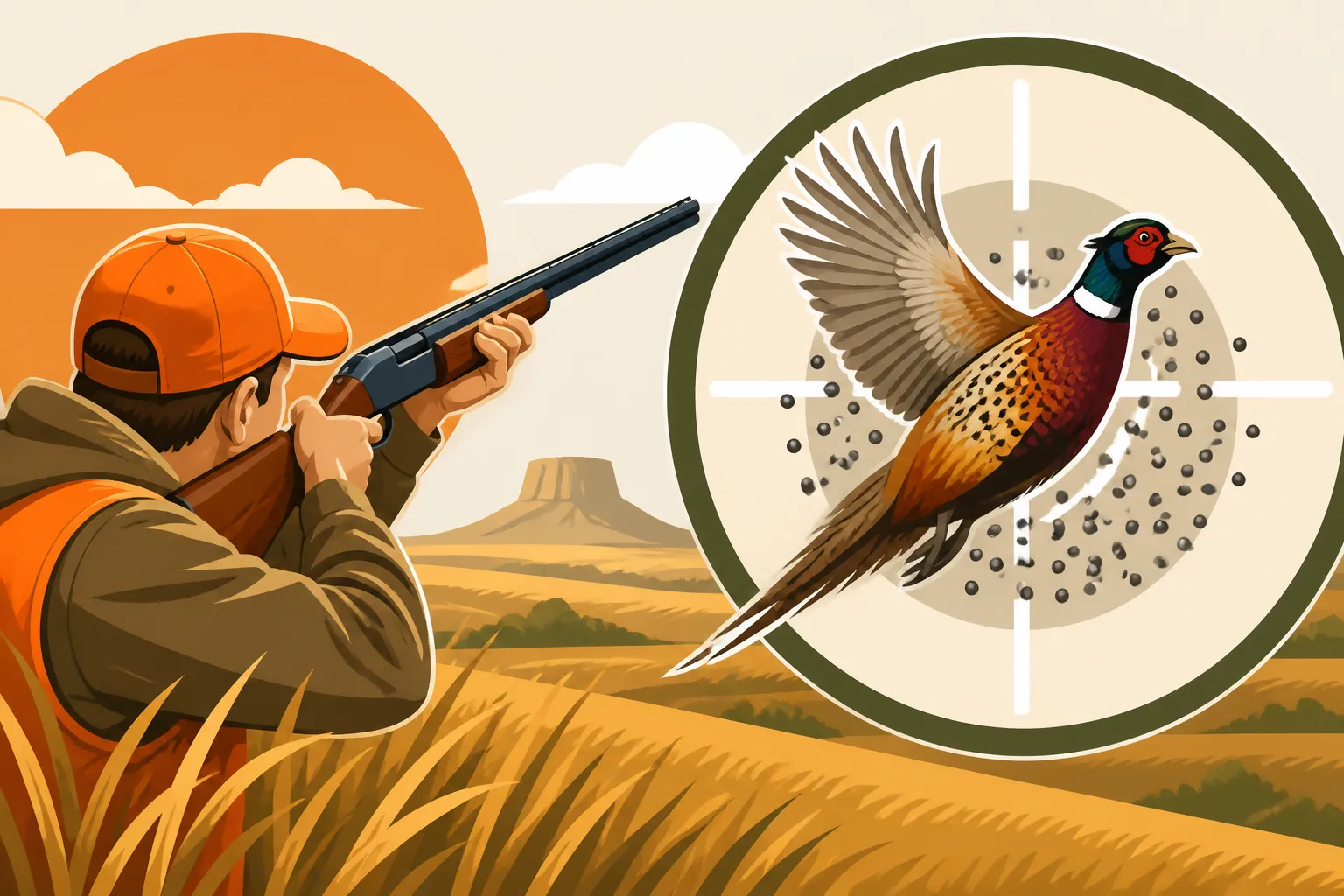
Smaller shot sizes, like #7.5 or #6, contain more pellets per ounce of shot than larger sizes, like #4 or #5. This higher pellet count translates to a denser pattern downrange, which increases the probability of hitting a fast-moving bird. For pheasants, especially early in the season when they might present a smaller target at closer ranges and you need to ensure multiple hits for a clean kill, a dense pattern is a huge advantage. More pellets mean a greater chance of hitting the vitals.
However, smaller pellets also carry less individual energy. They lose velocity faster and penetrate less deeply. This is a critical consideration. While you want a good pattern, you also need each pellet that hits the bird to have enough energy to break bone, damage organs, and create a lethal wound channel. A bird peppered with tiny pellets that don't penetrate adequately is a wounded bird, not a dead one. Larger pellets, conversely, carry more energy and penetrate deeper but come in lower counts per load, leading to sparser patterns. The trick for early-season pheasants is finding that sweet spot where you have sufficient pellet count for a dense pattern and enough energy in each pellet for reliable kills at typical flushing distances. This is a balance you learn through experience, and by understanding your ammunition.
Patterning Your Shotgun
You could read all the advice in the world, but nothing beats patterning your own shotgun with the specific loads you plan to use. Every shotgun is a law unto itself, and choke tubes also play a massive role. What patterns beautifully in your buddy's Remington 870 with a modified choke might be wildly different in your grandpa's old Winchester Model 12 with an improved cylinder choke. Patterning involves shooting at large sheets of paper (at least 30×30 inches, or even larger) at various distances – say, 20, 30, and 40 yards. You're looking for an even distribution of pellets within a 30-inch circle, with enough pellets in the center to cleanly kill a bird.
When you pattern, pay attention to "holes" in your pattern where a bird could potentially slip through untouched. You also want to see how many pellets land in a pheasant-sized kill zone within that 30-inch circle. If you're using #7.5 shot, you'll likely see a very dense pattern at 20 yards, possibly too dense, turning the bird into confetti. At 40 yards, that same #7.5 might be too sparse or lack penetration. By contrast, #5 shot might be perfect at 40 yards but a bit too open at 20. Patterning helps you understand your shotgun's effective range with different loads and chokes, allowing you to fine-tune your setup. It's a crucial step that many hunters skip, and it will give you a significant advantage in the field. This attention to detail is something I often discuss on GoHunt forums.
Recommended Shot Sizes for Early-Season Roosters
Let’s get down to the brass tacks: what shot size should you actually be carrying in your vest for those exciting early-season pheasant hunts?
The Argument for Smaller Shot
For most early-season pheasant hunting in Nebraska, especially when you’re working thick cover where birds are holding tight and flushes are often under 30 yards, smaller shot sizes like #6 are often the top choice. Some hunters even prefer #7.5 or #7 in these situations, particularly if they are confident in their close-range shooting and want the absolute densest pattern possible.
Here’s why #6 is such a consistent performer:
- Higher Pellet Count: Compared to #5 or #4, #6 shot delivers a greater number of pellets, creating a very forgiving pattern that increases your chances of connecting with a fast-flushing bird. When a rooster explodes from dense switchgrass right in front of you, speed and spread are your allies.
- Sufficient Energy at Close Range: At typical early-season flushing distances (0-35 yards), #6 pellets still carry plenty of kinetic energy to reliably penetrate a pheasant's plumage and vitals. You’re not trying to anchor a goose at 60 yards; you’re looking for decisive kills on a pheasant within its natural habitat.
- Versatility: While #6 shines at closer ranges, it still performs admirably for those slightly longer, unexpected shots out to 35-40 yards, especially with a tighter choke. This makes it a great all-around choice for the varied conditions you might encounter on a single walk through a shelterbelt and then an adjacent milo field.
If you know you'll be in incredibly thick stuff, like tall cattails or heavy willow bottoms, where literally every shot will be within 25 yards, a 7.5 might be considered for maximum pattern density. However, for general early-season hunting, #6 offers a better balance of pellet count and energy. Remember, a wounded bird is the worst outcome, and #6 minimizes that risk in the closer ranges you'll face.
When to Consider Slightly Larger Shot
While #6 is fantastic, there are situations where you might want to load up with #5 shot, even early in the season. These situations typically involve more open terrain or hunting methods that might result in longer shots.
- Open Fields and Wild Flushes: If you’re hunting very open CRP fields, stubble fields, or expansive native grasslands where birds tend to flush wilder and at longer distances (35-50 yards), #5 shot can be a better option. The individual pellets retain more energy at these extended ranges, leading to deeper penetration and more reliable kills. While your pattern will be less dense than #6, the increased energy per pellet makes up for it on those longer shots. This is often the case when Glassing the Nebraska Sandhills for Mule Deer and accidentally pushing a pheasant covey, though that's a different hunt altogether.
- Windy Conditions: Nebraska is known for its wind. On a blustery day, smaller #6 or #7.5 pellets can be more easily deflected by the wind, leading to less consistent patterns and reduced accuracy. Larger #5 pellets, with their greater mass, are less affected by crosswinds, giving you a slight edge on accuracy when conditions are tough.
- Late Early Season Transition: As the early season progresses towards the true heart of November, and cover starts to thin out from frosts and field work, pheasants often become warier. This is a transitional period where shots might start to stretch out. Having some #5 loads on hand, or even mixing a #6 in the first barrel and a #5 in the second, can be a smart play.
Ultimately, the choice often comes down to predicting the kind of shots you expect to encounter. If you're busting heavy cover and expecting close-range explosions, stick with #6. If you're covering more ground in open areas and anticipating longer flushes, #5 might give you an advantage.
Specific Recommendations (with a table)
Here’s a quick overview of shot sizes and their typical uses for early-season pheasants, keeping in mind that patterning your gun is always recommended.
| Shot Size | Pellet Count (per oz of lead) | Best Use Cases (Early Season) | Pros | Cons |
|---|---|---|---|---|
| #7.5 | ~350 | Very dense cover, close-range flushes (<25 yards) | Extremely dense pattern, excellent for quick, close shots | Low individual pellet energy, limited effective range, prone to wounding at distance |
| #6 | ~225 | Standard early season, varied cover, typical flushes (15-35 yards) | Good balance of pellet count and energy, versatile, effective for most situations | Can be too dense at very close range, less penetration at longer ranges |
| #5 | ~170 | Open cover, wilder flushes, longer shots (30-45 yards), windy days | Higher individual pellet energy, better penetration, less wind deflection | Less dense pattern, higher chance of missing if pattern has holes |
Keep in mind these are general guidelines. If you are Choosing a Shotgun for Walking Prairie Birds, consider how different gauges (12, 20, 28) affect pellet count with these shot sizes. A 20-gauge with #6 shot will have fewer pellets than a 12-gauge with #6 shot, so you might lean towards a #7.5 in the 20-gauge for that density.
Other Factors Beyond Shot Size
While shot size is critical, it's just one piece of the puzzle. Several other factors work in conjunction with your ammunition to ensure success in the field.
Choke Selection and Its Impact
Your choke tube is arguably just as important as your shot size, if not more so, in determining your pattern density and effective range. For early-season pheasants, especially with #6 or even #7.5 shot, many hunters opt for more open chokes like Improved Cylinder (IC) or Light Modified (LM).
- Improved Cylinder (IC): This choke provides a relatively wide pattern, which is incredibly forgiving on those unexpected, close-range flushes in thick cover. When a bird explodes at 15-20 yards, an IC choke ensures a broad spread of pellets, making it easier to hit the bird quickly. It’s perfect for the "chip shots" you get when working heavy vegetation.
- Light Modified (LM) or Modified (Mod): As shots start to stretch a bit, or if you're primarily hunting slightly more open cover, a Light Modified or Modified choke offers a denser pattern than an IC, extending your effective range while still being somewhat forgiving. This is a great choice if you anticipate a mix of close and medium-range shots.
Many seasoned hunters, including those I chat with on GoHunt, will often run an IC or LM in their first barrel (for the close shot) and a Modified in their second barrel (for the follow-up or longer flush) on an over/under or side-by-side. For pump or semi-auto shotguns, an LM or Mod choke is a solid all-around choice for early-season, allowing for versatility. Understanding your choke is just as vital as understanding your shot size. Choke Choice for Walking Birds is a topic worth exploring in detail.
The Importance of Shot Placement
No matter how perfect your shot size and choke selection, nothing can replace good shot placement. You can have the ideal pattern of #6 shot, but if you're not swinging through the bird and hitting it squarely, you'll still miss or wound it. Pheasants are tough birds, and they need to be hit in the vitals (head, neck, chest cavity) for a quick, humane kill.
Early season pheasants can be deceptive. Their vibrant colors and strong flight might make them seem closer or slower than they are. Practice is key – whether it's clays before the season or simply visualizing the shot. Focus on seeing the bird, swinging past it, and pulling the trigger. Don't stop your swing! A common mistake is to "peck" at the bird, stopping the gun as you shoot, which almost always results in shooting behind a fast-moving target. The denser patterns provided by #6 shot and open chokes can be forgiving, but they won't make up for a complete lack of fundamentals. This skill translates across all upland bird hunting, whether you’re after pheasants or Quail Coveys in Nebraska Shelterbelts.
Legalities and Nontoxic Shot Considerations
Before heading out, always double-check current Nebraska hunting regulations. While lead shot is generally legal for upland game on private land, nontoxic shot is required for hunting pheasants on all federal lands and many state-owned or managed wildlife management areas (WMAs). This is a critical detail that some hunters overlook, leading to potential fines and confiscated birds.
If you plan to hunt public ground, such as many of Nebraska’s excellent Open Fields and Waters (OFW) tracts or specific WMAs, you must use nontoxic shot. Steel shot is the most common and affordable nontoxic alternative. When switching to steel, remember that steel is lighter than lead for the same size, meaning #6 steel acts more like #4 or #5 lead in terms of energy, but #6 steel is physically larger than #6 lead. Many hunters will drop one or two shot sizes (e.g., if you shoot #6 lead, try #4 or #5 steel) and/or go up a speed (faster velocity loads) to achieve similar downrange performance with steel. Again, patterning your gun with your chosen nontoxic load is absolutely essential. Don't assume your steel loads will perform the same as your lead loads. Nontoxic Shot Rules on Nebraska WMAs outlines this in more detail.
When you're out there walking those fields, make sure you're properly visible, too. Remember, Nebraska has specific Nebraska's 400-Square-Inch Orange Rule requirements for hunter orange, even during archery season, so check those regulations to stay safe and legal.
Good luck out there, and may your early season be filled with flushing roosters and successful retrieves!
Disclaimer
This article is for general informational purposes only and does not constitute professional advice. Laws, prices and regulations vary by location and change over time. Consult a qualified professional for guidance on your specific situation.