Red Dots on a Turkey Shotgun
For years, many of us have struggled with the traditional bead sight on our turkey shotguns, trying to line up that perfect shot on a wary Nebraska gobbler. The frustration of trying to get your eye perfectly aligned in the dim pre-dawn light, or when a big tom suddenly pops up closer than expected, is real. This guide dives deep into how red dot sights can revolutionize your turkey hunting experience, offering superior precision and faster target acquisition, making those critical moments in the field a lot less stressful and a lot more successful.
Why a Red Dot Sight for Your Nebraska Turkey Shotgun?
Let's be honest, hunting turkeys is often a game of seconds. That grand old tom might stick his neck out for just a fleeting moment, and if your aim isn't spot-on, you're left with a memory of what could have been. A red dot sight is a game-changer for many hunters because it takes a lot of the guesswork and physical alignment out of the equation, giving you a distinct advantage when every feather counts.
The Frustration of Traditional Beads
Think about it: a single bead at the end of your barrel asks a lot of you. Your eye needs to be perfectly centered over the rib, and that bead needs to be sitting just right on the turkey's head and neck. In the excitement of a gobbler strutting into range, or the sudden rush when one appears out of nowhere, it's incredibly easy to lift your head slightly, cant your gun, or simply not get that perfect sight picture. This can lead to missed birds or, worse, poorly placed shots. We’ve all been there, watching a magnificent bird walk away, replaying the shot in our minds and wondering what went wrong. The traditional bead, while simple, leaves a significant margin for error when precision is paramount for these tough birds.
Precision Pattern Placement
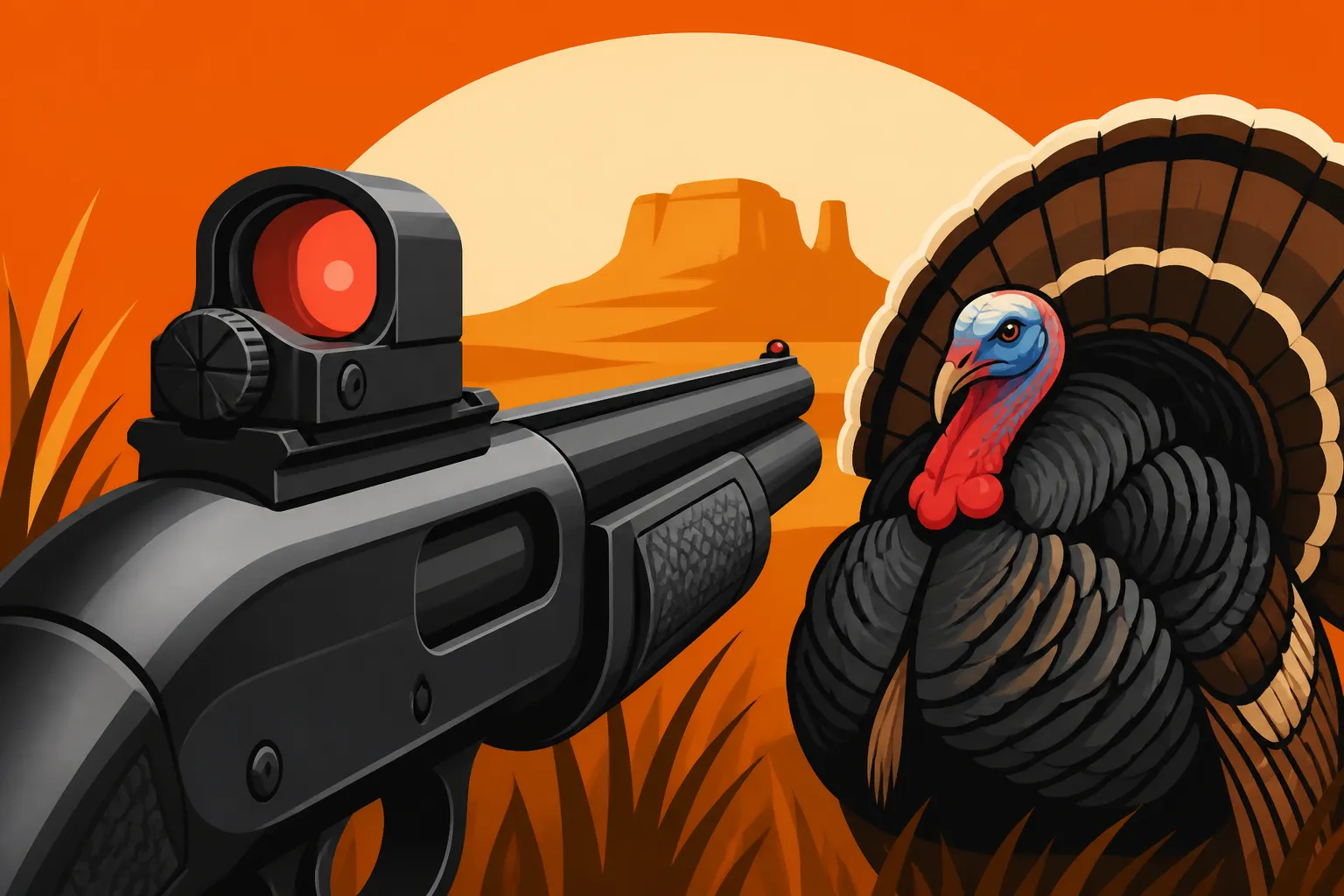
This is where a red dot truly shines. Instead of aligning three points (your eye, the bead, and the target), you're only aligning two: the red dot and the target. The red dot projects an aiming point directly onto your field of view, so wherever that dot is, that's where your shotgun pattern will go, assuming you've patterned it correctly. This allows for incredibly precise placement of your turkey load, ensuring that the densest part of your pattern hits the head and neck of the gobbler. When you've put in the work calling a bird in, perhaps even utilized scouting tools like GoHunt to find their preferred roosting areas, you want that shot to count. This precision greatly increases your chances of a clean, ethical harvest, which is always the goal.
Speed and Target Acquisition
Turkeys, especially big, mature gobblers, can be incredibly unpredictable. One moment they're 60 yards out, the next they've covered half that distance in a few quick steps, or they've suddenly presented a shot when you least expect it. With a red dot, target acquisition is dramatically faster. There's no fumbling to align irons or beads; you simply bring the gun up, put the dot on the target, and squeeze the trigger. This speed can make all the difference, particularly when hunting in thick river bottom timber or when a bird is skirting the edge of a field. The wide, unobstructed field of view offered by most red dots also means you maintain full situational awareness, allowing you to track the bird's movements without tunnel vision.
Overcoming Low Light Challenges
Nebraska spring turkey season often means early mornings, and those first and last legal shooting hours can be notoriously dim. Trying to pick up a tiny front bead against a dark background, or a gobbler shaded by dense timber, is a significant challenge. A red dot, with its illuminated reticle, cuts through this low light with ease. You can adjust the brightness to suit the conditions, from a faint glow in the pre-dawn mist to a brighter dot in open daylight. This means you have a clear, visible aiming point regardless of how much ambient light is available, extending your effective hunting time during those critical periods when turkeys are most active. This is a huge advantage when you're trying to Call a Nebraska Gobbler Off the Roost as the sun is just beginning to peek over the horizon.
Key Features to Look for in a Turkey Shotgun Red Dot
Not all red dots are created equal, and what works great on a handgun or AR-15 might not be the best fit for the recoil and specific demands of a turkey shotgun. When you're out chasing longbeards in Nebraska, your gear needs to be robust, reliable, and perfectly suited to the task.
Durability and Weather Resistance
Nebraska weather can throw just about anything at you during spring turkey season. One day it's calm and warm, the next you're facing driving rain, strong winds, or even a late-season snow flurry. Your red dot sight needs to be able to shrug off these conditions without missing a beat. Look for sights that are advertised as waterproof, fog-proof, and shockproof. This typically means O-ring sealed optics and nitrogen purging to prevent internal fogging. A robust housing, often made from aircraft-grade aluminum, will protect the internal components from accidental bumps or drops. You don't want your sight failing you when you've just spent hours calling in a bird, or when you're caught in a sudden downpour while trying to Hunt Nebraska Turkeys in Late Season. Investing in a durable optic means peace of mind, knowing it will perform when it matters most.
Dot Size and Reticle Options
Red dots typically come with different dot sizes, measured in Minutes of Angle (MOA). A common dot size for turkey hunting is around 3-5 MOA. A smaller dot (e.g., 2 MOA) offers more precision, making it excellent for longer shots, but can be harder to pick up quickly. A larger dot (e.g., 5-8 MOA) is very fast to acquire, which can be great for close-range, fast-breaking shots, but might obscure more of the target at extended distances. For turkeys, where you're aiming for a small target area (the head and neck), a dot that gives you a good balance of precision and speed is ideal. Some red dots even offer multiple reticle options, such as a dot surrounded by a circle, which can be even faster for target acquisition while still providing a precise aiming point.
Battery Life and Illumination Settings
The last thing you want is a dead battery in your sight when a gobbler finally commits. Look for red dots with excellent battery life, sometimes measured in tens of thousands of hours. Many modern red dots also feature motion-sensing technology that automatically turns the sight on when moved and off when stationary, conserving battery power. Multiple illumination settings are crucial too. You'll need low settings for dim light conditions to prevent the dot from flaring, and brighter settings for harsh sunlight. Easy-to-use controls that allow for quick adjustments, even with gloves on, are a major plus. It's always a good practice to carry a spare battery, but a sight designed for long life reduces the chances of needing it in the field.
Mounting Options and Compatibility
Before you even think about buying a red dot, consider how it will mount to your specific shotgun. Many popular turkey shotguns come drilled and tapped from the factory, ready for a scope base. Common mounting systems include Weaver or Picatinny rails, which offer robust and versatile attachment points. Some red dots can be mounted directly to specific shotgun models using proprietary bases. Ensure the red dot you choose is compatible with your shotgun's mounting system. Also, think about the height of the mount. You want the red dot to sit at a comfortable height that allows for a natural cheek weld when you shoulder the gun, so your eye is perfectly aligned with the dot without having to strain or adjust your head awkwardly.
Setting Up Your Red Dot for Nebraska Gobblers
Having a red dot on your turkey shotgun is only half the battle. The other, equally important half, is setting it up correctly and patterning your shotgun to ensure that dot translates into a devastating pattern on target. This isn't a "slap it on and go" kind of deal; it requires thoughtful attention to detail.
Mounting Your Sight Securely
First things first, get that sight mounted rock solid. Many turkey hunters opt for a Picatinny rail section that mounts to their shotgun's receiver, and then attach the red dot to that rail. Use a quality thread locker (like blue Loctite, which allows for removal later) on all mounting screws. Torque values are important – consult your optic's manual or a reliable gunsmith for the recommended foot-pounds. Over-tightening can strip screws or damage the sight, while under-tightening can lead to the sight shifting under recoil. A loose sight means inconsistent point of impact, and that's the last thing you want when you're trying to put down a big tom that you've watched come to your calls in the timber, perhaps near an area you scouted using GoHunt's detailed maps. Once mounted, give it a good tug and twist to ensure there's no play.
Patterning Your Shotgun with a Red Dot
This is, without a doubt, the most critical step. Your red dot sight doesn't guarantee a good pattern; it only guarantees where the center of that pattern will go. You need to know what your specific shotgun, choke, and turkey load combination is doing at various distances.
Head to the range with several different brands and shot sizes of turkey loads, as well as a few different chokes if you have them. Start at a close distance, like 20 yards, and shoot at large paper targets with a turkey head outlined on them. Observe the point of impact and pattern density.
Gradually move back to 30, 40, and even 50 yards (or your personal maximum ethical range). You'll quickly see which loads and chokes perform best in your gun. This process helps you understand your shotgun's capabilities and limits. Remember, a tight pattern is key for turkeys.
Zeroing for Optimal Performance
Once you've mounted your red dot and identified your preferred load/choke combination, it's time to zero the sight.
Begin at 25 yards. Place a small aiming point on your turkey target – a small adhesive dot works well. Shoot a single shot, aiming the red dot precisely at that aiming point.
After the shot, check your target. Where did the center of your pattern hit relative to your aiming point? You'll use the windage and elevation adjustments on your red dot to move the point of impact. If your pattern hit low and left, you'll adjust the red dot up and right. Most red dots have audible clicks for adjustments; consult your manual for the value of each click (e.g., 1 MOA per click).
Shoot another shot, make adjustments, and repeat until the center of your pattern consistently aligns with your red dot at 25 yards. Then, move back to your maximum effective range (e.g., 40 yards) and confirm your zero. Slight adjustments might be needed, as sometimes patterns can shift slightly at longer distances. The goal is for that red dot to precisely mark the center of your kill-shot pattern on the turkey's head and neck.
Eye Relief and Field of View Considerations
Unlike traditional rifle scopes, most red dot sights offer unlimited eye relief, meaning you can place your eye at varying distances from the optic and still see the dot clearly. However, achieving a consistent and natural cheek weld is vital for repeatable accuracy. Experiment with the mounting position of your red dot until you find one that allows you to quickly shoulder your shotgun, bring your head to the stock comfortably, and instantly see the red dot. You shouldn't have to crane your neck or lift your head to find the dot. The wide field of view provided by a red dot is a huge advantage, as it allows you to maintain awareness of the entire hunting scene, not just what's through a magnified tube. This is incredibly helpful when you're trying to decipher movement in dense cover or if you need to quickly pick up another bird that pops up unexpectedly. A good setup will feel natural and become an extension of your body, making those quick shots much more intuitive.
Field Use and Practical Tips for Turkey Hunters
You've got your red dot mounted, zeroed, and patterned. Now it's time to take it to the field and put it to work. Turkey hunting, especially in Nebraska's diverse landscapes from the Pine Ridge to the river corridors, presents a unique set of challenges. Knowing how to effectively use your red dot in real-world scenarios can make a huge difference in your success.
Using the Red Dot in Various Scenarios
From a tight ground blind nestled against a big cottonwood to a more open setup on a field edge, your red dot needs to perform.
For close-range encounters, say a gobbler that pops up at 15 yards while you're Setting Up Against a Cottonwood, the speed of target acquisition is paramount. Just throw the gun up, put the dot on the head/neck, and fire. The wide field of view means you won't lose sight of the bird.
For longer shots, pushing out to 40 or 50 yards (if your pattern supports it), the precision of the small dot helps you place the shot exactly where it needs to be. Take your time, get steady, and focus on that dot.
In changing light conditions, remember to adjust your illumination. A dot that's too bright will "bloom" and obscure your target, while one that's too dim will be hard to find. Practice adjusting it quickly and quietly.
If you're hunting in heavy cover, where glimpses of a turkey might be fleeting, the red dot's ability to be used with both eyes open helps maintain peripheral vision and track the bird through the brush.
Battery Management and Backup Sights
Even with excellent battery life, always carry a spare battery for your red dot. Murphy's Law dictates that the one time you forget it will be the day your battery dies. Familiarize yourself with how to quickly change the battery in the field. Some red dots have open-top battery compartments, making changes easy, while others require removing the sight.
Consider a backup sighting system. Many turkey shotguns still have a front bead, and while not ideal, it can serve as a last resort if your red dot completely fails. Ensure your red dot mount doesn't completely obstruct this bead. Alternatively, some hunters opt for small, removable iron sights that can be quickly attached if needed, though this adds complexity. The goal is to avoid being caught completely unprepared, especially if you're out on public land far from your vehicle, perhaps even in an area you found using The Nebraska Public Access Atlas.
Legal Considerations for Optics in Nebraska
When it comes to using optics like red dot sights on shotguns for turkey hunting in Nebraska, the rules are generally quite permissive. Currently, there are no specific prohibitions against using non-magnifying or magnifying optics on shotguns for turkey hunting. Red dots fall squarely within accepted equipment. However, it's always smart to double-check the latest regulations from the Nebraska Game and Parks Commission before heading afield, as rules can occasionally change. While red dots are perfectly fine, it's a good reminder that other advanced night-vision or thermal optics for certain species or times of day might have restrictions, though these typically don't apply to daytime turkey hunting with a red dot. Always ensure you're compliant with all Nebraska Legal Shooting Hours and other general hunting regulations.
Practice Makes Perfect
Just like any other hunting skill, proficiency with a red dot sight comes from practice. It’s not enough to simply mount it and zero it; you need to train your body and eyes to use it instinctively. Spend time at the range practicing quick mounts and target acquisition. Simulate different hunting positions – sitting, kneeling, even shooting from a blind. The more comfortable and natural it feels, the more effective you'll be in the field.
If you're comfortable with your red dot, you'll be more confident when that big tom struts into range. Confidence in your gear and your shooting ability is a huge part of being a successful and ethical hunter. Whether you're calling in a Merriam's in the Pine Ridge or an Eastern in the Missouri River breaks, that precision and speed can make all the difference.
| Feature | Ideal for Turkey Hunting | Considerations |
|---|---|---|
| Durability | Waterproof, fog-proof, shockproof | Nebraska weather is unpredictable; protects against rain, dust, and bumps |
| Dot Size | 3-5 MOA | Balances precision for head/neck shots with fast target acquisition |
| Battery Life | 10,000+ hours, motion-sensing, easy battery change | Prevents mid-hunt power failure; always carry spare |
| Illumination | Multiple brightness settings, audible clicks | Adapts to low light, bright sun, and quiet adjustments |
| Mounting | Weaver/Picatinny rail, secure attachment | Ensures stable zero; consider height for natural cheek weld |
| Field of View | Wide, unobstructed | Maintains situational awareness; helps track moving birds |
Disclaimer
This article is for general informational purposes only and does not constitute professional advice. Laws, prices and regulations vary by location and change over time. Consult a qualified professional for guidance on your specific situation.