Bow Sights for Open-Country Shots
Bowhunting in Nebraska's wide-open spaces presents a unique set of challenges. That sweeping vista of grass, timber, or crop fields might look inviting, but it also means unpredictable winds, vast distances, and shots that often stretch further than what many archers are used to. Choosing the right bow sight isn't just about sticking pins in a housing; it's about equipping yourself to be accurate and ethical when those critical moments arise, and this guide is here to help you navigate those choices for Nebraska's diverse hunting landscapes.
The Unique Challenges of Open-Country Bowhunting in Nebraska
If you've spent any time chasing whitetails in the river bottoms of eastern Nebraska or stalking mule deer in the sprawling Sandhills, you know that "open country" isn't just a turn of phrase. It defines the entire experience. This isn't the timber-choked woods where 25-yard shots are the norm. Out here, deer, antelope, and even turkeys can appear at distances that would make a flatlander's jaw drop, demanding a whole new level of precision from your gear, especially your bow sight. The environment itself becomes a factor, turning what might be a simple shot in a different setting into a complex calculation of distance, wind, and animal movement.
The biggest frustration many hunters face is underestimating these factors. They might practice diligently at 20, 30, and even 40 yards in their backyard, only to find themselves utterly unprepared when a mature mule deer stands broadside at 60 yards across a prairie draw, or a Sandhills whitetail gives them the slip because they couldn't confidently hold their pin at an unfamiliar distance. It's a humbling experience that highlights the need for a sight that not only performs mechanically but also inspires confidence in conditions far removed from a static target range. The sheer scale of the landscape and the often-sparse cover dictate that your equipment needs to be up to the task of truly reaching out.
Understanding Distance and Pin Gaps in Wide Open Spaces
In Nebraska's expansive terrain, judging distance accurately is paramount, and the relationship between your pins and those distances becomes critically important. A few yards off in your range estimation, or a sight with pins spaced too far apart for precise aiming, can mean the difference between a clean harvest and a heartbreaking miss. Imagine you're Glassing Sandhills Blowouts for Mule Deer. That buck might be standing perfectly still, but the undulating ground and lack of reference points can make a 45-yard shot look like 35, or vice-versa. When your arrow leaves the string, it’s going to drop, and in open country, that drop becomes much more pronounced and unforgiving over longer ranges.
This isn't just about having "more" pins; it's about having the right pins, spaced correctly for your setup and typical hunting distances. If your 30-yard pin and 40-yard pin are practically touching, you might struggle to accurately aim at an animal standing at 37 yards. Conversely, if they're too far apart, you might have too much space between the pins to confidently hold on a target that falls directly between two markings. The visual accuracy of your sight picture needs to match the actual trajectory of your arrow. This is where diligent practice and understanding your arrow's flight path at various distances, especially those beyond your comfort zone, becomes absolutely essential.
Battling the Nebraska Wind
Ah, the wind. If you've hunted Nebraska for more than an hour, you know it's not a question of if the wind will blow, but how hard and from what direction. On the open plains, in a picked cornfield, or even down a wide river bottom, wind can have a dramatic effect on your arrow's flight, pushing it off target with surprising force. It's not uncommon for a steady 15-20 mph breeze to be present, and that can translate to several inches of drift on a 40 or 50-yard shot. For bowhunters, this is one of the most frustrating and often overlooked variables. You can't just aim and shoot; you have to mentally adjust, which is hard enough, but you also need a sight that isn't adding to the problem by being flimsy or having loose components that vibrate in the breeze.
The challenge intensifies when you consider crosswinds or swirling winds in areas with broken cover, like a vast river corridor or the edge of a large shelterbelt. Even a slight headwind or tailwind can alter your arrow's vertical impact point, making distance judgment even more critical. A solid, well-built bow sight that holds its settings rigidly and doesn't introduce its own movement in the wind is a significant advantage. Furthermore, a sight with clear, bright pins allows you to focus solely on the target and any necessary windage adjustments, rather than struggling to acquire your pin against a busy background or in fading light when the wind is often at its calmest. You're already fighting the elements; your sight shouldn't be another battle.
Types of Bow Sights for Open-Country Success
When you're staring down a long shot in Nebraska's wide-open country, your bow sight becomes your most critical aiming tool. There are several primary types of sights, and each comes with its own set of advantages and disadvantages that you'll want to weigh carefully against the specific demands of hunting out here. Choosing the right one often comes down to a balance of simplicity, precision, and your personal shooting style. What works perfectly for River-Bottom Whitetail Hunting in Eastern Nebraska might not be ideal for Spot-and-Stalk Mule Deer in the Nebraska Sandhills.
It's tempting to think that "more expensive" automatically means "better," but that's not always the case. The best sight is the one that allows you to be most accurate and confident in the field, under pressure. Consider your typical shot distances, how much time you have to range and set up, and your comfort level with adjustments. A complicated sight that you struggle to operate quickly in a high-pressure situation is far less effective than a simpler one you can instinctively trust.
Fixed Pin Sights for Simplicity and Reliability
Fixed pin sights are the workhorses of the bowhunting world, and for good reason. They are generally rugged, simple, and reliable, featuring multiple pins (typically 3 to 7) set at predetermined distances, like 20, 30, 40, and 50 yards. The beauty of a fixed pin sight for open country lies in its speed. Once you've ranged your target, you simply select the appropriate pin and shoot. There's no fumbling with adjustments, no worry about whether you remembered to move your pin back to a closer distance after a long shot attempt. For many hunters, this "set it and forget it" approach is invaluable, especially when a deer or antelope presents itself quickly.
However, fixed pin sights do have their limitations, particularly when those longer open-country shots come into play. If your longest pin is set at 60 yards and a buck stops at 68, you're faced with an uncomfortable "gap shot" where you have to hold between pins, often guessing the exact holdover. While many fixed pin sights offer micro-adjustments for windage and elevation, the individual pins themselves remain static. For most Nebraska hunters who might encounter shots from 20 to 60 yards, a well-set-up 5-pin sight can cover the vast majority of scenarios effectively. The robustness of a fixed pin sight, often with fewer moving parts, also means less chance of something breaking or shifting when you're miles from the truck.
Single Pin Adjustable Sights for Precision
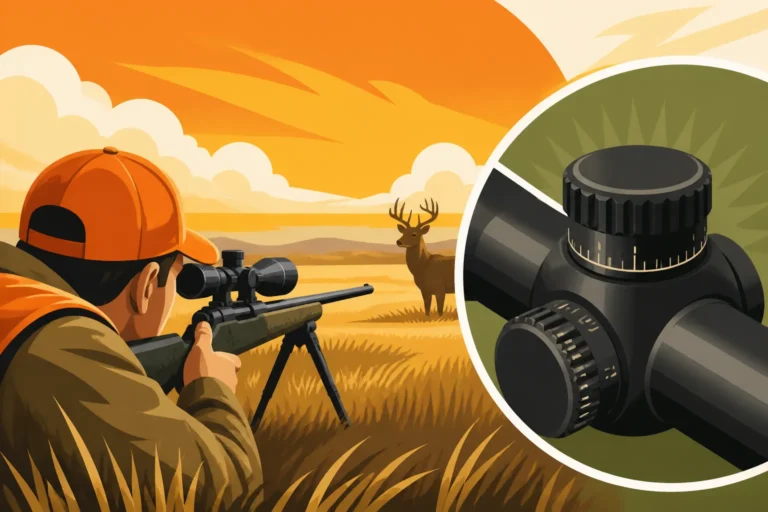
For bowhunters who prioritize pinpoint accuracy at varying distances and are comfortable making on-the-fly adjustments, a single pin adjustable sight can be a game-changer in open country. These sights feature just one aiming pin, which can be moved up or down via a dial or lever to match the exact yardage of your shot. Many come with custom sight tapes, allowing you to mark specific yardages precisely for your arrow's trajectory. This means no more holding between pins; if the animal is at 53 yards, you dial your sight to 53 yards. This level of precision is incredibly appealing when you're looking at a longer shot where every inch counts.
The main drawback, however, is the time it takes to make that adjustment. In a fast-paced hunting scenario, ranging the animal and then dialing your sight might take precious seconds that you simply don't have. If a whitetail bounds into a clearing and offers a quick shot, fiddling with a dial could mean missing the opportunity entirely. This type of sight demands disciplined ranging and a smooth, quick adjustment process. For stalking antelope on the wide-open prairie where you might have more time to set up, or for Archery Antelope Over Water in Nebraska from a blind where shots are more controlled, a single pin sight truly shines. It allows for unparalleled accuracy, but requires practice and patience to master in real-world hunting conditions.
Multi-Pin Movable Sights: The Hybrid Approach
Sometimes, you want the best of both worlds, and that's where multi-pin movable sights come in. These innovative designs typically feature multiple fixed pins (say, 20, 30, and 40 yards), with the entire pin housing also being adjustable. This allows you to use your fixed pins for closer, quicker shots, much like a traditional multi-pin sight. However, when a longer shot presents itself (say, beyond 40 yards), you can "gang adjust" the entire housing down, effectively turning one of your pins (often the lowest one) into a "floater" that can be dialed to precise longer distances, similar to a single pin adjustable sight.
This hybrid approach offers incredible versatility for open-country bowhunting. You maintain the speed and simplicity for common distances, but gain the precision for those extended shots that are so typical in Nebraska. Imagine you're hunting a cornfield edge and a deer pops out at 35 yards – you use your fixed pin. Later, a different buck hangs up at 70 yards across a pasture – you quickly range it, adjust your housing so your lowest pin is now set for 70, and take the shot with confidence. It's a system that minimizes compromise, offering both quick acquisition and long-range accuracy. Brands are continually innovating in this space, looking for ways to make these adjustments faster and more intuitive, which is excellent news for the Nebraska bowhunter.
Key Features to Look for in Open-Country Bow Sights
Beyond the basic sight type, several specific features become incredibly important when you're hunting in Nebraska's expansive environments. These aren't just "nice-to-haves"; they're critical components that contribute to durability, precision, and overall performance when conditions are anything but ideal. The difference between a good sight and a great sight often lies in these details.
When you're considering a new sight, think about the specific situations you've faced or anticipate facing. Has a loose screw ever cost you a shot? Have you struggled to see your pin in low light? Do you ever shoot from uneven ground? These experiences will guide you toward the features that truly matter for your hunting style and the Nebraska landscape.
Pin Size and Brightness for Varying Light Conditions
In open country, light conditions can change rapidly. From the bright glare of midday sun on a Sandhills hillside to the dim glow of dawn or dusk in a river bottom, your pins need to be visible and distinct. This is a delicate balance. A larger, brighter pin might be easier to acquire in low light, but it can also cover up too much of a distant target, reducing accuracy. Conversely, a tiny pin offers precision but can disappear against a dark background or in fading light. Most modern bow sights use fiber optics to gather ambient light and illuminate the pins, but the quality and length of these fibers can vary greatly.
For Nebraska, a good compromise is often a sight with slightly smaller, high-quality fiber optic pins (around .019" or even .010" for the lower, longer-range pins) that are well-protected within the sight housing. Some sights offer rheostat lights that allow you to adjust the brightness of your pins, preventing "starbursting" in low light or excessive glare in bright conditions. Being able to clearly see your aiming point without it obscuring the target or being too dim to find is absolutely crucial for ethical shooting, especially during those prime hunting hours just after sunrise and just before sunset.
Micro-Adjustments and Tool-Less Design
Imagine you've driven hours to your hunting spot, set up your blind, and as you're taking a practice shot, you realize your sight is just a hair off. Or perhaps after a long day of walking, a slight bump causes a minute shift. In open country, where every yard and every inch of accuracy counts, having the ability to make precise, tool-less micro-adjustments for both windage and elevation is invaluable. Instead of fumbling for an Allen wrench, you can simply turn a small dial, making tiny, repeatable clicks that move your pins in precise increments. This allows you to fine-tune your sight quickly and quietly in the field without drawing attention to yourself.
Beyond basic adjustments, many high-quality sights also offer second- and third-axis adjustments. These are critical for long-range accuracy, especially when shooting from uneven terrain or from a treestand. Second-axis adjustment ensures your sight pins are truly vertical relative to gravity, not just your bow riser, preventing left/right misses on angled shots. Third-axis adjustment compensates for the rotational angle of your bow, ensuring your pins are true when shooting up or downhill. These might sound like minor details, but for those 60-yard-plus shots in Nebraska's rolling landscapes, they become non-negotiable for consistent accuracy.
Integrated Levels and Third-Axis Adjustment
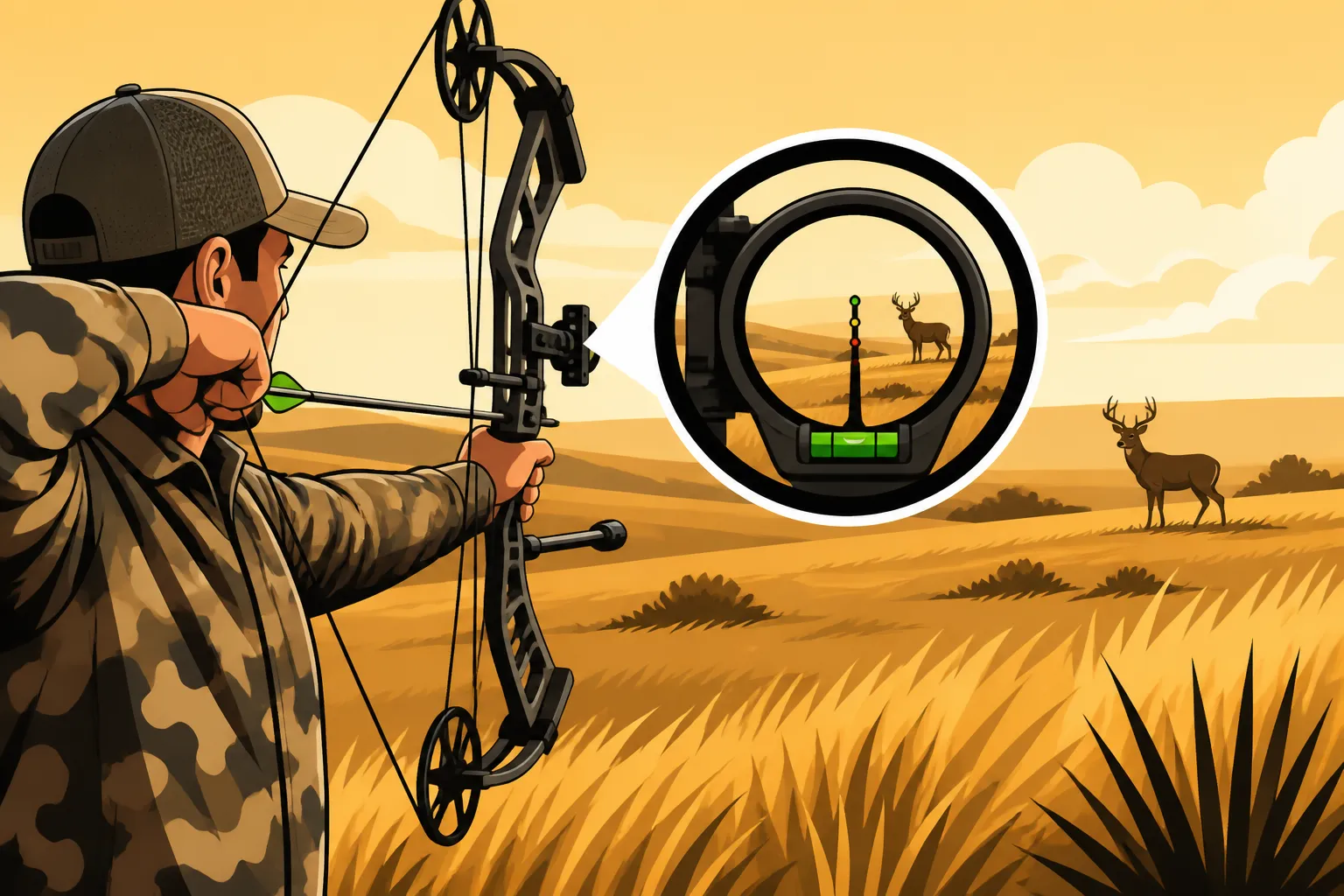
Holding your bow perfectly level is a fundamental principle of accurate archery, and it becomes even more critical when shooting at longer distances in open country. A slight cant of your bow, imperceptible at 20 yards, can result in a significant left or right miss at 60 yards. This is why an integrated bubble level, clearly visible in your sight picture, is a feature you absolutely shouldn't overlook. A good level allows you to ensure your bow is plumb before you release, eliminating one major variable in your shot.
As mentioned earlier, third-axis adjustment takes this a step further. While a standard level ensures your sight is vertical when held flat, a third-axis adjustment compensates for the angle of your bow when shooting uphill or downhill. In the Sandhills, for example, you might be shooting a mule deer in a blowout below you or a whitetail climbing a ridge. Without proper third-axis adjustment, your level can give you a false reading, leading to shots that land significantly off-target. Quality sights designed for these demanding conditions will offer these adjustments, allowing you to true up your aiming system regardless of the shooting angle. Don't underestimate the power of these subtle adjustments; they are game-changers for truly maximizing your accuracy in Nebraska's diverse hunting terrain.
| Sight Type | Pros | Cons | Best For |
|---|---|---|---|
| Fixed Pin | Fast target acquisition, very durable, fewer moving parts | Limited long-range precision, gap shooting at odd distances | Quick shots, typical hunting ranges (under 60 yards), rough conditions |
| Single Pin Adjustable | Extreme precision at any distance, clean sight picture | Slower to adjust for quick shots, risk of forgetting to dial | Controlled stalks, longer range hunting, patient setups |
| Multi-Pin Movable | Versatility (fixed pins + adjustable for long range) | Can be more complex than fixed pins, still requires adjustment for long shots | All-around hunting, combines speed for close with precision for far shots |
Integrating Technology: Rangefinders and Archery Calculators
In the vast expanses of Nebraska, where a deer or antelope might pop up at any distance, relying on guesswork for yardage is a recipe for disaster. Modern archery has truly embraced technology to help bridge the gap between hunter and animal, making ethical long-range shots not just possible, but repeatable. Your bow sight is one piece of the puzzle, but it works in concert with other tools to ensure precision.
Gone are the days when "aim for the middle of the chest" was sufficient advice for varying yardages. Today's bowhunters understand that precise distance data, coupled with a perfectly set up sight, is the foundation of accuracy. If you're not integrating a quality rangefinder and considering how archery calculators can help, you're leaving a significant advantage on the table, especially when chasing game like those elusive Mule Deer in the Nebraska Sandhills and Panhandle.
The Indispensable Role of a Quality Rangefinder
Let's be blunt: a quality rangefinder is no longer an optional accessory for open-country bowhunting in Nebraska; it's an absolute necessity. Whether you're in a treestand overlooking a vast cornfield or on the ground trying to close the last hundred yards on an antelope, knowing the exact distance is the first step to making an ethical shot. In undulating terrain, what looks like 40 yards might actually be 55, or vice-versa. A good rangefinder quickly and accurately provides that critical data, often with angle compensation built in to give you the "shoot-to" distance rather than the line-of-sight distance, which is crucial when shooting from a Treestands and Saddles on Public Ground or from a steep incline.
Think about situations like Stalking Pronghorn on Nebraska Grassland. Every slight rise and fall of the ground changes your effective range. Trying to eyeball it will consistently lead to errors. A rangefinder like those from Sig Sauer, Leupold, or Vortex (to name a few popular brands) can give you readings out to several hundred yards, ensuring you can quickly assess the shot even if the animal is beyond your effective range, giving you time to reposition. The speed and reliability of your rangefinder directly impact your ability to select the correct pin or dial in your single-pin sight, making it an indispensable partner to your bow sight.
Using Archery Calculators and Apps
Once you have your rangefinder and bow, the next step is ensuring your sight is perfectly calibrated. This is where modern archery calculators and apps come into play. These tools, often available on your smartphone or through dedicated online platforms, allow you to input critical data about your setup – arrow weight, arrow speed, peep height, sight-to-peep distance, and more. With this information, the calculator can generate a custom sight tape or provide precise pin gaps for fixed pin sights. This is particularly useful for single-pin adjustable sights, as it allows you to create a sight tape that perfectly matches your arrow's trajectory, leading to unparalleled accuracy.
Some companies even offer integrations where you can input your sight model and arrow specs, and the app will generate a printable sight tape ready to apply to your movable sight. Tools like the ones often referenced by serious hunters on platforms like GoHunt can help you fine-tune your setup without spending countless hours guessing and shooting. They take the guesswork out of pin calibration, allowing you to effectively utilize every yard of your bow's capability. This technology, combined with meticulous testing at the range, ensures that when you see that trophy buck or Merriam's turkey in your sights, your pins are exactly where they need to be for a clean, ethical shot.
Field Practice and Setup for Nebraska's Terrain
Having the best bow sight for open-country shots in Nebraska is only half the battle. The other, equally crucial half, is dedicated practice and meticulous setup. You can buy the most advanced, feature-rich sight on the market, but if you don't know how to use it proficiently under realistic conditions, it's just an expensive paperweight. Nebraska's varied landscapes demand a specific kind of practice, one that goes beyond static range shooting.
This isn't just about shooting arrows; it's about building confidence and muscle memory for the moments that truly count. It means recreating the challenging scenarios you'll encounter in the field, from uneven footing to changing light and, of course, that ever-present Nebraska wind. Without this kind of preparation, even the best equipment won't guarantee success.
Practicing at Extended Ranges
When hunting in Nebraska, especially for game like mule deer or antelope in the Panhandle, or even longer-range whitetails in large crop fields, you absolutely must extend your practice beyond the typical 20, 30, and 40 yards. Getting comfortable and proficient at 50, 60, and even 70 yards is essential. This doesn't mean you should take 70-yard shots in the field, but if you can consistently group arrows at 70, a 50-yard shot will feel much more manageable and ethical. This practice helps you understand your arrow's flight characteristics, particularly how wind affects it at those longer distances.
Set up targets at varying, unmarked distances on an open range that mimics the Nebraska landscape. Use your rangefinder, identify your target, acquire your pin, and execute the shot. Practice shooting from kneeling, sitting, and even awkward positions, simulating what might happen when a buck steps out unexpectedly and you have limited movement. The more you push your comfortable range in practice, the more confident and accurate you'll be when those 40 or 50-yard opportunities arise in the real world. Remember, your personal ethical maximum range is often shorter than your maximum practice range, and extending the latter directly improves the former.
Setting Up Your Sight for Varied Conditions
Open-country hunting in Nebraska means you'll encounter a huge range of conditions, often within the same day. Your sight setup and practice routines should reflect this. Don't just sight in on a perfectly calm morning; try shooting in different wind conditions, both head-on and crosswinds. Pay attention to how a consistent breeze moves your arrow, and develop a mental note of how much to hold off. If you're using a single-pin sight, practice making quick, smooth adjustments to various yardages, so it becomes second nature under pressure.
Consider practicing from elevated positions if you plan to hunt from a treestand, or from ground level if you anticipate using a ground blind. If you're hunting in the Pine Ridge, you might face steep uphill and downhill shots, making your third-axis adjustment and angle-compensating rangefinder crucial. Even something as simple as practicing in different lighting – from bright sun to overcast skies – can help you determine if your pin brightness is optimal or if an adjustable rheostat would be beneficial. The more variables you introduce into your practice, the better prepared you'll be to adapt when the unexpected happens in the field, ensuring your sight is always a reliable tool, not a potential liability. Wind Direction on Open Nebraska Prairie Stands can change everything, so be ready.
Disclaimer
This article is for general informational purposes only and does not constitute professional advice. Laws, prices and regulations vary by location and change over time. Consult a qualified professional for guidance on your specific situation.