Using a Fence Line to Close on Antelope
Antelope are some of the most challenging animals to hunt on the Nebraska plains. Their legendary eyesight, combined with the vast, open country they call home, often leaves hunters frustrated, feeling like they're trying to sneak up on a satellite dish with legs. Spotting a buck from a mile away is one thing; actually getting within shooting range without spooking him into the next county is an entirely different beast. This guide is all about one of the most effective, yet often overlooked, strategies for closing that impossible distance: expertly using a fence line to your advantage.
Understanding Antelope Behavior Around Fences
If you've spent any time observing pronghorn in Nebraska, you'll quickly realize they have a peculiar relationship with fences. Unlike deer, which often jump fences with relative ease, antelope are far more inclined to go under them. This isn't just a quirk; it's a critical behavioral pattern that astute hunters can exploit.
Why Antelope Prefer to Crawl Under Fences
Antelope are built for speed across open terrain, not for high-jumping. Their body structure, particularly their lack of vertical agility compared to deer, makes crawling under fences a far more efficient and less energy-intensive option for them. They'll often dip their heads and slide right underneath the bottom wire, sometimes even creating well-worn trails in the process. This habit is deeply ingrained. They've evolved in an environment where large, natural barriers like dense timber or steep canyons are less common than expansive grasslands. When early settlers introduced barbed wire fences, antelope adapted by going low rather than high.
This preference for going under creates predictable travel corridors. While they might occasionally jump a very low or damaged fence, their default behavior is to find the easiest path beneath. This means that any fence line, particularly one with a slightly elevated bottom wire or one that has been repeatedly used, can act as a natural funnel or a highway for their daily movements between feeding grounds, bedding areas, and water sources. Understanding this fundamental preference is the first step in using these linear barriers as part of your stalking strategy.
Reading Antelope Movement Along Fencelines
Just like any other game animal, antelope leave signs of their presence and movement. Along a fence line, these signs become even more pronounced due to their consistent behavior. Your job as a hunter is to learn to read these subtle cues to identify active crossing points and regular travel routes.
Look for worn paths or depressions in the soil directly under a fence, especially where the bottom wire might be slightly higher off the ground. These are tell-tale signs of repeated use. You might also find antelope hair snagged on the barbs or fresh tracks in soft earth after a rain. Droppings can also indicate recent activity, helping you determine if a particular crossing is currently in use. Pay attention to how these fence lines connect different habitat features. Does a fence run from a known feeding ground, like an alfalfa field or a patch of fresh grasses, directly to a water tank or a remote basin where they might bed down? Such connections are prime candidates for regular antelope travel.
The impact of water sources and feeding areas on fence line movement cannot be overstated. Antelope are creatures of habit, and their daily routines often involve moving between these essential resources. A fence line that acts as a direct route between a large pasture of nutritious forage and a stock pond will likely see consistent activity. Similarly, during hot Nebraska summers, antelope will water frequently, and a fence running alongside or leading directly to a water source can become a natural path for them. When Antelope Water in Hot Weather is a crucial piece of knowledge that can help you pinpoint these high-traffic areas along fence lines. By understanding why antelope move along certain fences, you can better predict when and where they'll be.
Scouting and Planning Your Approach
Successfully using a fence line for an antelope stalk isn't just about showing up; it requires diligent pre-season scouting and meticulous planning. This isn't like hunting deer in thick timber where you might stumble upon a fresh rub line. In the open country of Nebraska, you need to know exactly what you're looking for and how to approach it.
Pre-Season Scouting for Active Fencelines
Before the season even begins, dedicating time to scouting is paramount. Antelope have incredible eyesight, so your scouting needs to be done from a distance, minimizing your presence and avoiding any chance of spooking them before you even get a tag in your pocket. A good pair of binoculars, like a 10×42, is essential, but a high-quality spotting scope is truly invaluable for picking apart distant landscapes. From a vantage point a mile or more away, you can systematically glass vast areas, identifying where antelope are feeding, bedding, and, most importantly, which fence lines they are routinely crossing or traveling along. You're looking for concentrations of animals and habitual movement patterns.
As you observe, pay close attention to fence sections that appear to be used regularly. Look for those worn paths or breaks in the bottom wire, even through your optics. These are your potential access points. This is also where digital mapping tools really shine. Platforms like GoHunt allow you to layer satellite imagery, public/private land boundaries, and topographic maps. You can mark potential fence crossings, note prevailing wind directions for those spots, and even plan your long-distance approach routes, identifying potential cover like small hills, drainages, or taller vegetation. Understanding Glassing the Nebraska Sandhills for Mule Deer offers insights into effective glassing techniques that apply equally well to antelope, helping you locate these animals and their favored travel routes along fences. Don't underestimate the power of these tools in turning vast, intimidating landscapes into manageable hunting units.
Analyzing Wind and Topography
Once you've identified an active fence line and the antelope you want to target, the real planning begins, and it revolves almost entirely around wind and topography. Neglecting either of these can doom your stalk before it even starts.
Wind Direction: Antelope have a good sense of smell, and in the wide-open country, your scent will travel far. Always, and I mean always, approach an antelope with the wind in your favor, blowing your scent away from the animal. This often means taking a longer, more circuitous route to get on the downwind side of your target. Check the wind frequently; a small thermal shift can be enough to give you away. Using a wind checker powder is a cheap and effective way to confirm the exact wind direction and any subtle shifts as you move.
Topography: This is your best friend when using a fence line. While Nebraska might appear flat, there are always subtle dips, rises, and undulations in the terrain. These seemingly insignificant features can offer precious inches of cover that allow you to stay out of sight. As you plan your stalk using your mapping app (like GoHunt, where you can visualize contour lines), look for depressions, draws, or even slight rises that run parallel to the fence line you intend to use. These allow you to remain low and out of sight as you approach. If the fence line itself is on a slight crest, you might need to stay even further back, using the height of the fence itself as minimal cover, or wait until the antelope move into a more favorable position where the terrain offers you an advantage. The principles discussed in Wind and Thermals in the Sandhills are incredibly relevant here, as understanding how air currents behave in open country is vital for a successful, undetected approach. Every dip and rise becomes a potential hiding spot on your journey toward a shot.
Executing the Stalk: Using the Fence as Cover
With your scouting done and your plan laid out, it's time for the rubber to meet the road – or, more accurately, for your belly to meet the prairie grass. Executing the stalk along a fence line demands patience, stealth, and an understanding of how to effectively use this linear feature for maximum concealment.
Low-Profile Movement Along the Fence
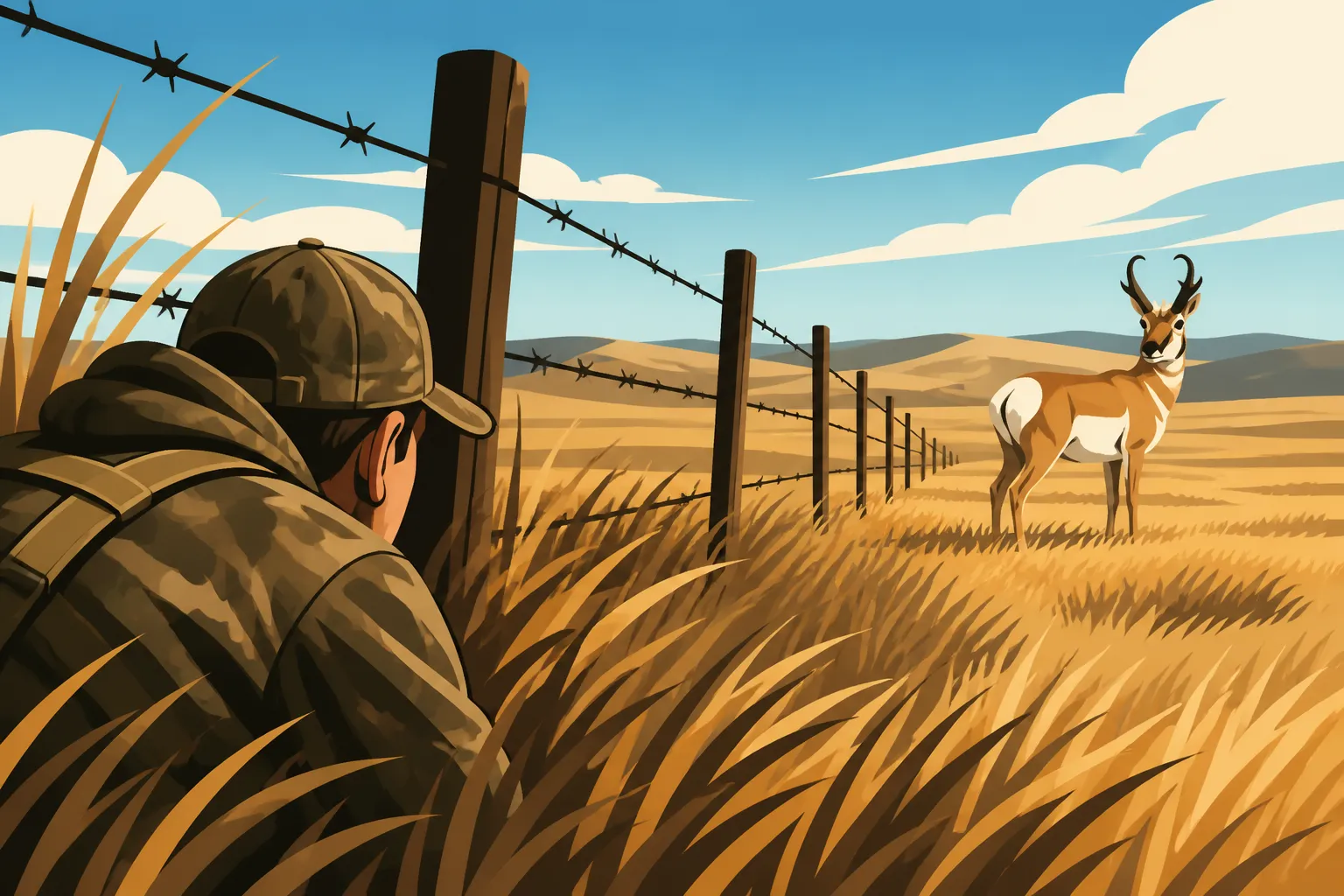
Antelope eyes are incredible; they can spot the slightest movement from extreme distances. This means your movement along a fence line needs to be as low-profile as humanly possible. Think like a predator, not a person on a casual stroll. Often, this means crawling, a slow and deliberate army crawl or bear crawl, keeping your body as close to the ground as possible.
The fence itself, even a simple four-strand barbed wire, can offer more visual obstruction than you might think, especially if the antelope is some distance away. Utilize the fence posts, small clumps of grass, or any slight changes in terrain immediately adjacent to the fence to break up your outline. Move one body part at a time, slowly and smoothly, avoiding jerky motions. If you're wearing camouflage, make sure it blends with the local vegetation and isn't contrasting sharply against the sky or ground. Even the shadow cast by the fence line itself can be enough to obscure your approach if you stay within it. Remember, this isn't a race; it's a test of wills and stealth. The goal is to get closer without the antelope ever realizing you're there.
Timing Your Movements with Antelope Attention
This might be the most critical aspect of any antelope stalk. You simply cannot move when an antelope is looking directly at you. You must become a master of timing your movements. Watch the antelope's head position. When it's feeding with its head down, or looking in the opposite direction, that's your window to advance. As soon as its head comes up or it turns its gaze towards your general area, freeze. Become a statue. Even a slight twitch can give you away.
Antelope often feed in bursts, taking a few bites, then lifting their heads to scan. Learn this rhythm. Sometimes, they'll turn their heads completely away, offering a precious few seconds to cover ground. Use these moments wisely. If you're stalking a group, you'll need to watch all of them. Often, one will be more alert than the others, acting as a sentinel. You have to beat the sharpest eyes in the herd. Patience is your greatest virtue here. It might take an hour to cover a couple hundred yards, but those are the stalks that often lead to success. For a broader understanding of effective stalking, refer to Stalking Pronghorn Across Open Nebraska Ground, as the core principles of using terrain and timing are universal.
Dealing with Unexpected Obstacles
No matter how well you've scouted and planned, the prairie will inevitably throw a curveball. Unexpected obstacles are part of the game when hunting antelope. This could be anything from a hidden ditch that forces you to expose yourself, a patch of noisy gravel, a sudden shift in wind direction, or even other wildlife like coyotes or deer that could inadvertently spook your target.
Flexibility is key. If you encounter an obstacle that compromises your cover or wind advantage, you have to be willing to adapt. Sometimes, this means pausing, reassessing, and waiting for the antelope to move to a more favorable position. Other times, it might mean retreating and attempting a different approach altogether. If the wind suddenly swirls, you might need to back off and circle around to regain the advantage. If a group of cattle suddenly appears and starts moving towards the antelope, you'll have to adjust your timing or even relocate. Always have a contingency plan in mind, and be ready to execute it. The prairie is dynamic, and your strategy must be too.
Getting Within Range and Taking the Shot
The culmination of all your hard work, stealth, and patience is getting within ethical shooting range. But even once you've successfully used the fence line to close the distance, the final steps and the shot itself require precision and confidence.
Estimating Distance and Shot Placement
In open country, judging distance can be incredibly deceptive, especially when your adrenaline is pumping. A rangefinder is not just a useful tool; it's an absolute necessity for antelope hunting. Before you even begin your final approach, and certainly before you take a shot, range the animal and any landmarks around it. Know your maximum ethical shooting distance for your chosen weapon, whether it's a bow or a rifle. For archers, this might be 40-60 yards; for rifle hunters, it could be 200-400 yards, depending on your skill and rifle setup. Never guess.
Antelope are relatively small animals, and their vital zone is compact. Aim for the classic "pocket" behind the shoulder for a lung shot. A quartering-away shot can also be effective, aiming to exit through the opposite shoulder. Avoid shoulder shots with archery gear unless you are extremely confident in your setup and shot placement, as their bone structure can be tough. Practice extensively at the range, especially at varying distances, so that when the moment comes, you can make an ethical shot under pressure. When considering your gear, especially for long-range situations, remember that tools like those found in the GoHunt mapping platform can often help you with range estimation in combination with your physical rangefinder, offering another layer of confidence in the field. Understanding the nuances of Archery Antelope From a Water Blind might focus on a different scenario, but the principles of shot placement and range judgment remain the same. Similarly, if using a rifle, knowing your Rifle Ranges Realistic in Open Country is critical for a humane harvest.
When to Break From the Fence Line
You've crawled, snuck, and timed your movements perfectly, and now you're finally within range, using the fence line as your last shred of cover. The critical decision now is when and how to break from that cover to take your shot.
Often, the fence line itself will provide you enough concealment to get into a prone or kneeling shooting position. If you're a rifle hunter, a bipod or shooting sticks are almost mandatory to ensure a stable shot in the open. For bowhunters, you might need to identify a small rise or a dense clump of sagebrush a few yards away from the fence that will provide just enough cover to draw your bow undetected. The key is to make this final movement as quickly and smoothly as possible while the antelope's attention is diverted or its head is down.
Once you rise or move into your shooting position, minimize your silhouette. Get stable, acquire your target, confirm your range, and execute your shot. If the antelope suddenly spots you during this final move, freeze. Sometimes, they'll simply stare, giving you a chance to settle and shoot. Other times, they'll bolt. If they bolt, don't rush a follow-up shot unless they stop and present a clear, ethical opportunity. Often, the best course of action is to re-evaluate and try another stalk later, or on a different animal. This final act of breaking cover is a high-stakes moment, demanding quick decision-making and precise execution to capitalize on all your previous efforts.
| Fence Type | Cover Potential (Visual) | Noise Potential | Crawling Difficulty | Best for |
|---|---|---|---|---|
| Barbed Wire (4-strand) | Low-Moderate | Low | Moderate | Prone/Low crawl |
| Woven Wire | Moderate | Low | High | Side-crawl/Kneeling |
| Electric Fence | Very Low | Very Low | Easy (but beware) | Prone/Kying very low |
| Old/Damaged Fence | Varies (often good) | Moderate | Easy | Exploiting gaps |
| Tall (6'+) Game Fence | High | Low | Easy | Full concealment |
Disclaimer
Hunting involves inherent risks, and conditions can change rapidly. Always prioritize safety, adhere to all local and state hunting regulations, and ensure you have proper landowner permission where required. This guide provides general information and recommendations; specific situations may require different approaches. Ensure all equipment is in good working order and practice extensively before heading afield.