Choosing a Rifle Caliber for Nebraska Deer
Choosing the right rifle caliber for deer hunting in Nebraska can feel like trying to pick out a single ear of corn from an entire field – there are just so many options, and everyone has a strong opinion! It's a real dilemma, especially when you consider how diverse our state's hunting grounds are, from dense river bottoms to wide-open Sandhills. This guide aims to cut through the noise and help you understand the nuances of various rifle calibers so you can confidently select the best one for your Nebraska deer hunting adventures.
Understanding Nebraska's Diverse Deer Habitats and Species
Before we even talk about specific bullets, it's crucial to wrap our heads around the kind of hunting scenarios you'll encounter here in Nebraska. Our state isn't a monolith; it's a tapestry of different terrains, each presenting unique challenges and opportunities for deer hunters. The deer themselves also behave differently depending on where they live, which can absolutely influence your shot distances and the types of ethical shots you're likely to take.
Whitetails in the River Bottoms and Farmland
If you're hunting in eastern Nebraska, particularly along the major river systems like the Platte, Elkhorn, or Missouri, you're primarily pursuing white-tailed deer. These areas are characterized by thick timber, dense cedar draws, and a patchwork of crop fields, often leading to shorter, quicker shots. Visibility can be limited to mere dozens of yards in some of the brushy creek bottoms or the sprawling cottonwood stands. You might be still-hunting along a frozen river bottom, sitting in a stand overlooking a soybean field, or carefully navigating heavy cover. In these environments, deer are often encountered at close to moderate ranges, and rapid target acquisition is key.
The frustration here can be carrying a rifle that's too powerful or unwieldy for quick swings in tight quarters. You're not often taking 300-yard shots in this type of habitat; more often, it's 50 to 150 yards, if not closer. The dense cover also means that if you don't anchor a deer quickly, it can disappear into the brush in seconds, making recovery a real chore. This kind of hunting often benefits from a flatter trajectory within reasonable range and good bullet performance on impact to minimize tracking. Think about how you’d set up for River-Bottom Whitetail Hunting in Eastern Nebraska or Hunting Standing Corn Before Harvest.
Mule Deer on the Open Plains and Sandhills
Shift gears completely, and you find yourself in the vastness of western Nebraska, particularly the iconic Sandhills or the Panhandle's Pine Ridge. Here, the quarry is often the majestic mule deer, known for their larger ears, bounding gait, and preference for wide-open spaces. This terrain means visibility stretches for miles, and shot distances can be significantly longer. You might spend hours glassing vast expanses, using tools like GoHunt to scout potential areas and identify key terrain features. When you finally locate a buck, closing the distance often involves a deliberate stalk across undulating terrain, and even then, a shot at 250, 350, or even 400 yards isn't uncommon.
The challenges in these areas are completely different. Wind is almost always a factor, and judging distance accurately is paramount. A bullet's ability to resist wind drift and maintain energy over long distances becomes incredibly important. You’re less likely to worry about clearing dense brush for a shot and more about making a precise, ethical shot from a stable position after a careful stalk. This is where a rifle with excellent long-range capabilities, paired with quality optics, truly shines. If you’re planning to hunt mule deer, you'll want to be ready for Spot-and-Stalk Mule Deer in the Nebraska Sandhills and understand the nuances of Wind and Thermals in the Sandhills.
The Overlap: Where Both Species Roam
Nebraska isn't always neatly divided. There are many areas, particularly in the central and western parts of the state, where both white-tailed deer and mule deer coexist. These "overlap zones" can offer a bit of both worlds: river breaks with heavy timber leading into open rangeland, or agricultural fields bordering cedar-choked canyons. Hunting here demands versatility from your chosen caliber. You might jump a whitetail in a thick draw at 75 yards, only to spot a mule deer buck feeding across a wide-open pasture 300 yards away later that same day.
This scenario is perhaps the most challenging for caliber selection, as you need a round that performs well at both closer ranges and extended distances without excessive recoil or dramatic bullet drop. Hunters in these areas often prioritize a "do-it-all" cartridge that can handle the unexpected. Knowing Where Whitetails and Mule Deer Overlap is crucial for anticipating these varied shot opportunities and choosing a rifle setup that won't leave you feeling undergunned or overmatched, no matter what presents itself.
Key Factors Influencing Caliber Choice
When you're staring at the rows of ammunition at your local sporting goods store, or even just agonizing over online forums, it's easy to get caught up in the numbers. But truly, choosing a rifle caliber for deer isn't just about velocity or bullet weight. It's about matching the tool to the task, and that means considering several practical factors that directly impact your hunting success and ethical responsibility.
Shot Distance: From Timber to Wide-Open Spaces
The anticipated range of your shots is perhaps the most critical factor. As we discussed, hunting eastern Nebraska river bottoms rarely demands 400-yard precision, while a shot in the Sandhills very well might. A cartridge that excels at 100 yards might be less forgiving at 300, and one optimized for long range might be overkill in close quarters, leading to excessive meat damage or simply feeling unwieldy.
For close-range hunting (under 200 yards), a wider variety of calibers perform admirably. The bullet doesn't have much time to drop, and wind drift is less of a concern. You're looking for good energy transfer and expansion at typical velocities. For those longer shots (200-400+ yards), you need a caliber that can deliver enough energy on target, maintain a relatively flat trajectory, and resist wind deflection. This means higher muzzle velocities and bullets with good ballistic coefficients (BC). Understanding the Rifle Ranges Realistic on the Nebraska Prairie will help you set realistic expectations for your chosen caliber.
Recoil Tolerance and Shooter Comfort
Let's be honest: recoil matters. A lot. There’s no point in owning a powerful magnum rifle if you flinch every time you pull the trigger, or if the sheer discomfort prevents you from practicing enough to shoot it accurately. A less powerful cartridge that you can shoot consistently and accurately is always, always better than a powerhouse you're afraid of. Accuracy is paramount for an ethical harvest, and practice builds accuracy.
Consider how much you're willing to practice and what feels comfortable for you. Modern rifles, recoil pads, and muzzle brakes can mitigate recoil to some extent, but the fundamental physics remain. Don't let ego dictate your caliber choice. A lighter-recoiling rifle might allow for quicker follow-up shots, too, which can be a real advantage if a deer is on the move or if your initial shot wasn't quite perfect. Your comfort level directly translates to confidence and precision in the field.
Bullet Construction and Energy Transfer
The caliber itself is only half the story; the bullet it fires is the other, equally important half. Different bullet constructions are designed for different purposes, impacting how they perform upon striking a deer. A bullet designed for rapid expansion on thin-skinned game might be too fragile for a shoulder shot on a large mule deer buck, while a tough, bonded bullet designed for deep penetration on elk might punch straight through a whitetail without expanding sufficiently to dump its energy.
Modern bullets, such as those from reputable manufacturers like Hornady, Federal, and Nosler, offer incredible performance. Look for bullets that balance expansion with penetration. For Nebraska deer, you want a bullet that expands reliably to create a wide wound channel but also retains enough mass to penetrate deeply into the vitals. Factors like bullet weight, jacket thickness, and core construction all play a role. A heavier bullet often retains more energy and drifts less in the wind, which is a major plus in open country. The right bullet in the right place is what ensures a quick, ethical kill.
Popular Calibers for Nebraska Deer and Their Applications
Now, let's get into the specifics! While there are countless rifle cartridges out there, a handful have truly earned their stripes as reliable deer getters in Nebraska. These calibers offer a great blend of power, accuracy, and manageable recoil for the majority of hunting situations you'll encounter.
The All-Around Workhorses: .270 Win, .30-06 Sprg, .308 Win
These three cartridges are arguably the most popular deer hunting calibers across North America, and for very good reason: they simply work. They represent a fantastic balance of power, trajectory, and recoil that makes them suitable for a vast array of hunting scenarios found in Nebraska.
- The .270 Winchester: This cartridge is legendary for its flat trajectory and modest recoil, especially with 130-grain bullets. It shoots fast and far, making it a favorite for deer hunters in more open country, but it still performs admirably in timber. Its flatter flight path means less holdover at extended ranges, which is a real benefit when you're glassing and estimating distances in the Sandhills. With quality bullet construction, a .270 Win has more than enough punch for any deer in Nebraska.
- The .30-06 Springfield: The quintessential American hunting cartridge, the .30-06 is incredibly versatile. It can handle a wide range of bullet weights, from 150 grains up to 180 grains (and even heavier for elk or bear). This versatility makes it an excellent choice if you hunt a variety of terrains, from dense timber to wide-open plains. While it has a bit more recoil than the .270, most shooters find it very manageable, and its proven track record for delivering game speaks for itself. It's a fantastic choice for White-Tailed Deer Across Nebraska or Mule Deer in the Nebraska Sandhills and Panhandle.
- The .308 Winchester: Often considered the short-action sibling to the .30-06, the .308 Winchester offers very similar performance in a more compact package. Its efficiency and accuracy make it a darling among hunters and target shooters alike. It delivers excellent energy on deer-sized game and is known for its inherent accuracy, even in rifles with shorter barrels. The .308's manageable recoil and solid ballistics make it a superb choice for hunters who want dependable performance without unnecessary bulk or punishing kick. It's a phenomenal option for Best Rifle Caliber for Nebraska Whitetails.
Modern Marvels: 6.5 Creedmoor and .280 Ackley Improved
The hunting world is always evolving, and newer cartridges continue to gain traction, often for good reason. The 6.5 Creedmoor and .280 Ackley Improved are two such examples, offering excellent performance that has captured the attention of many Nebraska hunters.
- 6.5 Creedmoor: This cartridge burst onto the scene and quickly became a sensation, primarily for its incredible accuracy and mild recoil. The 6.5 Creedmoor excels at long-range shooting thanks to its high ballistic coefficient bullets, which resist wind drift remarkably well. For hunting in the open plains of Nebraska, where crosswinds are a constant factor, this is a huge advantage. It's generally considered to have less recoil than a .308 Winchester, making it comfortable for extended practice sessions and ideal for new shooters or those sensitive to kick. While some question its power, with proper bullet selection, it is absolutely lethal on deer and can be a fantastic choice for 6.5 Creedmoor for Prairie Deer.
- 280 Ackley Improved: For those who appreciate a bit more punch than the 6.5 Creedmoor but still want a flat-shooting, efficient cartridge with reasonable recoil, the .280 Ackley Improved (often referred to as .280 AI) is a stellar option. It's essentially a .280 Remington with a "blown out" case, giving it a bit more case capacity and therefore more velocity. It offers ballistics that often mirror or even slightly exceed the venerable .270 Winchester, but with the ability to shoot heavier 7mm bullets, which can be advantageous in windy conditions or for larger-bodied deer. It's a bit more niche than the other calibers, and factory ammunition might be less common, but for the discerning hunter, it's a superb performer, especially when reloading your own ammunition.
Straight-Wall Cartridges: When Rules Dictate Your Choice
Nebraska, like many states, has specific regulations regarding firearms in certain areas. For deer hunting, this sometimes means adhering to "straight-wall cartridge" rules, especially in regions traditionally limited to shotguns or muzzleloaders. These regulations are designed to limit range and power in more populated or agriculturally dense areas.
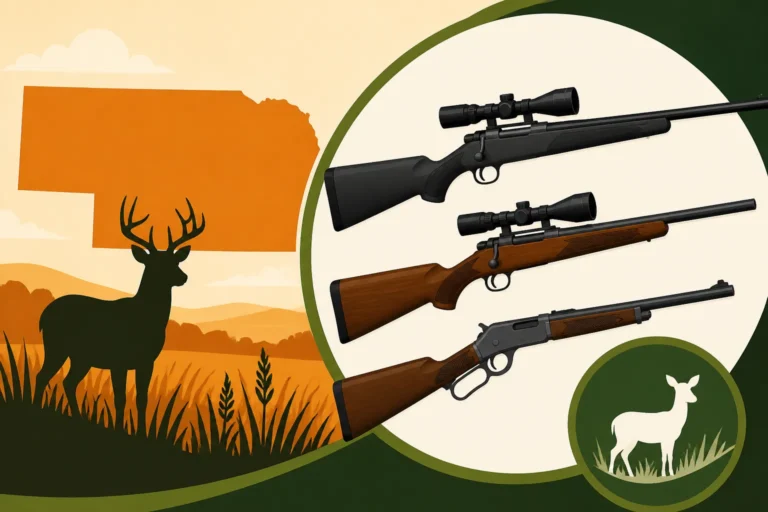
If you find yourself hunting in a unit or area where straight-wall cartridges are required, you'll need to adjust your thinking. Common straight-wall options include the .45-70 Government, .444 Marlin, .350 Legend, and .450 Bushmaster. These cartridges are characterized by their cases having straight walls rather than the bottleneck shape of most rifle cartridges. While their effective range is generally shorter than traditional bottleneck rifle cartridges, they are incredibly effective within their intended distances, typically up to 200 yards or so. They deliver significant energy on target, making them very deadly on deer. If you're hunting in one of these specific zones, understanding Straight-Wall Cartridge Rules in Nebraska is paramount, and choosing one of these purpose-built cartridges will ensure you're legal and effective.
Considering Specialized and Magnum Options
While the "workhorse" calibers will serve most Nebraska deer hunters well, there are situations and preferences that might lead a hunter to consider something a bit more specialized, or even a true magnum. These options bring their own set of advantages and disadvantages, and it's important to weigh them carefully against your specific hunting style and local conditions.
Stepping Up: .7mm Rem Mag and .300 Win Mag
For hunters who consistently face longer shot opportunities, particularly out west in the Sandhills or Panhandle, or those who simply prefer a flatter trajectory and more knockdown power, magnum cartridges like the .7mm Remington Magnum and the .300 Winchester Magnum become attractive options. These calibers truly shine when shots stretch beyond 300 yards.
- 7mm Remington Magnum: A perennial favorite for open-country hunting, the 7mm Rem Mag is known for its blistering velocity and flat trajectory, especially with heavier, high-BC bullets. It carries more energy downrange than the standard .270 or .30-06, making it excellent for mule deer where longer shots are the norm. Recoil is certainly more noticeable than a .30-06, but many experienced hunters find it manageable. It's a fantastic choice for hunting in wide-open country where you might be Glassing the Nebraska Sandhills for Mule Deer and need the confidence that your bullet will perform at extended ranges. While it's great for deer, it also has the power to handle larger game if you ever venture out of state or pursue other species.
- 300 Winchester Magnum: If you're looking for even more power and versatility, the .300 Win Mag answers the call. It can launch heavy .30-caliber bullets at impressive speeds, delivering immense energy on target. While it's more than enough for any deer in Nebraska, it truly comes into its own for larger game like elk or even moose. The trade-off is significantly increased recoil compared to the non-magnum .30s and even the 7mm Rem Mag. For some, the added recoil is a deterrent, impacting accuracy and comfort. However, for those who can handle it and practice with it, the .300 Win Mag offers unparalleled terminal performance for deer at long distances and provides a wide margin of error in bullet placement. If you're contemplating Magnum Calibers for Antelope or large mule deer, this is often the go-to.
Small Calibers for the Discerning Hunter: .243 Win
On the other end of the spectrum, some hunters prefer smaller, lighter-recoiling cartridges, and the .243 Winchester stands out as a classic choice. Often considered a "varmint" cartridge, it's also a surprisingly effective deer slayer when paired with the right bullet.
- 243 Winchester: The .243 Win is a fantastic choice for youth hunters, recoil-sensitive shooters, or anyone prioritizing minimal recoil and excellent accuracy. It shoots flat and fast with 95-100 grain bullets, and its mild report and minimal kick make it a pleasure to shoot. While it doesn't carry the raw energy of a .30-caliber, with modern premium bullets designed for deer, it's more than capable of taking down any Nebraska whitetail or mule deer. The key is precise shot placement within reasonable distances, typically under 250-300 yards. It demands a hunter who is disciplined and confident in their shooting abilities. When considering Is a .243 Enough for Nebraska Deer?, the answer is almost always "yes," provided the hunter understands its limitations and uses appropriate ammunition. It's particularly well-suited for smaller-bodied whitetails in the eastern part of the state.
The Role of Bullet Design in Terminal Performance
We've touched on bullet construction, but it bears repeating: the bullet itself is arguably more important than the head stamp on the case. A premium bullet in a moderately powered cartridge will almost always outperform a cheap, cup-and-core bullet in a magnum. Today's market offers an incredible array of purpose-built bullets, each designed to perform optimally under specific conditions.
For deer hunting, you'll generally want a bullet that exhibits controlled expansion. This means it expands rapidly to create a large wound channel but also retains a significant portion of its original weight to penetrate deeply into the vital organs. Examples include bonded bullets (like Federal's Trophy Bonded Tip or Swift Scirocco II), monolithic bullets (like Barnes TSX or Hornady GMX), or interlocked core designs (like Hornady InterLock or Nosler Partition). These designs ensure that even if you hit a deer's shoulder bone, the bullet has a good chance of breaking through and still reaching the vitals, instead of fragmenting on impact. Always choose your bullet type wisely, matching it to the caliber and the game you're pursuing. GoHunt, a valuable resource, can provide insights into current ammunition trends and hunter experiences with different bullet designs.
Practical Considerations Beyond the Caliber
Choosing a caliber is a big step, but it’s just one piece of the puzzle. To ensure a successful and enjoyable hunting experience in Nebraska, you need to consider a few other practical aspects that often get overlooked in the excitement of new rifle purchases. These elements contribute just as much to your readiness and effectiveness in the field.
Ammunition Availability and Cost
It's a frustrating scenario many hunters have faced: you buy a new rifle in an exciting, high-performance caliber, only to find that ammunition is either impossible to find, or prohibitively expensive. While less common for the popular "workhorse" calibers, it can certainly be an issue for more niche or specialized cartridges. When you're ready to load up for deer season, the last thing you want is to be scrambling for bullets.
Before committing to a specific caliber, especially one that isn't among the most common, do a quick check on ammunition availability and typical pricing. Can you readily find different bullet weights and brands? Will you be able to stock up on enough for practice, zeroing your rifle, and hunting? If you're a high-volume shooter, or if you plan to hunt for many years, the ongoing cost of ammunition can add up significantly. Reliability of supply and reasonable cost will allow you to practice more, which as we've established, is crucial for accuracy and confidence.
| Caliber | Common Bullet Weights (Grains) | Typical Recoil (Relative) | Trajectory (Relative) | Common Availability |
|---|---|---|---|---|
| .243 Winchester | 80-100 | Very Low | Flat | Excellent |
| 6.5 Creedmoor | 120-147 | Low | Very Flat | Excellent |
| .270 Winchester | 130-150 | Moderate | Flat | Excellent |
| .308 Winchester | 150-180 | Moderate | Good | Excellent |
| .30-06 Springfield | 150-180 | Moderate-High | Good | Excellent |
| .280 Ackley Improved | 140-168 | Moderate | Very Flat | Fair |
| 7mm Remington Magnum | 140-175 | High | Very Flat | Good |
| .300 Winchester Magnum | 165-200 | High-Very High | Very Flat | Good |
| .350 Legend | 150-280 | Moderate | Moderate (Straight-Wall) | Good |
| .450 Bushmaster | 250-300 | High | Moderate (Straight-Wall) | Fair-Good |
Note: Recoil and Trajectory are relative to other common deer hunting calibers and can vary based on specific rifle and load.
Rifle Weight and Portability
Imagine yourself still-hunting through thick plum thickets in eastern Nebraska, or climbing the steep, broken terrain of the Pine Ridge in pursuit of a mule deer. A heavy rifle, while potentially more stable for long-range shots from a rest, can become a real burden after a few hours of walking. Conversely, an ultralight rifle, while easy to carry, might be harder to hold steady for precise shots, especially if you’re trying to stabilize yourself after a quick stalk.
Consider your primary hunting method. If you're mostly sitting in a stand or hunting from a blind, a heavier rifle might not be an issue. But if you plan on covering a lot of ground, a rifle that balances weight with shootability is paramount. Even small differences in weight can make a big difference by the end of a long day afield. Think about how you’ll be handling the rifle when you're moving and when you're shooting. A comfortable carry is key to staying fresh and focused when that opportunity finally arises.
Practice, Practice, Practice
This might sound like a broken record, but it cannot be stressed enough: the most important factor in ethical and successful deer hunting is your proficiency with your chosen rifle. No matter how powerful or accurate a caliber is on paper, it's only as good as the shooter behind it. A hunter who can consistently place a .243 Winchester bullet precisely in the vitals will be far more successful than a hunter who flinches and misses with a .300 Win Mag.
Invest time and ammunition at the range. Practice shooting from various field positions – offhand, kneeling, prone, and using shooting sticks or a bipod – because deer rarely present themselves in a perfect bench rest scenario. Understand your rifle's capabilities and, more importantly, your own. Knowing your effective range, and sticking to it, is a mark of a responsible hunter. Before you head out for Nebraska's Nine-Day November Firearm Deer Season or Bowhunting Nebraska's Four-Month Archery Season, ensure you've put in the range time. It's the best insurance policy for a clean, ethical harvest and a rewarding hunting experience.
Disclaimer
This article is for general informational purposes only and does not constitute professional advice. Laws, prices and regulations vary by location and change over time. Consult a qualified professional for guidance on your specific situation.