Where Nebraska Antelope Concentrate
Finding antelope in Nebraska can feel like searching for a needle in a haystack if you don't know where to start. These incredible animals are built for wide-open spaces, and while they roam a significant portion of the state, they certainly don't just appear everywhere. This guide is dedicated to helping you understand the specific areas and habitats where Nebraska's pronghorn concentrate, giving you a real advantage in planning your next hunt.
Understanding Pronghorn Habitat Preferences in Nebraska
To truly understand where Nebraska antelope concentrate, you first need to get inside their heads a little and grasp what makes a piece of ground ideal for them. These aren't whitetails hiding in thick timber; they are creatures of the vast, open plains, and their survival hinges on their ability to see danger coming from a mile away and outrun it.
The Crucial Role of Open Grasslands
Pronghorn are often called "speed goats" for a reason – they are the fastest land animal in North America, and their primary defense mechanism is their incredible velocity. This means they naturally gravitate towards wide-open grasslands where they can spot predators (or hunters) long before they become a threat and then put on a burst of speed to escape. Rolling hills, expansive prairies, and even short-grass rangelands are their bread and butter. You won't find significant numbers of antelope lurking in dense river bottoms or heavy timber, because those environments negate their key advantage. They need clear sightlines to feel secure, both when grazing and when bedding down.
Think about how you would feel if you lived entirely in a dense forest. You'd constantly be on edge, right? Antelope feel the opposite in thick cover. They thrive where they can scan the horizon for miles in every direction. This preference for openness is why the western half of Nebraska, with its vast tracts of rangeland, is so much more appealing to them than the agricultural fields and denser woodlands of the eastern part of the state.
Water Sources and Antelope Behavior
Just like any other living creature, pronghorn need water, especially during the hot Nebraska summers. While they are remarkably efficient at extracting moisture from the plants they eat, regular access to water sources is still a significant factor in their distribution. They aren't generally picky about what kind of water source, as long as it's reliable. This could be a small stock dam, a windmill, a natural spring, or even a slow-moving creek.
Antelope tend to concentrate in areas where these water sources are readily available, particularly if they are scattered across large expanses of suitable forage. During dry periods, their dependence on these specific water holes becomes even more pronounced, and they will travel considerable distances to get a drink. As a hunter, understanding these patterns is crucial. Knowing where the water is can help you narrow down vast tracts of land. Many experienced hunters will tell you that scouting water sources, especially during August and early September archery seasons, is a critical part of their strategy, which is why topics like Archery Antelope Over Water in Nebraska are so valuable.
Sagebrush and Forage Diversity
While antelope thrive on various grasses, their diet is actually quite diverse, and they have a particular fondness for forbs and shrubs, especially sagebrush. Sagebrush not only provides essential nutrients but also offers some thermal cover during harsh weather and helps break up their outline visually against the landscape. This means that areas with a healthy mix of native grasses and significant stands of sagebrush are often prime antelope habitat.
Beyond sagebrush, they'll browse on a variety of other plants, including cacti, weeds, and even some agricultural crops if available. This dietary flexibility allows them to adapt to different conditions, but the presence of high-quality browse, particularly sagebrush, often indicates excellent, healthy antelope country. When you're glassing, pay attention to the vegetation. A monoculture of short grass might hold antelope temporarily, but areas with diverse plant life, especially those low-growing shrubs, are more likely to hold sustained populations.
Nebraska's Prime Antelope Country: The Panhandle and Sandhills
When you picture pronghorn in Nebraska, your mind should immediately drift westward. This vast, often sparsely populated region is truly the heart of Nebraska's antelope range.
The Panhandle's Unique Landscape
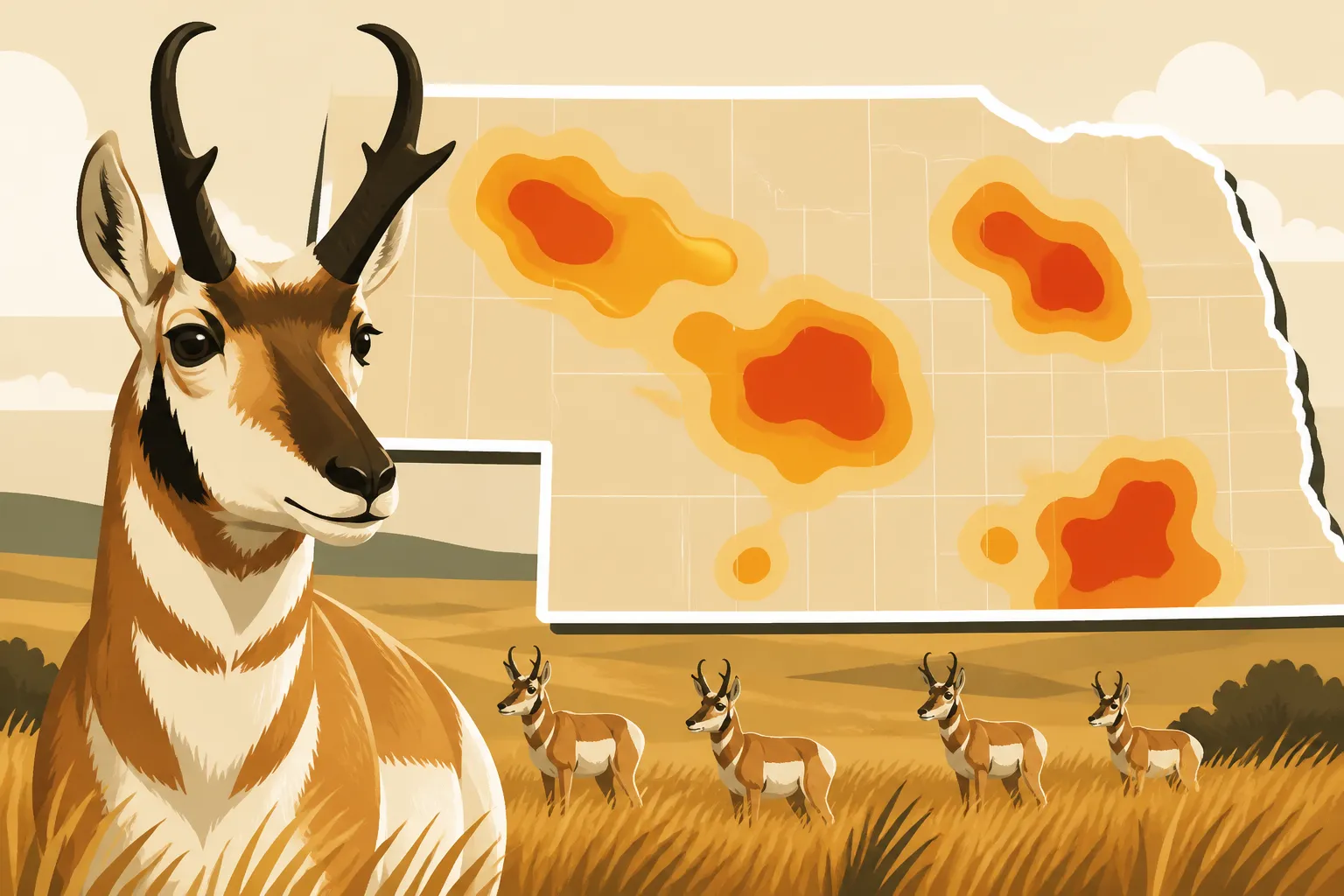
The Nebraska Panhandle, stretching across the westernmost portion of the state, is undeniably pronghorn paradise. This region is characterized by immense, sweeping rangelands, punctuated by the dramatic bluffs and canyons of the Pine Ridge, and the unique Wildcat Hills. While the Pine Ridge itself holds some deer and even elk, it's the more open, rolling prairie surrounding it that truly shines for antelope. Counties like Sioux, Dawes, Box Butte, Kimball, Banner, and Scotts Bluff consistently hold the highest concentrations.
Here, the sheer scale of the landscape provides everything an antelope needs: endless visibility, abundant forage, and enough space to avoid disturbance. The land often includes large cattle ranches, which, while private, often manage their rangelands in a way that benefits wildlife, including pronghorn. This region's less fragmented habitat and lower human population density make it ideal for these wide-ranging animals. When you're looking at a map or using an online tool like GoHunt to scout, these western counties should be your primary focus. This area is the core of Nebraska's Antelope Herds and Where They Live.
Sandhills: Surprising Antelope Habitat
While the Panhandle often gets the most attention, the Nebraska Sandhills, a vast and unique ecosystem, also holds significant numbers of pronghorn. Many people might assume "sand" means a barren wasteland, but the Sandhills are actually one of the largest stabilized sand dune regions in the world, covered by a diverse array of native grasses and dotted with countless shallow lakes and wetlands. The rolling nature of the Sandhills, with its broad valleys and high ridges, creates an ideal environment. The dunes provide excellent vantage points, and the valleys offer shelter from the wind and diverse forage.
Areas of the Sandhills, particularly those bordering the Panhandle and some of the more western and northern counties within the Sandhills proper, can be incredibly productive for antelope. The presence of abundant water in the many lakes and cattle ponds, combined with the mixed-grass prairie, makes for excellent habitat. While perhaps not as densely populated as some Panhandle areas, the sheer size of the Sandhills means that when you find a concentration, it can be substantial. Understanding the Nebraska Pronghorn Population Estimate helps put these numbers into perspective.
Overlapping Ranges and Migration Patterns
While not true migrations in the sense of elk or caribou, Nebraska antelope do exhibit seasonal shifts in their distribution, often moving between different areas based on food availability, water, and weather conditions. During the harsh winter months, they may seek out areas with less snow cover or where browse is more accessible. In spring, they might gravitate towards new green growth in specific pastures.
These shifts mean that a spot that holds antelope in July might not be as productive in September, or vice versa. They often use vast tracts of land, moving freely across property lines if not impeded by fences. This dynamic nature means that static scouting isn't enough; understanding these larger patterns and adapting your search throughout the season is key. Resources like the Nebraska Public Access Atlas, sometimes integrated into mapping platforms like GoHunt, can help identify large continuous blocks of habitat that might be part of these broader seasonal movements.
Key Geographic Units and Their Antelope Densities
Nebraska's game and parks agency divides the state into various management units, and for antelope, these units are critical to understanding where to hunt and what your permit options might be.
Specific Antelope Management Units
Nebraska's antelope hunting is permit-based, and these permits are typically specific to certain management units. While these unit names can change or be adjusted, generally, you'll find units like "Plains," "Sandhills," "Hat Creek," and others consistently designated for antelope hunting. The "Plains" unit often encompasses much of the Panhandle's prime open rangeland, while the "Sandhills" unit covers a significant portion of that unique ecosystem. Understanding these unit boundaries is not just a regulatory necessity; it also helps you visualize where the highest concentrations of antelope are managed.
Each unit has a limited number of permits available, reflecting the antelope population within its borders. Units with historically higher populations and consistent habitat will generally have more permits, though competition can still be fierce. It's vital to study the unit maps provided by the state to understand the specific geographic areas covered by each, as well as checking the Nebraska Antelope Unit List for current information on available permits and draw odds. These are the areas where the state wildlife biologists have identified sustainable populations that can support hunting pressure.
Public Land Access and Hotspots
While much of western Nebraska is privately owned, there are still excellent public land opportunities for antelope hunters within these concentration zones. The Oglala National Grassland in the Panhandle, for example, is a massive tract of federal land that offers significant opportunities. It's one of the best places for non-residents, in particular, to gain access to prime antelope habitat. Additionally, some Wildlife Management Areas (WMAs) and Open Fields and Waters (OFW) tracts, particularly in western Nebraska, can hold antelope.
The key to finding these public land hotspots is diligent research using the Nebraska Public Access Atlas, which is available both in print and as a fantastic mobile app. This atlas clearly outlines all public and publicly accessible lands, including OFWs, which are private lands opened to public hunting through an agreement with the state. Platforms like GoHunt, with their detailed mapping layers, can greatly assist in overlaying property boundaries with satellite imagery to identify promising public ground. However, even on public land, antelope can be pressured, so don't be afraid to walk a little further or hunt areas that require more effort. Exploring Oglala National Grassland Hunting can provide further insights into this expansive public resource.
Private Land Dynamics and Permission
Despite the public land options, a substantial portion of Nebraska's best antelope hunting takes place on private ground. Large cattle ranches dominate the Panhandle and Sandhills, and many of these properties hold significant numbers of pronghorn. Obtaining private land permission is often the most effective way to hunt antelope in Nebraska, but it requires effort and respect.
Making contact with landowners well in advance of the season is crucial. Be polite, offer to help with chores if appropriate, and always respect their land and rules. Some landowners might charge a trespass fee, while others might grant permission for free to responsible hunters. The advantage of private land is often less hunting pressure and potentially higher antelope densities, as these areas often have better habitat and less disturbance. Building a relationship with a landowner can pay dividends for years, providing consistent access to prime antelope country.
Reading the Landscape: Scouting for Antelope Concentration
Even when you're in known antelope country, locating the animals themselves still takes skill and effort. Their incredible camouflage and tendency to blend into the vast landscape make diligent scouting indispensable.
Glassing Strategies for Open Country
When you're hunting antelope in Nebraska, your binoculars and spotting scope are arguably more important than your rifle. Pronghorn are masters of using the rolling terrain to disappear, even in seemingly flat country. Effective glassing from high vantage points is the name of the game. Find a hilltop or even the roof of your truck, set up your tripod, and systematically pick apart the landscape. Don't just glance; scrutinize every ridge, every dip, every clump of sagebrush.
Use quality optics with sufficient magnification – 10x or 12x binoculars are a must, and a spotting scope (20-60x or higher) is invaluable for judging animals at extreme distances. Remember that antelope often bed down on high ground where they can maintain visibility. Look for flashes of white, the distinctive dark patch on their cheek, or subtle movements that give them away. This methodical approach is similar to Glassing the Nebraska Sandhills for Mule Deer and is absolutely critical for success with antelope.
Identifying Sign and Movement Corridors
While antelope don't leave the same kind of obvious sign as deer in thick timber, they still leave clues. Look for distinct trails where they travel between feeding areas, water sources, and bedding grounds. These trails often appear as subtle paths worn through the grass. Droppings can indicate consistent use of an area. In areas with prominent fences, look for crawl-unders where antelope have repeatedly squeezed beneath the wire. These "antelope gates" reveal their preferred travel routes.
Also, observe how the terrain funnels movement. A long ridge line, a wide, open valley, or a break in a long fence can all act as natural corridors. While antelope will sometimes just wander across vast plains, they often take the path of least resistance or the route that offers the best visibility. Learning to "read" these subtle signs and understanding how antelope use the landscape will significantly improve your chances of intercepting them.
Understanding Seasonal Shifts and Food Sources
Antelope diets, and therefore their locations, can shift throughout the hunting season based on the availability and quality of forage. Early in the archery season, when temperatures are hot and vegetation might be drying out, they are often heavily concentrated around reliable water sources and lush, green pockets of forage. As fall progresses and temperatures cool, they might disperse more widely, focusing on different plants as they become palatable or nutritious.
Rainfall patterns also play a huge role. A wet spring and summer can lead to widespread lush forage, meaning antelope are less concentrated around specific food plots or water holes. Conversely, a dry year will push them to the few remaining green spots or water sources. Keeping an eye on weather patterns and how they affect vegetation can give you a significant advantage. This goes hand-in-hand with understanding broader concepts like Late-Season Food Sources in Nebraska, even if that article focuses on deer, the principles of shifting food availability remain relevant.
Challenges and Considerations in Antelope Hunting
Antelope hunting, while incredibly rewarding, comes with its own set of unique challenges that every hunter needs to consider, especially when trying to pinpoint their concentrations.
The Impact of Weather and Water Availability
Nebraska weather is famously unpredictable and can drastically affect antelope behavior and distribution. Hot, dry conditions, particularly in early season, will draw antelope to water sources, making these areas prime hunting spots. This can lead to fantastic opportunities for bowhunters, as covered in Archery Antelope From a Water Blind. Conversely, abundant rainfall can disperse antelope across the landscape, as water is readily available everywhere, making them harder to pattern. A long, cold winter with deep snow can also impact herd health and movement, pushing them to areas with less snow cover where they can access forage.
Wind is another huge factor on the Nebraska plains. Antelope are incredibly wary, and consistent high winds can make stalking nearly impossible due to noise and erratic scent control. It can also make glassing very difficult. Always monitor the weather forecasts and be prepared to adapt your strategy based on the conditions. Understanding how weather impacts the habitat is also key, as discussed in Hunting Antelope After a Wet Summer.
Hunting Pressure and Antelope Habits
Nebraska's antelope permits are highly sought after, and while the vastness of the Panhandle and Sandhills means less "hunter saturation" than some other states, hunting pressure still plays a significant role. Antelope are incredibly sensitive to disturbance. Once they've been bumped a few times, they can become even warier, moving into less accessible areas or becoming almost entirely nocturnal in heavily hunted spots.
On public lands or easily accessible private lands, this pressure can quickly alter their daily routines. They might start feeding at night, bed down in terrain that offers more concealment, or simply move out of an area altogether. This means that scouting for areas that receive less pressure or being willing to walk a considerable distance away from roads and parking areas is often necessary to find unpressured animals. A good mapping app (like GoHunt offers) can show you road systems and public land boundaries, allowing you to plan routes that avoid common access points.
Unique Behavioral Traits of Pronghorn
Pronghorn possess a fascinating array of behavioral traits that set them apart from other big game animals, and understanding these can be a huge advantage. Their legendary eyesight, for example, is said to be equivalent to an 8x binocular, making them incredibly difficult to approach undetected in open country. They also possess a "flash" warning system where they erect the white hairs on their rump to signal danger to other antelope, which can quickly clear an entire herd from an area.
Perhaps most famously, antelope have a tendency to crawl under fences rather than jump over them. This seemingly odd behavior is a holdover from a time before fences, when they evolved on landscapes without significant vertical obstructions. This behavior can be both a blessing and a curse for hunters; it can funnel their movement along fence lines, but it also means they can disappear through an opening that a deer wouldn't even consider. Learning Why Pronghorn Go Under Fences and observing these crossing points can be key to patterning their movement on a landscape crisscrossed with wire.
Disclaimer
This article is for general informational purposes only and does not constitute professional advice. Laws, prices and regulations vary by location and change over time. Consult a qualified professional for guidance on your specific situation.