Saddle Hunting in Cottonwood Timber
Hunting Nebraska's cottonwood timber can be incredibly rewarding, but the thought of hauling a heavy traditional treestand deep into those river bottoms, navigating thick undergrowth, and then struggling to find the perfect setup often makes folks just want to stay home. Many of us have been there, facing the reality of limited access, pressured deer, and those frustratingly "perfect" trees that a ladder stand just won't fit. This guide is all about embracing a more agile, versatile approach to hunting those big river-bottom whitetails: saddle hunting in cottonwood timber. We'll dive deep into why this method makes so much sense, the essential gear you'll need, and the tactics that will help you succeed where traditional methods often fall short.
Why Saddle Hunting Shines in Nebraska's Cottonwood Bottoms
Nebraska's river corridors, particularly in the eastern and central parts of the state, are often defined by towering cottonwood trees. These areas are magnets for whitetails, offering dense cover, vital food sources from adjacent crop fields, and natural travel corridors. However, hunting them effectively can be a real headache. Traditional treestands, whether they're heavy ladder stands or cumbersome hang-ons, present significant challenges. They're bulky to carry, noisy to install, and often limit your shot opportunities to a narrow field of view. This is precisely where saddle hunting steps in as a game-changer, offering unmatched mobility, stealth, and a distinct advantage in these dynamic environments.
The Unmatched Mobility for Dispersed Timber
One of the biggest frustrations with hunting large, sprawling tracts of cottonwood timber, especially public access areas, is that the "perfect" tree for a conventional stand might be miles from the nearest road, or worse, it might be in a spot where deer only briefly pass through. Saddle hunting liberates you from these constraints. Instead of committing to one or two fixed stand locations, a saddle setup allows you to hike deep into the woods, scouting for fresh sign on the fly, and then quickly setting up in the exact tree you need for the current wind and deer movement. Imagine finding a fresh rub line along a hidden creek bed or spotting a hot scrape near a transition zone — with a saddle, you can be hunting that spot within minutes, not days. This ability to adapt on the fly is crucial when you're pursuing a cagey river-bottom buck that might change his patterns based on pressure or recent weather. The freedom to move and set up quietly gives you an edge that a heavy treestand simply can't match.
Stealth and a 360-Degree Shooting Advantage
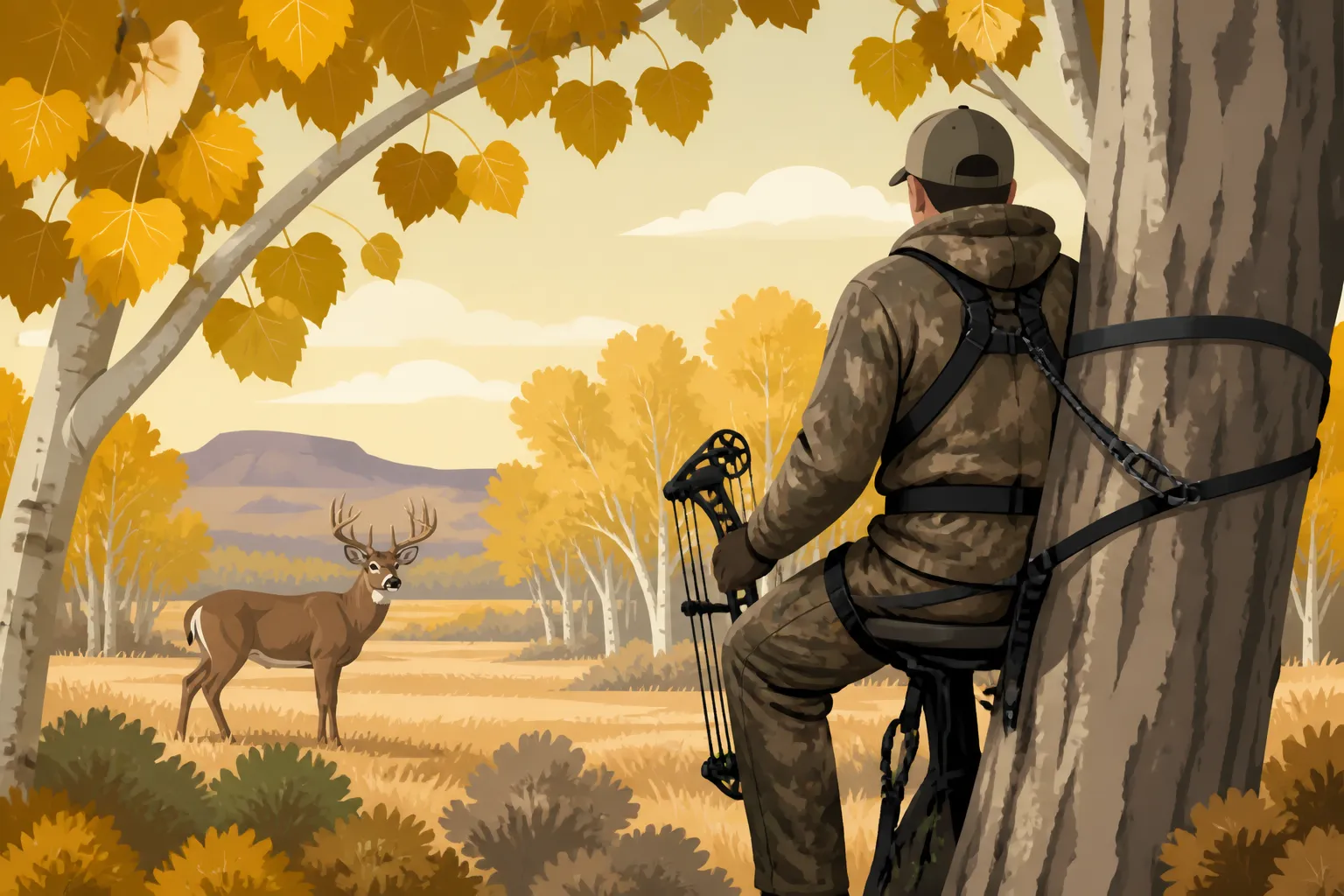
Cottonwood timber can be both open and incredibly dense, often with a clear understory that allows deer to see farther, mixed with thick tangles of saplings and brush. In such varied terrain, traditional stands can feel like a compromise. You pick a tree, trim your lanes, and hope deer walk into your narrow window. With a saddle, your world opens up. You're effectively tethered to the tree, allowing you to rotate around the trunk, using it as cover. This means a deer approaching from your "blind" side can be picked up, and you can simply shift your body to get a shot, using the tree itself as concealment.
Think about a whitetail buck sneaking through a River-Bottom Whitetail Hunting in Eastern Nebraska corridor. He's constantly looking and listening. Being able to subtly adjust your position without creaking metal or shifting weight on a platform can mean the difference between drawing your bow undetected and getting busted. The ability to shoot from any angle, even if you need to swing around the tree, gives you a huge advantage, especially when a deer doesn't follow the script. This flexibility greatly reduces the risk of being caught off guard, allowing you to maximize every encounter.
Comfort for All-Day Sits and Adaptability
Let's be honest, sitting motionless in a hang-on stand for hours can be downright painful, leading to fidgeting and early exits. Saddle hunting offers a different kind of comfort. Because you're essentially sitting in a fabric sling, your weight is distributed differently, and you have more natural movement. You can lean, stretch your legs, and even stand up and sit down with greater ease than in a traditional platform. This enhanced comfort translates directly into longer, more effective hunts. In fact, many hunters find they can comfortably sit from first light to last in a saddle, something that was unimaginable in a traditional stand.
Furthermore, cottonwood trees themselves can be challenging for traditional stands. Their bark can be rough, and finding a perfectly straight section with suitable limb structure for a platform can be tough. Saddles, however, are far more forgiving. They don't require the same specific tree dimensions. You're simply looking for a sturdy trunk with minimal low branches to impede your climb and draw. This adaptability means you have far more potential "stand" trees, increasing your options when Choosing a Treestand Site on Nebraska Farmland or deep in public timber. Even if a tree isn't perfectly straight, a saddle setup can make it a viable option, expanding your potential hunting locations significantly.
Essential Gear for Saddle Hunting in Nebraska's Cottonwoods
Saddle hunting, while minimalist in concept, still requires a specific set of gear to be safe and effective. When you're headed into Nebraska's cottonwood timber, you'll want to prioritize lightweight, durable, and quiet equipment. Each piece plays a critical role in your ability to access, ascend, and hunt from a tree with stealth and comfort. Don't skimp on quality here; your safety and success depend on it.
The Saddle System Itself
At the heart of it all is the saddle. This isn't just a simple harness; it's a carefully engineered piece of gear that cradles you comfortably while you're elevated. Look for a saddle that's adjustable, allowing you to fine-tune the fit for your body type and layering system. Remember, a Nebraska November can be chilly, so you'll want room for bulkier Base Layers for a Nebraska November without feeling restricted. Comfort is paramount for those long sits, so consider models with good lumbar support and wide leg straps to prevent pressure points.
Most saddles come with a bridge, which is the strap connecting your climbing method to the saddle. Some bridges are adjustable, which is a fantastic feature for dialing in your lean and shooting position. You'll also need a tree tether, which is your primary connection to the tree, keeping you safely secured. A high-quality tether should be quiet, easy to adjust, and strong enough to support your weight and movement. Many experienced saddle hunters also carry a secondary lineman's belt, which allows you to remain securely attached to the tree with both hands free while ascending or descending with climbing sticks, making the process much safer and more efficient.
Climbing Sticks and Platform
To get up the tree, you'll need climbing sticks. These are lightweight, modular sections that attach to the tree trunk, providing steps to ascend. For cottonwood timber, where trees can be tall and limbless, you'll want sticks that are easy to deploy quietly and provide adequate height. Some hunters prefer individual mini-sticks for maximum packability, while others opt for longer, connected sections for quicker setup. The key is to find a system that’s light enough for long hikes into remote spots but sturdy and secure once attached.
Once at hunting height, you'll need a platform. This isn't a full treestand platform, but rather a smaller, more minimalist surface that provides a stable place for your feet while you hunt. Some platforms are integrated with a stick, while others are separate units that attach to the tree. The platform gives you leverage, allows you to shift your weight, and makes standing and rotating much more comfortable. When choosing sticks and a platform, pay attention to the attachment method – cam straps, ropes, or chains. You want something that cinches down tight, prevents movement and noise, and is quick to deploy and retrieve, especially when you're trying to make a quick setup in a hot spot discovered through your GoHunt scouting app.
Safety and Accessory Management
Safety is non-negotiable in any elevated hunting scenario, and saddle hunting is no different. Always wear your saddle harness and stay tethered to the tree from the moment your feet leave the ground until they return. This continuous connection is a core tenet of saddle hunting safety. Beyond the basic tether, consider a good haul rope for pulling up your bow, backpack, and other gear quietly once you're set up.
Accessory management is another crucial element. Unlike a traditional stand with a shelf or hooks, you'll need ways to keep your gear close at hand without cluttering your space or making noise. Modular pouches that attach to your saddle or bridge, small gear hangers that screw into the tree (if regulations allow on public land), or even a quiet backpack with exterior loops can be invaluable. Think about where you'll hang your rangefinder, grunt tube, or a water bottle. In the often open understory of cottonwood timber, even a slight rustle can carry far, so quiet attachment and retrieval of gear are paramount. I’ve found that using small carabiners and quiet bungee cords to secure items to my bridge or saddle loops works wonders. It’s all about preventing unnecessary movement and sound, ensuring you can react to a Grunt Calls in Thick River Timber without fumbling.
Tactics for Setting Up and Hunting from a Saddle in Cottonwood Timber
Mastering saddle hunting in Nebraska's cottonwood timber isn't just about the gear; it's about intelligent setup, silent execution, and understanding how deer use these specific habitats. Unlike open country, the unique verticality and varying density of cottonwoods demand a thoughtful approach to tree selection, climbing, and shot execution.
Tree Selection and Ascending with Stealth
The key to successful saddle hunting in cottonwoods begins with tree selection. You're not looking for the perfect branching structure for a platform, but rather a robust, healthy trunk that's free of dead branches that might snap or make noise during your ascent. Aim for trees that offer natural cover, either from their own limbs (if present) or from surrounding smaller trees and brush. A good rule of thumb is to look for a tree that allows you to break up your outline against the sky or a darker background. In Nebraska, cottonwoods often grow in clusters or along thick creek beds, offering opportunities to use multiple trunks for concealment. Use your GoHunt maps to identify prime travel corridors, pinch points, or feeding areas that will lead you to the ideal tree.
Once you’ve selected your tree, your ascent must be as quiet as possible. This means packing your climbing sticks and platform so they don't clank together. Many hunters use small bungee cords or tape to silence their sticks during transport. When attaching your sticks, take your time. Ensure they are firmly seated and silent before you apply your weight. The rough bark of cottonwoods can be an advantage here, offering more grip for stick attachments. As you climb, keep your lineman’s belt attached, allowing you to work hands-free. This isn't just for safety; it allows for a smoother, quieter climb, as you're not constantly struggling to hold onto the tree while attaching sticks. Once at height, ensure your platform is rock solid before you unclip your lineman’s belt and attach your tree tether, rotating around the tree to find the most advantageous shooting lanes.
Optimizing Your Position for Shots
One of the great advantages of saddle hunting is the ability to easily rotate around the tree. This 360-degree capability means you can effectively shoot in any direction, turning the tree into your ultimate cover and shooting rest. When you first get into position, don't just pick one direction. Instead, evaluate all potential deer approaches. Are there trails behind you? A creek bed to your left? A cornfield edge to your right? Your vantage point should allow you to silently shift and draw your bow without excessive movement, no matter where a deer appears. This is particularly effective when you're set up near a field edge, where deer might pop out at unexpected angles while you’re Setting Up on a Nebraska Cornfield Edge.
Practice leaning out from the tree in various directions, simulating a shot. You'll quickly discover how slight adjustments to your tether length or the angle of your platform can significantly impact your comfort and ability to draw. For bowhunters, ensuring you have clear lanes for your arrow at typical deer distances is crucial. While saddle hunting offers more flexibility, it doesn't eliminate the need to identify and slightly trim critical shooting lanes before deer show up. However, unlike a fixed stand, you can often work around smaller obstacles rather than needing to clear them entirely. The ability to subtly shift and draw your bow with the tree as cover often means you can get away with less trimming, preserving natural cover and reducing your footprint.
Weathering the Elements and Staying Vigilant
Nebraska weather, especially in the fall, is famously unpredictable. A calm morning can quickly turn into a blustery afternoon. Wind Direction on Open Nebraska Prairie Stands is a major factor, and even in timber, strong winds can make a saddle sit less comfortable. In cottonwood timber, you're often higher up, catching more wind. Layering is crucial. A good Wind-Blocking Shells for the Plains will make a huge difference in staying comfortable. Remember, cottonwoods lose their leaves, and by late season, you'll be exposed.
Staying vigilant in a saddle means being constantly aware of your surroundings, but also knowing when to allow yourself a moment of rest. The comfort of a saddle allows for more natural movement, which can prevent stiffness and keep you more alert. However, subtle movements are still key. Use your binoculars to scan constantly, looking for flicking ears, a patch of hide, or antler tips. Deer in cottonwood bottoms can materialize silently. Listen for the crunch of leaves, the snap of a twig, or the distant sound of other hunters. Because you're often higher and less constrained than in a traditional stand, your field of view can be wider, but this also means more to watch. Pay particular attention to your entry and exit routes. Even if you don't harvest a deer, ensuring a quiet departure will keep your spot from getting burned for future hunts, especially on pressured public land.
Overcoming Challenges and Staying Safe
Saddle hunting offers many advantages, but it also comes with its own set of challenges, especially when navigating the specific environment of Nebraska's cottonwood timber. Understanding these potential hurdles and having strategies to overcome them is vital for both success and safety. From dealing with the characteristic features of cottonwoods to managing scent and staying secure, a prepared saddle hunter is a successful one.
Dealing with Unique Cottonwood Features
Cottonwood trees are distinct. They grow tall, often with few lower limbs, making them challenging to climb for traditional stands, but perfect for the discrete, high vantage points saddles offer. However, their bark can be quite rough, which is great for gripping climbing sticks, but less so for your hands and gear. Wearing good climbing gloves is a must, not just for warmth but to protect your hands from scrapes. Additionally, cottonwoods are known for shedding limbs, especially older, dead ones. Before you even start your ascent, take a moment to scan the tree for any unstable branches directly above you that could pose a risk. Safety first, always.
Another feature of cottonwood timber, especially in river bottoms, is the potential for varying undergrowth. Some areas might be wide open underneath, making deer more skittish due to lack of concealment. Other spots might be choked with thorny honeysuckle or greenbriar, making entry and exit a battle. When scouting, pay close attention to the density of the understory. Your saddle's mobility allows you to adjust your approach, choosing quieter, less obtrusive routes to your chosen tree. Use mapping tools to identify thinner strips of cover or natural openings that allow for a silent stalk in. The rough bark and sometimes uneven nature of cottonwood trunks mean you'll need to double-check the stability of every climbing stick and your platform before you commit your full weight.
Managing Scent and Staying Concealed
Even elevated in a saddle, scent control remains paramount, especially when hunting savvy Nebraska whitetails. The winds in river bottoms can swirl unpredictably, and deer are masters at using thermals. Mornings often bring descending thermals, pushing your scent down into the timber, while evenings see rising thermals. Being higher up can help your scent dissipate, but it doesn't eliminate the need for diligent scent control. This means showering with scent-free soap, washing your hunting clothes in scent-eliminating detergent, and storing them in airtight bags. Consider using a quality ozone generator for your gear if you're serious about minimizing your odor.
Concealment is also critical. While the saddle allows you to use the tree as cover, you still need to break up your human silhouette. Choosing a tree with some existing foliage (even sparse, late-season leaves) or surrounding smaller trees is ideal. Your camo pattern should match the environment, blending with the grays and browns of cottonwood bark and the subtle hints of remaining foliage. A face mask or face paint can further help you disappear into the tree. Remember, deer are incredibly good at picking out unnatural shapes. Even a slight glint from a piece of gear or an exposed hand can blow your cover. Before your hunt, take a moment to look at your setup from ground level, identifying any areas where your outline is too stark.
Ensuring Safety and Preparedness
Safety should always be your top priority. Always remain tethered to the tree. No exceptions. This is the golden rule of saddle hunting. Before each hunt, thoroughly inspect all your gear – your saddle, bridge, tether, lineman's belt, climbing sticks, and platform. Look for any signs of wear, fraying, or damage. Replace anything that looks compromised. Carry a sharp knife, a small first-aid kit, and a fully charged cell phone (though service can be spotty in some Nebraska river bottoms). Let someone know where you're hunting and when you expect to return.
In case of an emergency, having a plan is crucial. If you slip or fall while ascending, your lineman's belt should catch you. If you somehow find yourself suspended by your saddle's tether, you need a way to get back to solid ground or relieve pressure. Some hunters carry a small, foldable rescue step or prusik knot as an emergency ascender. The more remote your hunting location, such as when Scouting Nebraska Public Ground Before Opening Day, the more prepared you need to be for self-rescue. Understanding these risks and actively mitigating them ensures that your saddle hunting experience in Nebraska's cottonwood timber is not only successful but also safe.
| Feature | Traditional Hang-on Stand | Saddle Hunting System |
|---|---|---|
| Mobility | Low (heavy, bulky) | High (lightweight, packs small) |
| Stealth | Can be noisy during setup/adjustment | Very quiet, natural movements |
| Tree Selection | Requires specific branch/trunk shape | More flexible, adaptable to many trees |
| Vantage Point | Fixed, limited shooting lanes | 360-degree shooting around tree |
| Comfort | Can be uncomfortable for long sits | Often more comfortable for extended hunts |
| Pack Weight | Heavier, more cumbersome | Lighter, streamlined |
| Cost (Entry) | Potentially lower | Often higher initial investment |
| Learning Curve | Shorter | Longer, requires practice |
This article is for general informational purposes only and does not constitute professional advice. Laws, prices and regulations vary by location and change over time. Consult a qualified professional for guidance on your specific situation.