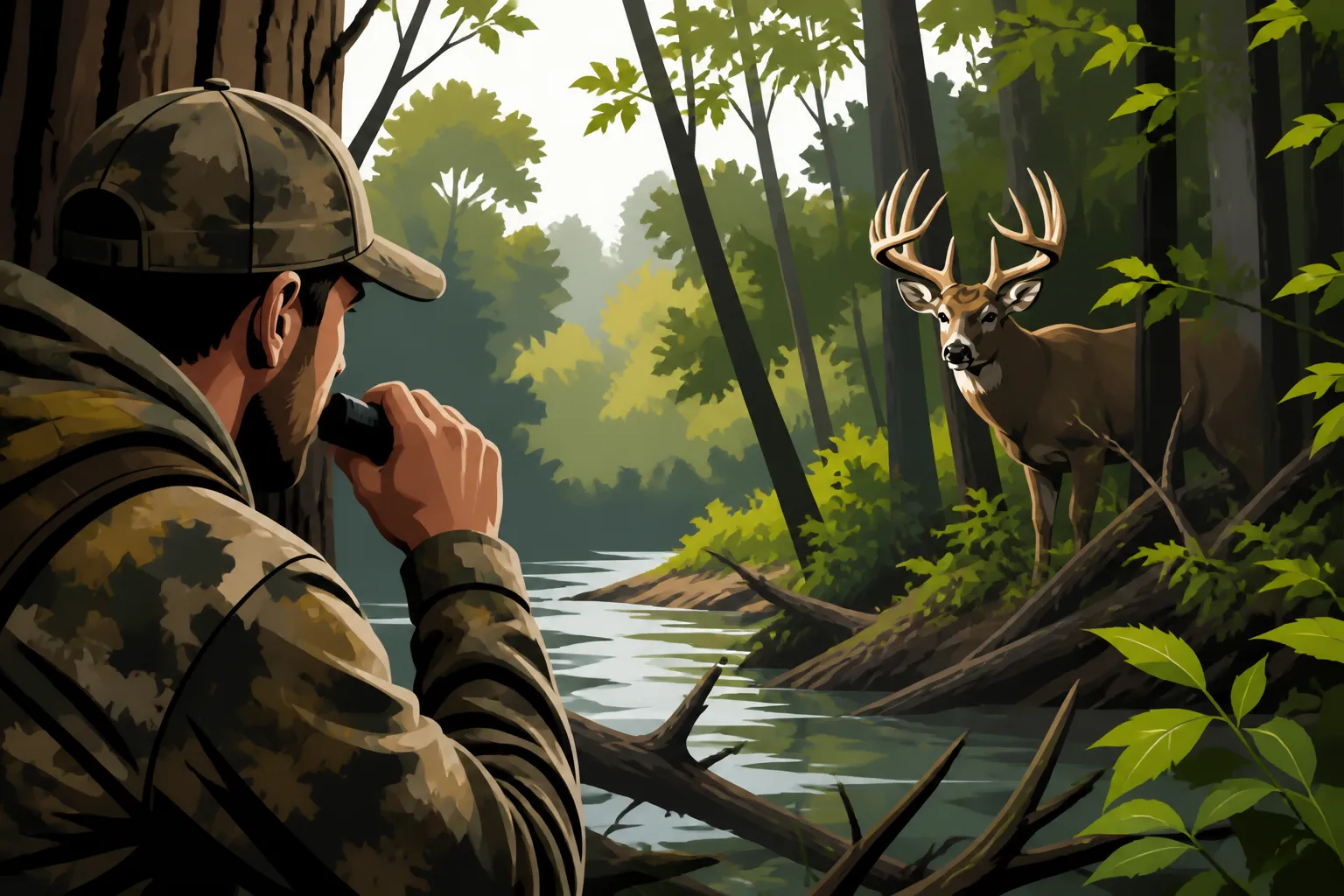
Grunt Calls in Thick River Timber
Hunting whitetails in the notoriously thick river timber of Nebraska can feel like trying to find a needle in a haystack, especially when those elusive bucks seem to ghost through the dense cover without a sound. It's a frustrating reality for many hunters, where visibility is limited, and the deer always seem one step ahead. This comprehensive guide is here to unravel the mysteries of effective grunt calling specifically for these challenging river bottom environments, helping you bring those hidden bucks into range.
The Unique Challenges of River Bottom Hunting in Nebraska
River bottoms in Nebraska are truly a world unto themselves. The terrain is often a chaotic mix of mature cottonwoods, dense cedar thickets, tangled briar patches, and flood-prone lowlands. While these areas are prime real estate for whitetails, they present a unique set of obstacles that require a specialized approach, especially when it comes to calling. The sheer density of cover means that deer can be just yards away, yet completely unseen.
Understanding Deer Behavior in Dense Cover
Whitetails are masters of their environment, and in thick river timber, they leverage every bit of cover to their advantage. Bucks, especially mature ones, will often use the densest parts of the timber as bedding areas during the day, only venturing out into more open edges or agricultural fields under the cover of darkness. Their movement patterns within these areas are usually very deliberate, often following subtle trails or natural funnels created by changes in elevation or vegetation.
When a buck hears a call in such a confined space, his immediate reaction is often caution. He can't always pinpoint the exact source due to the sound-absorbing nature of the timber and the complex acoustics. Instead of rushing in, a wise old buck will often circle downwind, trying to catch your scent before committing. They rely heavily on their nose and ears, and their eyesight, while good, is often hampered by the brush. Understanding this cautious, investigative nature is crucial for successful calling. You're not just trying to make noise; you're trying to replicate a sound that makes him feel comfortable enough to investigate without giving away your position. Often, a more subtle approach works best, allowing him to close the distance without feeling pressured.
The Limitations of Other Calling Methods
While rattling antlers or even using a snort-wheeze can be incredibly effective in more open country or during the peak of the rut, their efficacy diminishes significantly in thick river timber. Imagine two bucks fighting in dense brush – the sound doesn't carry far, and the visual cues are almost nonexistent. Rattling, in particular, can be a double-edged sword. The aggressive clashing of antlers, when not accompanied by a visual, can easily spook a wary buck who suspects something is amiss or that the "fight" is happening too close for comfort without him seeing it. A buck might pause, but if he doesn't see anything, he's more likely to melt away into the shadows than charge in.
Similarly, a snort-wheeze, which is an aggressive challenge, can be too much in a tight spot. It demands an immediate response or a visual confirmation that the environment simply doesn't allow. In contrast, a grunt call, especially a tending grunt or a social grunt, mimics the more common and less threatening vocalizations bucks make as they move through the timber, scent-checking scrapes or following does. It's a sound that suggests another deer is in the vicinity, moving naturally, which often piques a buck's curiosity more effectively than a full-blown sparring match he can't see.
Mastering the Grunt Call in Thick River Timber
Effectively using a grunt call in Nebraska's thick river timber is less about volume and more about nuance, timing, and strategic placement. It's a skill that develops with practice and a deep understanding of deer behavior in these specific environments.
Choosing the Right Grunt Call and Sound
Not all grunt calls are created equal, and knowing which one to use for river bottom hunting can make a big difference. Many calls on the market offer a range of tones, from deep, throaty buck grunts to softer, shorter doe or fawn bleats. For river timber, you generally want a call that can produce a realistic, deep buck grunt, but also has the versatility for softer, social grunts or even a tending grunt.
Types of Grunts to Master:
- Social Grunt: This is a soft, short "uhn, uhn" sound. Bucks make this when they're just cruising, scent-checking, or letting other deer know they're in the area without being aggressive. This is your bread and butter in thick timber. It's non-threatening and often sparks a buck's curiosity. A soft, single "uhn" every few minutes can draw in a curious deer without alerting them to danger.
- Tending Grunt: A tending grunt is a longer, more drawn-out "uuuuuhhhnnn" often repeated several times. Bucks make this when they are closely following a hot doe, trying to keep her from leaving. This call suggests a receptive doe is nearby, which can be irresistible to other bucks. Use this when you suspect a buck is already in the vicinity and you want to pull him in. Be careful not to overuse it, as it signals a specific scenario.
- Aggressive Grunt: These are louder, coarser, and often lower-pitched "GRRR-uhnnn" sounds. While less frequent in thick timber, they can be effective for a very specific situation where you've seen a buck and he's not responding to softer calls, or if you believe he's aggressively seeking does. Use sparingly.
Brands like Primos, Flextone, or Knight & Hale offer excellent grunt calls with adjustable reeds or tubes, allowing you to easily switch between tones. A good call should be comfortable to hold and manipulate quietly in cold weather. Practicing your grunts at home, varying the pitch and length, will ensure you sound natural and not like a distressed elk.
Strategic Setup for Calling Success
Where you set up is just as important as how you call. In thick river timber, a good setup maximizes your chances of seeing the buck before he sees or smells you, and gives you a clear shooting lane for those precious few seconds he might offer a shot.
- Utilize Natural Funnels and Travel Corridors: Deer in river bottoms often stick to the path of least resistance. Look for trails running parallel to the river, pinch points between dense thickets and water, or elevated benches that offer slightly easier travel. These are natural places to set up. Using resources like the Nebraska Public Access Atlas can help you identify these features even before you step foot in the woods.
- Wind Direction is Paramount: This cannot be stressed enough. A buck approaching a grunt call in dense timber will almost always try to circle downwind to scent-check the source. You absolutely must set up so that your scent blows away from these likely approach routes. If the wind is inconsistent, or swirling due to the terrain, it might be best to relocate or even choose another day. A smart hunter understands that even the best calling won't overcome a bad wind.
- Elevation is Your Friend: If possible, gain some elevation. A treestand, like those discussed in Choosing a Treestand Site on Nebraska Farmland, can provide a significant advantage in thick timber, allowing you to see over brush that would otherwise obscure your view and get your scent higher off the ground. Even a slight rise in terrain can offer a better vantage point.
- Clear Shooting Lanes (But Not Too Many): You need clear lines of sight for a shot, but don't clear so much brush that you create an unnatural, open area. Whitetails prefer cover. Focus on a few key lanes where you expect a buck to appear, perhaps along a main trail or at a natural break in the cover.
- Concealment is Key: Blend into your surroundings. Whether you're in a treestand or using a ground blind (which can also be effective in thick timber, see Ground Blinds in Open Nebraska Country), ensure you break up your outline and remain still. Movement will bust you faster than a bad grunt call.
Remember that river bottoms can be noisy places, especially with rustling leaves or running water. This noise can work for you, helping to mask your approach, but also against you, by making it harder for deer to hear your calls or for you to hear them approaching. A patient, observant approach, combined with strategic grunting, is the recipe for success.
Advanced Grunt Calling Techniques and Scenarios
Once you've mastered the basics, you can start layering in more advanced techniques to maximize your success in the challenging river bottom environment.
Combining Grunts with Other Tactics
Sometimes, a grunt alone isn't quite enough to seal the deal. In the right scenario, combining grunts with other subtle tactics can be incredibly effective, especially when a buck is hesitant or just out of sight in the thick cover.
- Subtle Rattling: Instead of crashing antlers together like a freight train, try a very light, short series of tickling or soft clashing of antlers, immediately followed by a few tending grunts. This mimics a buck that's just finishing a light sparring session or pushing a doe. The visual might be missing, but the combination of sounds can paint a more compelling picture in a buck's mind. Think about the sound of two young bucks sparring, not two giants battling. The goal is to suggest a natural interaction, not a full-blown brawl that might be too intimidating for a wary buck.
- Decoying for Visual Confirmation: This can be tricky in thick timber due to limited visibility, but if you have a slightly more open pocket or a clear shooting lane, a small, subtle decoy can work wonders. A simple doe decoy, positioned downwind of your setup but visible from a likely approach, can provide the visual confirmation a buck needs when he hears your grunts. He hears the grunt, then sees the "doe" that buck is tending, and his guard might drop. Just be mindful of safety, especially during firearm season, and ensure your decoy is visible only from the direction you anticipate the buck will approach.
- Scent Control and Enhancers: While not a calling tactic, excellent scent control is paramount when calling in close quarters. Deer will definitely try to circle downwind. Consider using deer scents, like dominant buck urine or estrus doe scent, placed strategically on wicks downwind of your setup, or even on a drag rag leading to your stand. This can help draw a circling buck past your position, or at least give him something else to focus on besides your human odor. Using high-quality scent eliminators on your clothing and gear is always a smart move when you're inviting deer into close range.
Adapting to Different Phases of the Rut
The rut isn't a single event; it's a progression, and your grunt calling strategy should evolve with it. The river bottoms hold bucks throughout these phases, but their motivations change. Understanding these nuances can significantly improve your success.
- Early Pre-Rut (Late September – Early October): Bucks are still mostly focused on feeding and establishing dominance, but they're starting to become more aware of does. Aggressive grunts or light rattling might get a response from younger bucks challenging each other. However, mature bucks are often more curious about social grunts, investigating who's in their territory. At this stage, a soft, inquisitive grunt is often more effective than an aggressive challenge. They're still somewhat in bachelor groups, so avoid anything too confrontational.
- Peak Pre-Rut (Mid-Late October): This is when things start to heat up. Bucks are actively searching for the first receptive does. Tending grunts become very powerful now, as bucks are eager to find a hot doe. Social grunts still work well, drawing in bucks that are cruising. This is often an excellent time to use a combination of light rattling and grunts, as bucks are testing each other and moving more freely. This period often overlaps with Hunting the Pre-Rut in Late October, making it a prime time for calling.
- Peak Rut (Early-Mid November): This is the magic window in Nebraska when the whitetail rut peaks. Bucks are actively chasing does, sometimes running them ragged. Tending grunts are incredibly effective because bucks are constantly looking for does. Aggressive grunts can also work, as bucks are less tolerant of competition. Don't be afraid to be a bit more persistent with your calling during this time, but still be mindful of the dense cover. Bucks are less cautious and more driven by instinct, making them more susceptible to calls. However, they might be moving so fast that you only get a fleeting chance. Keep your calls realistic, and often, less is more to avoid sounding fake.
- Late Rut/Post-Rut (Late November – December): Bucks are often worn out from the rut and focused on recovering body condition. Calling becomes much harder. Soft social grunts or doe bleats might still pique a buck's curiosity if he's still looking for a late-estrus doe, but don't expect the same aggressive responses. At this point, focusing on food sources and bedding areas, like those discussed in Late-Season Food Sources in Nebraska, might be more productive than relying solely on calling. However, a well-placed, subtle grunt can sometimes still draw in a weary buck looking for any advantage.
It's always a good idea to scout your hunting area beforehand, looking for fresh scrapes and rubs, to gauge where the deer are in their rut cycle. Online resources like GoHunt's forums or their detailed species insights can often provide current information and shared experiences from other hunters, helping you fine-tune your approach for specific conditions.
Common Mistakes and How to Avoid Them
Even the most seasoned hunters make mistakes, and when it comes to grunt calling in thick river timber, there are a few common pitfalls that can quickly ruin an otherwise promising hunt.
Overcalling and Undercalling
Finding the right balance of calling frequency and intensity is an art, not a science, and it's especially critical in dense environments where deer are often very close before you even know they're there.
-
Overcalling: This is perhaps the most common mistake. Many hunters get excited, or impatient, and start blasting their call too often or too loudly. In thick river timber, overcalling can sound unnatural, making a buck suspicious. Imagine if two bucks were constantly grunting at each other every few seconds – it just doesn't happen. A buck might peg you as a fake, or worse, become alarmed by the excessive noise without any visual confirmation. If a buck is circling downwind, constant calling might make him hesitate or simply melt away. You don't want to sound like you're broadcasting your location from a megaphone.
- Solution: Start soft and subtle. A single, soft social grunt every 5-10 minutes is often plenty. Listen carefully for responses – a twig snap, a distant grunt, or even the sound of hooves in the leaves. If you hear a response, reduce your calling frequency and wait. Let the buck feel like he's investigating you, not the other way around. If you see a buck, a more urgent tending grunt might be appropriate, but still, keep it realistic.
-
Undercalling: On the flip side, some hunters are so afraid of overcalling that they don't call enough. If your grunts are too infrequent or too quiet, a buck in the thick timber might never hear you, or if he does, he might not be motivated enough to investigate. The dense cover and ambient noise (wind, water, other wildlife) can easily swallow up your calls.
- Solution: Don't be afraid to experiment, especially if you haven't had any activity. If after 15-20 minutes of soft grunts you haven't heard or seen anything, try increasing the volume slightly or adding another grunt in a series. Sometimes, a slightly louder grunt is needed to penetrate the dense foliage. Use your ears and adapt. It's about finding that sweet spot where your call is heard but not overdone. Think of it like a conversation – you need to speak loud enough to be heard, but not shout.
The key is patience and observation. Think about what a real buck would do. They don't typically grunt incessantly. They grunt to communicate specific intentions, then often wait for a response. By mimicking this natural rhythm, you'll be far more successful.
Ignoring Wind and Terrain
As mentioned earlier, wind is your absolute enemy when it comes to deer hunting, and in the swirling, often unpredictable conditions of river bottoms, it's even more critical. Coupled with the complex terrain, ignoring these factors is a recipe for disaster.
-
The Wind Tunnel Effect: River valleys and deep draws can create natural wind tunnels, but they can also cause unpredictable swirls and eddies, especially when thermals are at play in the morning and evening. Your scent can be carried in directions you wouldn't expect.
- Mistake: Setting up with what you think is a favorable wind, only to have it swirl and carry your scent directly to an approaching buck.
- Solution: Always confirm wind direction with a milkweed seed, powder bottle, or a wind checker before and during your sit. Don't just rely on the forecast. Watch how the wind interacts with the terrain. If you're using GoHunt for scouting, pay close attention to topographical maps and consider how elevation changes and water features might influence air currents. If the wind is consistently swirling, it might be better to move to a different location or simply call off the hunt for that specific stand. Sometimes, the best strategy is no strategy if the conditions aren't right.
-
Terrain-Induced Blind Spots: The uneven ground, dense brush, and creek beds in river timber create countless blind spots where a buck can approach undetected.
- Mistake: Only focusing on one or two clear lanes, assuming a buck will come from a predictable direction.
- Solution: When setting up, mentally (or physically, if safe) map out all potential approach routes. Assume the buck will use the densest cover and try to circle downwind. Position yourself to have a shooting lane covering that downwind approach. Try to identify natural obstacles that might funnel a buck into a more visible path. Also, be aware of the sounds a buck makes as it approaches. If you hear crunching leaves or subtle movement, stop calling and be ready. This is where your ears become your best asset, as discussed in Still-Hunting Nebraska Cedar Draws, which often share similar characteristics to river timber edges.
Grunt Call Types for River Timber
| Grunt Call Type | Purpose | When to Use | Ideal Volume | Expected Buck Reaction |
|---|---|---|---|---|
| Social Grunt | To announce presence, spark curiosity | Early pre-rut, when cruising, in bedding areas, as a general locator | Soft – Medium | Curious, slow approach, may circle downwind |
| Tending Grunt | To mimic a buck with a hot doe | Peak pre-rut, peak rut, when you suspect a buck is nearby with a doe | Medium – Loud | Often aggressive investigation, tries to find the "pair" |
| Aggressive Grunt | To challenge another buck, assert dominance | Peak rut, when a buck is seen but not responding to softer calls | Loud | May provoke a challenge, or scare off wary bucks; use with caution |
| Doe/Fawn Bleat | To attract does, or curious bucks | Any time (especially during early season or post-rut for weary bucks) | Soft | Curiosity, can bring in does, which can bring in bucks |
Remember, successful grunt calling in Nebraska's thick river timber is a blend of knowing your calls, understanding deer behavior, and respecting the environment. It requires patience, adaptability, and a willingness to learn from every encounter.
Disclaimer
Hunting is an inherently dangerous activity. Always prioritize safety, adhere to all local, state, and federal hunting regulations, and obtain appropriate licenses and permits. The information provided in this guide is for informational purposes only and should not replace professional guidance or personal experience. Be aware of your surroundings and the capabilities of your equipment.