Hunting a Shelterbelt Between Nebraska Fields
Hunting a shelterbelt in Nebraska can feel like trying to find a needle in a haystack, especially when those linear strips of trees stretch for what seems like miles, disappearing into the vastness of agricultural fields. Many hunters get frustrated, walking through them haphazardly or dismissing them entirely. This guide will help you unlock the potential of these overlooked havens, teaching you how to effectively scout, strategize, and hunt shelterbelts for deer, pheasants, and quail in the heart of Nebraska's farm country.
Understanding Nebraska Shelterbelts: More Than Just Trees
In a landscape often dominated by row crops and open prairie, shelterbelts stand out as vital threads of habitat. They're not just pretty rows of trees; they are crucial corridors and refuges for wildlife, particularly in areas where natural timber is scarce. Neglecting these areas is a common mistake that can cost you opportunities, especially when pursuing elusive whitetails or hard-flying pheasants.
What Makes a Shelterbelt a Habitat Hub?
Think of a shelterbelt as a miniature ecosystem, concentrated into a long, narrow strip. In the expansive, often flat terrain of Nebraska, these linear oases offer something unique that large tracts of farmland cannot: consistent cover. Deer, pheasants, quail, and countless other species rely on them for various reasons throughout the year.
First and foremost, shelterbelts provide critical thermal cover, shielding wildlife from Nebraska’s often brutal weather extremes. In winter, dense evergreens like cedars and pines act as windbreaks, creating pockets of calm where animals can escape biting winds and heavy snow. This warmth is invaluable for conserving energy, especially for deer trying to make it through a harsh December. Conversely, in the scorching summer months, the shade from mature deciduous trees offers a respite from the sun, allowing animals to cool down and conserve moisture. This makes them ideal bedding areas regardless of the season.
Beyond mere protection, shelterbelts are also vital travel corridors. Imagine a whitetail buck moving from one cornfield to another, or from a bedding area to a water source. Instead of exposing itself in wide-open spaces, it will almost always choose the concealment and perceived safety of a shelterbelt. These linear features act as natural highways, connecting disparate pockets of habitat, funneling game movement in predictable ways. Hunters who understand this can position themselves along these routes for intercepting deer on their daily routines.
Finally, shelterbelts often offer a surprising array of food sources. While they might not boast the same bounty as a dedicated food plot, many shelterbelts contain berry-producing shrubs, acorns from oak trees, or even fallen seeds from nearby crops blown into the tree line. Furthermore, the undisturbed ground within a shelterbelt can harbor insects and grubs, providing sustenance for upland birds. Even when the adjacent fields are barren after harvest, the shelterbelt can still be holding pockets of edibles, making it a critical last resort for foraging animals. Understanding these elements is the first step to effectively Hunting a Shelterbelt Between Nebraska Fields.
Different Types of Shelterbelts and Their Appeal
Not all shelterbelts are created equal, and recognizing their distinct characteristics can significantly impact your hunting strategy. The species of trees and shrubs, their density, and their age all play a role in how wildlife uses them.
Evergreen Shelterbelts: These are often planted with species like Eastern red cedar, Ponderosa pine, or other conifers. They offer the densest year-round cover, making them prime bedding areas, especially in winter. The thick branches and needles block wind and snow, creating ideal thermal refuge. Deer love to bed down deep inside these, and pheasants will "roost" in them, seeking protection from owls and coyotes. Hunting these types often requires a more aggressive approach, such as still-hunting slowly or organizing a small drive, as animals will hold tight within the cover. When it comes to Still-Hunting Nebraska Cedar Draws, many of the same principles apply.
Deciduous Shelterbelts: Composed of trees that lose their leaves in the fall, such as cottonwood, elm, or hackberry, these shelterbelts provide excellent shade in summer but offer less concealment once the leaves drop. However, they can still be valuable. The leaf litter provides noise-reducing cover for still-hunting, and some deciduous trees offer mast crops like acorns, which can be a huge draw for deer. These are often better suited for stand hunting during the early archery season or after the leaves have fallen, focusing on travel routes along their edges.
Mixed Shelterbelts: The most common and often most productive are those that blend evergreens and deciduous trees. This combination offers the best of both worlds: year-round thermal and visual cover from the evergreens, combined with potential food sources and structural diversity from the deciduous species. These mixed belts tend to hold the highest density and diversity of game. They can be complex to hunt, but understanding how animals use each component will give you a significant advantage. The varying cover types offer opportunities for various tactics, from quiet observation to more active pushes.
Scouting Shelterbelts for Prime Hunting Opportunities
Effective scouting is the backbone of successful shelterbelt hunting. You can't just walk in blindly and expect results. You need to understand how animals are currently using the belt, what routes they prefer, and where they feel secure. This involves a mix of physical legwork and smart use of technology.
Reading the Signs: Deer Trails, Rubs, and Scrapes
When you first approach a shelterbelt, don't just focus on the trees. Look down, look up, and look for disturbances. The ground itself is often the best storyteller.
Trails: The most obvious sign is a well-worn game trail. These are the highways animals use, and in a linear feature like a shelterbelt, they often run parallel to the edges or cut through thinner sections. Pay attention to how fresh the tracks are, and try to discern what kind of animals are using them. A wide, matted trail with large hoof prints indicates deer, while smaller, more numerous tracks might point to pheasants or quail. Look for trails that lead directly into or out of adjacent fields, especially those connecting to known food sources like corn or alfalfa.
Rubs and Scrapes: If you're hunting deer, rubs (where a buck has rubbed its antlers on a tree) and scrapes (where a buck has cleared a patch of ground, often urinated, and left scent) are invaluable. Rubs indicate a buck’s presence and often his direction of travel, while scrapes are communication hubs. In a shelterbelt, you’ll typically find rubs on the perimeter trees or along internal trails. Scrapes, especially during the rut, will often be just inside the tree line, near a bottleneck or transition point. A cluster of fresh rubs and scrapes signals a buck's regular activity in that particular section. This kind of sign can help you confirm When the Whitetail Rut Peaks in Nebraska and where to focus your efforts.
Bedding Areas: Finding bedding areas is crucial. Look for thick, sheltered spots within the shelterbelt, often with a slight elevation or a dense cluster of evergreens. You might find flattened grass or depressions in the snow where deer have laid down. These spots will often have nearby escape routes into deeper cover or adjacent fields. Identifying Where Nebraska Whitetails Bed in Row-Crop Country is key to intercepting them before they move out to feed.
Upland Bird Sign: For pheasants and quail, look for dusting bowls, droppings, and shed feathers. Pheasants often leave distinctive "roosting" areas in dense evergreens, where you might find a concentration of droppings and ruffled feathers under a particular branch. Quail coveys will often leave tracks in dusty spots or feed sign near the base of shrubs. Quail Coveys in Nebraska Shelterbelts are often found in areas with good overhead cover and nearby open ground for foraging.
Leveraging Technology for Effective Scouting
While boots on the ground are irreplaceable, modern technology can greatly enhance your shelterbelt scouting efforts, especially in understanding broader patterns and minimizing disturbance.
Mapping Applications: Tools like GoHunt or other similar mapping apps are indispensable. Before you even set foot in the field, use satellite imagery to identify shelterbelts, analyze their length and density, and pinpoint potential entry/exit points. Look for where shelterbelts connect to other cover, cross ravines, or bottleneck between fields. These are often high-traffic areas. You can also mark potential stand locations, game trails, and bedding areas directly on your map, creating a detailed plan for your hunt.
Trail Cameras: Deploying trail cameras along game trails within or along the edges of shelterbelts can provide invaluable intelligence. Place them where trails funnel, near fresh rubs or scrapes, or where the shelterbelt intersects a fence line or ditch. Cameras can tell you not only what animals are using the shelterbelt but also when they are using it. Are deer moving through mostly at night, or are there consistent daylight movements? Are they coming from a specific direction? This data helps you refine your hunting times and stand locations. Just be sure to check the Trail Camera Rules on Nebraska Public Land if you're not on private property.
Wind and Weather Forecasts: Shelterbelts, by their very nature, are designed to influence wind. Understanding wind direction is paramount for stand placement and still-hunting. Use weather apps to predict wind direction and speed. Also consider how precipitation might affect animal movement – deer often seek the densest cover during rain or snow, making shelterbelts even more attractive.
Timing Your Scouting: Pre-Season and In-Season Insights
When you scout is almost as important as how you scout. Different times of the year offer different insights.
Pre-Season (Late Summer/Early Fall): This is your prime time for initial scouting. The vegetation is still full, allowing you to see the full extent of the cover. Look for early season deer sign, identify primary travel routes, and scout potential stand trees. This is also a good time to get Getting Private Land Permission in Nebraska if you don't already have it. Observing crops adjacent to the shelterbelt will give you an idea of potential food sources.
Mid-Season (October/November): As crops are harvested and leaves begin to fall, new deer movement patterns emerge. What changes in Nebraska after the corn comes off? Deer will shift their focus from standing crops to other food sources, often increasing their reliance on shelterbelts for cover and travel. This is a critical time to re-scout and adjust your strategy. Look for new scrapes and rubs indicating increased rut activity.
Late Season (December/January): With snow on the ground, animal tracks become incredibly easy to spot. Fresh snow is like a blank slate, revealing exactly how deer and birds are using the shelterbelt. Focus on finding concentrated bedding areas within the thickest parts of the shelterbelt and tracking fresh sign. This is when the thermal cover provided by evergreens in the shelterbelt becomes absolutely essential for survival.
Effective Hunting Strategies for Nebraska Shelterbelts
Once you’ve thoroughly scouted your chosen shelterbelt, it’s time to implement a hunting strategy. The linear nature of these features lends itself to a few distinct approaches, each with its own advantages and considerations.
Stand Placement for Whitetails
For bowhunters and firearm hunters alike, a well-placed stand can be incredibly effective in a shelterbelt. The key is to capitalize on the predictable travel patterns these linear features create.
Pinch Points and Funnels: Look for natural pinch points where the shelterbelt narrows, or where an obstruction forces deer into a tighter travel corridor. This could be where the tree line runs close to a fence, a ditch, or even a small culvert. Any feature that concentrates deer movement is a prime stand location. Consider placing your stand overlooking a well-used trail within one of these funnels.
Edges and Intersections: Deer often travel just inside the cover of a shelterbelt, but also along its edges, especially when moving between bedding and feeding areas. A stand placed on the edge, offering a clear view into both the shelterbelt and the adjacent field, can be highly effective. Pay attention to where the shelterbelt intersects with other cover, such as a creek bottom, a CRP field, or another smaller tree line. These intersections are often high-traffic zones. Many of the same principles for Setting Up on a Nebraska Cornfield Edge apply when hunting the edge of a shelterbelt.
Wind and Thermals: This cannot be stressed enough: always hunt with the wind in your favor. In a shelterbelt, wind can swirl, so try to find a spot where the prevailing wind pushes your scent away from the expected travel routes. Consider how thermals might affect scent dispersal, especially in the mornings and evenings. A subtle rise or dip in the terrain within the shelterbelt can create mini-thermals that you need to account for. Understanding Wind Direction on Open Nebraska Prairie Stands is critical, and this principle applies just as much, if not more, in the confined space of a shelterbelt.
Entry and Exit: Your entry and exit routes must be as quiet and scent-free as possible. Plan a route that keeps you out of the deer's primary travel paths and minimizes disturbance. If you’re hunting early morning, approach from a direction that puts the sun at your back, making it harder for deer to spot you.
Still-Hunting the Edges and Interior
Still-hunting is a highly effective, albeit challenging, method for shelterbelts, particularly in denser evergreen belts or during the late season when deer are holding tight.
Slow, Deliberate Movement: This isn't about covering ground quickly; it's about moving so slowly and deliberately that you can identify game before it sees you. Take one or two steps, then pause for several minutes, scanning thoroughly. Use your binoculars constantly to pick apart the cover. Look for horizontal lines (a deer's back), contrasting colors (an ear or antler), or sudden movements.
Using the Cover: Stay within the cover as much as possible, using tree trunks and dense shrubs to break up your outline. Move into the wind, allowing your scent to be carried away from the animals ahead. Pay close attention to any changes in terrain or vegetation within the shelterbelt; these often indicate where deer might pause or bed. If the shelterbelt is predominantly cedar, similar tactics to Still-Hunting Nebraska Cedar Draws will serve you well.
Focus on Transitions: Deer often hold tight in the densest parts of the shelterbelt but will often be found moving along internal edges or where the cover subtly changes. These transition zones are key. Work these areas slowly, pausing frequently to observe. If you're on private land, GoHunt's private land boundaries can help you plan your routes to stay within the property and maximize your hunting time.
Organizing Small Drives for Deer and Upland Birds
For some shelterbelts, especially longer, denser ones, a small drive with one or two hunting partners can be incredibly productive for both deer and upland birds.
For Deer: This typically involves one or two "pushers" walking through the shelterbelt while one or two "blockers" are positioned at the end or along key escape routes. The pushers move slowly, trying to get deer to quietly move toward the blockers. Communication is key, especially when dealing with the density of some shelterbelts. Safety is paramount: always know where your partners are and communicate clearly. This method is similar to Deer Drives on Small Nebraska Timber, but adapted for the linear nature of a shelterbelt. Blockers should position themselves to cover trails where deer are likely to exit the shelterbelt, often just inside the field edge or at a transition to another piece of cover.
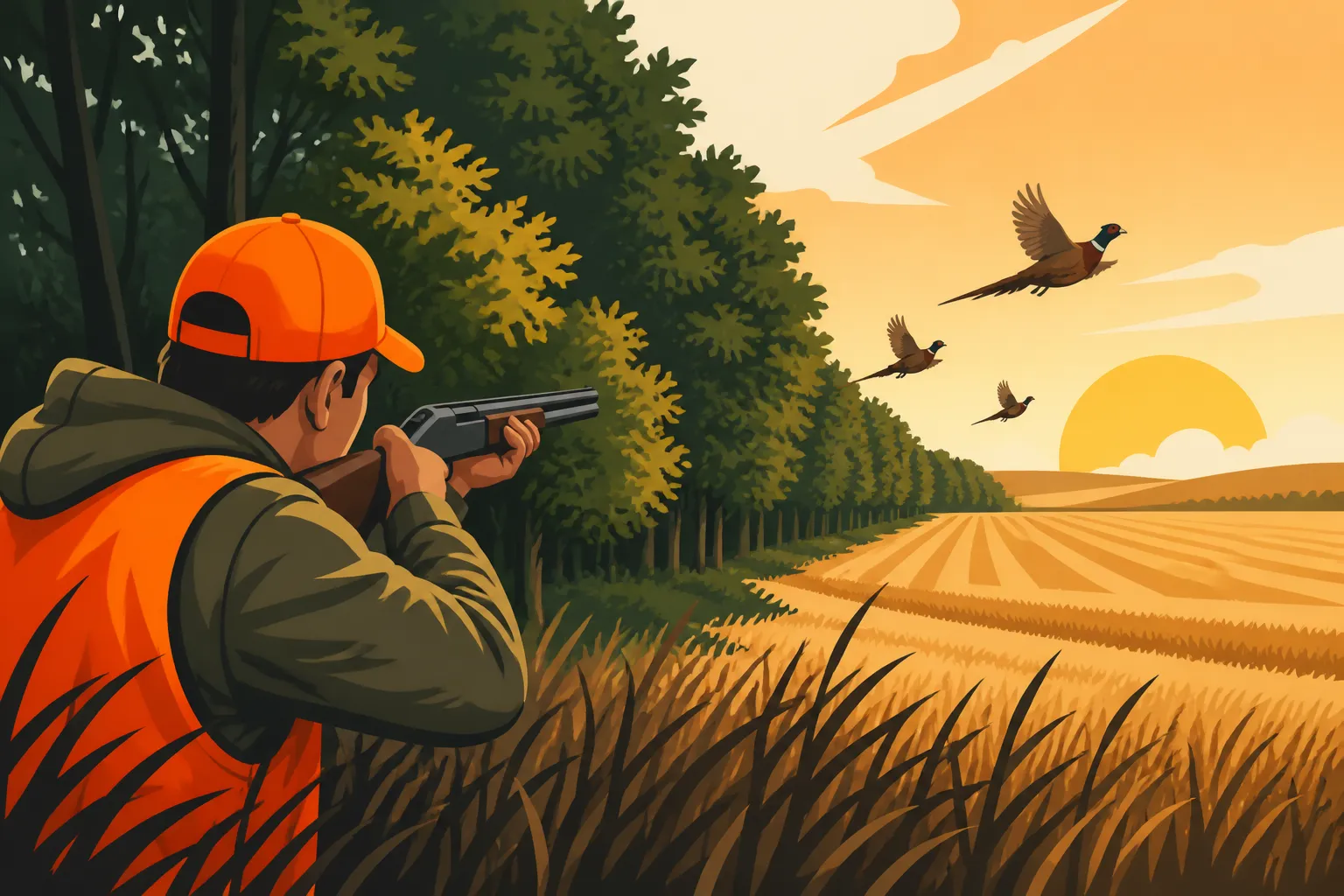
For Upland Birds (Pheasants and Quail): Shelterbelts are prime spots for pheasants and quail, especially later in the season when other cover has been flattened by snow or harvest. A drive, particularly with a dog, can flush birds holding tight. Pushers walk through the cover, ideally with a dog working ahead, while blockers are positioned at the end of the belt or where birds might escape into an adjacent field. Pheasants, especially, love to run ahead of hunters in linear cover, so blockers are essential. If you're Hunting a Pheasant Field Without a Dog, a well-organized drive can still be effective, but you'll need more pushers to cover the ground thoroughly.
| Hunting Strategy | Target Game | Best Shelterbelt Type | Pros | Cons |
|---|---|---|---|---|
| Stand Hunting | Deer | Mixed, Deciduous (after leaf drop) | High success rate in established travel corridors | Limited range, dependent on deer movement |
| Still-Hunting | Deer, Upland Birds | Evergreen, Dense Mixed | Flexible, covers ground, exciting | Requires stealth, low visibility, physically demanding |
| Small Drives (Deer) | Deer | Any dense or long shelterbelt, especially evergreen | Can push bedded deer, good for multiple hunters | Requires coordination, safety concerns, can push deer off property |
| Small Drives (Birds) | Pheasants, Quail | Dense Mixed, Evergreen, good for late season | Flushes tight-holding birds, good with dogs | Can be difficult without enough hunters/dogs |
Overcoming Common Challenges in Shelterbelt Hunting
Hunting shelterbelts comes with its own set of unique hurdles. From swirling winds to dealing with hunting pressure, being prepared for these challenges will significantly increase your odds of success.
Navigating Wind and Thermals in Linear Cover
Nebraska is renowned for its wind, and shelterbelts, while designed to break it, can also create unpredictable wind currents within their confines. This can make scent control a nightmare.
Understanding Wind Tunnel Effects: Imagine the wind hitting a long, dense shelterbelt. Instead of stopping entirely, it can be funneled and compressed, creating a "wind tunnel" effect down the length of the belt. This means your scent might not only travel directly downwind but could also swirl, eddy, and even be carried back upwind in certain pockets. This is why a single wind direction isn't always enough to plan.
Adjusting Stand Placement: If you're stand hunting, consider placing your stand higher to get your scent above potential swirling air currents, especially if the shelterbelt runs through a slight depression. Alternatively, position yourself on the lee side (downwind side) of the shelterbelt if possible, allowing your scent to be carried out into the open field rather than into the heart of the cover. Always have multiple stand options for different wind directions.
Still-Hunting with Caution: When still-hunting, constant awareness of the wind is crucial. Use a wind checker frequently. If the wind is swirling badly, you might need to change your approach, perhaps by pushing deer towards open areas where you can observe from a distance, or by focusing solely on areas of the belt with a consistent breeze. Remember, a deer's nose is its primary defense, and inconsistent wind patterns can bust a hunt faster than anything else.
Dealing with Pressure and Access
Nebraska's public lands, and even many private parcels, can experience significant hunting pressure. Shelterbelts, being obvious cover, can sometimes become magnets for other hunters.
Early Bird Gets the Worm: On public land or heavily hunted private land, getting there early is crucial. Often, the first hunter in sets the tone. If you can get into your stand or start your still-hunt before first light, you stand a better chance of intercepting undisturbed game. Use apps like GoHunt to identify public hunting areas, but also to understand the lay of the land, which might help you find less obvious access points.
Seeking Permission for Private Land: Most shelterbelts are on private property. This means you need to get permission. Don't underestimate the power of a friendly, respectful approach. Ask well in advance of the season, and offer to help the landowner in some way (e.g., helping with chores, sharing game meat). Building a good relationship with a landowner can unlock access to prime, less-pressured shelterbelts.
Utilizing Off-Peak Times: Weekdays, especially mid-week, generally see less pressure than weekends. Hunting during less-than-ideal weather (light rain, moderate wind) can also deter other hunters, leaving you with more elbow room. Deer and birds often move during these conditions anyway, seeking cover.
Adapting to Seasonal Changes
The Nebraska landscape is in constant flux, and how wildlife uses a shelterbelt changes dramatically throughout the seasons, especially before and after crop harvest.
Pre-Harvest vs. Post-Harvest: Before harvest, standing corn or soybeans offer incredible cover, sometimes making shelterbelts less critical for daily movement, though they still serve as travel corridors. Once the fields are cut, however, shelterbelts become absolutely essential. Deer that were bedding in corn will now flock to the densest cover available, and pheasants will concentrate in these strips. Understanding What Changes in Nebraska After the Corn Comes Off is vital; your strategy must pivot to focus heavily on these linear cover strips.
Snow Cover: Snow reveals all. Fresh snow highlights every track, every trail, and every bedding area. This is an incredible time for scouting and hunting. You can clearly see how deer are entering and exiting the shelterbelt, where they are feeding, and where they are bedding down for warmth. It's also an ideal time for still-hunting, as your movement over snow can be quieter, and animals stand out more against the white backdrop.
Late Season Food Sources: After the primary food sources are gone, shelterbelts can still offer sustenance. Look for berry bushes, persistent acorns, or any remaining waste grain blown in from fields. These seemingly small food sources can become critically important for deer, pheasants, and quail trying to survive the lean winter months. Your focus should shift to these concentrated food areas within the shelterbelt itself, or where it borders a remaining food source.
Disclaimer
Always consult the latest Nebraska Game and Parks Commission regulations before planning any hunt. Hunting laws and regulations can change, and it is the hunter's responsibility to be informed and compliant.