Rifle Ranges Realistic on the Nebraska Prairie
Hunting in Nebraska's wide-open spaces, especially out on the prairie or in the Sandhills, can be incredibly deceptive when it comes to judging distance. What looks like a chip shot often turns out to be a range much farther than you initially thought, leading to uncertainty and the potential for a poor shot. This guide is all about helping you understand the real factors that go into defining a truly "realistic" rifle range in Nebraska, ensuring you're confident and ethical when that trophy animal steps out.
The Lure and Deception of Open Nebraska Country
There's just something about the vastness of Nebraska that makes everything feel…closer. Whether you're scanning a Sandhills pasture for mule deer or looking across a huge cornfield stubble for whitetails, the lack of immediate landmarks can play tricks on your eyes. It's a common experience, and honestly, it can lead hunters to feel a lot of pressure to make a shot they might not be fully prepared for.
The "Long Shot" Mentality
We've all seen the hunting shows or heard the campfire stories about the incredible "one-shot kill" at immense distances. While modern rifles and optics are incredibly capable, that often fuels a "long shot" mentality that doesn't always align with practical hunting realities, especially when adrenaline is pumping and the wind is doing its Nebraska thing. You look across a sea of grass, and that deer or antelope just seems right there. Your brain registers "close," but your rangefinder often tells a very different, and sometimes humbling, story. This visual trickery is a major reason why many hunters struggle to accurately gauge distances on the prairie, leading to either missed opportunities or, worse, unethical shots. It's easy to get caught up in the excitement, but resisting that temptation to stretch your limits is key.
The reality is, a 300-yard shot on an open target range in perfect conditions is a completely different beast than a 300-yard shot at a living, breathing animal that might be moving, in swirling wind, and with you shooting off an improvised rest. The stakes are just so much higher. Trying to push your boundaries in a hunting scenario is rarely the right call, and it’s always better to know your true limits before you ever leave home.
Factors Affecting Effective Range on the Prairie
Beyond visual deception, numerous environmental and physical factors conspire to make those longer shots even more challenging in Nebraska. Wind, for starters, is a constant companion on the plains. A gentle breeze at your back can be a fierce crosswind 400 yards away, pushing your bullet significantly off target. It's why understanding Wind Direction on Open Nebraska Prairie Stands isn't just for deer hunters in timber, but absolutely crucial for anyone taking a long shot. Mirage, that wavy distortion caused by heat rising off the ground, can make precise aiming at distant targets almost impossible, especially on bright, sunny days.
Animal behavior also plays a huge role. A deer standing broadside at 200 yards might take a step just as you break the shot at 300 yards. They're not static targets. Then there’s your shooting platform – are you prone with a bipod, or trying to balance on wobbly shooting sticks? Adrenaline, of course, can turn even a seasoned shooter into a shaky mess. All these variables compound, narrowing your truly effective range considerably compared to what your rifle might achieve on paper. The difference between a controlled range environment and the dynamic, unpredictable reality of a hunt cannot be overstated.
Defining Your Personal Ethical Range
Understanding what your rifle can do is one thing, but knowing what you can do consistently under field conditions is another entirely. This honest self-assessment is the cornerstone of ethical hunting and will serve you far better than any theoretical maximum range.
The Importance of Practice and Honesty
Your ethical range isn't just a number; it's a reflection of your consistent accuracy under pressure. It's easy to shoot tight groups from a bench rest at 100 yards, but how do you perform after a long stalk, with your heart pounding, in variable winds, shooting from a bipod or even off a backpack? True practice involves simulating hunting conditions as closely as possible. Get out of your comfort zone at the range. Practice shooting from prone, kneeling, and sitting positions. Use the same gear you’d carry afield, including your backpack as a rest. Push yourself to greater distances, not to make a shot, but to identify where your consistency breaks down.
Be brutally honest with yourself. If you can consistently put three shots into a 6-inch circle at 250 yards, but struggle to do the same at 300 yards, then your ethical maximum range is likely around 250 yards for that specific scenario. Don't let ego dictate your shooting distances. It's far better to pass on a shot and maintain your ethical standards than to take a risky one. Don't forget that Zeroing at 200 Yards is a great starting point, but it's only a starting point for developing your skills.
Understanding MOA and Grouping
Minute of Angle (MOA) is a term you'll hear often, and it's simply a way to describe angular measurement that helps define accuracy. Roughly speaking, 1 MOA is about 1 inch at 100 yards, 2 inches at 200 yards, 3 inches at 300 yards, and so on. For hunting, a good rule of thumb is to be able to consistently put your shots into a 6-8 inch circle, which represents the vital zone of most deer and antelope. If your rifle is a "1 MOA gun," meaning it shoots 1-inch groups at 100 yards, that theoretically translates to a 6-inch group at 600 yards.
However, your personal grouping ability is what truly matters. If you can consistently shoot 2 MOA groups (2 inches at 100, 4 inches at 200, 6 inches at 300) from a field position, then 300 yards might be your maximum ethical range, assuming a perfect broadside presentation on a deer. For a smaller vital zone on an antelope, you might need to tighten that to a 4-inch group, meaning your ethical range could shrink to 200 yards or even less. Knowing your consistent group size at various distances and under different conditions is absolutely paramount to establishing your ethical range for any game animal.
Common Hunting Scenarios and Realistic Ranges
Nebraska offers a variety of habitats, and what's a realistic shot in one area might be unheard of in another. Understanding the nuances of each terrain will help you prepare for the distances you're most likely to encounter.
Whitetails in River Bottoms and Cropland Edges
Hunting whitetails in the dense river bottoms of Eastern Nebraska or along the edges of vast corn and soybean fields presents a very different challenge than hunting open prairie. Here, shots are often much closer, sometimes under 100 yards, and rarely stretching beyond 250 yards. The cover is thicker, obscuring sightlines, and deer often appear and disappear quickly. Think about River-Bottom Whitetail Hunting in Eastern Nebraska – you're dealing with timber, brush, and winding creek beds, not wide-open vistas.
In these environments, rapid target acquisition and precise shooting at shorter distances are often more critical than long-range capability. You might be shooting through small lanes in the trees, or having to react quickly as a deer skirts a Hunting a Shelterbelt Between Nebraska Fields. Wind might be less of a factor at 80 yards, but thick branches and fleeting opportunities become the primary challenge. Over-gunning or relying on long-range setups can actually be a hindrance in these closer quarters, where a quick, accurate shot with a solid rest is all you need.
Mule Deer and Antelope on the Open Plains
Now, this is where the perception of distance really gets interesting. When you're glassing the rolling hills of the Sandhills for mule deer or spotting pronghorn on a vast expanse of shortgrass prairie, longer shots become a more frequent reality. However, "longer" doesn't mean "any distance you can see." These are often 200-400 yard opportunities, and sometimes a bit more for truly skilled and well-equipped hunters. The sheer scale of the landscape can make 350 yards look like 200, and 500 yards look like 300. This is where a good rangefinder is non-negotiable.
The challenge here isn't just distance, but also wind and the lack of natural backstops. A slight rise might seem to hide a deer, but if you misjudge the range, your bullet could impact much higher or lower than intended. For Spot-and-Stalk Mule Deer in the Nebraska Sandhills or Stalking Pronghorn Across Open Nebraska Ground, you'll often find yourself trying to close the distance, but the animals themselves are adept at keeping their distance. In these situations, knowing your rifle's capabilities, your personal limits, and having a solid understanding of external ballistics become paramount. Many hunters find that advanced mapping tools, like those offered by GoHunt, can be incredibly helpful in pre-scouting these vast open areas. By reviewing topography and potential approach routes before the hunt, you can identify terrain features that might allow for a closer stalk, or at least predict where a longer shot might present itself, preparing you mentally and physically for the range challenge.
Gear and Techniques for Extending Ethical Range (Responsibly)
If you're serious about extending your ethical shooting range in Nebraska, it's not just about a powerful rifle. It's about a system of gear and a commitment to practice that works together to enhance your precision.
Optics and Rangefinding Beyond the Naked Eye
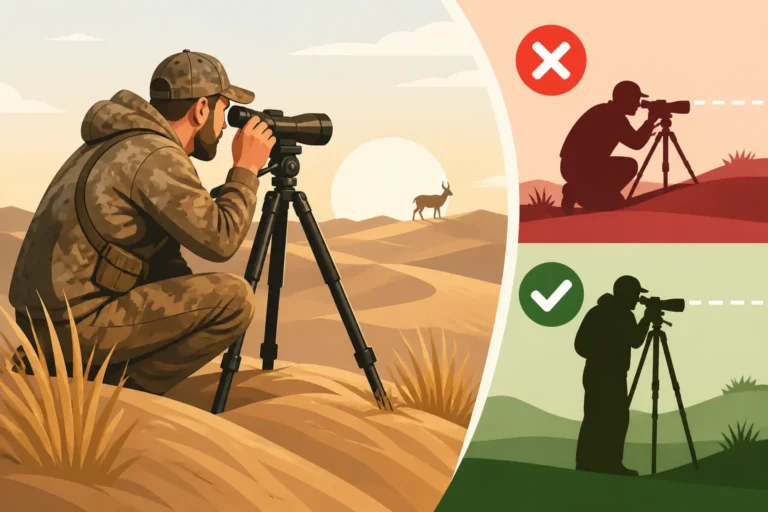
Good optics are absolutely critical for hunting Nebraska's open country. High-quality binoculars, often 10×42 or 12×50, are essential for picking apart distant terrain and identifying game. A spotting scope with higher magnification (20-60x) becomes invaluable for accurately judging the size and trophy quality of animals like mule deer and antelope at extreme distances, allowing you to make an informed decision on whether a stalk or shot is warranted. Spotting Scope Magnification for Antelope is a perfect example of where this type of magnification can make all the difference in the field.
However, the single most important piece of gear for realistic range assessment is a reliable rangefinder. Period. Guessing distances is a recipe for disaster on the prairie. A good rangefinder will instantly give you an accurate, ballistic-compensated distance to your target, eliminating guesswork. It's why we always recommend a quality rangefinder when discussing Rangefinders in Open Nebraska Country. Don't skimp here. Knowing the exact distance is the first step to making an ethical shot.
The Role of Ballistics and Dope
"Dope" is hunter slang for "data on previous engagements" – essentially, the ballistic information you need to make accurate shots at varying distances. This involves understanding your bullet's trajectory, how much it drops over distance, and how wind affects it. For longer shots, simply holding dead-on isn't enough once you're past your rifle's zero range. You'll need to either "hold over" (aim high) or adjust your scope's turrets. This requires knowing your bullet's ballistic curve and having a ballistic calculator, either on your phone or in your rangefinder, that accounts for factors like temperature, altitude, and wind.
Many experienced hunters keep a "dope card" taped to their stock or scope, showing exact adjustments for common ranges. This becomes your quick reference in the field. Tools that help you manage this data are increasingly popular. For instance, some hunters use apps that integrate with detailed mapping platforms. While you can't get live data from me, many hunters find that advanced hunting apps or mapping software, such as those found through GoHunt, often offer features that can help input and organize ballistic data, or even display basic drop charts, which, when combined with your personal rangefinder readings, help make more precise aiming adjustments in the field. Having this information readily available is a game-changer for extending your ethical range. Rifle Scopes for Long Nebraska Shots often come with features to assist with these adjustments.
Stable Shooting Platforms and Practice
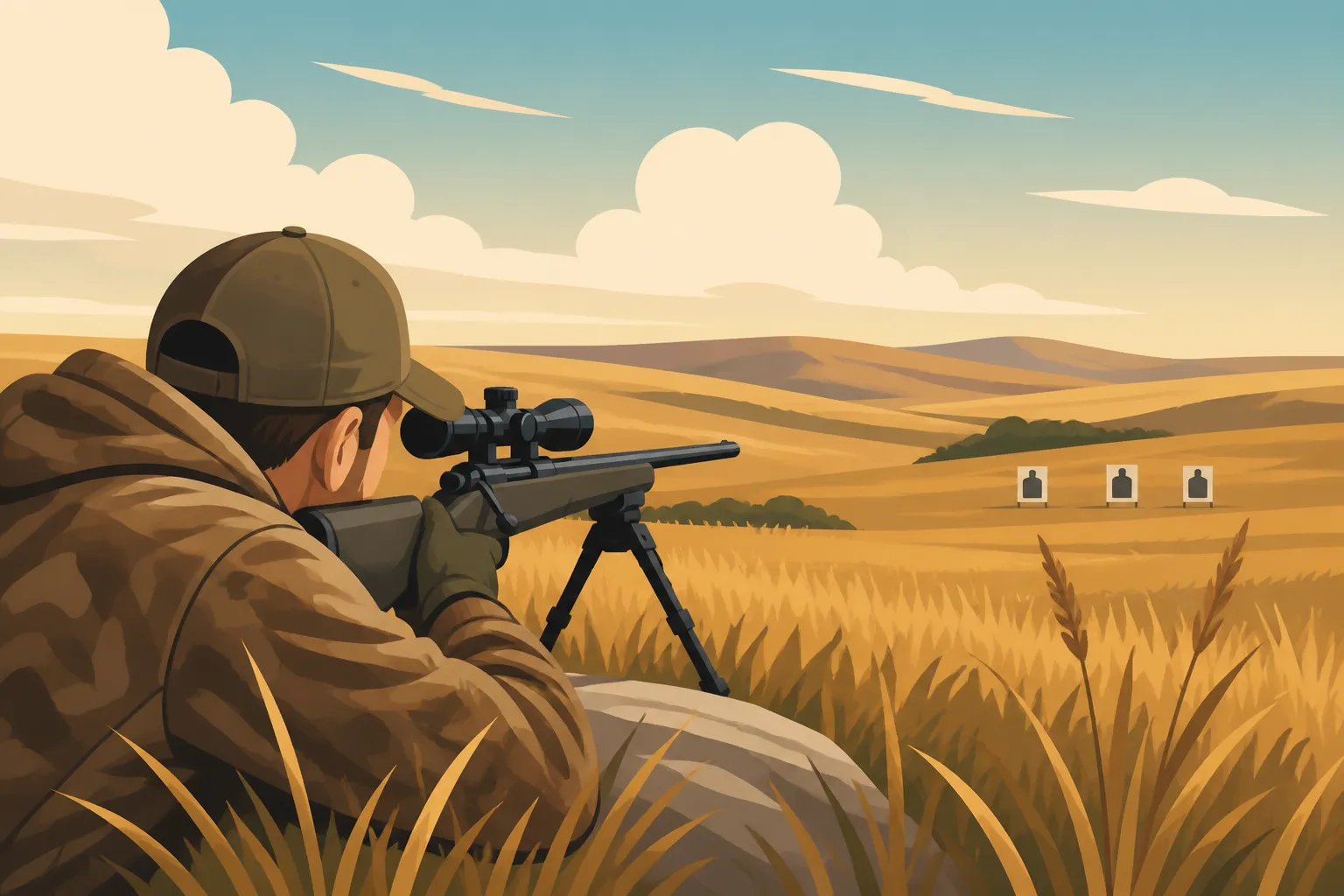
Even with the best rifle, optics, and ballistic data, you won't make consistent long shots without a rock-solid shooting platform. Trying to freehand a 300-yard shot is incredibly difficult, and for most, unethical. A good bipod attached to your rifle, especially when shooting prone, offers immense stability and is practically a requirement for prairie hunting. Shooting sticks are another excellent option, offering quick deployment and stability from kneeling or standing positions when a prone shot isn't feasible due to terrain or cover. Consider the value of Shooting Sticks and Bipods on Grass for any shot beyond 100-150 yards.
Regular practice with these platforms is just as important as having them. Don't just show up to the range, lay down, and deploy your bipod. Practice deploying it quickly, finding stability on uneven ground, and making rapid follow-up shots. Simulating real-world scenarios, where you might only have seconds to get steady, will build confidence and ensure that when the moment comes, you're not fumbling with your gear. The more you train from realistic field positions, the more reliably you'll extend your personal ethical range.
Avoiding the "Hail Mary" Shot and Ensuring a Clean Kill
Ultimately, the goal is always a clean, ethical kill. Sometimes, that means making the shot; other times, it means recognizing when it’s better to hold off.
When to Hold Off and When to Close the Distance
One of the hardest parts of ethical long-range hunting is knowing when to not pull the trigger. If the wind is gusting unpredictably, if the animal is quartering sharply, or if you simply don't feel 100% confident, the only ethical choice is to pass. This takes immense discipline, especially when you've put in hours of scouting and stalking. Remember, you can't "un-shoot" a bullet. A wounded animal is a terrible outcome for everyone involved.
Instead of taking a "Hail Mary" shot, focus on improving your position. Can you use a terrain feature to Closing the Last Hundred Yards on Sand? Can you wait for the animal to move into a better shooting lane or get a more favorable wind? This is where patience and advanced stalking skills truly shine. Sometimes, losing sight of an animal briefly during a strategic stalk to gain a closer, higher-percentage shot is the smartest move. Mapping applications, like the detailed topographic views available through platforms such as GoHunt, can be instrumental here, helping hunters identify those hidden draws, ridges, or patches of cover that might allow for a closer approach, turning a questionable long shot into a high-confidence, ethical close-range opportunity.
Follow-Up and Tracking Preparedness
No matter how confident you are in your shot, always be prepared for a follow-up. After taking a shot, observe the animal carefully, noting its reaction and direction of travel. Mark your shooting position and the animal's last known location with a physical marker or a GPS waypoint. Don't immediately rush to the spot; give the animal some time, especially if the shot wasn't perfect. This allows time for the animal to lie down and stiffen.
Once you begin tracking, pay close attention to the blood trail and sign. Having a good understanding of Blood Trailing After Dark in Nebraska and the necessary gear, like a bright headlamp, can be crucial if you're forced to track into the evening. A reliable GPS or mapping app (like those offered by GoHunt) on your phone is invaluable for marking blood spots and creating a precise grid pattern for thorough searching. The more prepared you are for tracking, the higher your chances of a successful recovery, even if the shot was pushed to your ethical limit.
Realistic Ranges for Nebraska Game (Assuming Skill and Optimal Conditions)
Here's a general guide to realistic ethical ranges, but remember, your personal ability and the specific field conditions are always the overriding factors. This table assumes a proficient shooter with quality gear and favorable environmental conditions.
| Game Species / Scenario | Typical Ethical Range (Yards) | Key Considerations |
|---|---|---|
| Whitetail Deer (River Bottoms/Timber) | 50-200 | Thick cover, quick shots, limited sightlines. Precision through small windows is key. |
| Whitetail Deer (Cropland Edges) | 100-250 | Longer sightlines, but deer may move rapidly across open ground. Wind can be a factor. |
| Mule Deer (Sandhills) | 200-400 | Vast open terrain, deceptive distances, constant wind. Prone or solid rest essential. |
| Pronghorn Antelope (Open Prairie) | 200-350 | Small vital zone, extremely wary animals, strong winds, mirage effects. Rangefinder absolutely critical. |
| Coyote (Predator Calling) | 50-300+ | Often stop briefly. Smaller target, but less concern for meat spoilage. Wind still a major factor. |
| Elk (Rare, Specific Areas) | 150-350 | Larger animal, but often in rugged terrain. Shot placement is paramount for quick takedown. |
This table is a guide, not a rulebook. Your personal ethical range might be shorter, and that's perfectly fine. The most important thing is knowing your limits and hunting within them.
Disclaimer
This article is for general informational purposes only and does not constitute professional advice. Laws, prices and regulations vary by location and change over time. Consult a qualified professional for guidance on your specific situation.