Chokes for Walk-Up Bird Hunting
One of the most common frustrations for upland bird hunters, especially those of us who love the challenge of walk-up hunting across Nebraska's diverse landscapes, is choosing the right shotgun choke. It can feel like a guessing game, leading to missed birds, mangled birds, or just plain confusion when faced with everything from a tight-flushing covey of quail to a long-flushing late-season pheasant. This guide is going to strip away the mystery, helping you understand choke tubes and how to pick the perfect one for your next Nebraska upland adventure.
Understanding the Basics of Shotgun Chokes
Before we dive into specific recommendations, let's get a solid grasp on what a shotgun choke actually is and why it's so important for successful bird hunting. Think of it as tailoring your shotgun's performance to the exact conditions you're facing in the field.
What is a Shotgun Choke and How Does it Work?
At its heart, a shotgun choke is simply a constriction at the muzzle end of your shotgun barrel. This constriction is designed to control how tightly your shot pattern holds together as it travels downrange. Without a choke, your shot would spread out very quickly, meaning fewer pellets would hit your target at even moderate distances. With a choke, the pellets are forced into a tighter column, maintaining a denser pattern further out.
Imagine a garden hose. If you just let the water flow out, it spreads wide and doesn't go very far. But if you put your thumb over part of the opening, you create a constriction, and the water streams out much farther and with more force. A shotgun choke works on a similar principle, but with a swarm of pellets rather than a stream of water. Different choke sizes, from very open (like Cylinder) to very tight (like Full), dictate how much that pattern constricts and how far it will remain effective. This seemingly small piece of metal can dramatically alter your effective range and your success rate on flushing birds.
Why Choke Selection Matters for Upland Birds
Choke selection isn't just a technicality; it's a critical component of ethical and effective upland bird hunting. For walk-up hunting, where flush distances can vary wildly based on cover, bird pressure, and even the weather, having the right choke can be the difference between a clean retrieve and a missed opportunity or, worse, a wounded bird. If your choke is too tight for close-flushing birds, you might miss entirely or "blow up" the bird with too dense a pattern. Conversely, if your choke is too open for longer shots, your pattern will be too sparse, and you'll pepper the bird with a few pellets, leading to a cripple.
In Nebraska, where you might be walking milo stubble one moment and working a dense cattail slough the next, a versatile approach to choke selection is invaluable. Early season pheasants might hold tight, flushing within 15-20 yards. Later in the season, after some hunting pressure, those same birds might bust out at 40 yards or more. Quail, known for their explosive covey rise, demand a quick-spreading pattern, while a single prairie grouse might offer a more deliberate shot. Understanding these scenarios is key to making an informed choice.
Common Choke Constrictions for Upland Hunting
Let's break down the most popular choke constrictions you'll encounter and discuss where each shines in the Nebraska upland fields. This isn't just about names; it's about understanding the practical application of each choke.
Cylinder and Skeet Chokes: Up Close and Personal
When you're walking through really dense cover – think heavy plum thickets or tall switchgrass that really holds birds tight – or jump shooting a small waterhole, a Cylinder or Skeet choke is often your best friend. These chokes offer the least amount of constriction, meaning your shot pattern spreads out very quickly.
A Cylinder choke is essentially no constriction at all, giving you the widest, fastest-spreading pattern. This is fantastic for those unexpected, close-quarters flushes that happen within 10-20 yards, which are common for quail in thick shelterbelts or pheasants tucked into a tight brush pile. The wide pattern gives you a larger margin for error on those lightning-fast reactions, increasing your chances of getting enough pellets on a small target at very close range.
A Skeet choke is just a tiny bit tighter than Cylinder, still offering a very open pattern designed for close-range work, as its name suggests (skeet shooting involves very close targets). Many hunters find this offers a slightly denser pattern than a pure cylinder, providing a bit more lethality at those close ranges without sacrificing the wide spread. If you're focusing on bobwhite quail in Southeast Nebraska or working small, dense pockets of cover, either of these chokes can be incredibly effective, ensuring you get a good pattern on a bird that might just get airborne and then dip back into the cover almost immediately.
Improved Cylinder: The Versatile Workhorse
If you were to ask most seasoned upland hunters what choke they start with on a typical day, many would likely point to an Improved Cylinder (IC). This choke is truly the jack-of-all-trades for walk-up bird hunting, especially in Nebraska's varied habitat. It offers a moderate amount of constriction, a sweet spot between the wide-open patterns of Cylinder/Skeet and the tighter patterns of Modified or Full.
Improved Cylinder is fantastic because it provides a good balance: your pattern spreads quickly enough for those 20-30 yard flushes, common when walking heavier CRP or walking strips of uncut cover between fields, but it still maintains enough density to be effective out to 30-35 yards. This versatility makes it ideal for mixed-bag hunts or when you're uncertain about how birds will be flushing. For example, when you're Walking Milo and Corn Stubble for Pheasants, you might encounter a bird that jumps at your feet or one that busts out 30 yards ahead. The IC can handle both.
Many hunters find that an IC choke gives them the confidence they need in a wide array of upland situations. It’s forgiving enough for quick, instinctive shots but still provides the necessary pattern density to cleanly harvest birds without excessive damage to the meat. It's often the choke I recommend for newcomers to Nebraska upland hunting, as it provides a solid foundation before specializing further.
Modified Choke: Extending Your Reach
When birds start getting a bit warier, or you're hunting more open country where longer shots are the norm, stepping up to a Modified choke is often the right move. Modified chokes offer more constriction than Improved Cylinder, resulting in a denser pattern that holds together for longer distances. This means more pellets on target when that rooster decides to test the limits of your shotgun's range.
This choke really shines in situations where birds are flushing between 30 and 40 yards. Think about late-season pheasants that have been pressured, or when you're hunting larger, more open tracts of Hunting Open Fields and Waters Tracts for Pheasants land where birds have more room to run before flushing. When you're Blocking and Driving a Nebraska Field, a Modified choke in your primary barrel can be incredibly effective, especially if you're positioned at the end of a field where birds might be pushing out at a faster pace.
A Modified choke also comes into its own if you're hunting in windy conditions, which are common on the Nebraska plains. A tighter pattern is less susceptible to wind drift, helping you maintain a consistent shot placement. While it's less forgiving on those very close flushes, its increased effective range makes it indispensable for many serious upland hunters throughout the season.
Full and Extra Full Chokes: When and Why
These are the tightest chokes available, designed to deliver the densest possible pattern at the longest ranges. A Full choke significantly constricts the shot, keeping it together out to 45 yards and beyond. An Extra Full or "Turkey" choke takes that constriction even further, often optimized for single-projectile-like patterns at extreme distances.
For walk-up upland bird hunting, particularly pheasants, Full and Extra Full chokes have a more specialized role. They are generally not recommended for early-season hunting or for species like quail or grouse due to the high likelihood of missing close-flushing birds or, if you connect, obliterating the bird with too many pellets. However, they can be useful in very specific scenarios.
Consider hunting extremely pressured, late-season roosters in Nebraska that consistently flush at 45-50 yards. In these situations, a Full choke might be the only way to consistently put enough pellets on target for a clean kill. Some hunters, when Hunting the Light Goose Conservation Order in spring, might even lean towards Extra Full for those very high-flying geese, though that's a different kind of "walk-up" scenario. It’s crucial to ethically consider the range and the bird. If you choose one of these tighter chokes, make sure you can consistently hit your target at those longer distances and ensure you're using appropriate shot sizes, like those discussed in Shot Sizes for Late-Season Nebraska Roosters. Remember, a tight choke reduces your effective pattern diameter, meaning your aim must be incredibly precise.
Matching Chokes to Nebraska Upland Species and Habitats
The beauty of Nebraska's upland hunting is its diversity, but that also means one-size-fits-all choke advice just doesn't cut it. Let's tailor our choke choices to the specific birds and habitats you'll likely encounter.
Pheasants: From Early Season to Late Season
Pheasant hunting is probably where choke versatility becomes most apparent throughout the season. In the early days, when birds haven't seen much pressure and cover is still thick and green, pheasants often hold tight. They might bust out of a stand of tall grass or a bushy creek bottom at 15-25 yards. For these scenarios, an Improved Cylinder or even a Skeet/Cylinder choke is excellent. The quicker spread minimizes the chance of shooting over or under the bird due to its rapid vertical ascent and gives you a generous pattern at those close ranges. Think about walking into dense CRP or a shelterbelt; the birds are right there!
As the season progresses, and especially after Nebraska's nine-day firearm deer season and significant hunting pressure, pheasants become much warier. They'll run ahead of dogs and hunters, flushing at 35-45 yards or even further. This is when you'll want to swap to a Modified choke, or possibly a Light Modified if your gun has it, to tighten up that pattern and extend your effective range. If you find yourself hunting vast, open fields or even Working a Cattail Slough in January where birds have plenty of escape routes and can get up and away quickly, a Modified choke will give you the necessary reach. For those truly wild, late-season roosters that flush at the absolute edge of ethical range, some hunters might even consider a Full choke, but this requires excellent shooting skill and discipline.
Quail and Grouse: Fast Flushes and Tight Cover
Hunting quail and grouse in Nebraska is a different ballgame compared to pheasants, largely due to their typical flush behavior and habitat. Bobwhite quail, primarily found in Southeast Nebraska, are known for their explosive covey rise. One minute, you're walking along a fence line or through a plum thicket, the next, a dozen birds erupt around you in every direction. These are almost always extremely close-range shots, often within 15-25 yards.
For such scenarios, an Improved Cylinder or even a Cylinder/Skeet choke is paramount. You need that quick, wide pattern to increase your chances of connecting with one of those darting targets. A tighter choke, like a Modified or Full, will almost guarantee you either miss completely or, if you connect, severely damage the bird. Quail Coveys in Nebraska Shelterbelts are a classic example where open chokes shine.
Similarly, when Working Sharptails and Prairie Chickens on Foot in the Sandhills, especially in their preferred choppy grass and short brush, the flushes can be unpredictable. Sharptails sometimes hold tight, while prairie chickens might get up a bit further out. However, most shots will still be within the 20-35 yard range. An Improved Cylinder remains an excellent choice here, offering a good balance for both closer flushes and those that might stretch out a bit. Some hunters might run an IC in the first barrel and a Modified in the second for a bit more versatility.
Mixed Bag Situations: Being Prepared
What if you're hunting an area in Nebraska where you might encounter pheasants, quail, and even an occasional grouse? This is where having interchangeable choke tubes, like those from GoHunt, becomes incredibly valuable. Being prepared means understanding the highest likelihood flush distances for each species in the specific cover you're in.
If you're starting your day walking dense river bottom cover that could hold both tight-flushing pheasants and quail, an Improved Cylinder is a smart starting point. If you then move to more open CRP fields where pheasants are expected to flush further, you could quickly swap to a Modified choke. For double-barrel shotguns, many hunters choose to run an IC in the first barrel (for the initial, closer shot) and a Modified in the second (for the follow-up, potentially longer shot).
Being prepared means not just having the chokes, but having the presence of mind to change them when the habitat or target species dictates. It’s an awareness that comes with experience, but knowing your options and having a system to swap chokes efficiently can truly elevate your hunting success.
| Choke Constriction | Typical Range (Yards) | Best For Nebraska Species & Scenarios | Pros | Cons |
|---|---|---|---|---|
| Cylinder | 10-25 | Close-flushing Quail, early-season Pheasants in heavy cover, jump shooting | Very wide, fast-spreading pattern; forgiving on quick, close shots. | Limited effective range; can "blow up" very close birds. |
| Skeet | 10-28 | Similar to Cylinder, slightly denser pattern for very close work. | Slightly denser than Cylinder, good for small birds at close range. | Limited effective range. |
| Improved Cylinder | 15-35 | Most common for Pheasants, Quail, and Grouse; varied cover. | Versatile, good balance of spread and density; excellent all-around. | May be too open for very long shots, too tight for extreme close. |
| Modified | 25-45 | Late-season Pheasants, Prairie Grouse in open country, blocking fields. | Denser pattern, extends effective range; good for warier birds. | Less forgiving on close flushes; can damage very close birds. |
| Full | 40-55+ | Very late-season, pressured Pheasants; specific long-range situations. | Maximum pattern density, longest effective range. | Requires precise aiming; easy to miss or damage close birds. |
Practical Considerations for Walk-Up Hunters
Beyond just knowing what each choke does, there are practical aspects that every walk-up hunter in Nebraska should consider to optimize their setup. It's about how you use the gear, not just having it.
Interchangeable Chokes: The Modern Hunter's Friend
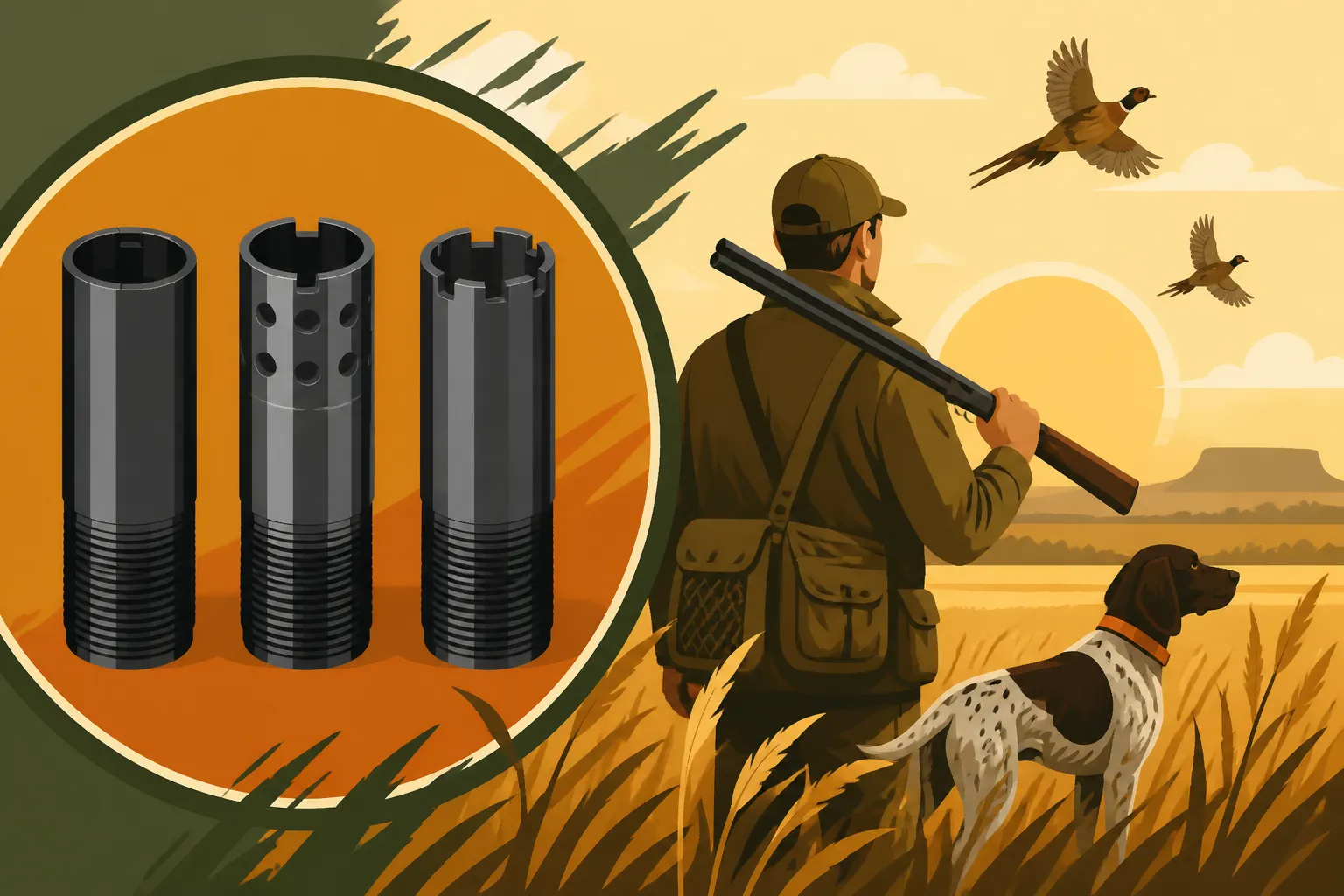
Most modern shotguns designed for hunting come with interchangeable choke tubes, often referred to as screw-in chokes. This is a game-changer for upland hunters, offering incredible versatility that older fixed-choke guns simply can't match. Instead of being stuck with one pattern, you can easily swap out chokes in the field with a small wrench. This adaptability is especially beneficial when navigating the diverse habitats of Nebraska.
Imagine you start your morning hunting a thick creek bottom, anticipating close-flushing quail or pheasants. You might have an Improved Cylinder in. But after an hour, you transition to vast expanses of milo stubble or a large block of CRP where birds are known to run and flush at greater distances. With interchangeable chokes, you can take a five-minute break, unscrew the IC, and thread in a Modified choke. This simple swap significantly increases your chances of success and ensures you're putting the most effective pattern on target for the conditions. Carrying a small pouch with a couple of different chokes (e.g., IC, Modified, Full) and the wrench is standard practice for many upland hunters, including those who rely on tools from companies like GoHunt for their outdoor gear. It means you're always ready for whatever Nebraska's fields throw at you.
Patterning Your Shotgun: An Absolute Must
This is perhaps the single most overlooked, yet most critical, step in choke selection. You absolutely must pattern your shotgun with your chosen chokes and the specific ammunition you intend to hunt with. Just because a choke says "Improved Cylinder" doesn't mean it will perform identically in every shotgun barrel with every brand and load of shotshell.
To pattern your gun, set up large sheets of paper (30×30 inches or larger works well) at distances typical for your hunting, usually 20, 30, and 40 yards. Shoot at the center of the paper, then examine the pattern. You're looking for consistent distribution of pellets, without large holes or "clumps," and enough pellet strikes within a kill zone (e.g., a 30-inch circle for pheasants) to ensure a clean kill. Pay attention to how different chokes tighten or spread your pattern at each distance. You might be surprised to find that a particular brand of shotshell performs better (or worse) with a specific choke in your gun. This process builds confidence, helps you understand your gun's actual effective range, and ensures you're not going into the field guessing about your setup.
Nontoxic Shot and Choke Compatibility
As more and more public hunting lands and certain private lands in Nebraska require the use of nontoxic shot, understanding its interaction with chokes is vital. Steel shot, the most common nontoxic alternative, behaves differently than lead shot. Steel is harder and less deformable, which means it doesn't compress as much when passing through a choke. This can lead to a tighter pattern than an equivalent lead load, and in some cases, can cause damage to older barrels or certain choke tubes if too tight a constriction is used.
Generally, it's advised not to use Full or Extra Full chokes with steel shot, especially in older shotguns, unless the choke tube and barrel are explicitly rated for steel. Most modern shotguns and their factory chokes are safe up to Modified with steel shot. Some manufacturers offer "High Performance Steel" choke tubes specifically designed to handle the pressures and properties of steel shot, often with slightly different internal geometries. When hunting areas with Nontoxic Shot Rules on Nebraska WMAs, always check your gun's manual and your choke tubes for steel shot compatibility. If in doubt, stick to Improved Cylinder or Modified with steel shot to avoid any potential issues and still achieve excellent patterns.
Advanced Tips and Common Mistakes
Even with a good understanding of chokes, there are nuances and pitfalls to avoid that can further improve your walk-up hunting experience in Nebraska.
Over-Choking vs. Under-Choking: Finding the Balance
This is the eternal debate among upland hunters and often the source of frustration.
Over-choking means using a choke that is too tight for the situation. This leads to patterns that are too dense at close ranges. The most common consequence is either missing the bird entirely (because the pattern is a small, precise beam you have to hit with) or, if you connect, obliterating the bird. No one wants to waste meat or see a bird mangled by a too-dense pattern. It can also create an ethical dilemma by not having a wide enough pattern for a clean kill if your aim is slightly off.
Under-choking means using a choke that is too open for the situation. This results in patterns that spread too quickly, becoming sparse and ineffective at longer ranges. You might "pepper" a bird with a few pellets, leading to a wounded bird that flies off to suffer. This is perhaps a more significant ethical concern. It's also frustrating to watch birds fly away unscathed because your pattern wasn't dense enough to deliver a lethal blow.
Finding the balance requires honest self-assessment of your shooting ability, understanding the typical flush distances for the species and habitat you're hunting, and patterning your shotgun. Most experienced walk-up hunters lean slightly towards being "under-choked" rather than "over-choked," as a slightly more open pattern can be more forgiving on the fast, often unpredictable flushes common in upland hunting. An Improved Cylinder choke is often considered the ideal balance for many.
Practice Makes Perfect: Drills for Upland Success
Knowledge about chokes is only half the battle; the other half is putting it into practice with consistent shooting. Simply knowing which choke to use won't make you a better shot. Regular practice, especially with drills that simulate upland hunting scenarios, is crucial.
Head to your local trap or skeet range. Skeet shooting, in particular, is excellent for practicing close-range, fast-moving targets that mimic a covey rise or a flushing pheasant. Trap shooting can help with those outgoing, longer-range shots. Beyond formal ranges, consider setting up a portable trap thrower in a safe location. Practice shooting clay pigeons at various distances, mimicking birds flushing from cover. Try different choke combinations and loads to see how they truly affect your shooting. For example, if you're planning to hunt in thick Nebraska shelterbelts, practice with your Improved Cylinder choke on clays that appear suddenly and at close range.
This practice not only helps you dial in your choke selection but also builds muscle memory, improves your swing, and boosts your confidence. The more you shoot, the more instinctive your reactions will become, allowing you to focus on the bird rather than second-guessing your equipment.
Disclaimer
This article is for general informational purposes only and does not constitute professional advice. Laws, prices and regulations vary by location and change over time. Consult a qualified professional for guidance on your specific situation.