Shot Sizes for Late-Season Nebraska Roosters
That late-season pheasant hunt in Nebraska can really test a hunter's patience and setup. The birds are wise, wary, and often bundled up against the cold, making them notoriously tough to bring down. It's a common frustration to watch a rooster absorb what felt like a perfect shot only to sail away seemingly unfazed. This guide is all about cutting through that frustration by meticulously breaking down the best shot sizes and loads to stack the odds in your favor when targeting those hard-earned December and January roosters.
Understanding Late-Season Roosters: Why They're Different
The pheasants you encounter in December and January are a far cry from the naive, jumpy birds of opening weekend. By the late season, these roosters have survived months of hunting pressure, inclement weather, and the general hardships of prairie life. Their physiology and behavior adapt, demanding a different approach from hunters, right down to the ammunition they choose.
Feathering and Toughness
As autumn fades into winter, pheasants develop a thicker, denser plumage to insulate themselves from Nebraska's biting winds and frigid temperatures. This isn't just a minor change; it's a significant layer of natural armor that can dramatically reduce the penetration of shot. Imagine trying to punch through a down comforter with a handful of tiny pebbles – that's somewhat analogous to what smaller shot faces against a fully-feathered late-season rooster. The robust feathering around their vitals, combined with their strong bone structure, means that your shot needs to carry enough energy and mass to not only penetrate this natural barrier but also deliver a lethal blow. Shots that might have been sufficient earlier in the season often glance off or simply get trapped in the feathers of a late-season bird, resulting in heartbreaking misses or, worse, wounded birds that escape.
Behavioral Changes and Flushing Habits
These aren't your grandpa's easy flushes. Late-season pheasants are experts at self-preservation. They've learned to hold tighter, often bursting from cover only when you're practically stepping on them, or, conversely, flushing well out of range, having detected your approach long before you even saw them. This wariness is amplified by constant pressure on both public and private lands. You might find them tucked deep into cattail sloughs, dense cedar thickets, or the most impenetrable corners of CRP fields. When they do flush, especially in open country, they often fly higher and faster than their early-season counterparts, putting more distance between themselves and the hunter in a shorter amount of time. This extended flush distance directly impacts the effective range of your shotgun and, consequently, the energy and pattern density of your shot, making accurate assessment of your shot choices even more critical. Understanding these behavioral shifts is key to anticipating their movements and ensuring your chosen shot is effective at those longer, more challenging ranges. You might even find yourself Late-Season Roosters and Longer Flushes being the norm rather than the exception.
The Impact of Weather
Nebraska winters can be brutal, and the weather significantly influences late-season pheasant hunting conditions. Cold temperatures, strong winds, and snow not only make hunting more challenging for us but also affect the birds. Wind can make pheasants hunker down even tighter, but it can also make them fly erratically once flushed, becoming difficult targets. Snow, particularly deep snow, can concentrate birds in specific areas, but it also provides a stark background against which they can be seen more easily, increasing their wariness. On truly bitter days, pheasants often move less, conserving energy, and may be found in dense thermal cover. Your shot needs to perform reliably in these conditions. Freezing temperatures can impact the performance of some ammunition, and the extra layers of clothing we wear can sometimes hinder our swing, making a clean shot even harder. It all boils down to needing a powerful, consistent load that won't let you down when the elements are stacked against you.
The Science of Shot Size: Pellets and Penetration
Choosing the right shot size isn't just guessing; it's understanding the physics of what happens when those pellets leave your barrel and travel downrange. For late-season roosters, this science becomes critically important because of their added resilience. It's a careful balance between having enough pellets to create a dense pattern and having each pellet carry enough energy to do its job.
Pellet Count vs. Pellet Energy
This is the eternal trade-off in shotgun ballistics. Generally, smaller shot sizes like #7.5 or #6 contain many more pellets per ounce than larger sizes like #4 or #3. More pellets mean a denser pattern, increasing the likelihood of hitting your target, especially a fast-moving one. However, smaller pellets carry less individual energy and shed that energy much faster over distance. They might create a good pattern up close, but at longer ranges, they lose the momentum needed for deep penetration, especially through thick feathers and bone.
Conversely, larger shot sizes have fewer pellets per ounce, which means your pattern will be less dense. If your aim is off even slightly, or if the bird is just in the wrong spot in the pattern, you might miss entirely or only hit with a couple of pellets, which isn't enough for a clean kill. But the advantage of larger pellets is their superior energy retention and mass. Each pellet hits harder and penetrates deeper. For those tough, late-season roosters, you need pellets that can punch through that thick plumage and reach vital organs. A single #4 pellet that penetrates the chest cavity is far more effective than several #7.5 pellets that only ruffle feathers. Finding the sweet spot between sufficient pellet count for a reasonable pattern and adequate individual pellet energy for penetration is paramount.
Effective Range and Pattern Density
Every shotgun and choke combination has an "effective range" at which it can consistently deliver enough pellets with sufficient energy to ethically harvest game. For pheasants, especially late-season birds, this range is typically within 35-45 yards. Beyond that, even with the right shot size, your pattern might spread too thin, or individual pellets might lack the energy for a clean kill.
Pattern density refers to how many pellets are within a given area at a specific distance. A dense pattern ensures that multiple pellets strike the bird, increasing the chances of hitting vital areas. A choke, like a modified or full choke, helps constrict the shot column, keeping pellets together for longer distances and thus maintaining better pattern density downrange. However, pattern density needs to be considered in conjunction with pellet energy. If your pattern is dense but made up of underpowered pellets, it won't be effective. Likewise, a few powerful pellets scattered too widely won't guarantee a hit. Knowing your shotgun, load, and choke combination – by patterning it on paper before the season – is the only way to truly understand its effective range and pattern density. This knowledge is what separates consistent success from hopeful guesses when a big rooster flushes hard at 40 yards. Choke Choice for Walking Birds is a topic many hunters consider, but how it interacts with shot size is often overlooked.
Material Matters: Lead vs. Non-Toxic
The type of shot material significantly impacts performance, especially when considering kinetic energy and penetration. Traditionally, lead shot has been the standard for upland hunting due offering excellent density and energy transfer. However, environmental concerns and regulations have led to the widespread adoption of non-toxic alternatives.
In Nebraska, Nontoxic Shot Rules on Nebraska WMAs stipulate that you must use non-toxic shot when hunting waterfowl and certain other game on specific public lands, including many Wildlife Management Areas (WMAs) and federal refuges. While lead is still generally permissible for upland birds on most private lands and some public areas, it's crucial to know the specific regulations for where you'll be hunting.
Non-toxic shot options like steel, bismuth, and tungsten alloys each have their characteristics. Steel is lighter than lead, meaning steel pellets of the same size have less mass and energy. To compensate for this, many hunters step up one or two shot sizes (e.g., if you'd use #5 lead, you might use #3 or #4 steel). Bismuth is denser than steel and closer to lead in performance, often allowing hunters to use similar shot sizes as lead. Tungsten alloys are the densest of all, providing superior energy and penetration, but they are also typically the most expensive. When making your choice, consider not only cost and availability but also the specific regulations for your hunting area and how the material will affect the effective range and killing power of your chosen shot size.
Recommended Shot Sizes for Late-Season Success
When those frosty late-season mornings arrive, and you're Hunting Open Fields and Waters Tracts for Pheasants, you absolutely need to be confident in your ammunition. This isn't the time for guesswork. The best approach is often a compromise, leaning towards shot sizes that deliver maximum impact without sacrificing too much pattern density.
Smaller Shot for Density: #5 and #6
While I just talked about the toughness of late-season birds, smaller shot sizes still have their place, particularly for hunters who prioritize pattern density and might be hunting in areas where shots are typically closer, or when Hunting a Pheasant Field Without a Dog, leading to tighter flushes. Shot sizes #5 and #6 are generally considered the smallest you should confidently use for late-season pheasants.
#6 Shot: A #6 lead pellet typically has a diameter of 0.11 inches, and there are roughly 225 pellets in a 1-ounce load. This high pellet count creates a very dense pattern at closer ranges (say, under 30 yards), increasing the probability of multiple hits. For a bird that flushes tight from thick cover, #6 can be devastating. However, its energy quickly dissipates, and penetration becomes marginal beyond 35 yards, especially against a heavily feathered rooster. If you're walking heavy cover or thick cattails where flushes are almost guaranteed to be close, #6 might work, but it's really pushing the lower limit for late-season birds. If using steel, I'd strongly advise against #6 for late-season roosters, as the lack of mass makes its performance almost negligible at ethical distances.
#5 Shot: This is arguably the most versatile and popular choice for pheasant hunting throughout the season, and it definitely earns its keep in the late season. A #5 lead pellet is about 0.12 inches in diameter, with roughly 170 pellets in a 1-ounce load. This offers a good balance: you still get a decent pattern density, but each pellet carries significantly more energy and penetrates better than a #6. At typical pheasant ranges (25-40 yards), #5 lead provides enough punch to cleanly dispatch late-season roosters, breaking through feathers and bone. If you're looking for a single all-around load, #5 is a strong contender. For non-toxic alternatives, a #4 steel load would be the equivalent to #5 lead in terms of effectiveness for many hunters, compensating for steel's lower density with a larger pellet size.
Larger Shot for Punch: #4 and #3
When you really need to reach out and touch a bird, or when you know you'll be dealing with very spooky, high-flying roosters, stepping up to #4 or even #3 shot can be a game-changer. These larger pellets sacrifice some pattern density for superior energy and penetration. This is often the best choice when you're Blocking and Driving a Nebraska Field and birds might flush at the far end, or when you're targeting those elusive "runners" that break cover well ahead of the dog.
#4 Shot: With a diameter of approximately 0.13 inches, a #4 lead pellet (around 135 pellets per ounce) delivers a significant punch. Each pellet carries substantially more kinetic energy and retains it better downrange than #5 or #6. This makes #4 an excellent choice for late-season birds, particularly if you anticipate longer shots (35-45 yards) or if the birds are exceptionally robust. The trade-off is a slightly less dense pattern, so your aiming must be precise. However, the increased individual pellet energy often means fewer pellets are required for a clean kill. For steel shot, #3 steel often mirrors the performance of #4 lead, providing that extra boost in mass and energy needed for distant birds. Many experienced hunters will Stepping Up Shot Size in December to #4 or #3 for this very reason.
#3 Shot: This is as large as most pheasant hunters will go, and it's reserved for specific situations. A #3 lead pellet is about 0.14 inches in diameter, with only around 110 pellets per ounce. The pattern density at 40 yards will be noticeably sparser than with #5 or #4, making it more challenging to hit with multiple pellets. However, if a single #3 lead pellet connects with a vital area, it delivers immense stopping power and deep penetration, even on the toughest birds. This shot size is best employed by experienced shooters who are confident in their ability to center a pattern on a fast-moving target, or when targeting very long-range birds where other shot sizes would simply be ineffective. It's often favored in areas with wide-open spaces, like parts of the Sandhills, where shots can stretch beyond 45 yards. For steel shot, #2 or even #1 steel would be the equivalent to #3 lead in terms of pellet size, but always verify pattern performance with your specific shotgun.
Gauge and Choke Considerations
The effectiveness of any shot size isn't isolated; it's intricately linked to your shotgun's gauge and the choke you're using. These factors work together to deliver the pattern that ultimately connects with the bird.
Gauge: While 12-gauge is by far the most popular for pheasant hunting, offering a wide array of load options and recoil pads, other gauges are certainly viable. A 20-gauge, for example, is lighter to carry, which is a blessing when Walking Nebraska Sandhills Meadows for Sharptails or walking thick CRP cover for pheasants all day. Modern 20-gauge loads, especially those with high velocities and heavier shot charges, can be very effective with #5 or #4 shot for late-season birds. The key is to choose the heaviest payload your 20-gauge can handle comfortably and pair it with a suitable choke. For youth hunters or those sensitive to recoil, a 20-gauge with appropriate shot size can be an excellent choice. Even a 28-gauge or .410 can be used, but for late-season roosters, they generally require extremely close shots and perfect patterns, making them less forgiving.
Choke: Your choke constricts the shot column as it leaves the barrel, influencing how tightly the pellets group downrange. For late-season pheasants, a tighter choke is almost always preferred to maintain pattern density at longer ranges.
- Modified (MOD): A modified choke is a popular all-around choice. It provides a good balance of spread for closer shots while still maintaining enough density for shots out to 35-40 yards. If you're walking relatively open cover and expect some varied flush distances, a modified choke with #5 or #4 shot can be very effective.
- Improved Modified (IM): This choke is a step tighter than modified and is an excellent choice for late-season birds. It keeps the pattern tighter for those 35-45 yard shots, delivering more pellets on target with greater energy.
- Full (FULL): A full choke provides the tightest patterns, ideal for maximum range (40+ yards) and delivering maximum pellet count on target at those distances. This is a common choice for hunters Blocking the End of a Nebraska Field or when pass-shooting high-flying birds. The downside is that at very close ranges, the pattern can be too tight, potentially "missing" the bird entirely or destroying too much meat with a dense center hit.
The best way to determine your optimal choke and shot size combination is to pattern your shotgun with various loads on paper at typical hunting distances (30, 40, and 50 yards). This will show you exactly how your chosen ammunition performs and identify any gaps in your pattern.
Optimizing Your Load and Gear for Tough Birds
Choosing the right shot size is foundational, but it’s just one piece of the puzzle. To truly maximize your effectiveness on those tough, late-season Nebraska roosters, you need to consider the entire ammunition system and how it integrates with your gear. This means thinking about everything from the velocity of your loads to your choke selection and even the specific shotgun you’re using.
High-Velocity Loads and Heavier Payloads
When tackling late-season roosters, speed and mass matter. Standard velocity loads might be fine for early-season birds, but for the added feathers and resilience of winter pheasants, you'll often benefit from stepping up to high-velocity loads.
High-Velocity Loads: These loads are engineered to push pellets out of the barrel at greater speeds, typically 1,300 feet per second (fps) or more. This increased velocity translates directly into more kinetic energy downrange, meaning each pellet hits harder and penetrates deeper. It also reduces the time it takes for the pellets to reach the target, which can be advantageous on fast-flying birds, reducing the amount of lead needed in your swing. Many ammunition manufacturers offer "heavy pheasant loads" or "high-brass" loads specifically designed for upland game, often featuring higher velocities and premium components. When comparing options, look for stated velocities on the box – anything in the 1,300-1,500 fps range can make a noticeable difference.
Heavier Payloads: The payload refers to the total weight of the shot charge in the shell, often expressed in ounces (e.g., 1 oz, 1 1/8 oz, 1 1/4 oz). While larger shot sizes inherently mean fewer pellets for a given weight, increasing the total payload means you're putting more pellets of that larger size into the air. For example, a 1 1/4 oz load of #4 shot will contain more pellets than a 1 oz load of the same size, resulting in a denser pattern while still delivering the individual pellet energy of the #4 shot. This is particularly beneficial for late-season birds, as it allows you to combine the penetration of larger shot with improved pattern density. However, be aware that heavier payloads and higher velocities will increase recoil, so choose a load you can shoot comfortably and accurately.
Choke Selection for Maximum Effectiveness
We touched on chokes earlier, but for late-season roosters, precise choke selection can be a real differentiator. Forget the "improved cylinder for everything" mentality; these birds demand a tighter pattern.
Tightening Up Patterns: For the average late-season pheasant hunt, especially if you're walking fields and expecting varied flush distances, a Modified (MOD) or Improved Modified (IM) choke is often the best starting point.
- Modified: Offers a good balance. If you're hunting thick CRP or shelterbelts where flushes might still be closer, but you also want to be prepared for those 35-yard shots, MOD is solid.
- Improved Modified: This is arguably the sweet spot for many late-season hunters. It provides a noticeable tightening over MOD, maintaining excellent pattern density out to 40-45 yards with appropriate shot sizes (#5 or #4 lead, or #3 steel). It's forgiving enough for slightly closer shots but truly shines when birds stretch out.
- Full: If you primarily hunt wide-open spaces where long shots are common, or if you're pass-shooting birds flying high over cornfields, a Full choke might be your best bet. It will give you the tightest patterns at the longest ranges. However, practice with a Full choke is essential, as its tight pattern can be unforgiving at close range.
Considerations for Steel Shot: When using steel shot, many hunters find they need to use a slightly more open choke than they would with lead to achieve a similar pattern, as steel often patterns tighter. For instance, if you usually use a Full choke with lead, you might find an IM or even MOD choke works better with steel shot to avoid overly dense patterns that could damage birds at close range or stress your barrel. Always check your shotgun manufacturer's recommendations for steel shot with specific chokes.
Pairing Ammunition with Your Shotgun
Your shotgun isn't just a generic tube; it's a unique system, and finding the right ammunition that patterns well out of your specific firearm is critical. Different shotguns, even of the same make and model, can pattern the exact same ammunition differently.
Patterning Your Gun: This is arguably the most crucial step that many hunters skip. Before the season, take your shotgun, various choke tubes, and several different brands and types of late-season pheasant loads (e.g., 1 1/4 oz #5 lead, 1 1/8 oz #4 steel, 1 1/4 oz #4 bismuth) to the range. Set up large paper targets (at least 30×30 inches) at 30, 40, and even 50 yards. Shoot at the center of the target and then analyze the pattern.
- Coverage: Is the pattern evenly distributed, or are there "holes" large enough for a pheasant to fly through unscathed?
- Density: Are there enough pellets within the vital zone of a pheasant target?
- Center Density: How tight is the core of the pattern?
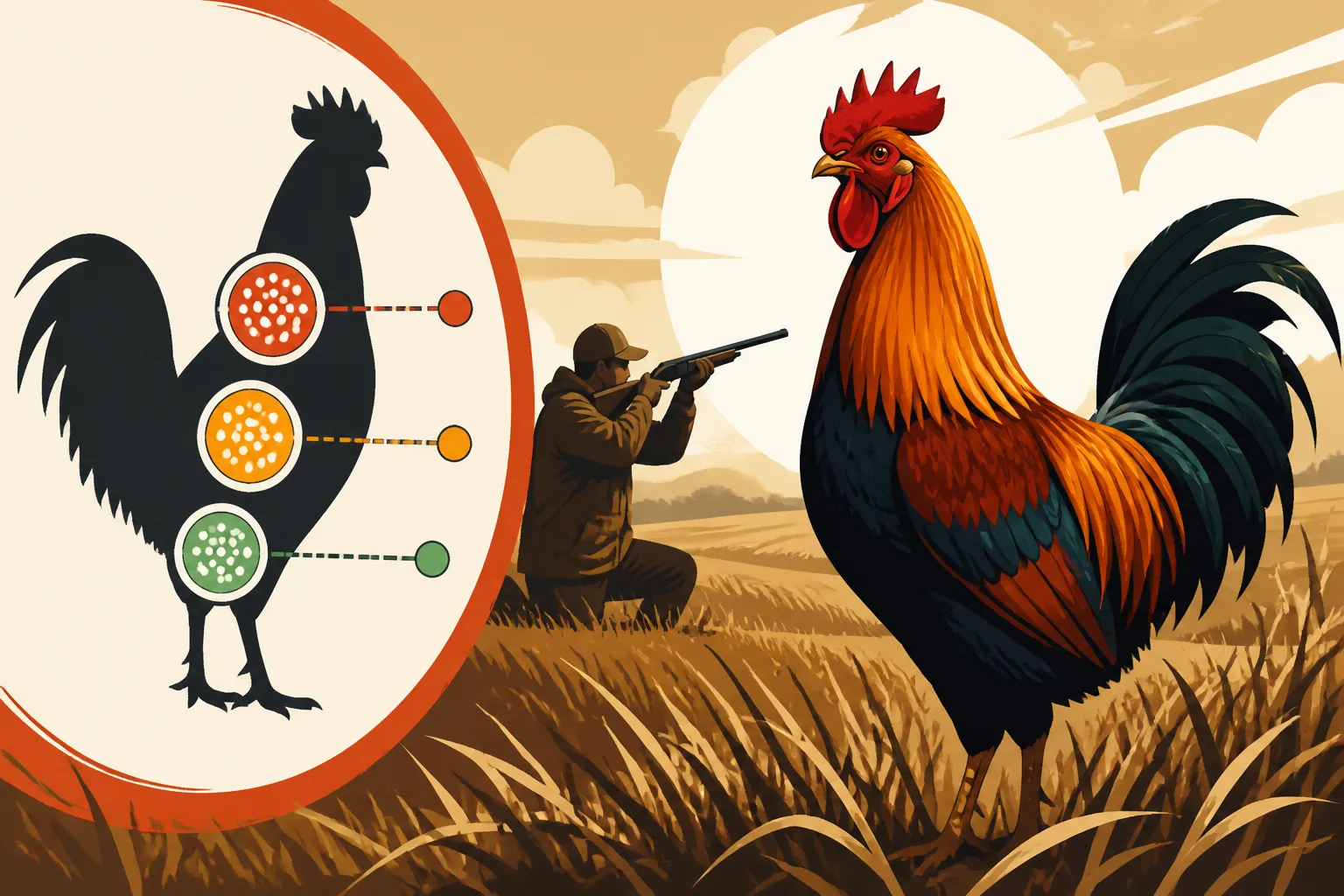
- Pellet Count: Count the number of pellets in a 30-inch circle at each distance. A good rule of thumb for pheasants is 4-6 pellets in the vital area (head/neck/body) for a clean kill.
Patterning will show you which specific loads and chokes work best with your shotgun. You might find that Brand A's #4 shot performs better than Brand B's, even if both are theoretically the same. This empirical testing will give you undeniable confidence in your setup. Additionally, using resources like GoHunt to scout potential hunting areas and understand the typical cover and likely shot distances can help inform your patterning strategy, ensuring your load is optimized for the actual conditions you expect to encounter.
Field Scenarios and Real-World Application
All the knowledge about shot size and ballistics is worthless if you can't apply it effectively in the field. Late-season pheasant hunting in Nebraska presents a variety of challenges, and adapting your approach—and confirming your ammo choice—to specific scenarios is key to success. This is where experience, observation, and confidence in your gear really come into play.
Walking Pressured Public Ground
Hunting public ground in Nebraska, especially later in the season, means you're often competing with other hunters and the birds are acutely aware of the pressure. These pheasants are experts at hiding and flushing well out of range. Places like state WMAs or tracts enrolled in the Open Fields and Waters program (which you can often find details on using GoHunt to plan your hunt) see a lot of foot traffic.
Strategy: When Scouting Nebraska Public Ground Before Opening Day you’ll notice the cover that often sees the most pressure tends to be adjacent to parking areas. Birds here are especially spooky. You'll need to work slowly, systematically, and be prepared for either a tight, explosive flush or a very distant one. This is a prime scenario where a tighter choke (Improved Modified or Full) and larger shot (#4 or #3 lead, or #3 steel) will pay dividends. The increased range and penetration are vital for those birds that erupt at 40+ yards. However, if you're pushing through really thick, unpressured corners of public land, where birds might hold tighter, you might find a #5 shot with a Modified choke still works if you can keep the shots relatively close. It’s all about anticipating where the birds will be and how they'll react.
Driving Heavy Cover and Cattail Sloughs
Some of the most consistent late-season pheasant hunting occurs in heavy thermal cover – think dense cattail sloughs, thick cedar draws, or even unharvested corn or milo fields. When Working a Cattail Slough in January, birds pack into these areas to escape the brutal cold and find refuge. Often, this hunting involves blocking and driving, where a line of hunters walks towards blockers strategically placed at the end of the cover.
Strategy: In these scenarios, the flushes can be incredibly varied. Birds might hold until they're almost underfoot, or they might try to sneak out the sides or rocket over the top of the line at extreme range. For the drivers walking through the cover, especially if it's thick, shots can be close and fast. A Modified or Improved Modified choke with #5 or #4 lead (or #3 steel) offers a good balance. For the blockers, who are often positioned for longer shots, a Full choke with #4 or #3 lead (or #2 steel) is frequently preferred to handle those high, fast flushes at the very edge of range. Understanding the nuances of Blocking and Driving a Nebraska Field can highlight why varied shot sizes across the hunting party can be advantageous. Communication within your hunting party about expected flush distances and your individual setups is paramount.
Adjusting for Weather and Bird Behavior on the Fly
Nebraska weather is famously unpredictable. A calm, sunny day can turn into a bitter, windy, snow-blown affair in a matter of hours. The birds' behavior will change right along with it, and your ability to adapt can make or break a hunt.
Strategy:
- Cold and Wind: When it's really cold and windy, pheasants often hold tighter, seeking refuge from the elements. This could mean slightly closer flushes, but it also means the birds are more bundled and resilient. A tighter choke (IM or Full) with #4 or #3 shot, delivered at high velocity, is generally recommended. The added energy will help penetrate those extra layers of feathers and cope with any crosswind drift on the shot string.
- Snow: Fresh snow can make birds stand out, but it can also make them incredibly wary, flushing at extreme distances. Deep snow might restrict their movement, concentrating them in specific areas, but they'll be hard to get close to. On snowy days, prioritize pattern density at range. Also, keep in mind that Steel Versus Lead on Nebraska WMAs becomes particularly important if snow cover indicates you'll be crossing designated non-toxic areas.
- Bird Resilience: No matter the weather, remember that late-season birds are tough. If you find yourself consistently hitting birds that keep flying, it's a clear sign your shot size might be too small, or your pattern too sparse at the ranges you're shooting. Don't be afraid to change out chokes if you have an interchangeable system, or switch to a different load if you've brought a variety. A successful hunter isn't just about shooting well; it's about making smart decisions before and during the hunt, constantly evaluating conditions and performance.
Shot Size Comparison for Late-Season Roosters
Here's a quick comparison of common shot sizes used for late-season pheasants in Nebraska. Remember, these are general guidelines, and actual performance depends on your specific load, gun, and choke.
| Shot Size (Lead) | Approximate Pellets/oz | Typical Diameter (in) | Best Use Case (Late-Season) | Pros | Cons | Steel Equivalent (Approx.) |
|---|---|---|---|---|---|---|
| #6 | 225 | 0.11 | Very close flushes (under 30 yds) in thick cover | High pattern density | Limited penetration, loses energy quickly | #5 or #4 |
| #5 | 170 | 0.12 | All-around good choice, 25-40 yds, balanced | Good balance of density & penetration | May struggle on very long shots or ultra-tough birds | #4 or #3 |
| #4 | 135 | 0.13 | Longer shots (35-45 yds), high-flying, tough birds | Excellent penetration, good energy retention | Slightly lower pattern density than #5 | #3 or #2 |
| #3 | 110 | 0.14 | Very long shots (40+ yds), extreme conditions, experienced shooter | Maximum penetration and knockdown power | Lowest pattern density, less forgiving, can damage meat | #2 or #1 |
Remember, the goal is always a clean, ethical harvest. Taking the time to understand the nuances of late-season pheasants and preparing your gear accordingly will lead to more successful hunts and fewer lost birds, allowing you to enjoy the full experience of Nebraska's Ring-Necked Pheasant Story.
Disclaimer
This article is for general informational purposes only and does not constitute professional advice. Laws, prices and regulations vary by location and change over time. Consult a qualified professional for guidance on your specific situation.