First Focal Plane Versus Second
Choosing the right rifle scope can feel like navigating a maze, especially when you start looking at technical terms like "First Focal Plane" (FFP) and "Second Focal Plane" (SFP). It's a common point of confusion for many hunters, causing genuine frustration when trying to figure out which one is truly best suited for the vast, diverse landscapes of Nebraska. This guide is here to demystify these scope types, break down their advantages and disadvantages, and help you make an informed decision that enhances your hunting experience across our beautiful state, from the Sandhills to the river bottoms.
What are First Focal Plane FFP Scopes?
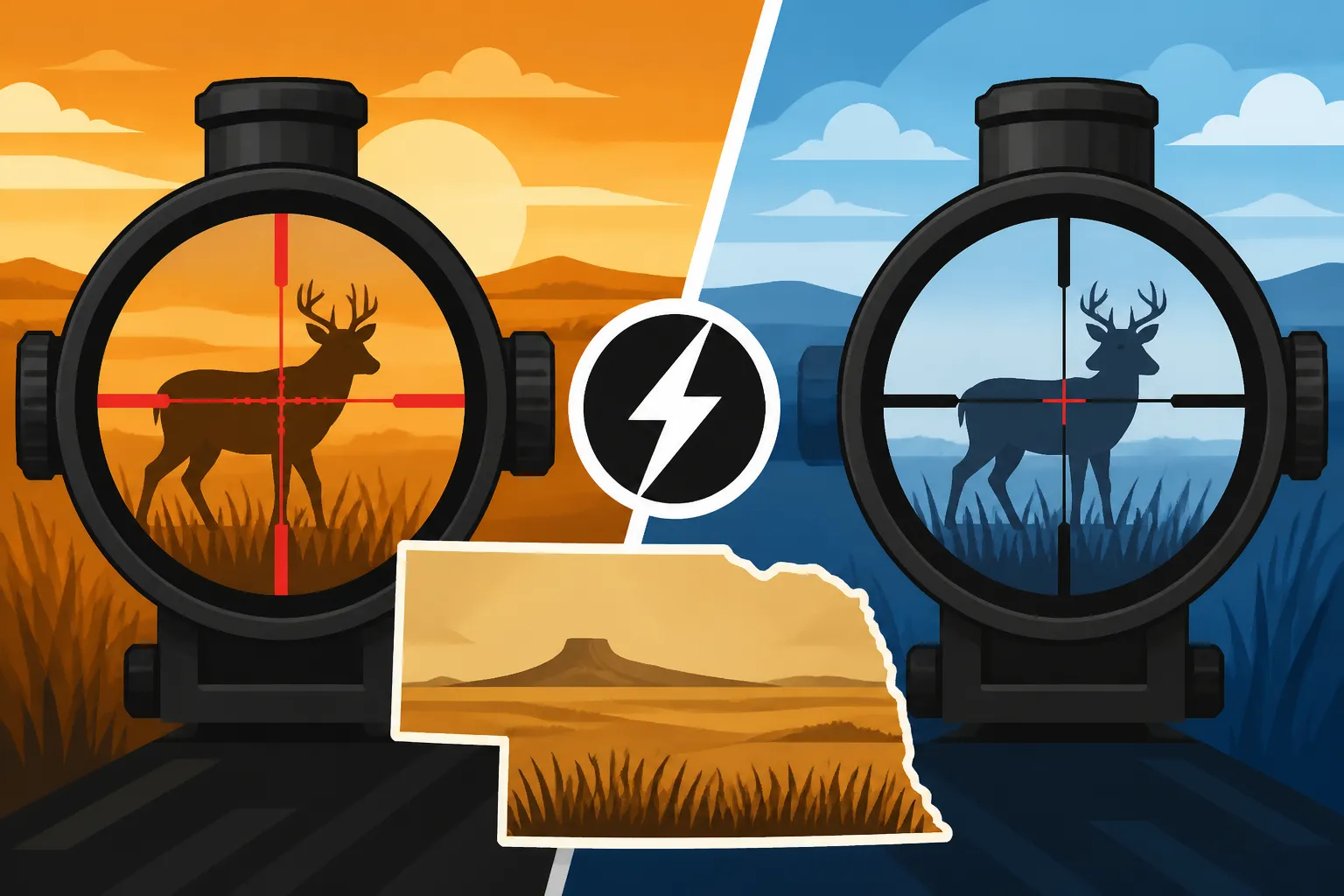
First Focal Plane, or FFP, scopes are designed so that the reticle—that crosshair or elaborate milling pattern you look through—is located in front of the magnification erector system. What this means in plain English is that the reticle actually changes size along with your target as you adjust the scope's magnification. Zoom in, and both your target and your reticle get larger. Zoom out, and they both shrink.
For a long time, FFP scopes were primarily found on high-end tactical or military optics, but they've gained significant traction in the hunting world, particularly among those who value precision at varying ranges. The key advantage here, and it's a big one for Nebraska hunters who might find themselves engaging deer or antelope at unknown distances, is that the subtensions of your reticle remain accurate at all magnification settings. Whether you're at 4x or 16x, the hash marks on your reticle, which are designed for holdovers (compensating for bullet drop) or for ranging your target, will always represent the same angular measurement. This consistency is a godsend for quickly estimating distances or compensating for wind hold without having to adjust for a specific magnification setting. Many hunters, when researching various optics, often turn to resources like GoHunt to dive deeper into the technical specifications and real-world performance of these precision instruments.
However, FFP scopes aren't without their quirks. At very low magnification settings, the reticle can become incredibly fine, almost disappearing against a dark background or in dense cover. This can be frustrating when a whitetail suddenly steps out at close range in a thick cedar draw during Muzzleloader Deer Hunting in Nebraska in December. Conversely, at high magnifications, the reticle can become quite thick, potentially obscuring smaller targets or fine details, especially at extreme distances. They also tend to be more complex to manufacture, which often translates to a higher price tag.
Understanding Second Focal Plane SFP Scopes
In contrast to FFP, Second Focal Plane (SFP) scopes position the reticle behind the magnification erector system. This means that the reticle itself remains the same size no matter how much you zoom in or out. Your target grows or shrinks, but the reticle stays constant.
SFP scopes have been the traditional choice for hunters for decades, and for good reason. Their simplicity is a major appeal. The constant reticle size means that at low magnifications, the reticle is still easily visible and robust enough for quick target acquisition, which is often crucial when Hunting a Shelterbelt Between Nebraska Fields for pheasants or a deer at close quarters. At high magnifications, the reticle maintains its proportional thickness, avoiding the "chunky" appearance that some FFP reticles can develop. This makes for a clean sight picture, especially helpful for target identification.
The main caveat with SFP scopes, however, is that any reticle features—like holdover points, windage marks, or ranging scales—are only accurate at one specific magnification setting. This is typically the highest magnification (e.g., 9x on a 3-9x scope) or a clearly marked setting like 10x or 12x. If you're not on that specific power, those marks are no longer true, meaning you can't reliably use them for precise holdovers or ranging. You'd have to use your turrets to dial in the shot or revert to a simple center-crosshair holdover, which requires more estimation. For a hunter consistently taking shots at varying ranges without dialing, this can introduce an element of guesswork. However, for many traditional hunting scenarios, where dialing turrets isn't practical or necessary, SFP scopes excel due to their straightforward design and often more accessible price point.
Key Differences and How They Impact Your Hunt
The fundamental difference between FFP and SFP scopes boils down to how their reticles behave with magnification, and this has direct implications for various hunting styles and scenarios common in Nebraska. Let's break down these impacts.
One of the most significant impacts is on reticle accuracy for holdovers and ranging.
- FFP scopes: With an FFP scope, if your reticle has hash marks for bullet drop compensation (BDC) or ranging, those marks are always accurate regardless of your magnification setting. This is incredibly beneficial for dynamic hunting situations, especially when Spot-and-Stalk Mule Deer in the Nebraska Sandhills. Imagine you're glassing a mule deer buck at a distance, ranging him with your binoculars, and then quickly identifying a new, closer target. If you zoom out to get a wider field of view, your holdover points will still correspond to the correct yardage. This constant relationship means less mental calculation and more confidence in your shot, even if the situation demands a rapid change in magnification.
- SFP scopes: On an SFP scope, those same reticle marks are only calibrated for a single magnification setting, usually the highest power. If you're hunting in thick river bottom timber and a whitetail appears at 75 yards, you might be on 3x magnification for a wide field of view. If your scope's BDC reticle is only accurate at 9x, you cannot use those holdover marks reliably at 3x. You'd either have to quickly crank up to 9x (losing field of view), dial your turret for elevation, or simply hold high based on experience. For many hunters, especially those who rely heavily on precise holdover points for mid- to long-range shooting and don't want to constantly adjust turrets, this limitation can be a dealbreaker.
Another critical area is reticle visibility and thickness.
- FFP scopes: At lower magnifications, an FFP reticle can become almost impossibly thin, making it hard to pick up quickly against a busy background, especially in low light conditions during Hunting the Pre-Rut in Late October. Conversely, at higher magnifications, it can become quite thick and busy, potentially covering too much of a distant target. This can be a concern when trying to precisely place a shot on a small vital area.
- SFP scopes: SFP reticles maintain a consistent size and thickness across the entire magnification range. This means you always have a clear, visible reticle for quick target acquisition at low power, and a clean, relatively fine reticle for precise aiming at high power. This consistent appearance can be less distracting and more intuitive for many hunters, especially those who prioritize speed over ultra-precise ranging reticles. For situations like Calling Spring Gobblers in Nebraska Timber, where quick, close shots are common, a clear and visible reticle at any magnification can be a significant advantage.
Consider also the ease of use under pressure.
- FFP scopes: For advanced shooters who practice holdovers and ranging at various magnifications, FFP can be incredibly intuitive. But for someone less experienced or under extreme hunting pressure, the changing reticle size can be disorienting if they're not fully accustomed to it.
- SFP scopes: The static reticle of an SFP scope is inherently simpler. There's no surprise when you zoom in or out; the aiming point doesn't change its perceived size. This can be a huge benefit for hunters who want to keep things straightforward and focus purely on the shot.
Finally, there's the cost and complexity. FFP scopes typically involve more intricate optical designs, which usually translates to a higher manufacturing cost and, subsequently, a higher retail price. SFP scopes, being a more mature and simpler technology, are generally more affordable, making them a popular choice for many hunters seeking quality optics without breaking the bank. When you're looking for Rifle Scopes for Long Nebraska Shots, you'll notice the price difference pretty quickly.
| Feature | First Focal Plane (FFP) | Second Focal Plane (SFP) |
|---|---|---|
| Reticle Behavior | Reticle grows/shrinks with magnification | Reticle remains constant size |
| Subtension Accuracy | Reticle subtensions (e.g., hash marks) are accurate at ALL magnifications | Reticle subtensions are accurate at ONE specific magnification (usually highest) |
| Visibility at Low Power | Can appear very fine, sometimes hard to see | Consistently visible, easy for quick acquisition |
| Visibility at High Power | Can appear thick, potentially obscuring target | Consistently clear and fine, good for precision |
| Ideal Use | Long-range shooting, holdovers/ranging at varying magnifications, dynamic hunting | General hunting, dialing turrets, close to medium range, traditional aiming |
| Complexity/Cost | More complex, generally higher price | Simpler, generally more affordable |
Choosing the Right Focal Plane for Your Nebraska Hunt
Deciding between an FFP and SFP scope for your Nebraska hunting adventures really comes down to understanding your specific hunting style, the terrain you'll frequent, and your budget. There's no universally "better" option; it's about what works best for you in the field.
If you find yourself frequently hunting the wide-open spaces of western Nebraska—think the vast Sandhills or the rugged Pine Ridge for mule deer and antelope—an FFP scope might offer a distinct advantage. These areas often present long-range shooting opportunities where quick adjustments to magnification might be necessary, and having a reticle that provides accurate holdovers at any power can be a game-changer. For example, if you're Glassing the Nebraska Sandhills for Mule Deer and spot a buck at 500 yards, you might zoom in to identify antler size, then zoom out slightly for a wider field of view for the shot, or if another animal presents closer. With an FFP, your ballistic data points on the reticle remain consistent, allowing for rapid decision-making without having to remember specific magnification settings for different holdovers. This consistency is highly valued by serious long-range enthusiasts and those who truly want to wring every ounce of performance from their Rifle Setups for Nebraska's Open Country. Many hunters use online resources like GoHunt to compare models and ensure they're getting the best match for these demanding conditions.
On the other hand, if your hunting primarily takes you to the river bottoms, small timber blocks, or agricultural fields of eastern and central Nebraska, where shots are typically closer and faster, an SFP scope is often an excellent choice. For situations like River-Bottom Whitetail Hunting in Eastern Nebraska, where a deer might burst out of cover at 30 yards, you need a reticle that's instantly visible and simple to acquire. The constant reticle size of an SFP scope means that at low magnifications, the reticle is bold and easy to see, facilitating quick target acquisition. You won't have to worry about the reticle becoming too thin or disappearing. While you might not have accurate holdovers at every magnification, for typical close-to-medium range deer hunting, many hunters either aim dead-on or use their turrets to dial in the shot if time permits. The clarity and simplicity of an SFP at the lower powers are incredibly practical for these scenarios, and they often come at a more accessible price point, which is a big plus for many hunters.
Consider your personal comfort level with technology and complexity as well. If you enjoy practicing ballistic calculations, understanding MOA or MRAD subtensions, and want a scope that offers maximum flexibility for holdovers without touching turrets, an FFP might appeal to your technical side. However, if you prefer a simpler, "set it and forget it" approach where you mostly rely on a center crosshair or dial your turrets for longer shots, an SFP will serve you exceptionally well. Don't forget to consider how factors like Wind Direction on Open Nebraska Prairie Stands might influence your shot; while a scope helps with elevation, windage is often a judgment call regardless of focal plane.
Ultimately, both FFP and SFP scopes are highly capable tools for hunting in Nebraska. Your choice should reflect your typical hunting environment, the distances you expect to shoot, your budget, and how you prefer to manage bullet drop and windage. Spend some time thinking about what kind of hunting you do most often, and what features you truly value in a scope, and you'll find the right focal plane for your next Nebraska adventure.
Disclaimer
This article is for general informational purposes only and does not constitute professional advice. Laws, prices and regulations vary by location and change over time. Consult a qualified professional for guidance on your specific situation.