Ear Size and Tail Colour at Distance
The immense challenge of correctly identifying deer species, particularly when they're a speck on the horizon or tucked into distant cover, is a frustration every Nebraska hunter knows well. That fleeting glimpse can make or break a hunt, especially with specific permit types. This guide dives deep into the subtle, yet critical, visual cues like ear size and tail color that help distinguish a whitetail from a mule deer, ensuring you make the right call in the field.
The Perplexing Challenge of Distance Identification
It’s happened to all of us. You’re glassing a distant hillside or a river bottom, and you pick up movement. Instantly, your heart rate jumps. Is it a deer? Yes! But then the real challenge begins. Is it a whitetail or a mule deer? In many Nebraska hunting units, this isn’t just an academic question; it can be the difference between a legal harvest and an illegal one. Misidentification can lead to heartbreak, a hefty fine, or worse, shooting a deer that wasn’t even legal for your permit. The pressure to make that call quickly and correctly is immense, and frankly, it's often much harder than it looks on a hunting show.
Why It's So Hard to Tell Them Apart
The primary reason distinguishing whitetails from mule deer at a distance is so challenging is the vastness of the Nebraska landscape and the often-poor visibility. You might be looking through heat shimmer on a warm day, into the glaring sun, or through fog, rain, or snow. The distance itself compresses perspectives and washes out details. A deer that looks like it has huge ears might just be turning its head at an odd angle, or a dark tail might be obscured by shadows. Our brains naturally try to fill in the gaps with what we expect to see, which can lead to mistakes.
Adding to this difficulty is the fact that Where Whitetails and Mule Deer Overlap in many areas of Nebraska. While whitetails dominate the eastern river bottoms and agricultural fields, and mule deer are kings of the Sandhills and Panhandle, there are significant transition zones. In these areas, you could genuinely encounter either species, making a quick identification based on habitat alone unreliable. Throw in young deer, which often have disproportionately large ears for their body size, or deer with unusual antler growth, and the task becomes even more complex. It's not always as simple as looking for a fork horn or a typical rack, especially when you're looking at a doe or a yearling buck.
The Stakes of a Misidentification
The consequences of misidentifying a deer species in Nebraska can be severe. Many units have specific permit requirements that dictate which species you can harvest. For instance, you might have a permit for an "Any Deer" tag that allows either species, but often, specific "Mule Deer Buck" tags are highly coveted and limited, or even restricted to residents. Conversely, some permits are "Antlerless Only," but even then, knowing the species is crucial for accurate harvest reporting and understanding herd dynamics. Shooting a mule deer buck on a whitetail-only permit, or vice-versa, can result in significant penalties, including fines, permit revocation, and even loss of hunting privileges.
Beyond the legal ramifications, there's the ethical side. No hunter wants to mistakenly take an animal that wasn't intended or legal. It disrespects the animal, the resource, and the regulations designed to manage healthy deer populations. Understanding Which Nebraska Units Have Mule Deer Restrictions is a crucial first step, but even within those units, you need to be absolutely certain of your target before you raise your rifle or bow. This means developing a systematic approach to identification, and it starts with focusing on those key physical traits that are usually reliable, even at great distances.
Key Visual Cues: Ears and Tails
When you're trying to make a split-second decision on a deer that's far away, your brain tends to look for the most obvious features. For deer, these are often the ears and the tail. These aren't just subtle differences; they are often the most defining characteristics that can help you confidently say, "That's a whitetail" or "That's a mule deer." Learning to key in on these first will give you a solid foundation for identification.
The Ear Test: Size and Shape
The ears are arguably the most prominent and consistent differentiator between the two species, especially in the absence of a clear view of the tail. Think about the name: "mule" deer. This isn't just a cute nickname; it’s a direct reference to their large, mule-like ears.
-
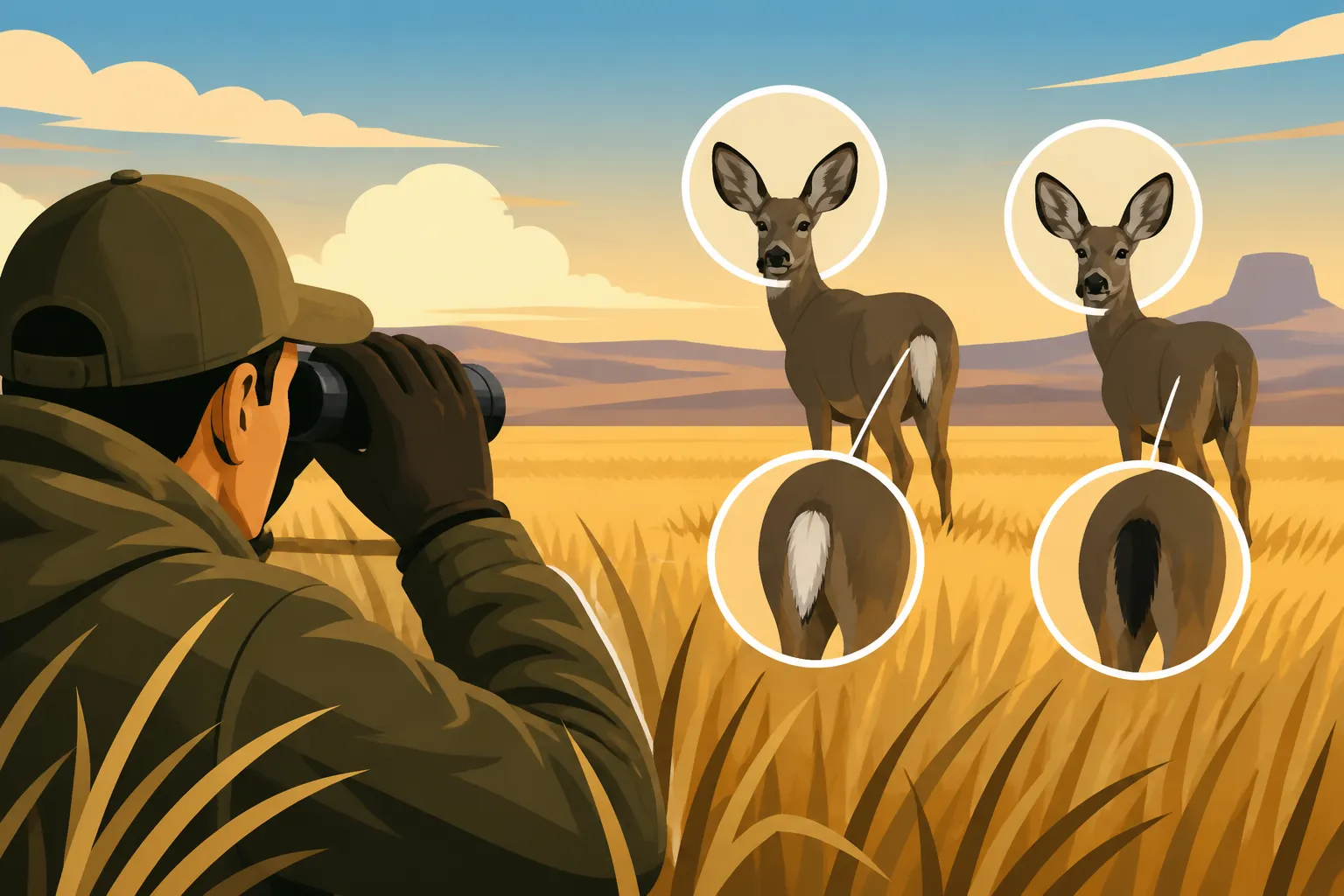
Mule Deer Ears: A mule deer's ears are notably long and wide, often appearing disproportionately large compared to its head. When relaxed, they extend significantly past the animal's eyes and can almost seem to touch when laid back. From a distance, they often look like oversized radar dishes, constantly swiveling to pick up sounds. This sheer size and prominent shape are usually visible even when other features are indistinct. When a mule deer is alert, those ears will often stand almost straight up, making them even more noticeable. It's a key aspect of Telling Mule Deer From Whitetails that experienced hunters swear by.
-
Whitetail Deer Ears: In contrast, a whitetail's ears are more proportional to its head size. They are shorter and narrower, and while they can certainly move, they don't have that "oversized" appearance of a mule deer. From a distance, a whitetail's ears will typically appear to be about half the length of its head or less, and they won't stand out as dramatically against the backdrop of its body. When a whitetail is alert, its ears might perk up, but they'll still be distinctly smaller than a mule deer's. Focus on that overall proportion—do they look like they belong on the head, or do they look a little too big for the head?
The Tail Tell: Color and Movement
While ears are often the first thing to catch your eye, the tail is another unmistakable identifier, especially when the deer is moving. The color, shape, and how it's carried are all crucial pieces of the puzzle.
-
Whitetail Deer Tail: This is where the whitetail gets its name, and for good reason! A whitetail's tail is broad, typically reddish-brown on top, but it has a distinctive, bright white underside. When a whitetail is alarmed or running, it will invariably hoist that tail high in the air, creating a flashing white flag. This "flagging" action is a dead giveaway, often the first and last thing you see as a whitetail bounds away. Even when relaxed, the tail might twitch, revealing glimpses of that white underside. In eastern Nebraska, along the river corridors where White-Tailed Deer Across Nebraska are abundant, you'll see this white flag all the time.
-
Mule Deer Tail: A mule deer's tail is quite different. It's typically shorter, narrower, and rope-like, usually cream or yellowish-white with a distinctive black tip. Critically, a mule deer almost never "flags" its tail high in the air when it runs. Instead, it holds its tail down or slightly out, often twitching it or flicking it back and forth. The prominent black tip is key. If you see a deer with a whitish, rope-like tail with a clear black tip, and it’s not flagging it high, you're almost certainly looking at a mule deer. This is especially true when hunting Mule Deer in the Nebraska Sandhills and Panhandle, where they are the dominant species.
Here's a quick reference table to help visualize the differences:
| Feature | White-tailed Deer | Mule Deer |
|---|---|---|
| Ear Size/Shape | Proportionate to head, shorter, narrower | Large, long, wide, mule-like, often extend past eyes |
| Tail Color | Reddish-brown on top, bright white underneath | Cream/yellowish-white, distinct black tip |
| Tail Movement | Flags high when alarmed/running, a prominent white flag | Held down or slightly out when running, twitches, rarely flags high |
Putting It All Together: Beyond Just Ears and Tails
While ears and tails are fantastic primary indicators, successful long-range identification often relies on a combination of clues. The best hunters don't just look for one thing; they gather all available information, cross-referencing it to build a confident identification. Think of it like being a detective: every piece of evidence, no matter how small, helps paint the full picture.
Habitat as Your First Clue
Before you even get a good look at a deer, its location can provide a strong hint. Whitetails, as their name suggests, tend to favor thicker cover—timbered river bottoms, creek drainages, and dense shelterbelts. They're often found within or very near agricultural fields, browsing on crops. If you're hunting in the thick cedar draws of central Nebraska or the cottonwood bottoms of the Platte, chances are you're looking at a whitetail. You can learn more about this by reading Where Whitetails and Mule Deer Overlap.
Mule deer, on the other hand, are creatures of open country. They thrive in the vast, rolling Sandhills, the rugged breaks of the Pine Ridge, and the wide-open grasslands. They're built for spotting predators from a distance and using topography to escape. If you're glassing a wide-open basin in the Sandhills or the breaks of the Panhandle, your odds of seeing a mule deer are significantly higher. Of course, deer don't read maps, and they will cross into "the other" species' territory, but habitat preference is a powerful predictor. Keep an eye on Reading Sign on a Nebraska Sandhills Two-Track for clues about local deer movements.
Movement and Gait
Another subtle but telling difference lies in how these two species move, especially when alarmed or covering ground.
-
Whitetail Movement: Whitetails are known for their graceful, fluid running style. They typically run with a smooth, almost flowing stride, often keeping their body low to the ground and weaving through cover. When truly alarmed, they will bound, but it's a powerful, low-to-the-ground burst of speed, punctuated by that high-held white flag. This stealthy, cover-seeking movement is part of what makes River-Bottom Whitetail Hunting in Eastern Nebraska so challenging and rewarding.
-
Mule Deer Movement: Mule deer have a very distinctive gait known as "pronking" or "stotting." When alarmed, they will typically bound with all four feet hitting the ground at once, propelling them upwards and forwards. It’s a very springy, almost pogo-stick-like motion, distinct from the whitetail's run. This high, bouncing stride is designed to offer a better view over tall grass and uneven terrain, and it's a dead giveaway if you see it. When they're just walking or trotting, they have a heavier, almost lumbering walk compared to the whitetail's elegance. Pay close attention to this when you're doing some Spot-and-Stalk Mule Deer in the Nebraska Sandhills.
Leveraging Optics and Technology
Good optics are non-negotiable for distance identification in Nebraska's wide-open spaces. A quality pair of binoculars, like a 10×42 or even a 12×50 for those really expansive views, will be your best friend. They allow you to resolve details like ear size and tail color that are impossible with the naked eye. Even better, a spotting scope on a tripod can make a distant speck turn into a clearly identifiable deer. When you’re Glassing the Nebraska Sandhills for Mule Deer, a spotting scope is often the only way to confirm a black tail tip or the full extent of those mule ears.
Consider tools like a rangefinder to get an accurate distance, which helps compensate for distance distortion. Some newer rangefinders even integrate with mapping apps. Speaking of apps, modern hunting apps, such as those from GoHunt, can be incredibly valuable. They allow you to overlay property boundaries, topographic maps, and even known habitat types directly onto your phone or tablet. Before you even head out, you can study the maps on GoHunt to see which deer species are historically found in certain areas, giving you a preliminary idea of what to expect. While GoHunt's mapping features are amazing for planning, remember that real-time visual confirmation is always paramount.
Practicing Your ID Skills
Like any skill, deer identification gets better with practice. Spend time observing deer, even outside of hunting season. Go for drives in areas known for both species and practice glassing them. Don't just look at the antlers; force yourself to focus on the ears, the tail, and how the deer moves. The more you consciously practice, the more these distinctions will become second nature.
Another great way to practice is to study photos and videos of both species. Look at a wide variety of angles, distances, and lighting conditions. Pay attention to how the light affects what you see. Consider joining online hunting forums or groups where hunters share photos and ask for identification help. The collective wisdom of experienced hunters can accelerate your learning curve. This preparatory work, alongside extensive Scouting Nebraska Public Ground Before Opening Day, will build your confidence and help prevent costly errors when it truly counts in the field.
Disclaimer
This article is for general informational purposes only and does not constitute professional advice. Laws, prices and regulations vary by location and change over time. Consult a qualified professional for guidance on your specific situation.