Hunting the Wildcat Hills Rimrock
Hunting the rugged, broken country of Nebraska's Wildcat Hills Rimrock for deer can feel like a whole different ballgame compared to the river bottoms or open Sandhills. If you've ever gazed at those dramatic bluffs, canyons, and scattered pines, you know the challenge is immense, but so is the reward. This guide is here to walk you through everything you need to know to confidently tackle this unique landscape and increase your chances of tagging a buck in one of the state's most distinctive hunting areas.
Understanding the Wildcat Hills Landscape and Its Challenges
The Wildcat Hills, stretching across parts of Scotts Bluff, Banner, and Morrill counties in the Nebraska Panhandle, aren't what most people picture when they think of the Cornhusker State. This isn't flat farmland or rolling prairie. It's a dramatic, broken country characterized by sharp elevation changes, deep canyons, sandstone bluffs, and scattered timber, primarily ponderosa pine and eastern red cedar. This unique topography creates an intricate puzzle for hunters, demanding different strategies and gear than you might use elsewhere.
Topography and Vegetation Specifics
Imagine endless vistas broken by sudden, steep drops into hidden valleys and draws. The Wildcat Hills are an eroded escarpment, a remnant of ancient geological forces that carved out these dramatic formations. You'll find yourself navigating rocky slopes, climbing steep buttes, and dropping into tight, timbered canyons. Ponderosa pines cling to the north-facing slopes and canyon bottoms, providing crucial cover and thermal regulation for wildlife. Eastern red cedars are also prevalent, forming dense thickets in draws and on benches, offering impenetrable bedding areas. The open, grassy ridge tops often feature yucca plants and prickly pear cacti, which, while beautiful, can make a stalk quite painful if you're not careful.
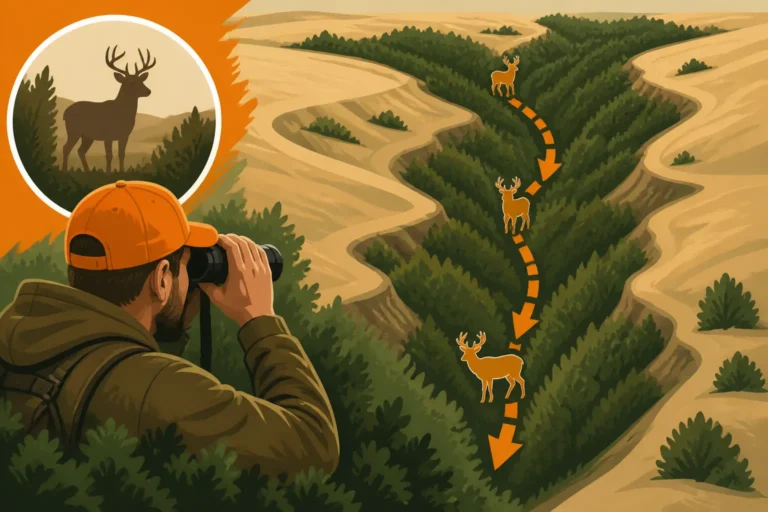
This diverse vegetation and extreme topography profoundly influence deer movement. Bucks often bed in the thickest cedar pockets, on sheltered benches, or tucked away beneath the rimrock itself, using the steep terrain to their advantage for security. They’ll navigate the intricate network of game trails along contours, dropping into canyons for water or crossing saddles between feeding areas. Understanding these natural travel corridors and bedding sanctuaries is paramount. You won't find them marching across open fields here; they'll be using every dip, rise, and patch of cover to stay out of sight.
Game Species and Their Habits in the Rimrock
While Nebraska is often known for its abundant whitetails, the Wildcat Hills are prime mule deer country. These majestic deer thrive in the broken, open terrain, using their keen eyesight and incredible hearing to detect threats from a distance. They are masters of using topography to disappear, often just melting away over a ridge or into a draw without you ever knowing they were there. Whitetails do exist in the Wildcat Hills, particularly in the lower, more riparian areas or in the thicker creek bottoms that wind through the region, but mule deer are generally the target species for most hunters venturing into this unique landscape.
Mule deer in the rimrock typically bed on benches or ledges that offer commanding views of the surrounding country. They're often found sunning themselves on south-facing slopes in cooler weather, soaking up warmth. Their feeding habits will often see them browsing on shrubs, forbs, and grasses across the hillsides, moving efficiently through the rugged terrain. During the rut, bucks will expand their range significantly, traversing vast distances across the ridges and through the canyons in search of does. This is where patience and persistent glassing become your best friends. You might spot a buck a mile away, feeding or traveling, and then it's a game of chess to figure out how to approach him. These deer are not easily fooled, and their instincts for survival are honed by the unforgiving nature of their home.
Essential Scouting and Planning for Success
Hunting the Wildcat Hills isn't a "show up and hunt" kind of place. Success here hinges heavily on thorough pre-season scouting and meticulous planning. This isn't just about finding deer; it's about understanding the land itself, how the deer use it, and how you can move through it effectively and safely.
Pre-Season Reconnaissance and E-Scouting
Before you ever set foot in the Wildcat Hills, your most powerful tool is likely sitting in your pocket or on your desk: a detailed mapping application. Tools like GoHunt, onX Hunt, or other high-quality mapping platforms with topographic and aerial imagery are non-negotiable here. Start by identifying prominent features: the highest bluffs for glassing, deep canyons that might hold water or dense bedding cover, saddles that serve as natural travel corridors, and any patches of timber that stand out. Look for benches or flat spots on steep slopes, as these are often used by deer for bedding or staging.
Overlaying public land boundaries is critical, which we'll discuss next. But beyond that, try to visualize deer movement. Where would you bed if you were a deer seeking security? Where would you travel from that bedding area to water or food? The beauty of e-scouting is that you can cover immense amounts of ground virtually, identifying promising areas that would take days or weeks to explore on foot. This allows you to prioritize your in-person scouting efforts. Don't underestimate the value of dropping pins on your map for potential glassing points, bedding areas, water sources, and even potential approach routes. Then, when you finally get boots on the ground, focus on confirming your e-scouting observations, looking for fresh sign—tracks, scat, rubs, and scrapes—and learning the lay of the land firsthand. Remember, the wind and thermals will be a huge factor, and you can get a feel for how they might behave in specific draws and canyons during your scouting trips.
Navigating Access and Public vs. Private Land
The Wildcat Hills region is a patchwork of public and private land, which can be both a blessing and a curse. You'll find tracts of Nebraska National Forest and Grassland, some state wildlife management areas (WMAs), and school trust lands, all offering public access. However, large portions of the hills remain in private ownership, often by ranchers who may or may not grant hunting permission. The key to navigating this is the Nebraska Public Access Atlas Mobile App or the printed version of the Atlas. It’s an indispensable resource for identifying every square inch of public hunting land, including Walk-In Access (WIA) tracts, in the area.
It's absolutely vital to know precisely where the public land ends and private land begins. Trespassing, even accidentally, can quickly derail a hunt and damage landowner relations for all hunters. Use your mapping app to display property boundaries clearly, and pay attention to fence lines, roads, and natural features that define these boundaries. Don't be afraid to knock on doors well in advance of the season if you're interested in private land access, but always be respectful of a landowner's decision, whether it's a yes or a no. The Wildcat Hills region, particularly areas like the Oglala National Grassland Hunting, shares similar challenges with access and terrain, making the Atlas and good mapping even more crucial. Successfully understanding and respecting these boundaries will allow you to focus on the hunt, rather than worrying about where you can and cannot go.
Proven Hunting Tactics for the Rimrock
Once you've done your homework and understand the landscape, it's time to talk tactics. The Wildcat Hills demands a strategic approach, blending patience, observation, and careful movement. This isn't about sitting still in a cozy treestand all day (though stands have their place here); it's about covering ground intelligently and making smart moves.
Spot and Stalk Mastery in Open Country
When you're hunting mule deer in the Wildcat Hills, spot-and-stalk is often your most effective method. This starts with finding a high vantage point—a bluff, a prominent ridge, or a distant butte—from which you can glass vast amounts of country. Invest in quality optics: a good pair of 10x or 12x binoculars on a tripod is essential, and a spotting scope can be invaluable for evaluating a buck at long range before committing to a stalk. Spend hours patiently picking apart the hillsides, looking for not just a whole deer, but a piece of a deer—an ear, an antler tip, a horizontal line in a vertical world. Remember that Glassing Sandhills Blowouts for Mule Deer requires a similar dedication to detail and patience.
Once you spot a buck you want to pursue, the real challenge begins: planning the stalk. This is where your detailed knowledge of the topography comes into play. Identify features that will provide cover—draws, ridges, cedar thickets, or even just the subtle undulations of the terrain. Always be mindful of the wind, as it shifts unpredictably in broken country, creating swirling thermals that can betray your presence. The advice on Wind and Thermals in the Sandhills is highly relevant here. Your goal is to approach undetected, closing the distance to within your comfortable shooting range. This often means long, circuitous routes, sometimes dropping into canyons only to climb out on the other side. Be prepared for a physically demanding journey, often involving crawling and belly-crawling in the final stages.
Still-Hunting Cedar Draws and Breaks
While spot-and-stalk is king in the open country, still-hunting can be incredibly effective in the denser cedar draws and pockets of ponderosa pine that dot the Wildcat Hills. These areas offer excellent bedding and escape cover for both mule deer and the occasional whitetail. The trick to still-hunting is moving incredibly slowly, taking a step or two, then pausing for several minutes to glass and listen intently. Use your binoculars to pick apart every shadow, every cluster of branches, looking for an antler, an eye, or the outline of a deer.
Focus on moving into the wind or with a consistent crosswind to keep your scent from reaching bedded deer. Pay particular attention to the edges of these thickets, where deer often feed or stage before moving into more open areas. When still-hunting, you're not just looking for deer; you're also reading the landscape for sign. Fresh tracks, rub lines, and scat can tell you a lot about deer activity in a particular draw. The techniques for Still-Hunting Nebraska Cedar Draws directly apply to the Wildcat Hills, emphasizing stealth and keen observation. This method requires immense patience, but it can pay off handsomely by ambushing a deer that feels safe in its sanctuary.
Stand Hunting on Key Features
While less common than spot-and-stalk or still-hunting, strategic stand placement can be effective in specific situations within the Wildcat Hills. This often involves identifying pinch points, saddles, or benches that funnel deer movement. A bench, a relatively flat area on a steep hillside, can serve as a natural travel route, a bedding area, or a feeding spot. Setting up on a Setting Up on a Terrace Bench in an area that funnels deer between a bedding thicket and a water source or feeding ground can be a productive tactic, especially during the rut when bucks are more actively cruising.
Ground blinds are often more practical than treestands in this rocky, often sparsely timbered environment. They can be brushed in effectively among cedars or against a rock outcrop, providing excellent concealment. Consider placing a blind overlooking a saddle that connects two significant drainages, a water source during dry periods, or a prominent game trail leading to a known bedding area. The success of a stand hunt here, as anywhere, depends on meticulous scouting and understanding how deer use specific features. Just remember, these deer are accustomed to vast open spaces, so your concealment needs to be top-notch.
Gear and Safety Considerations for Rough Terrain
Hunting the Wildcat Hills is physically demanding and often takes you into remote areas. Proper gear and a strong emphasis on safety are not just recommendations; they're necessities for a successful and safe hunt. Don't skimp on the essentials, and always be prepared for the unexpected.
Appropriate Gear for Rugged Hills
Your gear choices can make or break your hunt in the Wildcat Hills. First and foremost, quality optics are paramount. As mentioned, a good pair of 10x or 12x binoculars (like those from GoHunt's recommended gear list, perhaps) on a solid tripod will be your primary scouting tool. A spotting scope is also highly recommended for identifying and assessing distant animals. A reliable rangefinder is non-negotiable for accurately gauging distances in this vast, broken country, especially since judgment can be tricky with the expansive views. For more on rangefinding, check out Rangefinders in Open Nebraska Country.
Footwear is another critical consideration. You'll be doing a lot of climbing, descending, and walking on uneven, rocky, and sometimes sandy terrain. Investing in sturdy, comfortable hunting boots with excellent ankle support and a stiff sole is essential to prevent injury and provide stability. Think about boots suitable for Boots for Walking Nebraska Grass and Sand, but with added ruggedness for rocks. Layered clothing is crucial for adapting to the often-changing weather patterns of the Panhandle, which can swing from warm to cold, calm to windy, in a single day. Wind-blocking outer layers are a must. If you're carrying a rifle, consider one chambered for longer shots, and make sure your Rifle Scopes for Long Nebraska Shots are zeroed and suitable for this environment. A good backpack capable of carrying water, extra layers, emergency supplies, and potentially meat is also vital.
Safety Protocols in Remote, Steep Country
The Wildcat Hills, while beautiful, can be unforgiving. Being prepared for emergencies is non-negotiable. Always let someone know where you are going and when you expect to return. Carry a fully charged cell phone, but don't rely solely on it for navigation or communication, as service can be spotty in the canyons. A dedicated GPS unit or a fully downloaded map on a phone app, along with a compass and physical map, is a much safer bet. Consider a satellite messenger device for true peace of mind in remote areas.
Carry ample water, especially during early season hunts, as finding reliable natural water sources can be challenging. A comprehensive first-aid kit is essential, including items for cuts, scrapes, blisters, and sprains. Be mindful of rattlesnakes, especially in warmer months, and give them a wide berth. Physical fitness is a major safety factor; attempting to push your limits too far in rugged terrain can lead to injury. Know your physical capabilities and hunt within them. Finally, if you do harvest a deer, understand the challenges of retrieving it from steep, rocky terrain. Having a plan for Getting a Deer Out of a Nebraska Sandhills Basin or a deep canyon, including game bags and potentially a frame pack, will save you a lot of headache and ensure your hard-earned venison makes it home safely. Don't forget to follow proper field dressing and cooling protocols, especially if the weather is warm, referencing guides like Field Dressing and Cooling Game in Warm Weather.
Hunting Method Comparison
| Feature | Spot and Stalk | Still-Hunting | Stand Hunting |
|---|---|---|---|
| Primary Terrain | Open ridges, vast canyons, panoramic views | Dense cedar draws, ponderosa thickets, heavy cover | Pinch points, saddles, benches, natural funnels |
| Key Skill | Glassing, long-range observation, stealthy approach | Slow movement, keen close-range observation, patience | Scouting for travel patterns, concealment, scent control |
| Gear Focus | High-quality binoculars, spotting scope, rangefinder, durable boots | Quiet clothing, binoculars, comfortable footwear, scent control | Ground blind/treestand, scent control, binoculars, rangefinder |
| Physical Demands | Very High (climbing, long walks, crawling) | Moderate (slow walking, pausing, careful footing) | Low to Moderate (depends on access to stand site) |
| Best Conditions | Clear visibility, consistent wind, moderate temperatures | Windy or calm conditions, limited visibility (fog, rain) | Rutting phase, consistent deer movement patterns |
| Pros | Covers vast ground, target specific animals, exhilarating | Effective in thick cover, surprises bedded deer | Can intercept cruising bucks, less physical |
| Cons | Physically draining, requires precise wind reads, easily busted | Slower pace, limited visibility, can be frustrating | Dependent on deer movement, limited shot opportunities |
Disclaimer
Hunting is an inherently dangerous activity. This guide provides general information and recommendations. Always prioritize safety, adhere to all local and state regulations, and obtain proper licenses and permits. The terrain in the Wildcat Hills can be challenging, and weather conditions can change rapidly. Personal judgment and preparation are crucial for a safe and successful hunt.