Turret Systems for Prairie Shooting
Out on the wide-open expanses of the Nebraska prairie, where a trophy mule deer or a swift pronghorn can appear hundreds of yards away in a heartbeat, making an accurate shot isn't just about steady hands; it's about knowing exactly where your bullet is going to hit. Many hunters struggle with the sheer distances and the fickle nature of the wind, often resorting to guesswork or holdovers that leave them second-guessing. This guide will dive deep into how turret systems on your rifle scope can take the mystery out of long-range prairie shooting, giving you the confidence to make ethical, precise shots when it matters most.
The Challenge of Long-Range Shooting on the Nebraska Prairie
Nebraska's hunting landscape is incredibly diverse, but when it comes to big game like mule deer and pronghorn, you're often staring down vast stretches of open country. Think of the Sandhills, the grasslands of the Panhandle, or the endless stubble fields after harvest. Unlike the tight timber of eastern Nebraska, here, distances can be deceptive, and the wind is a constant, often swirling, factor. This unique environment presents a distinct set of challenges for any hunter, especially when an animal you've pursued for days finally presents a shot opportunity at 350 or 400 yards.
Why Standard Duplex Reticles Fall Short
Most hunters start with a simple duplex reticle, which essentially has a crosshair for aiming. For shots within 100-200 yards, especially on larger game like whitetails in the river bottoms, this works perfectly fine. You know your rifle's zero, and any slight holdover or hold-under is intuitive. But imagine that moment: you've finally spotted a magnificent mule deer buck feeding peacefully in a Sandhills blowout, and your rangefinder tells you he's at 375 yards. With a standard duplex reticle, you're now forced to guess how much to "hold over" its back to compensate for bullet drop.
This isn't a precise science. Are you holding over by 18 inches? 24 inches? It's a quick calculation based on your ballistic data, but without a specific reference point on the reticle, it's all estimation. Add in a crosswind, and now you're trying to hold over and "into" the wind, hoping your brain can perfectly triangulate the point of impact. This method introduces significant room for error, leading to missed shots, wounded animals, or at best, a lot of frustration. The vast, undulations of the Nebraska terrain make judging distance even harder, and those guesses quickly compound into uncertainty.
The Importance of Precision in Variable Conditions
Precision isn't just a fancy word for competitive shooters; it's absolutely crucial for ethical hunting, especially on the prairie. The conditions out here are rarely static. A crisp, calm morning can quickly give way to a blustery afternoon with 20 mph gusts, strong enough to push a bullet significantly off course at longer ranges. Temperatures can swing 30 or 40 degrees in a single day, which subtly affects bullet velocity and thus, its trajectory. While elevation changes aren't as dramatic as in the mountains, even subtle shifts across a large ranch can have an impact.
For smaller targets like prairie dogs, or even for big game like pronghorn that have less vital area than a deer, these variables become even more critical. A well-placed shot means the difference between a clean harvest and a long, difficult track, or worse, a lost animal. Turret systems provide a mechanical, repeatable way to account for these variables, ensuring that when you press the trigger, your bullet is sent exactly where you intend. It’s about taking the guesswork out of the equation and replacing it with calculable, confident adjustments. This is especially true when considering Reading Wind on the Nebraska Plains and how crucial it is to factor in lateral bullet drift.
Understanding How Turret Systems Work for Prairie Shooting
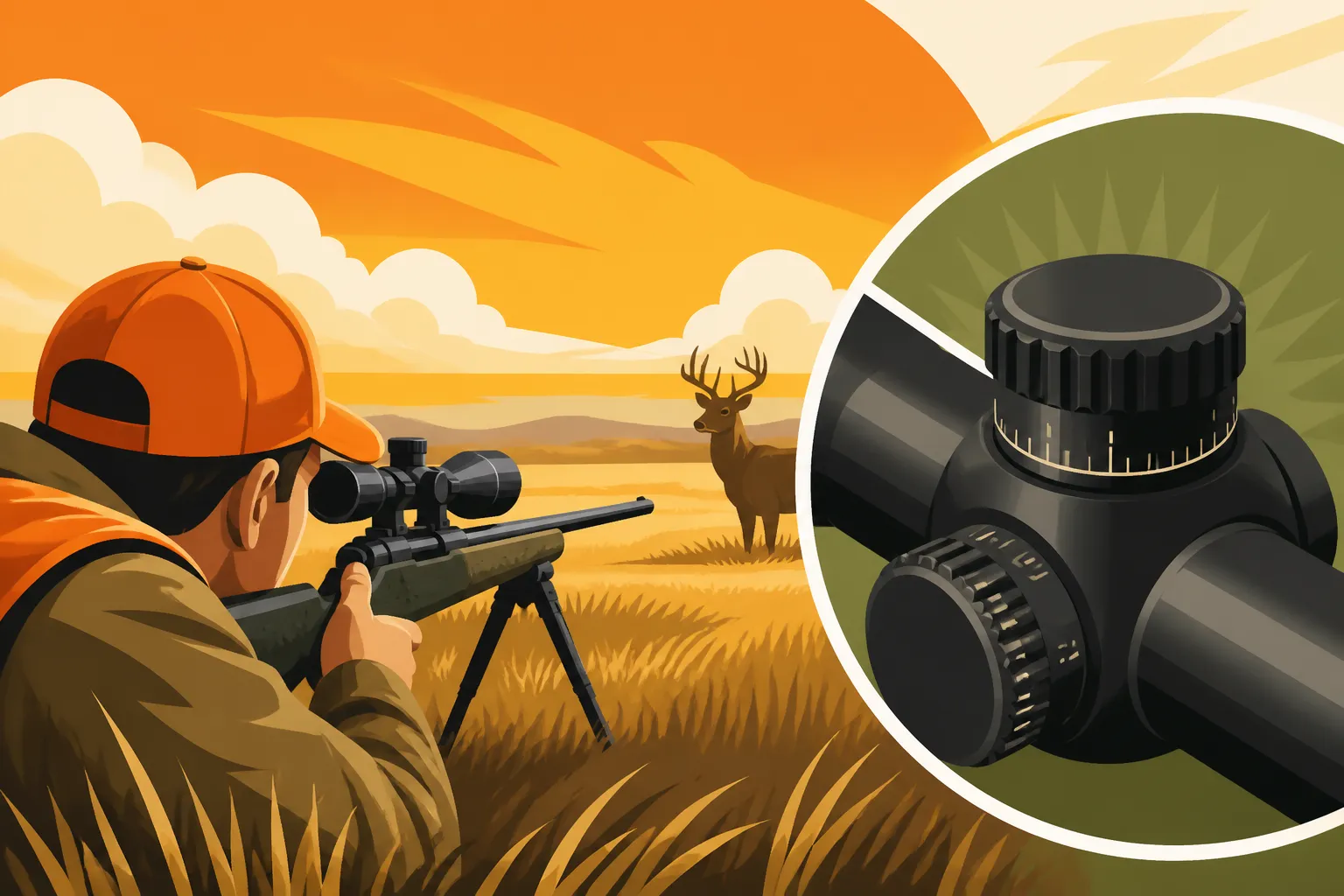
A rifle scope's turret system, sometimes called "dialing," "external adjustments," or "exposed turrets," is essentially a mechanism that allows you to physically adjust the point of impact of your bullet by rotating a knob on your scope. Instead of guessing how much to hold over or under, you literally "dial" in the exact correction needed for distance and, in some cases, wind.
Elevation Turrets: Dialing for Distance
The elevation turret is the knob typically found on top of your scope. This is your primary tool for compensating for bullet drop over varying distances. When you shoot a rifle, gravity immediately begins to pull the bullet down. The farther the bullet travels, the more it drops. Your rifle is "zeroed" at a specific distance (e.g., 200 yards), meaning that at that distance, your bullet hits exactly where your crosshairs are aimed. Beyond that, the bullet starts to fall below your crosshairs.
An elevation turret allows you to adjust the reticle up within the scope, making your point of impact higher. Each click on the turret corresponds to a precise amount of angular movement, usually measured in MOA (Minute of Angle) or MIL (Milliradian). For instance, if your scope is 1/4 MOA per click, then each click moves your bullet's impact roughly 1/4 inch at 100 yards, 1/2 inch at 200 yards, and 1 inch at 400 yards. If you know your bullet drops 20 inches at 400 yards, you can quickly calculate how many clicks (e.g., 20 clicks for a 1/4 MOA scope) to dial up to put your crosshairs back on target. This eliminates the need to hold above the animal, placing your reticle precisely where you want the bullet to strike. Having a well-zeroed rifle, perhaps at Zeroing a Rifle for Open Country, is the foundation for effective turret use.
Windage Turrets: Adjusting for Lateral Drift
The windage turret is usually located on the side of your scope (either left or right) and functions much like the elevation turret, but for horizontal adjustments. While reading the wind is a skill that takes years to master, a windage turret provides a way to precisely compensate for its effects. A strong crosswind on the Nebraska plains can push a bullet several feet off course at longer distances.
Unlike elevation, which is almost always a factor beyond your zero, windage isn't always needed for every shot. Often, for moderate winds or shorter distances, experienced shooters might still use a slight "hold into the wind" approach. However, for those gusting 15-20 mph crosswinds that seem to sweep across the Sandhills endlessly, dialing a few clicks of windage can be invaluable for ensuring a clean hit. Just like elevation, each click on the windage turret will move your point of impact a precise amount to the left or right, putting your crosshairs squarely back on your intended target. Understanding Wind and Thermals in the Sandhills is critical for using this feature effectively.
Zero Stops and Return-to-Zero Features
One of the greatest fears for any hunter using exposed turrets is accidentally spinning the turret past their established zero, or worse, getting lost in the adjustments under pressure. This is where features like "zero stops" and "return-to-zero" come into play, offering a huge boost in confidence and practicality.
A zero stop is a mechanical feature within the turret that physically prevents you from dialing the elevation turret below your established zero point. Once you've zeroed your rifle (say, at 200 yards) and set your zero stop, you can dial up for a 400-yard shot, take the shot, and then quickly spin the turret all the way back down until it hits the stop. You know, without even looking or counting clicks, that you are precisely back at your 200-yard zero. This is incredibly helpful when you're hunting in low light, when you're cold and fumbling with gloves, or when adrenaline is high after a long stalk. It removes any doubt about where your base zero is, allowing you to focus on the next shot or move with assurance. Some scopes even have a revolution indicator, so you know how many full turns you've made, further preventing you from getting lost in your adjustments.
Choosing the Right Turret System for Nebraska Hunting
With an understanding of how turret systems work, the next step is to choose one that fits your hunting style and the specific demands of Nebraska's diverse landscape. Not all turrets are created equal, and some features will be more beneficial than others depending on what and where you hunt.
MOA vs. MIL: Which System for You?
When looking at turret systems, you'll quickly encounter two primary measurement standards: MOA (Minute of Angle) and MIL (Milliradian). Both are angular measurements used to define the size of a group or the amount of adjustment needed. Neither is inherently "better" than the other; it largely comes down to personal preference and consistency with your other gear.
- MOA: This system is often favored by hunters in the United States because it relates more intuitively to imperial measurements. One MOA is approximately 1.047 inches at 100 yards. Most MOA scopes have clicks that adjust in 1/4 MOA increments, meaning each click moves the point of impact roughly 1/4 inch at 100 yards. This is straightforward if you're thinking in terms of inches of drop or windage at a given yardage. For example, if your ballistic calculator tells you your bullet drops 20 inches at 400 yards, and you have a 1/4 MOA scope, you'd dial up 20 MOA (80 clicks). It's a system many hunters find easier to grasp initially, especially if their rangefinder provides distances in yards.
- MIL: The MIL system is a decimal-based system often preferred by military, law enforcement, and many precision long-range shooters. One MIL equals 3.6 inches at 100 yards. Most MIL scopes adjust in 0.1 MIL increments, meaning each click moves the point of impact 0.36 inches at 100 yards. While the decimal nature might require a slight mental shift for those accustomed to inches, many find MIL calculations faster once they're used to it. For example, if your bullet drops 5.5 MIL at 500 yards, you just dial 5.5 MIL (55 clicks).
The most important thing is to pick one system and stick with it across all your gear – your scope, your rangefinder (if it has ballistic capabilities), and your ballistic calculator. Mixing MOA and MIL can lead to confusion and errors in the field. Consistency is key for accuracy. When picking out new optics, consider Rifle Scopes for Long Nebraska Shots and ensure the system matches your preferred method.
Exposed vs. Capped Turrets
Another key decision point is whether to go with exposed turrets or capped turrets. Each has its pros and cons, particularly for the active hunter.
- Exposed Turrets: These turrets are, as the name suggests, exposed to the elements and designed for quick, on-the-fly adjustments. They are often larger, easier to grip with gloves, and have clear, tactile clicks. For prairie hunting, where shot opportunities can arise quickly at varying distances, the ability to rapidly dial for elevation without fumbling for a cap is a huge advantage. Many exposed turrets also feature a zero stop, as discussed earlier, which is invaluable. The primary drawback is the risk of accidental adjustments. If your rifle is bumped in a truck, while hiking, or even by a snagged branch, an exposed turret can potentially move off your zero. However, many modern designs have stiffer detents or locking features to mitigate this.
- Capped Turrets: These turrets have a protective cap that screws down over the adjustment knob. This offers excellent protection against accidental adjustments and keeps dust, dirt, and moisture out of the mechanism. For hunters who prefer to set their zero and then use holdovers for most shots, or who hunt in extremely rugged conditions where bumps are inevitable, capped turrets offer peace of mind. The downside, of course, is that to make an adjustment, you first have to unscrew and remove the cap, which adds an extra step and can slow down a crucial shot opportunity. For long-range prairie hunting where quick adjustments for distant game like antelope are often necessary, the speed of an exposed turret can be a significant factor.
Tracking and Repeatability
These are two critical, yet often overlooked, aspects of a quality turret system. They speak to the mechanical integrity of the scope itself.
- Tracking: A scope's tracking refers to its ability to accurately translate the clicks you dial on the turret into the precise amount of impact shift downrange. If you dial up 10 MOA, the bullet's impact should move exactly 10 MOA. Poor tracking means that your bullet might move slightly less or more than what the clicks indicate, leading to inconsistencies and frustrating misses, especially at longer ranges. Good scopes will track true, meaning every click moves the reticle precisely as advertised.
- Repeatability: Repeatability means that if you dial your turret up 10 MOA, then back down 10 MOA, your reticle returns to the exact same zero point. Imagine dialing for a 400-yard shot, then needing to dial back to your 200-yard zero for a closer animal. If the scope isn't repeatable, your second shot might be off. High-quality scopes from reputable manufacturers are known for their excellent tracking and repeatability, which is a major reason they command a higher price. This is vital when you've done the work to Zeroing a Rifle for Open Country and need that zero to hold.
Ballistic Data and Calculators
Having a fantastic turret system is only half the battle; the other half is knowing how much to dial. This is where ballistic data and calculators become indispensable tools for the prairie hunter. Your rifle and ammunition combination will have a unique trajectory. Factors like your bullet's weight, ballistic coefficient (how aerodynamically efficient it is), and muzzle velocity all determine how much it will drop over distance.
Modern ballistic calculators, often found as smartphone apps, specialized handheld devices, or even integrated into advanced rangefinders, can take all of this data, plus environmental factors like temperature, barometric pressure, and even humidity, and provide incredibly precise solutions. You input your rifle's data, your bullet's data, and the current environmental conditions, and the calculator will tell you exactly how many MOA or MIL clicks to dial for any given distance. Some of these tools, like those offered through GoHunt, even allow you to create and save specific rifle profiles for quick recall.
Many hunters will use these calculators to create a "dope card" (Data On Previous Engagements) – a small chart that lists distances and the corresponding elevation adjustments (and sometimes windage for common wind speeds). This card can be taped to your rifle stock or scope for quick reference in the field. With a Ballistic Rangefinders for Long Shots, you can even get real-time firing solutions that factor in the angle of the shot and environmental conditions, streamlining your process even further.
Practical Tips for Using Turret Systems in the Field
Owning a scope with a turret system is just the first step. To truly harness its power and make those confident, precise shots on the Nebraska prairie, you need to develop good habits and practice diligently. It's about building muscle memory and trust in your gear.
Practice, Practice, Practice
I cannot stress this enough: a turret system is only as good as your familiarity with it. Simply owning one doesn't make you a long-range shooter. You need to spend time at the range, actively using your turrets. Don't just shoot at 100 yards. Take shots at 200, 300, 400 yards, and beyond, if your range allows.
- Dial and Shoot: Zero your rifle, then practice dialing up for different distances, taking a shot, and seeing where it impacts. Then, dial back to zero, dial for a different distance, and repeat. This reinforces the relationship between clicks and impact.
- Simulate Field Conditions: Practice from different shooting positions you might encounter in the field – prone, using shooting sticks, off a pack. This builds confidence in your setup. Remember, the Practical Range for a Prairie Rifle isn't just about what your rifle can do, but what you can do consistently.
- Time Yourself: In hunting situations, time is often of the essence. Practice ranging an object, consulting your dope card or ballistic calculator, dialing the turret, and getting into a shooting position within a realistic timeframe. The goal isn't to rush, but to be efficient and smooth.
Creating a "Dope Card" for Quick Reference
As mentioned, a "dope card" is an incredibly valuable tool for any hunter using a turret system, especially when chasing fast-moving animals like antelope or when a big mule deer might only offer a fleeting shot.
Your dope card should include:
- Distance: Common distances you expect to shoot (e.g., 200, 250, 300, 350, 400, 450, 500 yards).
- Elevation Correction: The corresponding number of clicks or MOA/MIL to dial for each distance, based on your ballistic data.
- Windage Correction (Optional but Recommended): You might include adjustments for a common crosswind (e.g., 5 mph, 10 mph) in both left and right directions, to give you a starting point.
Make your dope card durable. Laminate it or cover it in clear packing tape. Attach it to your rifle stock, the side of your scope, or even inside your binocular harness with strong tape or a rubber band for easy, quick access. When an animal appears, you can quickly range it, glance at your dope card, dial, and get ready for the shot without fumbling through an app or complex calculations. Many hunters use this in conjunction with their Optics for Glassing the Nebraska Sandhills to quickly assess the situation.
When to Dial vs. When to Hold
One of the nuances of prairie shooting is deciding when to make a physical adjustment to your turret and when to simply use a holdover or hold-under technique with your reticle.
- Inside Your Zero Range: For shots well within your established zero (e.g., a 100-yard shot with a 200-yard zero), you'll typically just hold a few inches low, or even aim dead-on if the difference is negligible for the size of the animal's vitals. No dialing needed.
- Intermediate Distances with Quick Shots: For distances slightly beyond your zero where an animal might not stand still for long, and you've practiced your holdovers extensively, holding might be faster than dialing. This is a personal decision based on practice and confidence.
- Longer, More Precise Shots (and When Time Allows): For most shots at extended ranges (say, 300+ yards) on game that isn't actively running, dialing is almost always the more accurate and ethical option. It removes the human element of estimation and puts your crosshairs exactly where they need to be. This is particularly true for animals like mule deer that might stand broadside for a minute or two, allowing you the precious seconds to make a precise adjustment. Using tools like those from GoHunt can help you visualize these scenarios and make informed decisions.
- Extreme Crosswinds: While reading the wind is crucial, for consistent, strong crosswinds, dialing in windage can provide an added layer of precision that a simple hold might miss, especially on more distant shots.
Environmental Factors and Adjustments
Your ballistic data isn't static. It's calculated for a specific set of environmental conditions (temperature, humidity, atmospheric pressure, and sometimes even altitude). While small changes might not affect a 100-yard shot, they become increasingly important as distances stretch out across the prairie.
- Temperature: Cold air is denser than warm air, meaning a bullet experiences more drag and flies slower. A shot taken on a freezing December morning will have a different point of impact than one taken on a warm September afternoon, even at the same distance.
- Barometric Pressure/Altitude: Higher altitudes and lower barometric pressure mean less air density, which reduces drag and allows bullets to fly flatter. While Nebraska isn't mountainous, there can be subtle differences across the state, and a severe low-pressure system can impact your bullet's flight.
- Humidity: While less impactful than temperature or pressure, very high humidity can slightly increase air density.
Modern ballistic calculators and apps can often account for these real-time conditions by using your phone's GPS for altitude and pulling current weather data. Before a critical hunt, it's always a good idea to confirm your ballistic data for the expected conditions, or at least be aware that significant swings in weather might require a slight adjustment to your "dope" or a re-confirmation of your zero.
Disclaimer
This article is for general informational purposes only and does not constitute professional advice. Laws, prices and regulations vary by location and change over time. Consult a qualified professional for guidance on your specific situation.