Choosing a Treestand Site on Nebraska Farmland
Hunting whitetails on Nebraska farmland can often feel like an overwhelming puzzle. With vast open fields, scattered timber pockets, and subtle terrain, pinpointing that perfect treestand location where deer consistently move can be incredibly challenging. This comprehensive guide is designed to cut through the guesswork, helping you understand deer behavior in these unique agricultural landscapes and master the art of choosing treestand sites on Nebraska farmland that put you in the best position for success.
Understanding Deer Movement on Farmland
Deer are creatures of habit and efficiency, and on Nebraska farmland, their habits are largely dictated by the rhythm of agriculture. Understanding this rhythm and how it influences their daily lives is the first step to choosing effective treestand sites.
Food Sources and Crop Cycles
In Nebraska's farming communities, deer revolve around the crops. Corn, soybeans, alfalfa, and winter wheat fields aren't just scenery; they are the primary food sources that draw deer in. The type of crop, its stage of growth, and the timing of harvest all play a monumental role in where and when deer will be.
Early in the season, during late summer and early fall, standing corn offers an incredible double whammy: food and cover. Deer will bed right within those tall stalks, emerging only a short distance to feed on the ears of corn. Soybean fields, too, are heavily browsed in the early season. As the season progresses and crops are harvested, the game changes entirely. Suddenly, what was dense, secure cover becomes open ground. Deer will still visit harvested corn fields to pick up dropped kernels, especially after a rain or snow, but their bedding and travel patterns will shift dramatically. They'll need to find alternative cover, often in smaller timber strips or thicker draws. Alfalfa fields provide consistent forage throughout the warmer months, while winter wheat, planted in the fall, can become a green magnet for deer, particularly late in the season when other food sources are scarce. Knowing the crop rotation of a specific farm, either through direct observation or by using mapping tools like GoHunt, can give you an invaluable predictive edge in understanding where the deer will focus their attention.
Bedding Areas and Escape Cover
While food brings deer into the area, bedding areas are where they feel safe and secure. On Nebraska farmland, these critical hideouts might not always be vast forests, but rather smaller, denser pockets of cover. Think of those brushy creek bottoms, thick cedar draws, overgrown fence lines, CRP (Conservation Reserve Program) fields, or even compact woodlots that dot the landscape. These areas, no matter how small, provide the thermal cover from harsh weather and visual concealment from predators, including hunters.
Deer will often choose bedding locations that allow them to quickly access food sources while also providing multiple escape routes. A narrow strip of timber along a river, for example, might be used as a bedding area during the day, offering escape into the river or further into the woods if disturbed. Pay close attention to these overlooked pockets of cover, especially those adjacent to prime feeding areas. The size of the bedding area isn't as important as its density and how it connects to other vital deer habitat. Pressure from hunters or even farm machinery can influence these choices, pushing deer into even smaller, less obvious thickets. If you're wondering where they disappear to, check out "Where Nebraska Whitetails Bed in Row-Crop Country".
Travel Corridors and Pinch Points
Once you understand where deer eat and where they sleep, the next step is identifying the "highways" they use to get between the two. These are the travel corridors, and finding them is paramount for treestand success. On farmland, these aren't always obvious. They could be timbered fencelines, brushy creek beds, the edge of a woodlot, or even a subtle ditch that offers just enough cover for a deer to feel comfortable. Deer will naturally use the path of least resistance and greatest concealment.
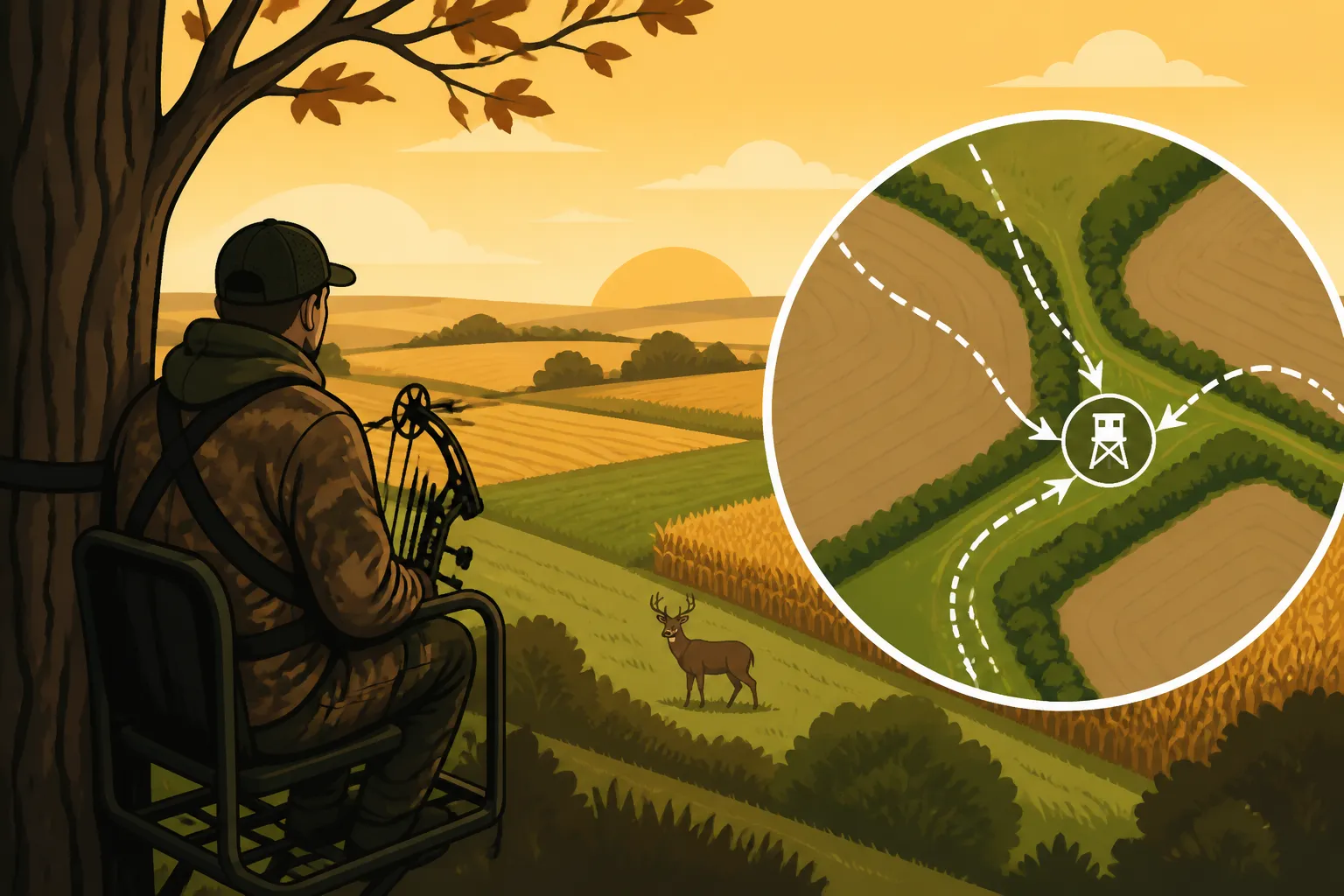
Pinch points are perhaps the most exciting discovery for a treestand hunter. These are areas where natural or man-made barriers funnel deer into a very narrow passage, concentrating their movement. Imagine a long timber strip that suddenly narrows to a small neck before opening up again, or a thick shelterbelt that crosses an open field, forcing deer to walk its edge. A culvert under a road, a narrow gap between two standing cornfields, or a deep ravine that makes crossing difficult except at specific points—these are all classic pinch points. Identifying these areas on an aerial map, then confirming them on the ground with tracks and rub lines, will give you high-percentage treestand locations. Deer are creatures of efficiency, and they will almost always choose the easiest, safest route, which often leads them right through a pinch point.
Scouting Techniques for Farmland
Effective scouting on Nebraska farmland is a multi-layered approach, starting from a bird's-eye view and drilling down to boots-on-the-ground confirmation. It’s about being smart and minimizing disturbance.
Pre-Season Aerial Reconnaissance
Before you ever set foot in the field, your scouting should begin with aerial reconnaissance. Tools like Google Earth, other satellite imagery platforms, or specialized hunting apps such as GoHunt are absolute game-changers for farmland hunting. These mapping services allow you to analyze the landscape from your couch, identifying key features that might be invisible or misleading from the ground.
Look for the obvious: large crop fields, timber blocks, and waterways. But also focus on the subtle details: how fields connect to cover, where drainages cut through open ground, the location of shelterbelts, and the routes that appear to offer the most concealment between food and bedding. Pay close attention to crop cycles from previous years if the imagery is updated regularly; this can offer clues about future plantings. Use these maps to identify potential bedding areas, primary food sources, and logical travel corridors. This initial digital scouting allows you to formulate a plan, marking potential treestand locations and entry/exit routes before you ever disturb the hunting area. This saves precious time and significantly reduces your footprint on the land, which is critical, especially on pressured farmland. If you're thinking about hunting public ground, remember to do some "Scouting Nebraska Public Ground Before Opening Day".
Boots-on-the-Ground Sign Reading
While aerial maps provide the blueprint, nothing can replace boots on the ground for confirming theories and finding fresh, actionable sign. However, ground scouting on farmland needs to be done strategically to avoid spooking deer before the season even begins. Ideally, much of your intensive ground scouting should be done during the off-season or well before hunting pressure starts.
Walk the edges of fields, especially those bordering timber or thickets. Look for well-worn deer trails leading into and out of cover. These trails are like deer highways. Examine rubs on trees and scrapes on the ground; fresh rubs and scrapes indicate recent buck activity. Pay attention to droppings – size and freshness can tell you a lot about the deer in the area and when they've been using it. Look for distinct entry and exit points deer use to access crop fields. Do they always cut through a specific corner, or do they follow a particular fence line? Understanding these micro-movements is crucial. While walking, visualize how you would approach and leave a potential stand site without alerting deer. Always be mindful of your scent and try to scout on windy days or just before a rain to minimize your impact.
Using Trail Cameras Strategically
Trail cameras are an invaluable asset for confirming deer presence and understanding their movement patterns without constant human intrusion. But like any tool, they need to be used strategically. Don't just hang them randomly. Place your cameras on those key travel routes, pinch points, and funnel areas you identified during your aerial and ground scouting. Position them where you expect deer to naturally pass by, rather than on a random tree in the middle of a field.
Consider putting cameras on primary trails leading into and out of feeding areas, along the edges of bedding cover, or at creek crossings. For bucks, target rub lines or scrape lines once they start appearing closer to the rut. Use the timestamps on the photos to identify when deer are using a particular area, which can help you narrow down your hunting times. A daytime picture of a mature buck tells you it's a potential morning or evening stand. Always check your cameras quietly and efficiently, preferably in the middle of the day when deer activity is lower, and always with the wind in your favor. Excessive intrusion to check cameras can do more harm than good, teaching deer to avoid those areas. This information, combined with your mapping data, creates a powerful picture of deer behavior.
Key Features for Treestand Placement
Once you've done your homework and understand the local deer patterns, it's time to choose those high-percentage treestand locations. On Nebraska farmland, success often boils down to identifying and utilizing specific terrain and cover features.
Field Edges and Transition Zones
The edges of agricultural fields are classic treestand locations, and for good reason. Deer frequently stage in the security cover just inside the woods before stepping out into a field to feed. Setting up a stand on a field edge, where the timber meets the open ground, allows you to catch deer during this critical staging phase. The exact placement depends on the specific field and the prevailing wind. If deer are consistently entering a field from a particular corner or along a specific timber line, that's your spot.
Beyond simple field edges, look for transition zones. These are areas where one type of cover gradually changes into another—for example, where a dense CRP field transitions into a more open pasture, or where a brushy drainage meets a timber block. These areas often attract deer because they provide a blend of cover and feeding opportunities, and they serve as natural travel routes. Observing how deer use "Hunting Standing Corn Before Harvest" is a great way to understand these dynamics, particularly when the crop provides both food and security. As the crops come off, understanding "What Changes in Nebraska After the Corn Comes Off" will be crucial for adjusting your stand locations.
Timber Strips and Woodlots
While not always extensive, timber strips and smaller woodlots are vital on Nebraska farmland. These linear features often act as primary travel corridors, allowing deer to move with a sense of security across otherwise open landscapes. Setting a stand within or along the edge of a timber strip can be incredibly effective, especially if that strip connects a bedding area to a feeding area, or if it narrows down to create a natural funnel. Look for convergences where two timber strips meet or where a strip makes a significant bend, as these often concentrate deer movement.
Small woodlots, sometimes just a few acres in size, can serve as mini-sanctuaries within vast fields. Deer will use these for bedding, particularly if they offer dense cover. Placing a stand on the downwind side of such a woodlot, anticipating deer exiting or entering, can be very productive. These isolated pockets of cover provide refuge and can hold surprising numbers of deer. Understanding how deer utilize smaller, dense patches of cover, such as a "Reading a Cedar Draw for Deer Movement", will give you an edge in these situations.
Creek Crossings and Drainages
Even in relatively flat agricultural landscapes, creek beds and drainages can be significant topographical features that dictate deer movement. Deer often prefer to cross water at specific, shallower points, or they will follow the contours of a drainage for concealment as they travel. These natural dips and cuts in the land create excellent funnels, especially in otherwise featureless fields.
Scout these drainages carefully for well-worn trails leading into and out of them. A distinct crossing point can be a goldmine for a treestand. Moreover, the dense vegetation often found along creek bottoms provides valuable cover for deer moving during daylight hours. Placing a stand overlooking a natural creek crossing or at a point where a drainage provides the only real cover in a large field can intercept deer moving between different parts of their home range.
Terrain Features and Topography
While Nebraska farmland might seem flat, even subtle changes in elevation can be critical for deer movement. A slight ridge, a terrace bench, or even an irrigation pivot road that runs along a natural contour can act as a preferred travel route for deer seeking the easiest path or a little extra cover. Deer will often follow these subtle elevation changes, using them for concealment as they move across open ground.
Understanding how these minor topographical features influence wind currents is also vital. Even a gentle rise can create a micro-thermal effect, causing air to move differently than on perfectly flat ground. Setting up a stand on a slight rise, such as a "Setting Up on a Terrace Bench", can give you a commanding view and an advantage over deer moving below you. Always consider how deer will use these features to their advantage, and plan your stand accordingly, aiming to intersect their travel routes while remaining concealed.
Wind, Sun, and Scent Management
You can pick the absolute best physical location for a treestand, but if you don't manage your scent, the wind, and your approach, that perfect spot can quickly become useless. These elements are non-negotiable for consistent success.
Playing the Wind for Success
Without question, the wind is the single most critical factor in treestand hunting. Deer have an incredible sense of smell, and if your scent is blowing towards them, they will detect you long before you ever see them. It's not just about what the weather app says; it's about understanding how wind moves across the specific terrain of your treestand location. On open Nebraska farmland, wind can be particularly tricky, swirling and eddying around timber blocks and through drainages.
You should always, always hunt with the wind in your favor, meaning it's blowing your scent away from where you expect deer to approach or from their likely bedding areas. This isn't just a suggestion; it's a commandment. This often means having multiple treestand locations for different wind directions. If the wind is wrong for a particular stand, don't hunt it. Period. Learning about "Wind Direction on Open Nebraska Prairie Stands" can be a real eye-opener. Furthermore, even subtle thermals can influence scent dispersal, especially in the mornings and evenings. Air typically falls into valleys and drainages in the morning and rises out of them in the evening. Factor this into your stand placement, particularly if you're set up near a creek bottom or a subtle depression.
Managing Sun Angles for Concealment
While not as critical as the wind, the sun's position can significantly impact your concealment and your ability to spot deer. Nobody wants to be backlit, silhouetted against a bright sky, making you stand out like a billboard. Similarly, having the sun directly in your eyes can make spotting incoming deer a frustrating challenge.
When choosing a treestand, consider the sun's path throughout the day. For morning hunts, try to position yourself so the rising sun is behind you, shining directly into the eyes of approaching deer. This creates glare for them and keeps you in shadow. Conversely, for evening hunts, aim to have the setting sun in the deer's eyes as they approach, again keeping you shaded and harder to spot. This isn't always possible, especially with limited tree options, but it's a factor worth considering. A well-placed stand that uses the sun to your advantage can give you those crucial extra seconds to draw your bow or shoulder your rifle.
Entry and Exit Routes
Even the best treestand location can be ruined if your entry and exit routes spook deer. The goal is to move to and from your stand without alerting any deer in the vicinity, especially those in or near their bedding areas. This requires meticulous planning and discipline.
Analyze your aerial maps and walk your planned routes during your scouting phase. Look for natural barriers or terrain features that can conceal your movement, such as deep ditches, standing corn rows (if allowed), or thick fencelines. Whenever possible, approach your stand from downwind of where you expect deer to be. Time your entry to be well before daylight and your exit well after dark, when deer are less likely to be in the immediate area. Minimize noise, use a flashlight sparingly, and avoid walking through known bedding areas or major travel corridors during peak deer activity. The fewer deer that know you're there, the better your chances. For detailed insights, check out "Entry and Exit Routes on Flat Farm Ground".
Stand Type and Setup Considerations
The type of treestand you choose and how you set it up are practical considerations that tie directly into the features you've identified and your overall hunting strategy.
Ladder vs. Hang-On vs. Saddle
The choice of treestand really boils down to your hunting style, the terrain, and the specific tree you're using.
- Ladder Stands: These are generally more stable and comfortable, making them a great choice for long sits in a permanent, high-traffic spot. They offer easier access for some hunters, but they are also heavier, bulkier, and less mobile. Once a ladder stand is up, it's usually there for the season, making it ideal for a proven, consistent location on private land where disturbance isn't a huge concern.
- Hang-On Stands: These offer much more versatility. Lighter and more compact than ladder stands, they can be set up in a wider variety of trees, often deeper in cover where a ladder stand wouldn't fit. They require climbing sticks or screw-in steps, adding to the setup time, but their mobility means you can have several sets of sticks and move a single stand between multiple locations based on current deer movement or wind conditions. They are a popular choice for hunters who need to adapt.
- Saddle Hunting: The ultimate in mobility and minimalist hunting. A saddle allows you to hunt virtually any tree, offering 360-degree shooting angles and incredible concealment as you melt into the tree's trunk. It requires a different climbing system and a significant learning curve, but for hunters who prioritize stealth and the ability to quickly adapt to changing conditions, especially on public land or for "Hunting a Shelterbelt Between Nebraska Fields", it's an unrivaled option.
Tree Selection for Concealment and Safety
Regardless of the stand type, tree selection is paramount. You need a tree that offers both safety and concealment. Look for a healthy, sturdy tree with enough trunk circumference to safely secure your stand. Always check for signs of rot, dead limbs, or instability. No buck is worth risking an injury.
For concealment, seek out trees that have natural cover around them—dense branches, persistent leaves (like oaks or cedars), or even multiple trunks that break up your silhouette. A tree with good back cover is always preferable, as it helps you blend in and makes it harder for deer to spot your movement. Aim for a height that gives you a good vantage point for observation and shooting, but not so high that you're silhouetted against the sky. Typically, 15 to 25 feet off the ground is a good range, offering a decent shot angle without being overly exposed.
Brush-In and Shooting Lanes
Even with a naturally concealed tree, a little extra effort can go a long way. After setting your stand, take some time to "brush in" your stand if needed. Use natural vegetation from the immediate area to add extra cover around your stand, breaking up your outline further. Just be mindful not to alter the natural appearance too much or create unnatural disturbances that might alert deer.
Equally important is clearing your shooting lanes. Do this before the season, if possible, to allow deer to get used to the slight changes. Carefully trim branches that would impede your shot at various distances and angles. Don't overdo it and create a gaping hole in the canopy that screams "hunter here!" Instead, create natural-looking lanes that offer clear lines of sight to your anticipated shooting zones. Remember that leaves will fall as the season progresses, so clear lanes that will remain clear through late season. Visualize potential shots from your stand, consider the movement of deer on the trails, and trim strategically to maximize your opportunities.
| Treestand Type | Mobility | Comfort | Concealment (Typical) | Ideal Use Case |
|---|---|---|---|---|
| Ladder | Low | High | Moderate | Permanent, high-traffic private land spots; accessibility. |
| Hang-On | Medium-High | Moderate | High | Versatile for multiple setups, adaptable to varying trees/cover. |
| Saddle | Very High | Low-Med | Very High | Ultimate mobility, public land, dense cover, unique shooting angles. |
| Ground Blind | Low (but movable) | High | High | Open country, fields, quick setup, bad weather, youth hunters. |
Disclaimer
Always consult the most current Nebraska Game and Parks Commission regulations before planning or undertaking any hunting activities. Hunting regulations, season dates, and permit requirements can change, and it is the hunter's responsibility to be fully informed and compliant with all applicable laws.