Right-of-Way Width on Nebraska Roads
It’s a scenario every hunter in Nebraska has faced: you're driving down a seemingly endless gravel road, eyes peeled for a hidden draw or a promising patch of cover, and suddenly, you spot movement. A beautiful whitetail buck, maybe, or a pheasant bursting from the ditch. Your heart races, but then a crucial question slams into your mind: Am I legally able to hunt this spot? Where exactly does the public right-of-way end, and private land begin? This confusion about right-of-way width on Nebraska roads is a real frustration, and this guide is here to untangle it, helping you hunt confidently and legally.
Understanding Nebraska Road Right-of-Way for Hunters
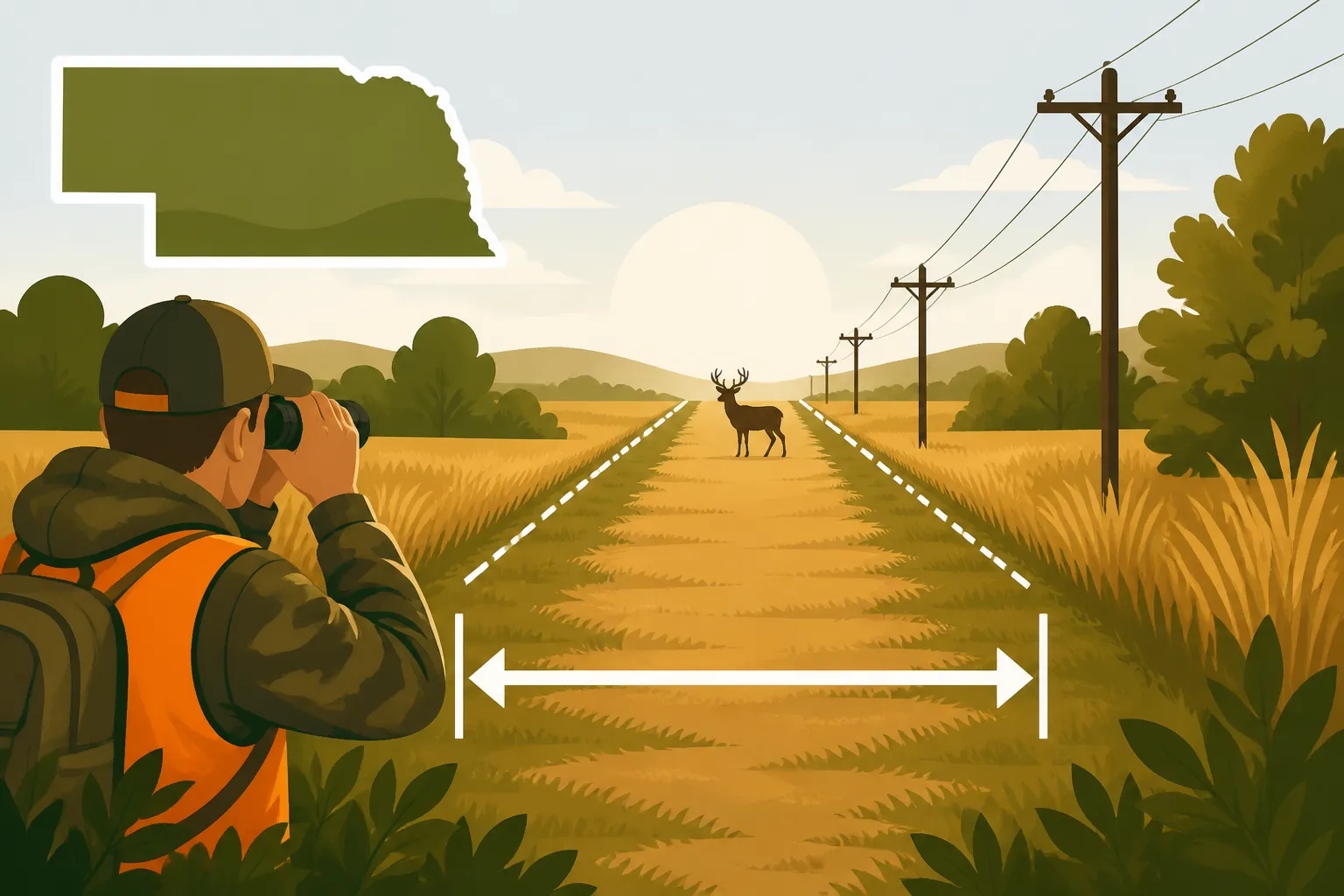
Let’s get down to basics. What exactly is a right-of-way? It’s not always about outright ownership of the land. Think of it more like an easement – the public, usually represented by a government entity like the state or a county, has the legal right to use a strip of land for transportation and all the things that go along with it, like utility lines, ditches, and road maintenance. This strip of land is often much wider than just the paved or graveled surface you're driving on. It extends a set distance from the center of the road on both sides.
As a hunter, understanding this distinction is absolutely critical. In Nebraska, the law is very clear: you cannot hunt on private land without explicit permission from the landowner. Period. While it might seem obvious, the invisible line between public right-of-way and private property is a common tripping point. Many times, the most accessible hunting opportunities, especially for small game or even deer moving between properties, occur in these roadside areas. If you don't know where that line is, you're risking a trespassing charge, which no one wants. It's not just about avoiding legal trouble; it's about respecting landowners and maintaining a positive image for all hunters.
The biggest challenge, and what causes so much head-scratching, is that there isn't a single, uniform right-of-way width that applies to every road in Nebraska. Oh, how we wish it were that simple! The width can vary significantly depending on the type of road—is it a major state highway, a well-maintained county road, or one of those barely-there minimum maintenance dirt tracks out in the Sandhills? The age of the road, when it was established, and even specific local county ordinances can all play a role. What might be 33 feet from the centerline on one road could be more or less on another. This variability is precisely why so many of us feel like we’re guessing in the field, and it underscores the importance of having some practical knowledge and the right tools in your hunting pack.
Common Right-of-Way Widths and How to Identify Them
Alright, let's talk numbers and how to actually figure this out when you're standing with your shotgun or bow. While there’s no universal rule, there are some common standards that apply to different types of Nebraska roads.
State Highways and Major Paved Roads: For major state highways, like Highway 2 cutting through the Sandhills or Highway 81 running north and south, the right-of-way is generally quite substantial. These can often be 66 feet, 100 feet, or even wider from the center of the pavement to each side. These roads are typically well-defined with clear shoulders and ditches. While hunting from or across a paved highway is almost never a good idea due to safety and specific regulations, knowing the right-of-way here helps define where you can legally access adjacent public land or where you need to seek permission on private parcels. Always prioritize safety first when hunting anywhere near these high-traffic arteries.
County Roads and Gravel Roads: This is where most of us hunters encounter the bulk of our right-of-way questions. Many county roads, especially those established in earlier times, adhere to an old standard of four rods, which translates to 66 feet. This means the right-of-way extends 33 feet from the centerline of the road to each side. So, imagine a 66-foot wide strip of land. If the gravel track itself is, say, 20 feet wide, that leaves about 23 feet on each side that is part of the right-of-way but might look like private pasture or field edge. However, some county roads, especially those that were "dedicated" later or in different ways, might have a right-of-way of 50 feet from the centerline. It really can vary, and this is where the frustration sets in because there isn't always a signpost proclaiming the exact width. For these roads, especially in more agricultural areas, you'll find yourself needing to consult maps or county resources.
Minimum Maintenance Roads and Two-Tracks: Ah, the wild west of Nebraska roads. These are the ones that often lead to fantastic hunting but also the most confusion. Minimum maintenance roads mean the county only promises to do the bare minimum to keep them passable. You might find grass growing in the middle, deep ruts, or just a couple of tire tracks winding through a field. The traveled portion can be very narrow, but here’s the kicker: the legal right-of-way for these roads can still be the standard 66 feet (33 feet from the centerline) or even 50 feet from the centerline, even if only a few feet are actually being driven on. This makes Hunting Nebraska Road Ditches a very real, and often legal, proposition, but you absolutely need to be sure you're within that invisible boundary.
Here’s a quick overview of typical widths, but remember, these are general guidelines:
| Road Type | Typical Right-of-Way Width (Centerline to Property Line) | Common Total Width | Notes |
|---|---|---|---|
| State Highways | 50-100 feet or more | 100-200+ feet | Varies widely by specific highway and section. |
| County Roads (Gravel) | 33 feet | 66 feet | Very common standard, especially for older roads. |
| County Roads (Paved) | 33-50 feet | 66-100 feet | Can vary more than gravel, depending on improvement projects. |
| Minimum Maintenance | 33 feet | 66 feet | Legal width often much wider than traveled path. |
| Unopened/Section Line | Variable, often 33 feet | 66 feet | May be legally dedicated but physically impassable. |
To accurately determine the right-of-way in the field, especially on those trickier county and minimum maintenance roads, you need modern tools. This is where apps like onX Hunt and GoHunt become invaluable for Nebraska hunters. Their detailed property line layers and public land overlays are a game-changer. With onX Hunt, you can see precisely where the property lines are relative to the road, helping you visualize that right-of-way. While these apps show property lines, they often give you a very good indication of where the right-of-way begins and ends, especially when it abuts a private parcel. These tools can save you countless headaches and ensure you're not accidentally crossing into prohibited areas, a crucial step to avoid violating Nebraska Trespass and Permission Law. You can overlay different maps and see things like onX Layers for Nebraska Land Status, which can be incredibly helpful. If you’re really in doubt, or for the most official information, you could technically contact the county clerk or highway department, but that’s rarely practical when you’re out in the field trying to locate a target species. Having these apps on your phone is like carrying a land surveyor in your pocket. Knowing Finding Nebraska Property Lines is key to staying legal.
Legal Considerations and Best Practices for Hunting Near Nebraska Roads
Even with a good understanding of right-of-way widths, there are still crucial legal considerations and best practices every Nebraska hunter needs to keep in mind to stay safe and legal.
The "Centerline Rule" and Its Nuances: While the 33-foot "centerline rule" (making a 66-foot total right-of-way) is a widely applied standard for many county roads, it’s not absolute. As mentioned, variations exist. Even if you're standing squarely within what you believe is the public right-of-way, the actual huntable area can be further restricted. Consider ditches that are too steep or deep to safely hunt in, or areas that are clearly used as driveways or immediate yards by adjacent landowners. The spirit of the law, and good hunter ethics, means not pushing boundaries even if technically legal. Plus, Nebraska Posted Land Signage Rules can often indicate where a landowner intends to restrict access.
Fences are Not Always Property Lines: This is one of the most common misconceptions that trips up hunters. Just because you see a fence doesn't mean it's the property line, or that everything on one side is private and the other is public. Farmers and ranchers often build fences within their property, set back from the actual right-of-way line. Why? Sometimes it’s for snow control, making it easier to clear the road. Sometimes it’s for ease of construction, following a natural contour. Sometimes it's simply tradition. So, don’t rely solely on fences as your guide. A mapping app can help clarify Finding Nebraska Property Lines and prevent you from making an assumption that could lead to trouble. It’s always best to have current, accurate information rather than relying on old assumptions.
Safety Zones and Shooting from Roads: Even if you're on a legal right-of-way, you cannot shoot from the traveled portion of a public road, and you certainly cannot shoot across a public road if the projectile impacts private land without permission. Beyond that, general hunting safety dictates not shooting toward dwellings, barns, or livestock. Nebraska law has specific safety zone requirements around occupied buildings. So, just because you’re on the right-of-way doesn’t give you free rein to shoot in any direction. Your shot must be safe, ethical, and within Nebraska Legal Shooting Hours. Always consider your backdrop and what's beyond your target.
Retrieving Game onto Private Land: Let’s say you make a clean shot on a whitetail buck that was legally within the public right-of-way, but the animal runs onto adjacent private property. This is a very common and agonizing situation. In Nebraska, the law is clear: you must have landowner permission to enter private land, even to retrieve legally shot game. This is where building relationships with landowners ahead of time can be incredibly valuable, especially if you plan to hunt areas bordering private tracts. Don't just assume it's okay. Knock on the door, make the call, and always ask for permission. This is covered in detail in Retrieving Game From Private Land, and it’s a non-negotiable part of ethical hunting. Ignoring this rule can lead to significant fines and penalties, not to mention creating bad blood with landowners.
When in Doubt, Don't: This is perhaps the most important piece of advice regarding right-of-way and hunting. If you are uncertain about whether you are on public right-of-way or private land, do not hunt. It's always better to err on the side of caution. Take the time to consult your mapping app, double-check county plat maps if you have them, or simply move on to a spot where you are absolutely certain of your legal standing. The minor inconvenience of moving to a new location is always preferable to the serious repercussions of accidental trespassing. This advice is especially critical if you are Using a Ground Blind on Nebraska Public Ground near a boundary, ensuring your blind and your activities are entirely on public ground. Whether you're hunting in Finding Access in Eastern Nebraska Farm Country or on the wide-open prairie where Hunting the Nebraska Sandhills Without Permission can be tricky, knowledge and caution are your best allies.
Disclaimer
This article is for general informational purposes only and does not constitute professional advice. Laws, prices and regulations vary by location and change over time. Consult a qualified professional for guidance on your specific situation.