Window Mounts for Vehicle Glassing
Glassing across vast Nebraska landscapes from your vehicle often means fighting wobbles and unsteady views, especially when trying to pinpoint that distant buck or a covey of pheasants. This guide is all about making those roadside scouting sessions count by introducing you to the magic of window mounts for your optics, helping you achieve rock-solid stability and clarity when it matters most. No more straining your eyes or missing crucial details because of a shaky hand; we’re going to dig into how these simple tools can transform your scouting game.
Why Window Mounts are a Game Changer for Vehicle Glassing in Nebraska
When you're out hunting in Nebraska, especially in the vast Sandhills or the sprawling plains, a significant amount of your scouting often happens from the comfort and mobility of your truck or SUV. Whether you're cruising gravel roads trying to locate a group of deer or pulling off to scan a distant ridge for mule deer, your vehicle becomes your mobile observation post. However, trying to hold binoculars or a spotting scope steady for extended periods in these situations is a challenge that most hunters know all too well. This is precisely where a quality window mount shines, transforming a frustrating wobble into a stable, crystal-clear view.
Think about it: you've just spotted something intriguing far off in a cornfield stubble field or on a distant pasture. You pull over, kill the engine, and grab your optics. Without a window mount, you're bracing your elbows on the door, holding your breath, and fighting every tiny vibration, every gust of wind, and the inevitable fatigue that sets in. A window mount eliminates all that. It creates a solid, unmoving platform, allowing you to settle in and truly dissect the landscape with your optics. This stability is not just about comfort; it's about seeing more, judging better, and making more informed decisions about your next move. For hunters who spend hours behind glass, this isn't a luxury; it's a necessity.
The unique challenges of Nebraska's diverse terrain—from the vast, open plains where wind is a constant companion, to the rolling hills and creek bottoms that demand precise glassing—make a window mount an indispensable piece of gear. You might be parked on an unpaved two-track road, the vehicle still subtly swaying from the uneven ground, or dealing with a persistent crosswind that makes hand-holding any optic a battle. A good window mount negates these external factors, giving you a steady image even when the world around you isn't. It's about maximizing your optical investment, ensuring that the incredible light-gathering capabilities and magnification of your expensive binoculars or spotting scope aren't undermined by simple instability.
Stability in Shaky Situations
The primary benefit of a window mount is, without a doubt, the unparalleled stability it provides. Anyone who's tried to hold 10x binoculars steady for more than a minute knows the struggle. Add in a higher magnification spotting scope, and it becomes nearly impossible to get a consistent, clear image when hand-holding. This is particularly true when you're perched in your vehicle, whether it's still running (bad idea for glassing, kill the engine!), or just settling after pulling off a bumpy gravel road. The subtle vibrations from the engine, the residual jostling, or even just your own body movements are magnified through your optics, turning a potential trophy into a blurry mirage.
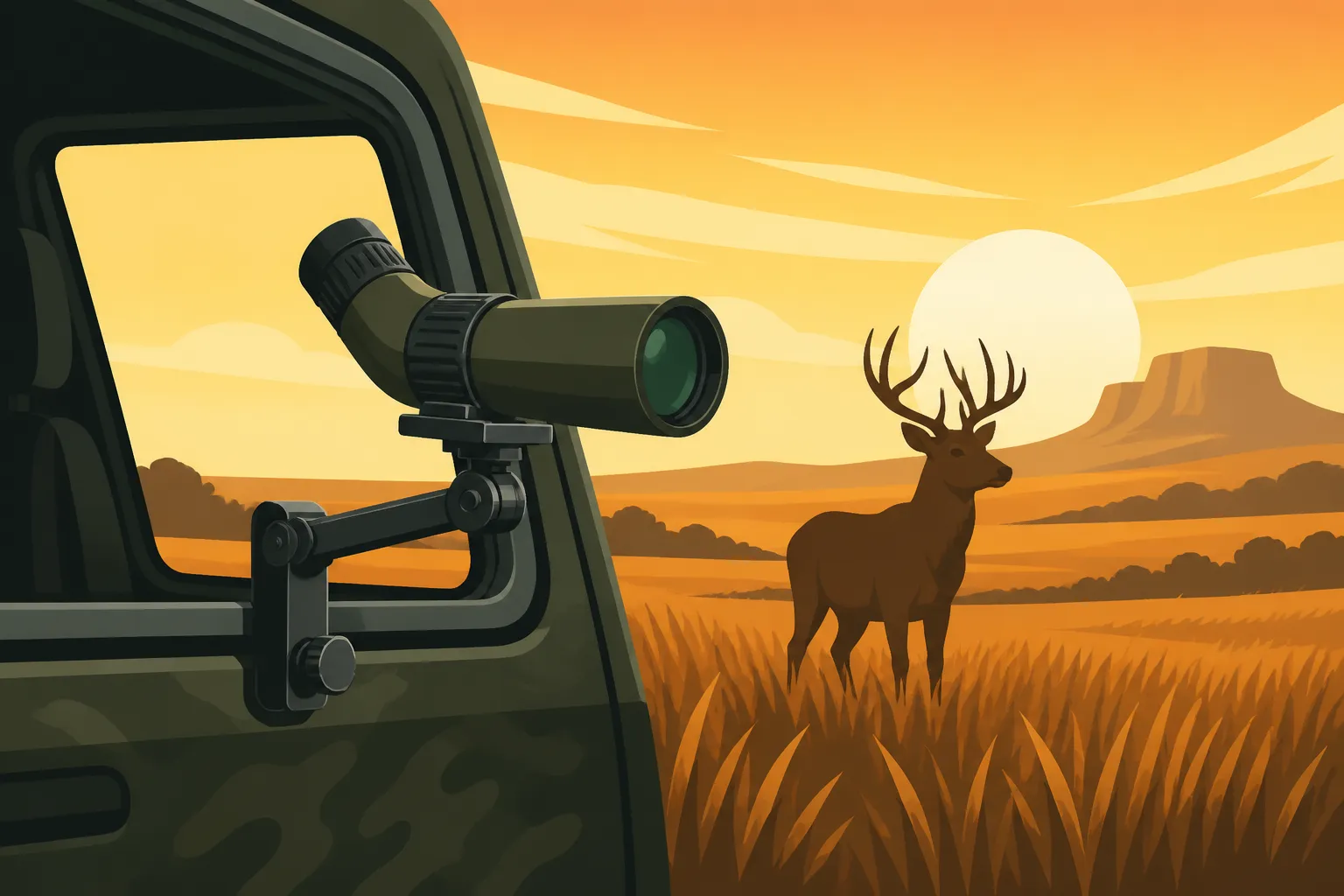
A window mount clamps securely to the top edge of your partially rolled-down window or rests firmly on the sill, creating a direct, rigid connection for your optics. This eliminates human tremor and vehicle vibrations, allowing the optical image to settle and become tack sharp. You'll immediately notice the difference: instead of constantly trying to re-center and stabilize, you can focus entirely on what you're seeing. This improved stability means you can pick out finer details, like an antler tine sticking up in tall grass, the subtle twitch of an ear, or the difference between a distant rock and a bedded deer. It genuinely extends your effective glassing range because clarity at extreme distances is directly tied to how still you can hold your optics.
Consider a scenario where you're glassing a distant draw in the Nebraska Sandhills, looking for a mule deer buck. The light is fading, and every little bit of clarity counts. Without a mount, you're constantly fighting the urge to drop your arms, reposition, or shake out the fatigue. With a window mount, your spotting scope is locked in, allowing you to patiently pick apart the shadows and contours, distinguishing between sagebrush and potential antler points. This is where patience and persistence pay off, and a steady platform empowers you to sustain that effort. It frees your hands to take notes, check your map, or grab a rangefinder, all while your optics maintain their fixed gaze.
Comfort and Endurance for Long Sessions
Let’s be honest, hunting can involve a lot of sitting and waiting, but scouting often means extended periods of active glassing. Holding binoculars or a spotting scope up to your eyes for five, ten, or even thirty minutes at a stretch can quickly lead to arm fatigue, neck strain, and general discomfort. This isn't just a minor annoyance; it significantly reduces your effectiveness. When you're constantly shifting, lowering your optics, and rubbing your neck, you're missing precious moments of observation. This is especially true when searching for subtle movements in vast landscapes.
A window mount virtually eliminates this physical strain. Once your optics are secured, you can relax your arms and focus solely on scanning the terrain. This allows for much longer, more comfortable glassing sessions, which in turn increases your chances of spotting game that might only show itself for a brief moment. Instead of quitting due to discomfort, you can maintain your vigilance, patiently waiting for that deer to stand up or that pheasant to step out from cover. It's about sustained effort without the physical cost. Many hunters also find that Glassing the Nebraska Sandhills for Mule Deer requires incredible patience, and a comfortable setup is key to that success.
Furthermore, this enhanced comfort contributes directly to better performance. When your body isn't fighting fatigue, your mind is clearer and more focused. You're less likely to rush your scans or overlook details. This extended endurance is crucial for covering large areas, such as the open rangeland where you might be Stalking Pronghorn Across Open Nebraska Ground. The ability to methodically sweep an entire hillside, pause on suspicious spots, and maintain that level of scrutiny for hours on end is a significant advantage. It allows you to transform scouting from a physically taxing chore into a more enjoyable and productive part of your hunting adventure.
Types of Window Mounts and What to Look For
So you’re convinced a window mount is the way to go for your Nebraska hunting adventures. But when you start looking, you’ll quickly realize there are a few different styles out there, each with its own quirks and benefits. Understanding the nuances between clamp-style and platform-style mounts, and knowing what key features to prioritize, will help you pick the perfect one for your specific needs and hunting style. This isn't a one-size-fits-all situation, and what works best for spotting antelope from a distance might be different than what you need for closer-range deer observation.
The choice often comes down to the kind of optics you'll be mounting, the vehicle you're using, and your personal preferences for setup and adjustability. Some mounts are quick and dirty, perfect for fast deployment, while others offer rock-solid stability for heavy, high-magnification spotting scopes that demand absolute stillness. Don't forget to consider how often you'll be taking it on and off, and if portability is a major concern. The more you know about the options, the better equipped you'll be to make an informed decision that enhances your time in the field, rather than adding another piece of gear to fuss with.
Clamp-Style Mounts
Clamp-style window mounts are probably the most common and recognizable type you'll encounter. They typically feature a spring-loaded or screw-tightened clamp that secures directly onto the top edge of your partially rolled-down vehicle window. The beauty of these mounts lies in their simplicity and versatility. They are generally lightweight, compact, and quick to attach and detach, making them a favorite for hunters who are frequently on the move or need to switch vehicles.
These mounts are excellent for binoculars and smaller, lighter spotting scopes. They usually offer a good degree of adjustability, allowing you to pivot, tilt, and sometimes extend your optics to get the perfect viewing angle. This flexibility is really helpful when you're parked on uneven ground or need to scan a wide arc without constantly repositioning your vehicle. For a quick glassing session along a two-track road, trying to determine if that distant blob is indeed a group of deer, a clamp-style mount provides sufficient stability and is incredibly convenient. They don't require any special window sills or complex setups, just a window that can roll down a few inches. Many hunters value their ease of use when they are trying to cover a lot of ground quickly, using mapping tools from GoHunt to identify potential glassing points and then using these mounts for a quick scan.
However, clamp-style mounts do have their limitations. Because they're attached to the window itself, the overall stability can sometimes be influenced by the window's fit in the frame. If you have a vehicle with a slightly loose window, you might still experience some subtle movement. They also tend to be less robust for extremely heavy or long spotting scopes, where any flex in the window or the mount itself can compromise stability. While generally very good, they might not offer the absolute rigidity that some large, high-power optics demand for precise, long-range observation in windy conditions common in Nebraska.
Platform-Style Mounts
Platform-style window mounts offer a different approach to stability. Instead of clamping to the window, these mounts typically feature a flat base that rests on the window sill, with an upright post or arm that holds your optics. Many of these also incorporate a strap or brace that extends down inside the door to provide additional support and prevent tipping. The core idea here is to create a broader, more stable foundation for your optics, often utilizing the solid structure of the door itself rather than just the window glass.
These mounts are often preferred for larger, heavier optics, particularly high-magnification spotting scopes used for serious long-range glassing. If you're using a 60x or 80x spotting scope to judge a mule deer buck's antlers at over a mile away, the absolute rigidity a platform mount provides can be invaluable. The wider base distributes weight more effectively and significantly reduces any wobble or flex, even in gusty Wind and Thermals in the Sandhills. While they might take a moment longer to set up than a simple clamp mount, the enhanced stability for critical observations is often well worth the trade-off.
The main drawback of platform-style mounts is that they can be bulkier and less universally adaptable. They need a reasonably flat and stable window sill to rest on, which some vehicles might not provide. They also tend to be heavier and less compact for packing. However, for dedicated glassing setups where maximum stability is paramount, especially when paired with a good Spotting Scope Magnification for Antelope or Rangefinders in Open Nebraska Country, a platform mount is often the superior choice. They truly excel when you anticipate extended periods of intense scrutiny, allowing you to maximize the potential of your high-end optics without compromise.
Essential Features for Nebraska Hunters
Regardless of whether you choose a clamp or platform style, there are several key features that every Nebraska hunter should look for in a window mount. First and foremost is durability. Nebraska weather can be tough, with extreme temperatures, dust, and moisture. You need a mount made from robust materials, such as anodized aluminum or high-impact polymers, that can withstand years of abuse in the field. Avoid flimsy plastics that might crack under stress or extreme cold. A well-built mount is an investment that will pay dividends.
Adjustability is another critical feature. Look for mounts that offer a wide range of motion—tilt, pan, and height adjustment—to accommodate different vehicle types, varying terrain, and individual user preferences. Smooth, positive locking mechanisms are essential to ensure that once you’ve set your optics, they stay put. There’s nothing more frustrating than a mount that slowly sags or creeps out of position. Some mounts offer a geared head for precise adjustments, which is a huge plus when trying to fine-tune your view on a distant animal.
Finally, consider ease of use and portability. While a platform mount offers superior stability, if it takes too long to set up or is too cumbersome to carry between spots, you might find yourself leaving it in the truck. A quick-release plate for your optics is a fantastic feature, allowing you to rapidly attach and detach your binoculars or spotting scope from the mount itself. For glassing vast areas like the Oglala National Grassland Hunting or during long days in the Hunting the Nebraska Sandhills, every minute saved on setup means more time actually glassing. Many hunters find that reviewing product descriptions and user experiences on specialized hunting sites, like those offered by GoHunt, can provide insights into these practical aspects before making a purchase.
Here's a quick comparison of the two main types:
| Feature | Clamp-Style Window Mount | Platform-Style Window Mount |
|---|---|---|
| Attachment | Clamps directly to the rolled-down window edge. | Rests on the window sill, often with an internal door brace. |
| Stability | Good for most binoculars and smaller scopes; can be influenced by window play. | Excellent, very rigid, ideal for heavy/high-magnification optics. |
| Optic Size | Best for binoculars (8x-12x) and compact spotting scopes. | Ideal for large, heavy spotting scopes and powerful binoculars. |
| Adjustability | Often highly flexible with tilt, pan, and height adjustments. | Generally good adjustability, but might be more fixed in height. |
| Setup Time | Very quick to attach and remove. | Slightly more involved, needs a stable sill and sometimes internal brace. |
| Portability | Lightweight and compact, easy to transport. | Can be bulkier and heavier. |
| Vehicle Fit | Works with most vehicles that have roll-down windows. | Requires a suitable flat window sill; less universal fit. |
| Common Use | Quick scans, scouting, identifying distant objects. | Detailed, long-range observation, antler judging, prolonged glassing. |
Practical Tips for Using Your Window Mount Effectively in Nebraska
Having the right window mount is only half the battle; knowing how to use it to its full potential in the diverse Nebraska hunting landscape is what truly makes a difference. It's not just about clamping it on and pointing it in a direction; strategic positioning, understanding your vehicle's angles, and integrating it with your overall scouting strategy will dramatically improve your success. This means thinking about everything from where you park to how you secure your precious optics.
The vastness of Nebraska's hunting units, from the expansive Sandhills to the river bottoms, demands a deliberate approach to glassing. You'll often be covering miles of territory, pulling over frequently to scan promising areas. Learning to quickly and efficiently deploy your window mount and begin glassing without wasted motion is a skill that comes with practice. It's about making every stop productive, ensuring you don't miss that fleeting glimpse of an animal moving through sparse cover or bedded down in a distant pasture.
Positioning for Optimal Field of View
When you pull off the road to glass, your immediate inclination might be to just park and set up. However, taking a few extra moments to consider your vehicle's position can make a world of difference. Think about the angles: if you're trying to glass a draw that runs parallel to the road, angling your vehicle slightly can open up a much better field of view through your side window. Sometimes, even backing up or pulling forward just a few feet can dramatically change what you can see, cutting through dead zones created by small hills or trees.
Once your vehicle is optimally positioned, consider the height and angle of your window mount. You want to be comfortable, but also have enough clearance to smoothly pan and tilt your optics across the entire area of interest. Adjust the mount so your eye aligns naturally with the eyepiece without straining your neck or body. For extended sessions, you might even consider adjusting your seat position for maximum comfort and stability. Remember, the goal is to be able to scan methodically and patiently, without constant fidgeting or readjusting. Don't be afraid to experiment with different window heights or mount adjustments until you find that sweet spot for your current glassing task.
It's also crucial to remember that your vehicle is not just a platform; it's also a blind. Use the vehicle itself to break up your silhouette and conceal your movements, especially if you think game might be within visual range. By positioning your mount and your body effectively, you can remain low and out of sight while still having an unobstructed view of the area you’re trying to pick apart. This subtle concealment, combined with rock-solid stability, increases your chances of observing game acting naturally, which is often key to Reading Sign on a Nebraska Sandhills Two-Track.
Integrating with Your Glassing Strategy
A window mount isn't a standalone tool; it's an integral part of a broader glassing strategy. For example, many hunters start their long-range scans with powerful binoculars, often mounted on the window, to quickly identify potential areas of interest. Once something catches their eye—a flicker of movement, a suspicious shape—they'll then switch to a higher-powered spotting scope, which also goes on the window mount, for a more detailed examination. This two-tiered approach allows for efficient scanning and precise investigation, maximizing your time behind glass. This method is particularly useful when you need to be quick and decisive, such as when Closing the Last Hundred Yards on Sand after spotting a pronghorn.
Consider the role of other tools like a Rangefinders in Open Nebraska Country. While your optics are mounted and stable, your hands are free to quickly range a distant landmark or even the animal itself. This seamless integration of gear allows for quicker, more accurate decision-making in the field. You're not fumbling with gear; everything works together to give you the information you need, right when you need it. Some hunters even use their phone on a separate mount for quick access to mapping apps or resources from GoHunt, complementing their optical observations with digital intelligence.
Furthermore, integrating your window mount into your scouting routine means understanding its limitations and strengths. It's fantastic for stationary glassing, but if you need to quickly get out of the vehicle and make a stalk, you need a system for rapid deployment and secure storage. Practicing quick attachment and detachment of both the mount and your optics will ensure you're never caught flat-footed. Think about how the mount will assist you in scenarios like Glassing Sandhills Blowouts for Mule Deer where you might need to quickly scan and then plan an approach. This proactive thinking transforms a simple accessory into a strategic asset.
Vehicle Considerations and Safety
While window mounts are incredibly useful, it's vital to consider your vehicle's specifics and always prioritize safety. Not all vehicle windows are created equal. Some modern vehicles have very narrow window frames or extremely curved windows that might not be compatible with certain clamp-style mounts. Always test your mount with your specific vehicle before heading into the field. Ensure that the mount clamps securely without damaging your window or the door trim. For platform mounts, verify you have a stable, flat sill to rest it on.
When driving, always remove your window mount and secure your optics. An optics setup left attached to a window mount can become a dangerous projectile in the event of a sudden stop or accident, not to mention the risk of damage to your expensive binoculars or spotting scope. Most mounts are designed for quick removal, so make it a habit to unmount them and store them safely when you're moving from one glassing spot to the next. Treat your optics and mount with the same care you would any other valuable piece of hunting gear.
Lastly, be mindful of legalities. While using a window mount for observation is generally fine, ensure you are always parked legally and not obstructing traffic. On public roads, pulling completely off the travel lane and being aware of private property boundaries is paramount. Always check the Nebraska Trespass and Permission Law and use resources like the Nebraska Public Access Atlas to ensure you're scouting ethically and lawfully. A window mount enhances your ability to hunt smarter, but it doesn't excuse neglecting safe and responsible practices.
Disclaimer
This article is for general informational purposes only and does not constitute professional advice. Laws, prices and regulations vary by location and change over time. Consult a qualified professional for guidance on your specific situation.