What Nebraska Trespass Law Requires
It can be incredibly frustrating to be out in the field, pursuing game, only to suddenly question if you're standing where you're legally allowed to be. The lines between public and private land, and the rules about access, aren't always crystal clear, leading to anxiety about accidentally breaking the law. This guide will walk you through the specifics of Nebraska's trespass laws, particularly as they apply to hunters, helping you understand your responsibilities and avoid unwanted legal trouble.
Understanding Nebraska's Core Trespass Laws
Nebraska's approach to trespass, especially when hunting is involved, is designed to protect private property rights while providing clear guidelines for hunters. It’s not just about what you can’t do; it’s about what you must do to ensure you're acting lawfully and respectfully. Understanding these fundamental principles is the cornerstone of ethical and legal hunting in the Cornhusker State.
Defining Trespass in a Hunting Context
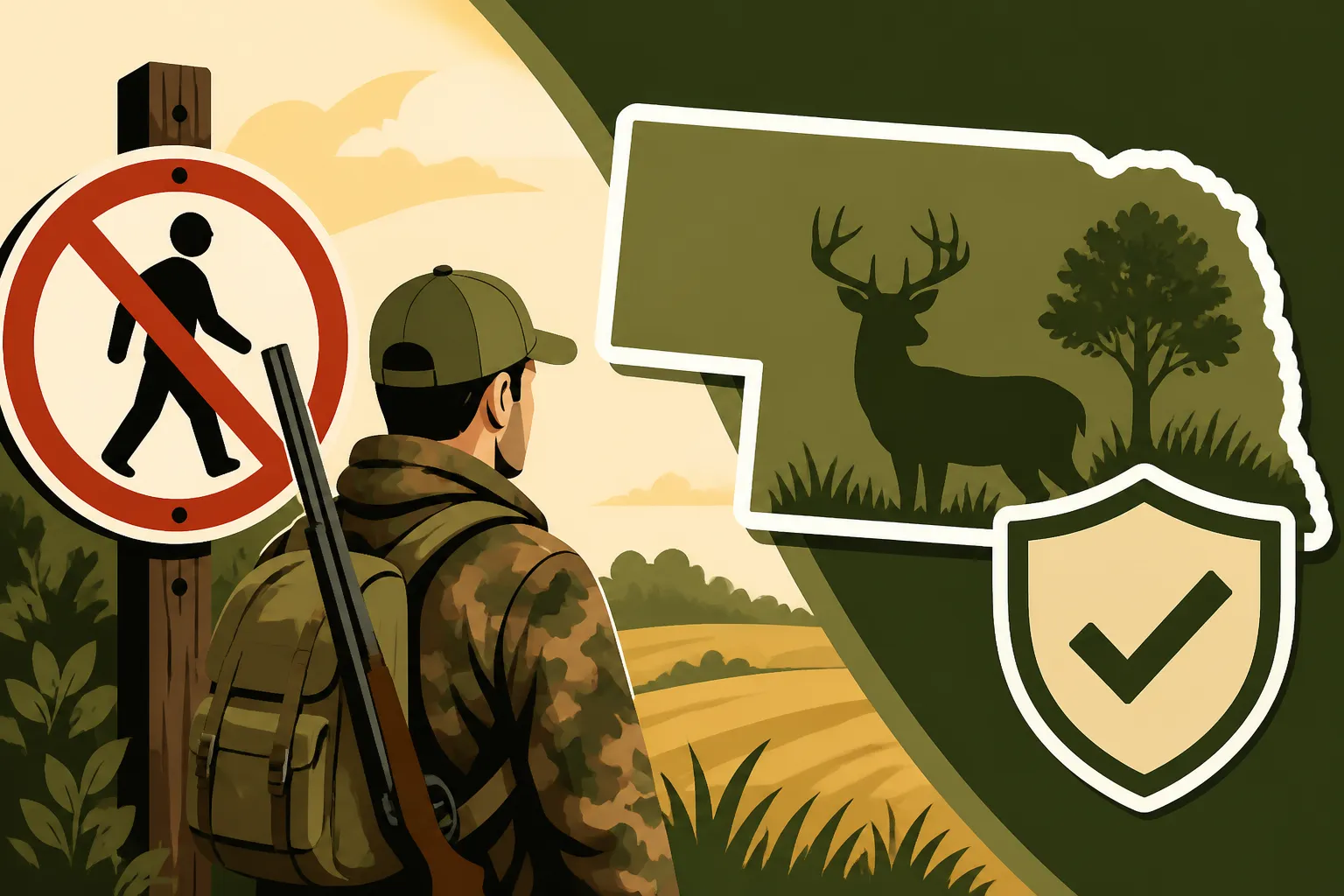
In Nebraska, trespass isn't just a casual stroll onto someone else's property. For hunters, it involves entering or remaining on private land to hunt, fish, or trap without explicit permission. This means that even if a piece of land isn't posted with "No Trespassing" signs, if it's private property, you generally need permission from the landowner or tenant to be there for hunting purposes. The act of pursuing game, setting up a stand, or even just scouting without permission can constitute trespass. It's a common misconception that unposted land is fair game, but that's simply not the case in Nebraska. The law protects landowners whether their property is marked or not.
Think of a scenario where you've been working a pheasant field near a timber edge, and a rooster flushes wild, sailing over a fence line into what appears to be an unharvested soybean field. Your instinct might be to follow, but without knowing the ownership and having explicit permission, crossing that fence constitutes trespass. Even if you don't carry a firearm across, merely entering the land to scout or retrieve a downed bird without permission can be a violation. It’s a hard lesson to learn when adrenaline is high, but the law is clear.
Implied vs. Express Permission
This is where many hunters get tripped up. Some states operate under a "trespass by posting" rule, meaning if land isn't posted, it's generally considered open to public access unless specifically prohibited. Nebraska, however, generally requires express permission for hunting, fishing, or trapping on private land. This means you need a direct, clear communication from the landowner or tenant granting you access. This isn't usually something that can be merely "implied" by the absence of signs or a friendly wave from a distance.
Express permission can be verbal, but it's always a good idea to get it in writing if possible, especially for extended hunts or if you're traveling a long distance. A written agreement, even a simple text or email, can save a lot of headaches if there's ever a misunderstanding. For instance, imagine you spoke to a landowner over the phone, and they verbally granted you permission for the archery season. If a game warden approaches you in the field, having that landowner's contact information readily available to confirm your story is crucial. Even better, a signed slip of paper or a written message explicitly stating the permission for specific dates and activities provides undeniable proof. When in doubt, asking for written permission is always the safest bet. It’s important to clarify if Do You Need Written Permission in Nebraska? when seeking access.
Penalties and Consequences
The consequences of trespassing in Nebraska can range from a minor citation to significant fines, loss of hunting privileges, and even a criminal record, depending on the severity and frequency of the offense. For a first offense of hunting on private land without permission, you could face a substantial fine. Repeated offenses or more egregious acts, like damaging property while trespassing, can lead to much harsher penalties. These might include larger fines, court costs, and the revocation of your hunting, fishing, and trapping permits for a period of time.
Beyond the immediate legal ramifications, there's the broader impact on your hunting reputation and the relationship between hunters and landowners. A single act of irresponsible trespass can sour an entire community's view of hunters, making it harder for everyone to gain future access. It truly is a big deal. For example, if you're found hunting without permission on a small parcel of timber near a town, the local landowner might press charges, and the incident could lead to your name being published in local papers. This not only carries legal weight but also a social stigma that can be difficult to shake off. Understanding Nebraska Hunting Violation Penalties helps underline the seriousness of these actions.
Identifying Private Land and Posted Boundaries
Navigating the landscape to determine public versus private land can feel like solving a puzzle, especially in areas with mixed ownership. However, modern tools and a keen eye for physical markers can make all the difference in staying on the right side of the law. Knowing how to identify boundaries and signs is just as important as knowing the laws themselves.
Recognizing "No Hunting" Signs and Markings
Nebraska law specifies what constitutes legally posted private land. While the general rule is that you need permission for private land whether it's posted or not, clearly marked signs serve as an undeniable declaration of the landowner's intent. According to Nebraska's Posted-Land and Trespass Rules, signs should generally be conspicuous, legible, and placed at reasonable intervals around the property boundary. Common markings include "No Hunting" or "No Trespassing" signs. Sometimes, landowners will also paint fence posts or use specific colors to indicate their property lines, often using orange or purple paint, especially at gates or corners.
It's not enough to simply glance quickly; you need to be observant and actively look for these indicators. If you see signs or painted posts, consider it an explicit warning. Disregarding these visible warnings could lead to more severe penalties if caught. For example, imagine you're walking a fence line, and every 100 yards there's a bright orange plastic sign clearly stating "NO HUNTING." Even if you thought the land was otherwise accessible, ignoring those signs would be a clear violation. Landowners often go to great lengths to mark their property, and hunters are expected to respect those efforts.
Using Technology for Land Ownership
In today's hunting world, digital mapping applications have become indispensable tools for avoiding trespass. Services like onX Hunt offer detailed property lines, landowner names, and even different land classifications (public, private, state, federal) directly on your phone or GPS device. This allows you to identify boundaries with impressive accuracy, even when physical signs are scarce or absent. Similarly, other apps such as GoHunt provide robust mapping capabilities that can assist in identifying these crucial property lines, allowing for proactive planning and in-the-field navigation.
Before you even leave home, you can use these apps to scout potential hunting areas, identify adjacent landowners, and plan your approach to ensure you stay on legal ground. While in the field, they act as a real-time GPS, showing your exact location relative to property boundaries. This is especially helpful in areas with complex ownership patterns, such as fragmented timber parcels or checkerboard public/private sections in the Sandhills. For example, if you're chasing deer through a creek bottom, and the property lines weave through the terrain, a mapping app like onX Layers for Nebraska Land Status can show you exactly where the public land ends and private land begins, preventing an accidental crossing. The Nebraska Public Access Atlas Mobile App is another great resource, specifically for identifying public access points and lands.
Navigating Roads and Right-of-Ways
Understanding what constitutes a legal right-of-way around roads and ditches is another area where confusion often arises for hunters. In Nebraska, public roads typically have an associated right-of-way that extends a certain distance from the center of the road. While the road itself is public, the land within the right-of-way, and certainly beyond it, might still be privately owned. Hunting from a road right-of-way can be permissible if you are on the public portion of the right-of-way and you are not shooting across private land without permission, or otherwise violating local ordinances. However, the exact width of these rights-of-way can vary, and it's often difficult to determine the precise boundary without surveying tools.
Often, hunters consider shooting game in the ditch next to a road. While a ditch might seem like public access, it's crucial to know that the ditch often falls within the privately owned right-of-way or directly adjacent private property. This is why Hunting Nebraska Road Ditches can be tricky business. Generally, unless the ditch is explicitly designated as public hunting land (like an Open Fields and Waters tract), you should assume it's private and requires permission. It's not uncommon for landowners to consider the entire area up to the fence line as part of their private property, even if it's within what you might perceive as a roadside ditch. Always err on the side of caution and seek permission if you are unsure.
Specific Scenarios and Common Misconceptions
Hunting situations can throw curveballs, and sometimes you find yourself in a gray area regarding land access. Addressing common scenarios and clearing up misconceptions can help you make informed decisions and maintain a good relationship with landowners and the broader hunting community.
Retrieving Game from Private Land
One of the most agonizing situations for a hunter is when a hard-earned shot results in a game animal running onto clearly marked or known private property where you do not have permission. Your instinct is to recover your animal, but the law in Nebraska is clear: you generally cannot enter private land to retrieve game without first obtaining permission from the landowner or tenant. This applies even if you watched the animal fall just over the fence.
Attempting to retrieve game without permission is still considered trespass. The best course of action is to locate the landowner, explain the situation, and respectfully request permission to enter and retrieve your animal. Most landowners, when approached politely and honestly, will grant access, especially if you offer to show them where the animal is and ensure you won't bring a firearm onto their property for the recovery. If you cannot locate the landowner or they deny permission, your options become limited. You may need to contact the Nebraska Game and Parks Commission for advice, but they cannot compel a landowner to grant you access. This delicate situation is explicitly covered by Retrieving Game From Private Land, emphasizing the importance of ethical conduct and landowner relations.
Hunting Adjacent to Private Property
When hunting near a private land boundary, it's not enough to simply be on public or permitted land; you also need to be mindful of where your shots are directed and where your hunting efforts impact neighboring properties. Shooting across property lines onto private land without permission is a serious offense, even if you remain on public ground. Your projectile cannot legally enter private land without the landowner's consent. This means being acutely aware of your surroundings, your target, and what lies beyond it.
Consider hunting a thin strip of public land that borders an active cattle pasture. You might be legally positioned on the public ground, but if you take a shot at a deer and the bullet travels across the fence into the pasture, that's a violation. Furthermore, be conscious of the behavior of hunting dogs if you're upland hunting. While dogs don't understand property lines, you, as the hunter, are responsible for their actions. If your dog crosses onto private land without permission, you could still be cited for trespass. Always keep your dogs under control, especially near boundaries. Being aware of Reading a Nebraska Deer Unit Boundary is key to avoiding these issues.
Corner Crossing and Its Nuances
Corner crossing is a particularly contentious issue that has garnered national attention, especially in Western states. It refers to the act of moving from one parcel of public land to another public parcel by stepping over or through the shared corner where four land sections meet, without physically touching the private land that occupies the other two corners. For example, imagine a checkerboard pattern: Public-Private, Private-Public, Public-Private, etc. At the point where four corners meet, two public and two private, a hunter might want to "corner cross" from one public parcel to another.
While technically, in some interpretations, you might not "touch" private ground, many landowners view this as a form of trespass because you are crossing their airspace or disrupting their perceived dominion over their property's corners. In Nebraska, like many states, the legal interpretation of corner crossing for hunting access is complex and not universally agreed upon or definitively settled by clear statutes. The safest advice is to avoid corner crossing unless you have explicit permission from the landowners whose properties meet at that corner. This is especially true given the ongoing legal battles and varying opinions on this topic. It’s always best to be overly cautious and respect a landowner's wishes, even if the letter of the law feels ambiguous. The topic of Corner Crossing Rules in Nebraska itself indicates the complexity involved.
Summary of Nebraska Trespass Guidelines for Hunters
To ensure you have a clear understanding, here's a quick reference on key aspects of Nebraska's trespass laws for hunters:
| Aspect | Nebraska Rule for Hunters | Key Implications |
|---|---|---|
| Permission Required | Explicit permission from landowner/tenant is generally required to hunt, fish, or trap on private land. | This is not a "trespass by posting" state. Unposted private land is not considered open access for hunting. Always ask. Verbal permission is acceptable, but written is always better. |
| Posted Land | Landowners may post "No Hunting" or "No Trespassing" signs or use painted fence posts (often orange or purple). | These signs serve as clear notification, reinforcing the need for permission. Disregarding them can lead to more severe penalties. |
| Technology Use | Apps like onX Hunt and GoHunt provide property lines and landowner info. The Public Access Atlas is also a key resource. | Utilize these tools for pre-scouting and in-field navigation to avoid accidental trespass. They are invaluable for identifying ownership and planning legal access points. |
| Road Right-of-Way | Hunting within public road rights-of-way may be legal, but typically doesn't extend to ditches or adjacent private land. | Assume ditches and land beyond the fence are private and require permission. Shooting across private land from a public right-of-way is illegal. |
| Game Retrieval | You cannot enter private land to retrieve downed game without prior permission from the landowner. | Always attempt to contact the landowner first. Approach respectfully and explain the situation. Do not enter without explicit consent, even if the animal is clearly visible. |
| Shooting Across | It is illegal for your projectile (bullet, arrow) to cross onto private land without the landowner's permission. | Be aware of your target and backdrop. Ensure your shot will not impact private property if you do not have permission for that property. |
| Corner Crossing | This practice is legally contentious and generally advised against without express permission from involved landowners. | While physically avoiding private land, many landowners object to this. It's best to seek permission from all landowners whose property meets at the corner to avoid potential legal issues and maintain good relations. For more details, see Corner Crossing Rules in Nebraska. |
Remember, your actions as a hunter reflect on the entire hunting community. By understanding and respecting Nebraska's trespass laws, you not only protect yourself legally but also help preserve hunting opportunities and foster positive relationships with landowners across the state. Should you ever witness illegal activity, knowing how to handle it responsibly is also key, and Reporting a Poacher in Nebraska outlines the process.
Disclaimer
This article is for general informational purposes only and does not constitute professional advice. Laws, prices and regulations vary by location and change over time. Consult a qualified professional for guidance on your specific situation.