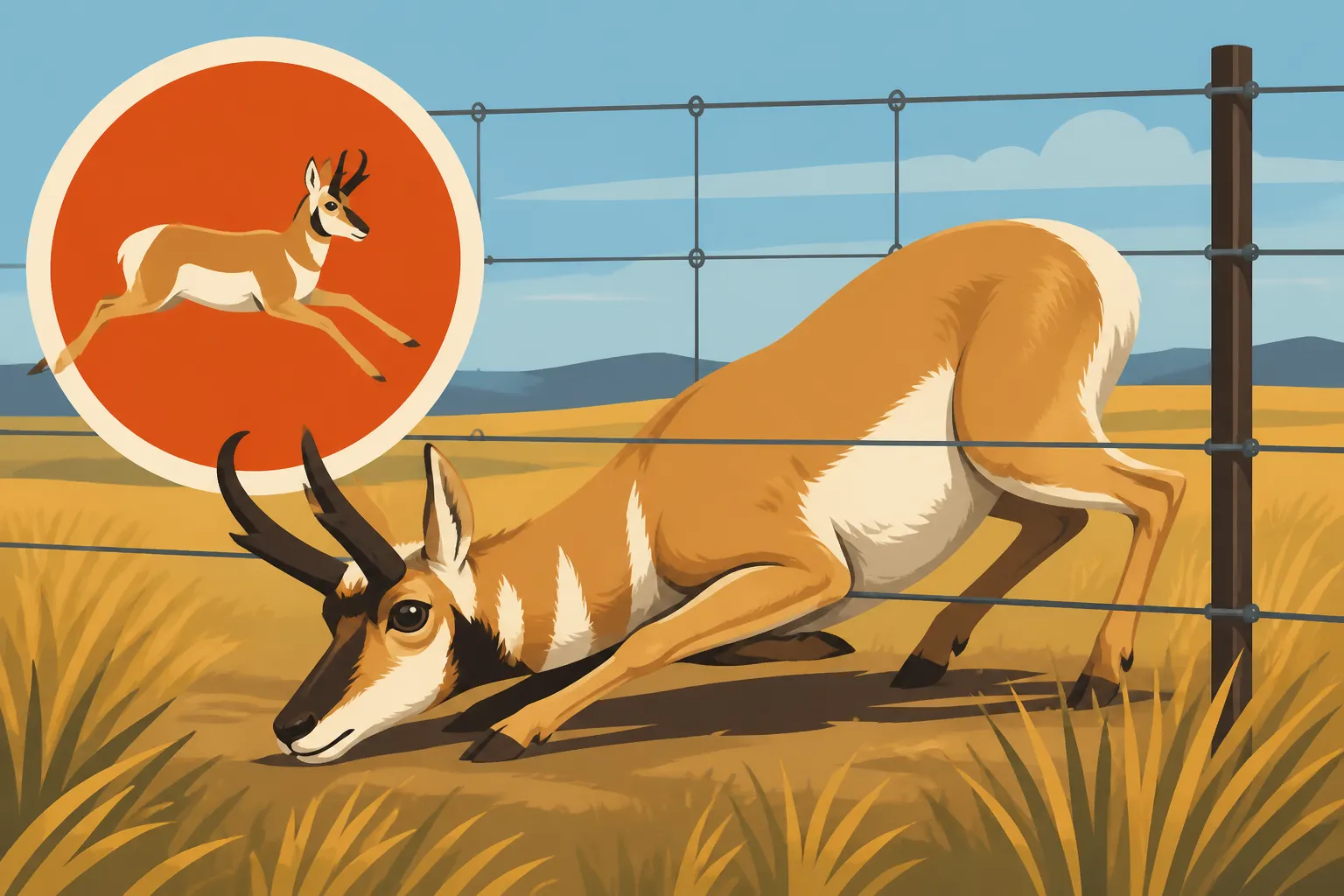
Why Pronghorn Crawl Under Fences
For anyone who has spent time observing pronghorn on the vast plains of Nebraska, one behavior consistently stands out: their almost uncanny insistence on crawling under, rather than leaping over, fences. It can be a perplexing sight, especially if you're used to seeing deer clear obstacles with effortless bounds. But this unique behavior isn't just a quirky habit; it's a deep-seated evolutionary trait that speaks volumes about the pronghorn's natural history and the challenges they face in a landscape increasingly bisected by human infrastructure. This guide will dive deep into why these incredible animals choose to slink rather than soar, and what that means for understanding and hunting them in the Cornhusker State.
The Evolutionary Design of a Pronghorn
Pronghorn are often called "antelope," but they're not true antelope at all. They're a unique species, the last surviving member of a distinct family, and their physical adaptations tell a story of survival on the open, vast plains of North America. When you understand how they're built and what they're built for, their preference for crawling suddenly makes a lot more sense.
Built for Speed, Not for Leaping
Imagine the ancestral home of the pronghorn: wide-open grasslands, few trees, and even fewer natural barriers. Their primary defense against predators like wolves, coyotes, and ancient cheetahs (yes, cheetahs used to roam North America!) was blistering speed and endurance. These animals are truly built for the chase. They possess incredibly large lungs and hearts for their size, allowing for sustained bursts of speed that make them the fastest land mammal in North America. Their legs are relatively short and stout, designed for powerful forward propulsion across flat terrain.
However, this specialization comes with trade-offs. Unlike deer or elk, which evolved in more varied terrains with forests, broken country, and natural obstacles, pronghorn didn't need to develop the anatomy for high, graceful leaps. Their spinal column is relatively rigid, optimized for a running gait that covers immense distances with minimal effort, but not for the flexible arching motion required to clear high barriers. When you see a deer jump, their body contorts and extends beautifully. A pronghorn, on the other hand, tries to maintain a more level posture, which is perfect for gaining speed but inefficient for vertical clearance.
Ancestral Landscapes Without Fences
Think about Nebraska's Sandhills, or the expansive plains of the Panhandle. Before European settlement, these lands were largely unfenced. Rivers, canyons, and occasional bluffs were the main geographical features. When a pronghorn encountered an obstacle, it was usually something they could go around, or perhaps a low, natural feature they could easily step over or squeeze through. There was no evolutionary pressure to develop the high-jumping capabilities that modern fences now demand.
This ancestral memory, if you will, is hard-wired into their behavior. When confronted with a fence, their instinct isn't to look for the path over it, but the path through it or under it. It's a testament to how recent, in evolutionary terms, our human modifications to the landscape truly are. For millennia, there was simply no need to jump, so why waste energy and risk injury trying to do so now? This is why you'll see pronghorn herds bunch up against a fence line, seeking the lowest point or a break, rather than scattering and clearing the barrier like a herd of whitetail. Pronghorn Antelope on the Nebraska Plains are animals deeply connected to their open habitat.
The Mechanics of the Crawl
Watching a pronghorn navigate a barbed wire fence is a masterclass in flexibility and caution. It's not always pretty, but it's effective for them.
Low Belly, Flexible Neck
Pronghorn have a body shape that is perfectly suited to slipping under obstacles. Their bodies are streamlined and their legs, as mentioned, are not exceptionally long. This low-slung profile allows them to duck and weave more easily than a taller, lankier animal. When they approach a fence, they typically lower their heads, often tucking their noses close to the ground, and gingerly pick their way under the lowest wire. They'll often push their body through a gap, sometimes scraping their backs or rumps, but always favoring the low route. Their necks are surprisingly flexible, allowing them to twist and turn their heads to get past the wire without getting caught up.
Barbed wire, of course, adds an extra layer of difficulty and danger. A pronghorn can get tangled or cut, especially if they panic or encounter an exceptionally tight spot. However, their generally calm and methodical approach often minimizes these risks. They seem to intuitively understand the need to move slowly and deliberately to avoid injury.
Why Not Just Jump?
Beyond the anatomical reasons, there's also the energy cost and risk assessment. Jumping takes a significant amount of energy, especially repeatedly. For an animal whose survival depends on conserving energy for bursts of speed over long distances, unnecessarily jumping is counterproductive. Furthermore, a high jump, especially with a rigid spine, increases the risk of landing awkwardly and suffering an injury. A sprained ankle or a twisted leg on the open plains can be a death sentence, making the careful crawl a safer bet.
It's also worth considering the mental aspect. If generations upon generations have never had to jump, the neural pathways and learned behaviors for jumping simply aren't as strong as for navigating low obstacles. They are incredibly observant animals, and they quickly learn where the best crawl-unders are on a particular fence line, often creating visible trails. This learned behavior reinforces the crawling habit.
Fences: A Modern Challenge to Ancient Instincts
The proliferation of fences across the American West, including vast portions of Nebraska, presents a significant challenge to pronghorn. While they can and do adapt to some degree, these barriers impact their movement patterns, access to resources, and overall population health.
Impact on Migration and Foraging
Fences can sever traditional migration routes, preventing pronghorn from reaching seasonal foraging grounds or water sources. In areas with high fence densities, animals may be forced to travel much greater distances to find a suitable crossing, expending valuable energy and increasing their exposure to predators or road hazards. Imagine a severe winter in western Nebraska, where pronghorn need to move to lower elevations or areas with less snow to find browse. If their traditional routes are blocked by fences they can't easily cross, it can lead to increased mortality.
Beyond migration, fences can also fragment daily foraging patterns. A prime feeding area might be just across a fence from a bedding ground, but the pronghorn must expend extra time and effort to find a safe crossing, rather than simply moving between them. This is particularly true on public lands or properties that feature a patchwork of ownership, where fence designs and maintenance vary wildly. Using tools like GoHunt can sometimes help hunters visualize these fence lines on different land types, which might inform scouting decisions. Hunting Antelope After a Wet Summer might mean they're spread out, but fences still dictate their movement.
Fence Design and Pronghorn Movement
The good news is that there's a growing awareness among landowners and conservation groups about "pronghorn-friendly" fence designs. The key elements that make a fence problematic for pronghorn are:
- Low bottom wire: If the lowest wire is too close to the ground, it becomes extremely difficult, if not impossible, for pronghorn to crawl under without getting tangled. A bottom wire at least 18 inches off the ground is generally considered much more passable.
- Too many wires: Fences with five or more wires, especially if tightly strung, create a dense barrier that's hard to navigate.
- Barbed wire on the bottom: Barbs on the lowest wire are the biggest culprit for injuries and entanglement. Smooth wire on the bottom is a simple, yet highly effective, modification.
Conservation efforts often involve retrofitting existing fences or constructing new ones with these principles in mind. This includes initiatives to raise bottom wires, replace barbed wire with smooth wire on the lowest strand, and even install "pass-throughs" where sections of fence can be easily dropped or lifted.
| Fence Feature | Pronghorn-Friendly | Pronghorn-Unfriendly | Impact on Movement |
|---|---|---|---|
| Bottom Wire Height | 18+ inches | Less than 12 inches | Easy crawl vs. Snagging/Impassable |
| Bottom Wire Type | Smooth wire | Barbed wire | Safe passage vs. Risk of injury/entanglement |
| Number of Wires | 3-4 wires | 5+ wires | Easier to find gaps vs. Dense barrier |
| Wire Spacing | Wider spacing | Tighter spacing | More room to squeeze vs. Constricting |
| Fence Tension | Moderately taut | Very tight | Allows some flex vs. Rigid and unyielding |
Adapting to the Landscape: What Hunters Can Learn
For hunters in Nebraska, understanding why pronghorn crawl under fences is more than just an interesting biological fact; it's a crucial piece of the puzzle for successful hunting. This behavior heavily influences their movement patterns and, by extension, your strategy.
Identifying Travel Corridors
Since pronghorn prefer to go under fences, they will establish preferred crossing points, especially in areas with well-maintained or uniformly designed fences. These crossings often become funnel points, much like a deer trail through thick timber. Learning to identify these "crawl-under" highways is a huge advantage. Look for:
- Worn trails: Visible trails leading to and from a low section of fence.
- Matted grass: Areas under a fence where grass is flattened or sparse from repeated passage.
- Hair snags: Occasionally, you might find strands of pronghorn hair caught on a low barbed wire.
- Low wires: Visually identify sections where the bottom wire is naturally higher or where posts are farther apart, creating a larger gap.
These predictable crossing points can be excellent ambush sites, especially for archery hunters. While Archery Antelope From a Water Blind is a common tactic, understanding fence crossings opens up more possibilities.
Using Fences to Your Advantage
Knowing that pronghorn are hesitant jumpers allows you to use fences as natural barriers in your stalking strategy. If you're trying to close the last hundred yards on a buck, and there's a fence between you and him, you know he's likely to go under it if spooked, rather than over. This can sometimes give you a predictable escape route to anticipate.
Conversely, remember that fences can also hinder your movement. What seems like a small obstacle on a map (like those found on GoHunt, which can show land features and ownership) can become a significant barrier if you're trying to quickly reposition or pursue a wounded animal. Always consider fence lines in your approach and exit strategies.
Patience and Observation
Hunting pronghorn, especially in open country, is often a game of patience and observation. Spend time glassing an area, not just for the animals themselves, but for their patterns of movement. Watch how a herd interacts with a particular fence line. Do they always use the same spot? Is there a noticeable "gate" or a section where the fence is in disrepair? These observations will tell you a lot about their daily routines and how they navigate their world.
When considering a decoy strategy, remember that a Decoying a Rutting Pronghorn Buck often involves bringing the animal closer to you in open terrain. If there's a fence between you and the decoy, the buck might choose to crawl under the fence to approach it, which can be an excellent opportunity if you're positioned correctly.
Ultimately, the pronghorn's unique relationship with fences is a fascinating example of how wildlife adapts – or struggles to adapt – to a changing environment. Understanding this behavior not only deepens your appreciation for these magnificent creatures but also makes you a more informed and effective hunter on Nebraska's wide-open plains.
Disclaimer
This article is for general informational purposes only and does not constitute professional advice. Laws, prices and regulations vary by location and change over time. Consult a qualified professional for guidance on your specific situation.