How Far to Walk From the Parking Area
It's a familiar sight for anyone who's ever hunted public land in Nebraska, especially during peak seasons like the opening weekend of firearm deer or pheasant season. You pull up to a promising-looking public access point, eyes scanning the horizon for signs of game, only to find several other vehicles already parked. That sinking feeling sets in: "Is this spot already pounded?" The truth is, many hunters gravitate towards the easiest access, meaning the real opportunities often lie just a bit further away. This guide will help you understand the dynamics of hunter pressure, strategize how far to walk from your vehicle, and equip you with the knowledge to find less-pressured game, even on popular public ground.
The Frustration of Front-Country Pressure on Nebraska Public Land
There’s nothing quite like the anticipation of stepping out of your truck on opening morning, the air crisp, the sun just beginning to paint the eastern sky. Then you see it: a line of other vehicles, some with lights already on, hunters moving into what you thought was your secret spot. It's enough to make you wonder if there's any point in trying to hunt close to the road. This phenomenon, often called "front-country pressure," is a very real challenge for public land hunters, and it fundamentally changes how game animals behave.
Why Most Hunters Stick Close to the Pavement
Let's be honest, we're all looking for convenience to some extent. After a long drive, the idea of a short walk to a potential hunting spot is incredibly appealing. Many hunters stick close to the road for a variety of understandable reasons. Sometimes it's simply a matter of familiarity; they've hunted that 100-yard strip for years and know a few good spots. Others might have physical limitations that make a long hike prohibitive, or they're just not confident in navigating deeper into unfamiliar territory, especially in the dark.
There's also the perceived effort-versus-reward calculation. Why bust your hump walking two miles when a deer might be just over the hill from the truck? For many, the mental barrier of going "way back in there" is simply too high. This isn't a judgment; it's a reality that creates an opportunity for those willing to push a little further. Game animals, unfortunately, learn this habit very quickly, becoming more wary and less predictable in these easily accessible zones.
The Visible Impact on Game Behavior
The impact of this front-country pressure on game is undeniable. Deer that might otherwise browse openly in a field edge near a road will become nocturnal, only moving under the cover of darkness. Pheasants, typically known for holding tight in cover, will flush at extreme ranges or simply run along a ditch for hundreds of yards before taking flight, often out of range or on private land. Waterfowl become incredibly adept at spotting hunters and decoys, flaring high above a spread that's too close to a visible access point.
It's a direct result of conditioning. Game animals, particularly deer, learn where the "safe zones" are – those patches of thick cover that are just far enough from the beaten path that most hunters won't bother. These areas become sanctuaries where they can bed down and feel secure. On the flip side, areas with high human traffic become places to avoid during daylight hours. This creates the infamous "public land deer" or "educated rooster" phenomenon, where animals seem to possess an almost supernatural ability to evade hunters, all because they've learned the patterns of human intrusion. To find success, we often need to break those patterns.
Finding the "Sweet Spot": How Far is Far Enough?
So, if everyone else is sticking close to the road, how far is far enough to make a difference? There isn't a magic number that applies to every piece of ground, every species, or every day. It's a nuanced calculation, but there are some solid principles that can guide you to that elusive "sweet spot."
The Law of Diminishing Returns vs. Increased Opportunity
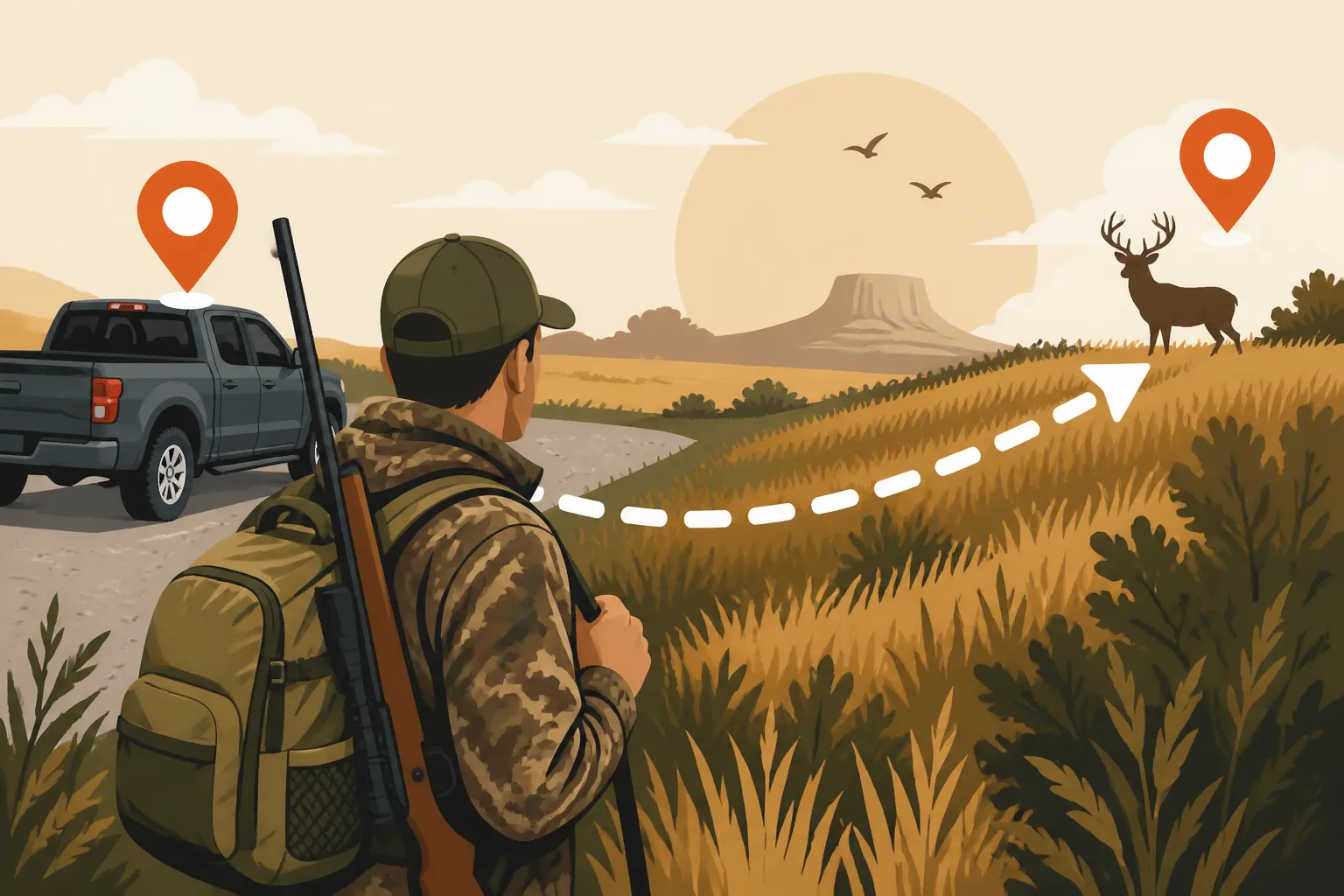
When we talk about walking distance, it's not just about covering ground. It's about crossing invisible thresholds that deter most other hunters. The first 400 to 800 yards from a well-used parking area often sees the most concentrated pressure. Think of it as a ripple effect: the further you get from the drop-off point, the fewer hunters you're likely to encounter. This doesn't mean you need to embark on a multi-mile expedition every time, but a willingness to go that extra distance can dramatically increase your odds.
Consider the terrain. A half-mile walk through a dense cedar thicket or across rugged, sandy blowouts in the Sandhills is a vastly different proposition than a half-mile stroll down a smooth two-track. The effort required can act as its own barrier. Generally, if you can push 1 to 2 miles into public land, you'll often find a significant drop-off in hunter traffic. This is where the game is less wary, where they might hold tighter, or where bucks might be more inclined to cruise during daylight hours looking for does during the rut. It's all about increasing your opportunity by reducing competition and exploiting the habits of other hunters.
Leveraging Terrain and Natural Barriers to Your Advantage
The true art of finding unpressured ground isn't just about raw distance; it's about identifying and utilizing natural barriers that act as deterrents. Deep, muddy drainages, thick stands of impenetrable timber, areas with heavy blow-sand, steep hillsides, or even seemingly insignificant creek crossings can all funnel or deter hunters. If it looks hard to get through or around, that's often where game finds refuge.
For instance, a narrow, winding creek might not seem like much on a map, but if it requires waders or a small canoe to cross, it becomes a major barrier for many. If you're willing to make that effort, you've just unlocked a huge chunk of ground that most others ignore. In the Sandhills, finding deep basins or areas with extremely soft sand that makes vehicle travel (or even walking) difficult can reveal pockets of undisturbed mule deer. Similarly, in eastern Nebraska's river bottoms, thick stands of multiflora rose or honeysuckle, while a pain to navigate, often hold whitetails that are completely ignored. Hunting a Creek Crossing in the Sandhills requires specific tactics, but the reward is often a truly secluded experience. Remember, animals will always gravitate to areas where they feel safe, and those areas are often defined by natural obstacles.
Understanding Different Game Species' Pressure Tolerance
The "how far" question also depends on what you're hunting. Different game species react to pressure in distinct ways, and understanding these differences can help you refine your walking strategy.
Deer, especially mature bucks, are masters of evasion. In areas with significant pressure, they will quickly shift to nocturnal patterns or seek out the densest cover imaginable, often surprisingly close to human activity if that cover is sufficiently thick. You might not need to walk five miles, but rather half a mile into a nearly impenetrable cedar draw or a dense plum thicket that no one wants to fight through. Where Nebraska Whitetails Bed in Row-Crop Country highlights how they utilize specific cover types when pressured. Pheasants and quail, on the other hand, often react by running ahead of hunters or flushing at the absolute edge of shotgun range. To get into unpressured birds, you might need to walk a couple of miles through less desirable-looking cover or work edges that are hard to reach from a road. Waterfowl, being highly mobile, will simply avoid areas that see too much disturbance. For them, a longer walk to a remote pothole or a secluded bend in a river can be the key to getting under birds that have seen every spread near the road.
| Factor | Front-Country Hunting (Close to Road) | Back-Country Hunting (Further Walk) |
|---|---|---|
| Hunter Pressure | High; multiple vehicles, frequent encounters | Low to moderate; fewer vehicles, rare encounters |
| Game Behavior | Wary, nocturnal, quick to flush/run, often educated | More natural, relaxed, greater chance of daytime movement |
| Effort Required | Minimal walking, easy access | Significant walking, potentially rugged terrain |
| Gear Needed | Standard day hunt gear | Sturdy boots, larger pack, water, first-aid, navigation |
| Success Rate | Often lower due to competition/wary game | Potentially higher due to less pressured game |
| Solitude | Low; constant awareness of other hunters | High; sense of wilderness and peace |
| Physical Risk | Lower; closer to vehicle/help | Higher; further from assistance, potential for getting lost |
Practical Strategies for Covering Distance Effectively
Deciding to walk further is one thing; actually doing it effectively is another. It requires a blend of preparation, smart planning, and the right mindset. Simply trudging off into the unknown hoping for the best isn't a strategy; it's an exercise in frustration.
Pre-Season Scouting: Knowing Where to Go Deep
The best time to figure out where to walk is long before the season opens. Pre-season scouting, both in person and with maps, is absolutely critical. Drive or walk the perimeters of public land, looking for features that might deter other hunters but attract game. Are there deep drainages that cut off easy access? Are there hidden pockets of dense timber or plum thickets a mile from the road? These are the places that often hold less-pressured animals.
Utilize topographic maps and aerial imagery to identify pinch points, bedding areas, remote water sources, or food plots that are a significant distance from any vehicle access. Look for terrain that looks difficult to navigate. This is where your advantage lies. Pay attention to how the land lays and where the easiest routes are. The goal is to avoid those easy routes and opt for the path less traveled. Scouting Nebraska Public Ground Before Opening Day can give you a head start in pinpointing these secluded honey holes.
Gear Up for the Long Haul
If you're going to put in the miles, you absolutely need the right gear. This isn't the time to skimp on essentials. Your feet are your most important asset, so invest in quality, comfortable, and well-broken-in boots. Nebraska terrain can be incredibly varied, from muddy river bottoms to abrasive Sandhills blowouts and thorny plum thickets, so choose boots that can handle it all. Boots for Walking Nebraska Grass and Sand are a non-negotiable part of your kit.
Beyond footwear, think about layering your clothing for Nebraska's notoriously unpredictable weather. A long walk can generate a lot of heat, but sitting still afterward can quickly lead to a chill, especially in a brisk prairie wind. A good base layer, insulating mid-layers, and a wind-blocking outer shell are essential. Layering for a Nebraska November Sit is crucial for comfort and safety. You'll also need a lightweight but capable pack to carry water, snacks, a basic first-aid kit, a headlamp, and any other essentials for a full day afield. Packs for a Day on Public Ground need to be comfortable for miles of walking, often with the added weight of game on the way out.
Mindset and Pacing: The Marathon, Not the Sprint
Approaching a long walk-in hunt requires a specific mindset. It's a marathon, not a sprint. You're not trying to set a land speed record; you're trying to move efficiently and quietly to an unpressured area. Start slow, especially if you're hiking in before dawn. Rushing in can spook game before you even get to your chosen spot. Conserve your energy for the actual hunt and, critically, for the pack-out, especially if you're fortunate enough to harvest an animal. Getting a Deer Out of a Nebraska Sandhills Basin is a monumental task, and you'll be glad you saved some strength.
Accept that not every long walk will result in success. There will be days when you put in the miles and see nothing. That's part of the process. However, the reward for this effort isn't just a potential harvest; it's the solitude, the feeling of truly hunting wild animals on their terms, and the satisfaction of knowing you're in a place few others bother to reach. The peace and quiet of a remote Nebraska canyon or a far-flung corner of an Open Fields and Waters tract can be its own reward. Hunting Open Fields and Waters Tracts for Pheasants often requires this extended effort.
Tools and Tactics to Pinpoint Remote Access and Holding Areas
In today's hunting world, "scouting" doesn't just mean driving around with binoculars anymore. Modern tools and smart planning can unlock remote access points and help you identify where game is likely to hide from the crowds.
Digital Mapping Apps: Your Best Friend for Public Land
Digital mapping applications have revolutionized public land hunting, making them an indispensable tool for finding those remote, unpressured areas. Services like onX Hunt and GoHunt allow you to overlay public and private land boundaries, view detailed topographic lines, and examine high-resolution aerial imagery right on your phone or computer. This is huge for identifying landlocked public parcels, understanding the lay of the land, and pinpointing thick cover or terrain features that are a good distance from any road or parking area.
These apps allow you to mark waypoints for your vehicle, your planned entry and exit routes, and any potential game sign or bedding areas you identify during scouting. Crucially, many offer the ability to download maps for offline use, which is a lifesaver in the vast expanses of Nebraska where cell service can be non-existent. onX Layers for Nebraska Land Status can show you not just property lines, but also specific habitat types and other data that helps you plan your deep dive. By studying these maps, you can find the "back door" into an area that others are approaching from the "front door."
Utilizing the Nebraska Public Access Atlas for Remote Spots
The Nebraska Public Access Atlas is an invaluable resource that goes hand-in-hand with digital mapping. While it clearly outlines all public hunting ground, the real trick is to look beyond the obvious. Don't just scan for the largest WMAs (Wildlife Management Areas) or Open Fields and Waters (OFW) tracts. Instead, zoom in on the smaller, perhaps less conspicuous parcels, or sections of larger areas that are physically challenging to reach. Reading the Nebraska Public Access Atlas isn't just about seeing what's public; it's about seeing what's hard to access.
Look for tracts that have limited road frontage, or areas that are tucked away behind private land, requiring you to enter from a less obvious point. These often require a longer walk-in, sometimes even crossing corners or utilizing obscure easements. Identify areas accessible via minimum-maintenance roads or two-tracks that might be too muddy or sandy for most vehicles, especially during inclement weather. These hidden gems are often overlooked, leading to less pressured game. The Atlas can show you the overall picture, and then your mapping app can help you scout the micro-terrain.
Strategic Entry and Exit Routes
Planning your entry and exit isn't just about getting to and from the parking area; it's about doing so without spooking game or alerting other hunters to your presence. Avoid walking directly across open fields or skylining yourself on ridge lines. Instead, use natural cover such as tree lines, creek bottoms, or the backside of hills to conceal your approach. Consider the wind direction not just for the hunt itself, but for your walk-in and walk-out. You don't want your scent blowing into the area you plan to hunt before you even get there. Wind Direction on Open Nebraska Prairie Stands can be a major factor in your success.
Sometimes, the best strategy is to enter from an entirely unexpected direction. If everyone is coming in from the north parking lot, perhaps a long walk around to the south side, even if it adds mileage, will put you into untouched territory. This often means parking further away down a side road or taking a less-direct path. This requires extra effort and often an earlier start, but the payoff of encountering undisturbed game in a solitary setting is well worth it. You're not just trying to get to a spot, you're trying to get into a zone where the game hasn't seen or smelled a hunter all season.
Disclaimer
This article is for general informational purposes only and does not constitute professional advice. Laws, prices and regulations vary by location and change over time. Consult a qualified professional for guidance on your specific situation.