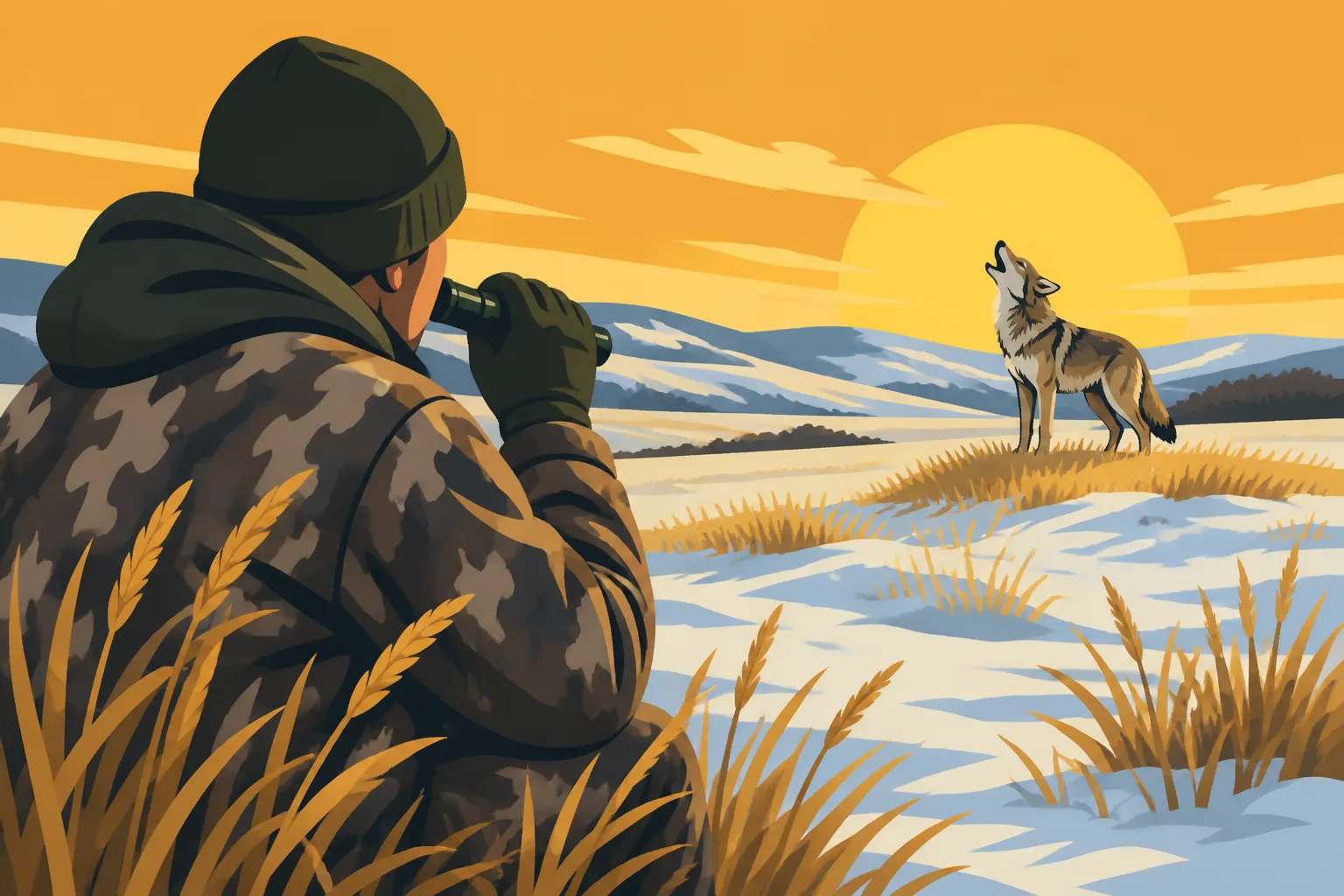
Coyote Calling on Winter Grassland
The biting wind whips across the vast, snow-covered plains, making every breath a frosty challenge. You've hiked for miles, carefully picked your spot, and started your call sequence, only to be met with deafening silence. It’s frustrating when you put in the effort during the bitter Nebraska winter and the coyotes seem to vanish. This comprehensive guide is here to walk you through the nuances of successful coyote calling on winter grassland, covering everything from understanding their behavior to advanced calling techniques, so you can increase your odds of success even when the mercury drops.
Understanding Winter Coyote Behavior on Nebraska Grassland
Winter transforms the Nebraska landscape into a stark, beautiful, but often unforgiving environment. For coyotes, it's a time of both challenge and opportunity, and understanding their motivations during these colder months is absolutely crucial for any successful calling strategy. Ignoring these subtle shifts in their behavior is a common pitfall that can leave hunters out in the cold, literally and figuratively.
Why Winter is Prime Time for Coyotes
Believe it or not, despite the harsh conditions, winter can be the best time to target coyotes. This is primarily due to a couple of key biological and environmental factors. First, winter marks the coyote breeding season, typically peaking from late January through March. This heightened hormonal activity means coyotes are more vocal, more territorial, and more inclined to seek out or respond to other coyotes. A lone male, driven by the urge to find a mate, might respond aggressively to perceived competition, or a pair might vocalize to reaffirm their bond or warn off intruders. Secondly, food scarcity becomes a real issue. The easy pickings of summer and fall are gone. Rodents are hunkered down, birds are harder to find, and deer, while present, are less vulnerable to a single coyote. This intense hunger makes them incredibly opportunistic; they're more likely to investigate a distress call, hoping for an easy meal. Finally, for those interested in the fur, winter pelts are at their thickest and most desirable, offering the best quality.
Reading the Winter Landscape for Coyote Sign
When the ground is blanketed in snow, it becomes a canvas for animal movement, and coyotes are no exception. Learning to "read" this canvas can save you countless hours of calling in barren areas. Look for clear, distinct tracks – coyotes typically walk in a straight line, placing their hind feet almost directly into their front prints, giving the impression of a single line of travel. Fresh tracks are your best friend; if you find them, you know coyotes are actively using that area. Beyond tracks, keep an eye out for scat, which often contains hair and bone fragments from their winter diet. You might even stumble upon old deer carcasses, or "winter kills," which are like magnets for scavengers, including coyotes. These spots are excellent places to set up. Think about natural travel corridors in open country: fence lines, the edges of shelterbelts, the bottoms of slight draws or coulees, and the fringes of frozen creeks. These are the highways coyotes use to move from bedding areas to feeding grounds. Pay particular attention to areas where the wind has cleared snow, exposing grass, as rodents might be more active there, drawing in coyotes. Utilize tools like the GoHunt app or other mapping software to identify these features from afar, allowing you to scout effectively without putting boots on the ground and leaving your scent.
Food Sources and Their Influence
As mentioned, food becomes a primary driver for coyotes in winter. While they are incredibly adaptable, they primarily target whatever is easiest to come by. In Nebraska's grasslands, this often means voles, mice, and other small rodents burrowing under the snow. Coyotes will "mouse" by pouncing on unseen prey, a clear indicator of their hunting strategy. Larger game, like cottontail rabbits or pheasants, become high-value targets, especially if they are weakened by cold or injury. This is why rabbit distress calls are so universally effective in winter – they tap into a coyote's primal need for calories. Don't forget about deer. While coyotes rarely take down a healthy adult deer, they are quick to scavenge deer carcasses from vehicle collisions, old gut piles from deer season, or winter-killed animals. These "honey holes" can attract coyotes from a wide area, so identifying them is a strategic advantage. When you're scouting, look for concentrations of tracks around these food sources. A good place to learn about these animals is by looking into How Many Coyotes Nebraska Has.
Essential Gear for Winter Coyote Calling in Nebraska
Heading out for coyotes in the dead of winter without the right gear is a recipe for a miserable, unproductive day. The elements alone are enough to send even the most hardened hunter packing. Having the right tools, especially when it comes to calls, optics, and personal comfort, significantly increases your chances of staying in the field longer and, more importantly, bringing home a coyote.
Calls: Electronic vs. Hand Calls
The heart of coyote calling is, of course, the call itself. You'll find two main categories: electronic calls and hand calls, both with their own strengths and weaknesses, especially in winter.
Electronic Calls: These are incredibly versatile, offering a wide array of sounds from various prey animals (rabbits, birds, rodents) to a full suite of coyote vocals (howls, barks, pup distress, challenges). Brands like Foxpro and Lucky Duck are popular choices among serious predator hunters for their sound quality and remote-control functionality. The ability to place the call away from your hiding spot, sometimes 50-100 yards, is a huge advantage. This draws the coyote's attention away from you, allowing for more natural approach angles and giving you precious extra seconds for a shot. In winter, having a remote means less movement on your part, which is crucial when trying to stay warm and concealed. They're also fantastic for broadcasting sounds across vast, open grasslands, making them heard from a greater distance.
Hand Calls: These include open-reed and closed-reed models. Open-reed calls are very versatile, allowing you to produce a wide range of distress sounds with practice. Closed-reed calls are simpler to use, often mimicking a specific animal like a jackrabbit. The main advantage of hand calls is their simplicity, reliability (no batteries to die in the cold!), and the intimate control you have over the sound. Some hunters prefer the raw, natural sound of a hand call, believing it can sound more authentic than an electronic counterpart. They are excellent for close-in work or when a subtle sound is needed. Many experienced callers carry a few hand calls as backup, or to add a unique tone that an electronic call might miss.
Regardless of your preference, selecting sounds that mimic prey animals active in winter (cottontails, jackrabbits, mice, pheasants) is key. Don't forget coyote vocals – howls are incredibly effective during the breeding season to locate coyotes or draw in curious or territorial individuals.
Here's a quick comparison:
| Feature | Electronic Calls | Hand Calls |
|---|---|---|
| Sound Variety | Extremely High (dozens to hundreds of sounds) | Moderate (depends on call type/skill) |
| Volume Control | Excellent (remote adjustment) | Manual (lung power, diaphragm control) |
| Placement | Can be placed away from hunter | Must be used by hunter |
| Ease of Use | Simple (press button for desired sound) | Requires practice and skill |
| Weather Impact | Batteries can drain faster in cold | No battery issues, can freeze if moist |
| Cost | Higher upfront cost ($100-$800+) | Lower cost ($10-$50 per call) |
| Versatility | Excellent for all distances and scenarios | Best for close to medium range, specific sounds |
Optics for Long-Range Detection
Nebraska's grasslands are vast and open, meaning coyotes can often be spotted at incredible distances before they ever get within calling range. This is where quality optics become indispensable. You don't want to spend precious calling time only to discover coyotes were watching you from a half-mile away.
Binoculars: A good pair of 10×42 binoculars is the workhorse of any predator hunter. They allow you to sweep the horizon, identify subtle movements, and confirm what you're seeing. Look for good low-light performance to aid in the crucial first and last hours of the day. They're essential for spotting coyotes making their way to your calls. Check out a detailed guide on Optics for Glassing the Nebraska Sandhills for more insights.
Spotting Scopes: While not always necessary, a spotting scope (15-45x or 20-60x) can be a game-changer when trying to determine if that distant speck is a coyote, a deer, or just a clump of grass. It's particularly useful if you're hunting in areas with a lot of undulating terrain or when trying to judge the direction of travel of an approaching coyote from far off.
Rangefinders: In open country, judging distance is notoriously difficult. A laser rangefinder is a non-negotiable piece of gear. You need to know the exact distance to potential shooting lanes, landmarks, and ultimately, to the coyote itself, to make an ethical shot. Many modern rangefinders also offer ballistic compensation, which can be invaluable in the wind-swept plains.
Investing in quality optics will pay dividends in increased awareness and more accurate shot placement.
Winter Clothing and Concealment
Staying warm and concealed isn't just about comfort; it's about remaining motionless and undetected. Coyotes have incredible eyesight, a keen sense of smell, and exceptional hearing.
Layering: The golden rule of winter hunting. Start with a moisture-wicking base layer to pull sweat away from your skin. Add insulating mid-layers (fleece, down, synthetic puffy jackets) to trap warmth. Your outer layer is critical. It needs to be windproof and water-resistant. The wind on the Nebraska plains can cut through you like a knife, so prioritize a good wind-blocking shell. Learn more about effective layering in Wind-Blocking Outerwear for the Plains.
Concealment: Snow camouflage patterns are ideal, but even plain white or light-colored outerwear can break up your silhouette against a snowy backdrop. A face mask or balaclava is essential, not just for warmth, but to hide your face and minimize movement. Don't forget gloves or mittens. A large, well-placed patch of sagebrush, a snow drift, or a small ground blind can provide critical concealment. Consider how you'll move to your stand and set up without exposing yourself. Setting up on a slight rise can give you a better view, but also makes you more visible. Sometimes a low-profile ground blind, brushed in with local vegetation, offers the best concealment, especially on private land or specific public access areas. Learn more about Using a Ground Blind on Nebraska Public Ground effectively.
Footwear: Your feet will be the first to get cold. Invest in high-quality, insulated, waterproof boots. You'll be sitting still for extended periods, and poor footwear will end your hunt prematurely. If you anticipate long walks, find boots that offer a good balance of warmth and comfort. Take a look at Insulated Boots for a Firearm Season Sit for excellent advice on keeping your feet warm.
Strategic Setups for Nebraska's Winter Grasslands
The vast, open nature of Nebraska's winter grasslands demands a highly strategic approach to coyote calling. You can't just plop down anywhere and expect success. Every element of your setup, from your approach to your hiding spot, must be meticulously planned to account for the coyote's acute senses and the environmental conditions.
Choosing Your Stand Location
Selecting the right spot for your stand is arguably the most critical decision you'll make. This isn't just about finding a good hiding spot; it's about orchestrating the coyote's approach.
Wind Direction is Paramount: Coyotes will almost always circle downwind to scent check the call, trying to confirm if the distress is real and safe. You must position yourself with the wind blowing from the direction you expect the coyote to come, across your shooting lane, and then into the cover behind you. This allows you to spot them as they try to get downwind of your call. Never let the wind blow your scent into the area where you expect coyotes to come from or travel through. This is where scouting tools like GoHunt, with their integrated wind mapping, become invaluable for planning your approach and setup before you even step out of the truck. Understanding Wind Direction on Open Nebraska Prairie Stands is vital for success.
Visibility and Terrain: Look for locations that offer a good, unobstructed view of the surrounding terrain, ideally 200-400 yards in all directions. Gentle rises, the crests of rolling hills, or the edge of a wide, shallow draw can provide this advantage. However, balance visibility with concealment. A few scattered yucca plants, a small cluster of cedars, or even a large hay bale can offer the crucial breakup of your silhouette. Avoid standing right on top of a hill; instead, position yourself just below the crest, looking out, allowing you to shoot over the top while staying hidden. Consider the sun's position – never sit with the sun directly at your back, silhouetting you. Instead, try to have the sun in the coyote's eyes during their approach.
Natural Features: Keep an eye out for natural funnels or pinch points in the landscape. A narrow draw, a sparse line of brush, or a low spot between two rises can concentrate coyote movement. Setting up near these features can dramatically increase your chances. Also, look for any elevated vantage points that might serve as a "coyote magnet" or a good place for them to stop and survey before committing.
Approaching and Exiting Without Spooking
Getting to your stand and leaving it undetected is just as important as the calling itself. Coyotes are incredibly wary, especially in areas with hunting pressure.
Stealth is Key: Move slowly and quietly. In snow, every crunch is magnified. If possible, walk on bare patches of grass or follow game trails where the snow is packed down. Avoid breaking twigs or rustling tall grass.
Scent Control: While complete scent elimination is nearly impossible, minimizing your scent is crucial. Wear clean hunting clothes, store them in scent-free containers, and use scent-eliminating sprays. Your human odor is a dead giveaway, especially when the air is cold and carries scent effectively. Always approach from a direction that keeps your scent out of the primary calling area.
Using Terrain for Cover: Just as you use terrain for your stand, use it to conceal your approach and exit. Walk through draws, stay behind rises, and use any available cover to break up your outline. Never walk directly across an open field to your stand if there's an alternative. Planning your entry and exit routes using detailed maps (like those found on GoHunt or other mapping apps) is essential before you even leave your vehicle. Once you’re in your spot, remain still and quiet, minimizing movement, especially sudden, jerky motions.
Decoy Usage and Placement
Decoys can be a powerful tool to draw a coyote's attention away from your actual position and give them something visual to focus on, increasing their commitment to the call.
Motion Decoys: These are perhaps the most effective. A small, battery-operated decoy that spins or flutters, mimicking a wounded bird or rabbit, can be irresistible to a curious or hungry coyote. Place it 20-50 yards in front of your position, slightly upwind of your electronic call (if using one). The movement gives the coyote a visual focal point, making them less likely to stare directly at your hide.
Rabbit or Bird Decoys: Simple, static decoys of a rabbit or a pheasant can also work, especially when combined with a distress call. While they lack movement, they still provide a visual confirmation of the sound. Place these in a visible spot where an approaching coyote can easily see them.
Placement Strategy: The key is to place your decoy where it will be seen by the approaching coyote but not directly in front of you. This forces the coyote to focus on the decoy, often approaching it from the side or slightly downwind, allowing you to get a shot as it closes in. Experiment with distances; sometimes a closer decoy works better, other times a slightly further one. The main goal is to shift their focus and give them a target other than your well-hidden self.
Effective Calling Sequences and Tactics
Once you're set up, the real art begins: the calling itself. This is where you leverage your understanding of coyote behavior, your gear, and the environment to lure a wary predator into shooting range. It's not just about making noise; it's about telling a convincing story.
Starting the Sequence: Distress Calls
The vast majority of successful winter coyote hunts start with a distress call. This taps into the coyote's strongest instinct: the need for an easy meal.
Choosing Your Distress: Rabbit distress (cottontail, jackrabbit) is almost always a solid choice. These are high-calorie meals, and coyotes are constantly seeking them out in winter. Bird distress calls (pheasant, crow, magpie) can also be highly effective, especially if you're hunting near known bird cover. Rodent distress (mice, voles) can work well for coyotes focused on smaller prey, but might not carry as far across open country.
Call Duration and Pauses: Don't just blast away continuously. A typical sequence might involve 45-60 seconds of calling, followed by 1-3 minutes of silence. During the silence, remain absolutely motionless and scan the entire area, especially downwind. Coyotes can come in quickly and silently. Repeat this sequence for 15-25 minutes. If nothing shows up, you can try switching to a different distress sound or adding some coyote vocals. The initial calling should be loud enough to grab attention but not so loud it sounds unnatural or spooks them. Adjust volume for the conditions; in high winds, you might need more volume. This is where an electronic call with remote volume control truly shines. When you are looking for specific tactics for calling, sometimes you might need to adjust your Rattling Volume for Open Country depending on the sound you are making, even for predators.
Mid-Sequence: Coyote Vocals
If distress calls aren't immediately effective, or if you're trying to locate coyotes, integrate coyote vocals into your sequence. This is particularly potent during the breeding season.
Howls: Lonewolf howls or interrogation howls can be used to locate coyotes. Start with a couple of howls and listen for a response. If you get one, you know there are coyotes in the area, and you can then switch to distress or more aggressive coyote vocals. Challenge howls (short, sharp barks ending in a howl) can infuriate a territorial male, bringing him in to investigate.
Ki-Yis and Pup Distress: These calls mimic a coyote in pain or a lost pup. A female, especially, might respond aggressively to a pup distress call, coming to investigate or protect her territory. A series of short, sharp ki-yis can sound like a fight, attracting curious coyotes.
When to Use: Use howls initially to locate, or after 10-15 minutes of distress calls without a response. Use challenge howls sparingly and judiciously; they can either bring a coyote charging in or send a timid one running. Pup distress is excellent if you suspect a den or if you're trying to draw out a protective female.
Reading Coyote Response and Adjusting
This is where experience really comes into play. You need to be constantly observing and ready to adapt.
What to Look For: Watch for coyotes trotting in, often pausing to listen. They might circle widely downwind, trying to catch your scent. Sometimes, they'll simply appear, having used terrain to conceal their approach. Look for head cocks, ears swiveling, and the distinct gait of an animal on a mission.
Adjusting Volume and Call Type: If a coyote hangs up at a distance, try decreasing the volume of your distress call to make it sound like the "injured" animal is getting weaker. Sometimes, a series of soft whimpers or mouse squeaks can be the final trigger to bring them into range. If they seem hesitant, a soft, seductive howl might draw them in. If they're coming in hard, maintain the distress call but be ready for the shot. Don't be afraid to switch calls entirely if one isn't working – a rabbit distress might not grab them, but a bird distress might. If you are struggling with finding suitable land, the Nebraska Public Access Atlas can be an invaluable resource.
Shot Placement and Follow-Up
Ethical hunting dictates a quick, clean kill. For coyotes, this typically means a shot to the chest, aiming for the vitals (heart/lungs).
Rifle Choice: For Nebraska's open grasslands, a rifle chambered in a flat-shooting caliber is ideal. Common choices include .204 Ruger, .223 Remington, .22-250 Remington, 6.5 Grendel, or .243 Winchester. These offer the velocity and accuracy needed for longer shots often encountered on the plains. Learn more about effective firearms in Rifle Setups for Nebraska's Open Country.
Precision: Take your time, if possible, to ensure a well-placed shot. Use shooting sticks, a bipod, or even a backpack to steady your rifle.
Follow-Up: Coyotes are tough animals. If a coyote doesn't drop immediately, be prepared for a quick follow-up shot. Never assume it's dead until you've confirmed it. If it runs, mark the last spot you saw it and immediately begin tracking. In snow, tracking is often easier, but they can cover ground quickly.
Coyote calling in winter is challenging, but incredibly rewarding. By understanding their behavior, preparing with the right gear, strategically setting up, and mastering your calling sequences, you'll greatly increase your chances of success on the vast, beautiful grasslands of Nebraska.
Disclaimer
Hunting carries inherent risks, and conditions in the field can change rapidly. Always prioritize safety, follow all local and state regulations, and respect wildlife. The information provided in this guide is for informational purposes only and should not be considered a substitute for professional instruction or personal experience. Always confirm current regulations with the Nebraska Game and Parks Commission before heading afield.