Thermal and Night Vision Rules in Nebraska
It's an age-old desire for hunters: to see clearly in the dim light of dawn or the deepening shadows of dusk. With modern thermal and night vision technology, the ability to pierce the veil of darkness feels within reach, offering a tantalizing glimpse into a nocturnal world. However, many Nebraska hunters quickly discover a frustrating disconnect between what technology can do and what the law allows them to do when pursuing game here. This guide will clarify the specific regulations around thermal and night vision devices for hunting in Nebraska, helping you understand where these exciting tools fit—and where they absolutely don't.
The Allure and Limitations of Low-Light Optics
The moment you look through a modern thermal or night vision device, it feels like magic. What was once impenetrable darkness becomes clear, animals glow with heat signatures, and hidden movements are revealed. It's a powerful experience, and it's completely natural for hunters to wonder how they can integrate such game-changing technology into their pursuits. Yet, this is often where the reality of Nebraska's hunting laws steps in, creating a significant hurdle for those dreaming of extending their hunting hours.
Why Night Vision and Thermal Feel Like a Game Changer
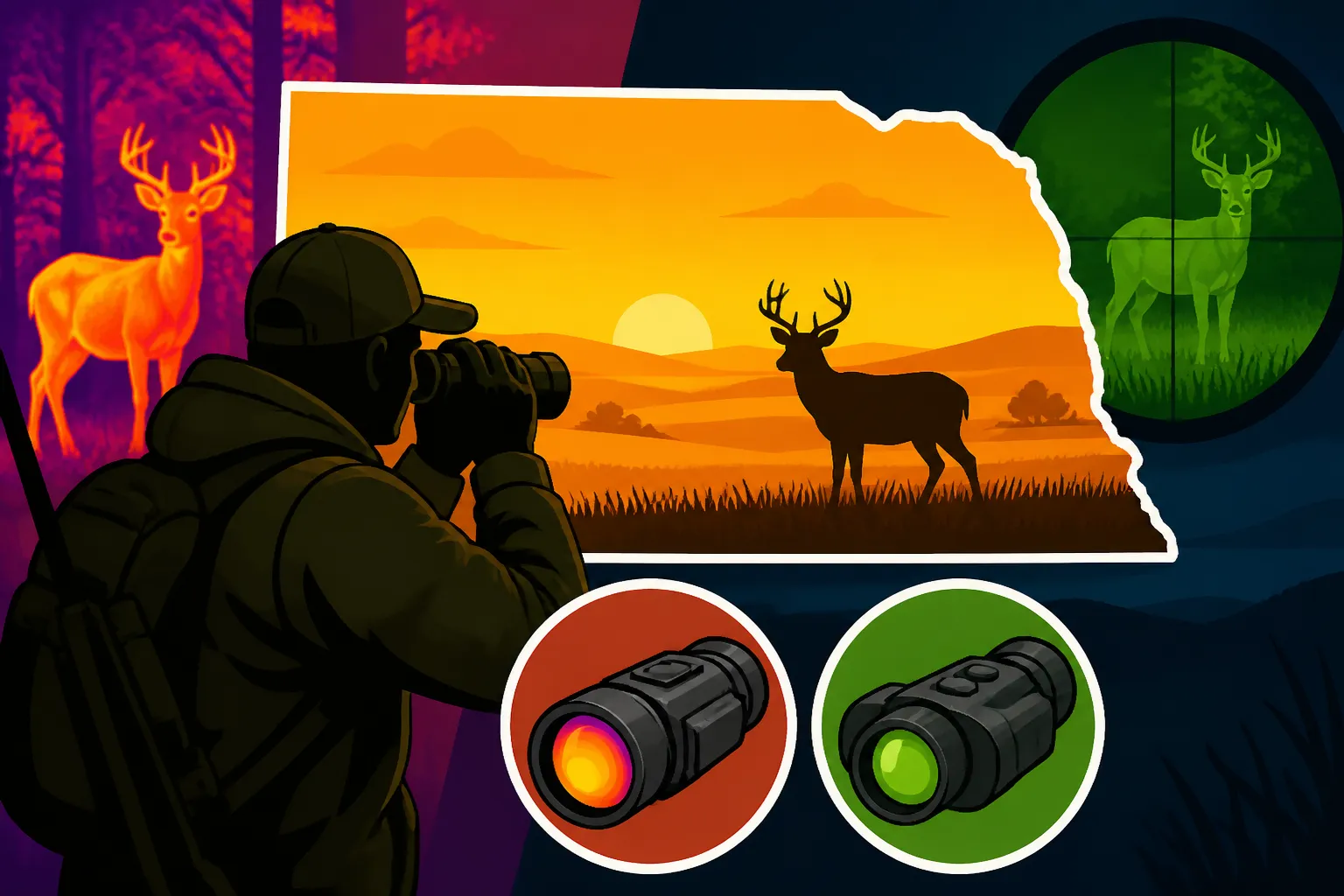
Imagine sitting in a blind, the last vestiges of daylight fading, knowing that deer are moving just out of sight in the thick timber. Or perhaps you're predator calling on a vast, open prairie, convinced there's a coyote approaching, but the darkness swallows all visible movement. This is precisely where thermal and night vision technology shines. Thermal imaging detects heat, allowing you to "see" animals through brush, fog, or even in complete darkness, long after the naked eye gives up. Night vision, on the other hand, amplifies ambient light, turning a moonlit field into a surprisingly clear landscape.
For hunters, these tools offer an undeniable advantage: enhanced situational awareness, the ability to locate downed game, and the potential to identify animals in challenging conditions. The thought of confidently identifying a target or tracking a wounded animal with such clarity, even after sunset, is incredibly appealing. It taps into a primal hunter's instinct to overcome environmental limitations.
The Slippery Slope of Ambiguity
One of the biggest frustrations for hunters considering these technologies is the perceived ambiguity or sheer complexity of the laws. You hear whispers that they're allowed for coyotes but not deer, or only on certain lands. It's easy to get caught up in rumors or misunderstandings, leading to hesitation or, worse, unintended violations. The reality is that wildlife regulations are often very specific, and what might be legal for one species or in one state could be strictly prohibited in another. Nebraska has its own distinct set of rules, and simply owning a thermal or night vision scope doesn't automatically grant you the right to use it in the field for all game. It's a critical distinction that can feel like a cold shower to those excited by the technology.
The line between observation and hunting, or between predator hunting and big game hunting, is often where this ambiguity seems to reside. Many hunters struggle to understand why a device that simply helps them see could be illegal. This confusion often stems from the core intent of game laws: to maintain fair chase principles, manage wildlife populations, and ensure public safety. Using technology that fundamentally alters the "rules" of the hunt, especially when it comes to vision in darkness, is often seen as crossing a line in conservation ethics and management.
Understanding Nebraska's Specific Regulations
Let's cut right to it. Nebraska's regulations regarding thermal and night vision devices are quite clear, though they do differentiate between game species. For most big game and birds, these devices are firmly in the "prohibited" category. However, there are exceptions, particularly for predators and furbearers, which is where many hunters get understandably confused. Always remember, ignorance of the law is no excuse, and checking the current Nebraska Game and Parks regulations annually is your absolute best defense against a costly mistake.
General Rules for Hunting at Night
When we talk about "hunting at night" in Nebraska, we're talking about anything outside of "legal shooting hours." Generally, Legal Shooting Hours are defined as 30 minutes before sunrise to 30 minutes after sunset. This is a crucial window for all legal hunting, and attempting to take game outside these hours is poaching, regardless of the equipment used.
For most game animals, including deer, elk, antelope, and all upland birds and waterfowl, the use of any artificial light or device that enhances vision at night (like thermal or night vision) is strictly forbidden for the purpose of hunting or locating game. This isn't just about shooting; it's about the act of hunting. So, even using a thermal scope to locate a deer after legal shooting hours, even if you don't intend to shoot it until morning, could be interpreted as an illegal act depending on the context and intent. The spirit of the law here is to keep big game hunting firmly within daylight hours, promoting fair chase and preventing unfair advantages.
Specifics for Deer, Elk, and Antelope
This is where many hunters are often disappointed: Thermal imaging and night vision devices are strictly prohibited for hunting or spotting deer, elk, or antelope in Nebraska at any time. This applies even during legal shooting hours. The intent is clear: these technologies provide an unfair advantage over these species, fundamentally altering the challenge of the hunt. This includes:
- Mounted on a firearm: You cannot have a thermal or night vision scope attached to your rifle, bow, or muzzleloader.
- Handheld devices: You cannot use handheld thermal binoculars or monoculars to locate or track these animals for hunting purposes.
- Any phase of the hunt: This isn't just about the shot. It applies to scouting, tracking, and attempting to harvest.
The law is designed to prevent hunters from gaining an unfair technological edge over big game species. So, if your goal is to pursue White-Tailed Deer Across Nebraska or Pronghorn Antelope on the Nebraska Plains, leave the thermal and night vision gear at home. Stick to traditional optics and rely on your scouting and fieldcraft.
Predator and Furbearer Exceptions
Here's the significant exception that often causes confusion: Thermal imaging and night vision devices are generally permitted when hunting predators (like coyotes, bobcats, and foxes) and furbearers outside of legal shooting hours in Nebraska. This is where technology enthusiasts can find an outlet for their gear.
The rationale behind this distinction is largely rooted in wildlife management. Predators are often managed differently than big game species. Their populations can be robust, and in some areas, landowners actively seek to reduce their numbers due to livestock depredation. Offering hunters more tools to pursue them can be a valuable management strategy.
However, even with predators, there are critical caveats:
- Species specific: This permission applies specifically to legally designated predators and furbearers. Do not assume it extends to other species.
- Local ordinances: Some cities or counties might have their own restrictions on discharging firearms at night, even for predators. Always check local laws.
- Public vs. Private Land: While generally allowed on private land with permission, be extremely cautious and verify rules for hunting predators at night on public lands. Some Wildlife Management Areas (WMAs) or federal lands might have specific restrictions on nighttime hunting or the use of artificial lights, even for predators. Always check the rules for the specific tract you intend to hunt. Resources like the Nebraska Public Access Atlas or mapping apps like GoHunt can help identify land ownership and regulations, but always verify directly with the managing agency.
- Method of take: You still must adhere to other legal methods of take. For instance, you can't use prohibited ammunition types, even for predators.
So, for a dedicated Coyote Calling in Nebraska Winter expedition, your thermal monocular or night vision scope could be a legitimate tool. Many hunters find that combining calls with thermal spotting dramatically increases their success rates in locating these wary animals after dark. You can use these devices to scan vast fields, pick up heat signatures, and identify incoming coyotes long before they'd be visible otherwise. This is a game-changer for night hunting predators. You might even find yourself calling them in closer than you thought possible, using the darkness as your concealment while your optic provides the advantage.
What Gear Is Permitted
Given the strict limitations on thermal and night vision for most hunting, it's vital to understand what tools are allowed. Nebraska hunters rely heavily on traditional optics and good old-fashioned fieldcraft to succeed, proving that skill and patience often trump technology.
Legal Lighting Options for Night Hunting
When it comes to artificial lights, the rules are again species-dependent, and this often ties back to predator hunting.
- For Big Game and Birds: Absolutely no artificial lights are allowed for hunting or spotting big game (deer, elk, antelope) or birds (pheasants, turkeys, waterfowl). This means no flashlights, headlamps, or vehicle lights for locating or pursuing these animals, even if not mounted to a weapon. The rule is broad to prevent any advantage gained from artificial illumination during their legal hunting hours.
- For Predators and Furbearers: When hunting predators and furbearers outside of legal shooting hours, the use of artificial lights (like powerful spotlights, headlamps, or weapon-mounted lights) is generally permitted. This is where predator hunters often utilize bright lights to spot and identify animals once they've been called in or located with other means. Many hunters use red or green filters on their lights, believing these colors are less alarming to coyotes and foxes. This allows hunters to visually confirm their target and ensure a clean shot once an animal responds to a call. This is perfectly legal when engaged in Predator Calling on the Nebraska Plains.
It's important to distinguish between using a flashlight for navigating to your stand in the dark before legal shooting hours, which is generally permissible for safety, and using it to actively locate or pursue game. The latter is illegal for big game.
Passive Optics and Their Limitations
For all legal hunting activities, traditional, passive optics are your bread and butter. These devices don't generate light or amplify it; they simply gather and magnify existing light.
- Binoculars and Spotting Scopes: High-quality binoculars are indispensable for hunting in Nebraska, especially when glassing vast landscapes like the Sandhills. For big game, particularly in open country, Optics for Glassing the Nebraska Sandhills can be the difference between spotting a distant buck and going home empty-handed. They are completely legal to use during legal shooting hours for any species. A good pair of 10×42 binoculars can help you pick apart distant cover, identify subtle movements, and judge trophy quality. Spotting scopes, often used on tripods, provide even greater magnification for detailed long-range observation, particularly useful for Judging a Mule Deer Buck in the Field or Judging Pronghorn Horn Length.
- Rifle Scopes: Standard rifle scopes with various magnifications are, of course, legal for hunting during legal shooting hours. While some modern scopes have illuminated reticles, this is typically for enhancing visibility of the reticle itself, not for illuminating the target or providing night vision capabilities. As long as the scope isn't amplifying ambient light to create a night vision effect or displaying thermal signatures, it's generally fine.
Hunters often invest significantly in these traditional optics because they are effective, legal, and truly enhance the hunting experience within the established rules. When you're spending hours sitting in a treestand or walking vast tracts of public ground, reliable binoculars and a clear rifle scope are crucial tools.
The Grey Areas and What to Avoid
While the rules are fairly explicit, some "grey areas" can trip up hunters. The main one relates to intent. If you have thermal or night vision gear with you while hunting big game, even if it's turned off or in your pack, you could potentially face questions from conservation officers if they suspect you intend to use it. The safest bet is to leave prohibited gear at home when hunting species for which it is illegal.
Another point of confusion can arise with advanced rifle scopes that offer multiple features. Some scopes might have digital reticles or low-light performance that approaches night vision. If a device has an "image intensifying" or "thermal" function, it falls under those prohibitions regardless of its other features. If in doubt, err on the side of caution and consult the current Nebraska Game and Parks regulations or contact them directly. A phone call can save you a significant fine and the loss of hunting privileges.
| Device Type | Permitted for Big Game (Deer, Elk, Antelope) | Permitted for Predators (Coyote, Bobcat, Fox) | Notes and Conditions |
|---|---|---|---|
| Thermal Imaging Scope (Weapon-Mounted) | PROHIBITED at all times | Generally PERMITTED for night hunting* | Must be for legal predator/furbearer hunting only. |
| Night Vision Scope (Weapon-Mounted) | PROHIBITED at all times | Generally PERMITTED for night hunting* | Must be for legal predator/furbearer hunting only. |
| Handheld Thermal/NV Monocular | PROHIBITED for hunting/locating | Generally PERMITTED for locating/hunting* | Cannot be used to locate big game for harvest. |
| Artificial Light (e.g., Spotlight, Weapon Light) | PROHIBITED for hunting/locating | Generally PERMITTED for night hunting* | Cannot be used to locate big game for harvest. |
| Standard Optical Rifle Scope | PERMITTED during legal hours | PERMITTED anytime (day/night) | Must not have image intensifying/thermal features. |
| Binoculars/Spotting Scope | PERMITTED during legal hours | PERMITTED anytime (day/night) | Passive optics only, no light amplification or thermal. |
*Note: Always consult the current Nebraska Game and Parks regulations for specific species, seasons, and unit restrictions. "Night hunting" for predators typically means outside legal shooting hours for big game (30 min after sunset to 30 min before sunrise). Verify specific public land rules before using these devices.
Responsible Hunting and Ethical Considerations
Beyond the letter of the law, every hunter has a responsibility to uphold ethical hunting practices and ensure safety. While technology advances, the core principles of fair chase and respect for wildlife remain paramount. This is especially true when discussing tools that can dramatically alter the balance between hunter and hunted.
Safety First: Beyond the Legalities
Even when using thermal or night vision for legal predator hunting, safety should be your absolute priority. Shooting at night, even with enhanced optics, introduces significant risks. Target identification becomes paramount. You need to be absolutely certain of your target and what lies beyond it. A thermal signature can tell you an animal is there, but it can't always tell you if it's a coyote, a domestic dog, or even a person walking in the distance.
- Positive Identification: Never take a shot unless you have 100% positive identification of your target. Use secondary optics, calls, and other methods to confirm what you're seeing.
- Backstop Awareness: Always know your backstop. In the dark, this is incredibly difficult to ascertain. Avoid shooting towards roads, buildings, or areas where people or livestock might be, even if they're not visible. The vast, open fields of Nebraska can offer good backstops, but terrain can change, and you might encounter obstacles or dwellings you didn't know were there.
- Working with a Partner: For night predator hunting, having a partner can greatly enhance safety. One person can operate a light, another the thermal, and both can help confirm targets and observe surroundings.
- Legal Firearms for Nebraska Deer or predators must always be handled with the utmost care, especially in low-light conditions.
Remember, technology is a tool, not a substitute for sound judgment and adherence to the fundamental rules of firearm safety.
Planning Your Hunt Within the Rules
Thoughtful planning is the bedrock of any successful and ethical hunt. For Nebraska hunters, this means meticulously understanding the species you're pursuing, the season dates, and the specific regulations that apply to your chosen gear.
- Know Your Species: Double-check whether the species you're targeting falls under the "big game" category (where thermal/NV is prohibited) or "predator/furbearer" category (where it's generally allowed at night).
- Check Seasons: Even for predators, there can be specific seasons or bag limits. Always consult the most current regulations from Nebraska Game and Parks.
- Understand Legal Shooting Hours: This is critical. For big game, adhere strictly to Legal Shooting Hours. For predators, understand when you are legally allowed to hunt at night.
- Scouting is Key: Regardless of the technology, effective scouting is invaluable. Even for predator hunting with thermal, knowing the terrain, common travel routes, and potential hiding spots during the day will make your night hunt far more productive and safer. Scouting Nebraska Public Ground Before Opening Day or even private land is a skill that pays dividends. You can use mapping applications like GoHunt to study topographical maps, aerial imagery, and property boundaries to identify optimal calling locations and understand your surroundings, which is especially important before heading out in the dark.
- Permit Requirements: Make sure you have all necessary permits. Even for predators, a valid hunt permit is required. For example, understanding Nebraska Big Game Permits and How to Get One ensures you're legally pursuing any big game opportunities you might have.
By taking the time to plan thoroughly and understand the nuances of Nebraska's hunting laws, you can integrate modern tools responsibly into your hunting repertoire, or simply reaffirm your commitment to traditional methods, all while upholding the proud heritage of ethical hunting.
Disclaimer
This article is for general informational purposes only and does not constitute professional advice. Laws, prices and regulations vary by location and change over time. Consult a qualified professional for guidance on your specific situation.