Zeroing at 200 Yards
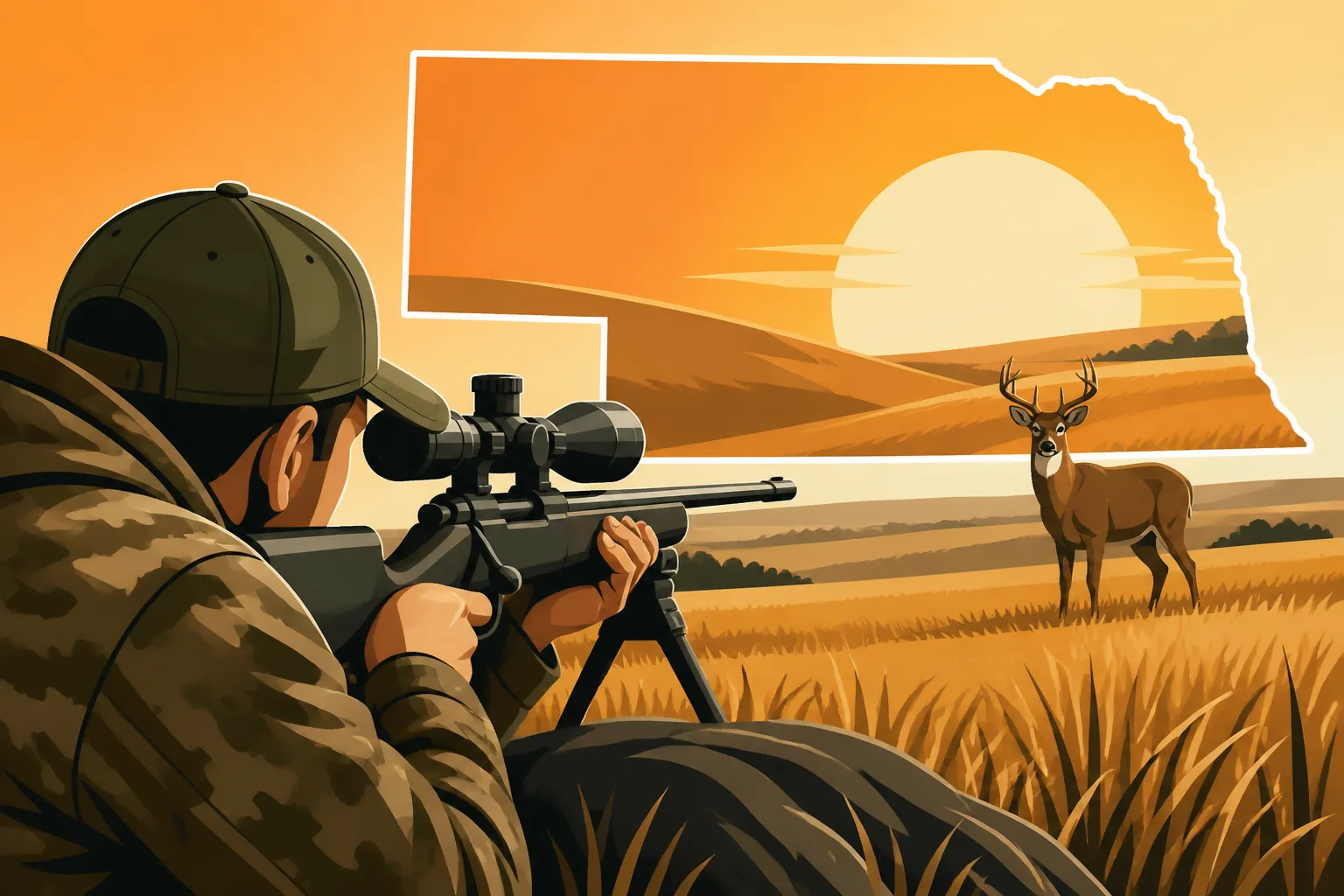
It's a familiar scenario for many Nebraska hunters: you spend a solid afternoon at the range, meticulously zeroing your rifle at 100 yards, feeling confident. Then, opening morning rolls around, and you're faced with a big mule deer buck or a pronghorn antelope standing at 250 yards across a wide-open prairie. Suddenly, that 100-yard zero feels a little… insufficient. The truth is, while a 100-yard zero works great in thick timber or for shorter brushy shots, much of Nebraska's hunting landscape demands a different approach. This guide is all about tackling that challenge head-on by walking you through the why and how of zeroing your rifle at 200 yards, preparing you for those longer, more common shots you'll encounter in the Cornhusker State's vast country.
Why 200-Yard Zero Makes Sense for Nebraska Hunting
Let's be honest, Nebraska isn't known for its dense, dark forests. While we certainly have our share of fantastic river bottom timber and cedar draws, much of the prime hunting ground, especially out west and in the Sandhills, is wide open. This expansive terrain dramatically changes the average shot distance you might expect compared to states with heavier cover.
The Reality of Open Country Shots
Think about it: when you're glassing the vast, rolling hills of the Sandhills for a mule deer, or scanning the high plains for antelope, those animals aren't always going to present themselves at a tidy 75 yards. It's far more common to spot them at 200, 300, or even 400 yards. The same goes for hunting the numerous open fields and vast tracts of public land available through programs like Open Fields and Waters. Deer might be feeding on a pivot corner, or moving along a distant fenceline, well beyond that comfortable 100-yard mark. If your rifle is zeroed at 100 yards, by the time your bullet reaches 200 or 250 yards, you're already dealing with significant bullet drop. This means you have to guess at holdover, which introduces more variables and less precision, increasing the risk of a wounded animal. For more on setting up your rifle for these conditions, check out Rifle Setups for Nebraska's Open Country.
This isn't just about deer and antelope, either. Predator hunters, especially those calling coyotes on the Nebraska plains, often face similar long-range scenarios. A yote might hang up at 250 yards, wary of approaching the call. Having a rifle effectively zeroed for these distances puts you in a much better position for a clean, ethical shot. It’s about being prepared for what Nebraska hunting actually presents, rather than hoping every animal walks into your personal 100-yard bubble.
Flattening Your Trajectory for Ethical Kills
The beauty of a 200-yard zero is that it effectively "flattens" your bullet's trajectory for a significant portion of its flight path. Instead of your bullet constantly dropping after 100 yards, a 200-yard zero means your bullet actually rises above your line of sight slightly between 50 and 150 yards, only to cross your line of sight again at 200 yards. This creates what's often called a "point-blank range" where you can aim dead-on at the animal's vitals for a wide range of distances without needing to adjust your aim.
Consider a typical hunting cartridge, like a .308 Winchester or a .270 Winchester. With a 100-yard zero, you might be looking at 6-8 inches of drop at 250 yards, and even more at 300. That's a lot of estimation, especially when an animal's vital zone is only 8-10 inches tall. With a 200-yard zero, that same bullet might only be 2-3 inches high at 100-125 yards, and then perfectly on target at 200. At 250 yards, you might only be dealing with a 2-4 inch drop, which is much more manageable within the vital zone. This larger margin for error within the vital zone significantly increases your chances of an ethical, one-shot kill. It minimizes the mental gymnastics of holdover in the heat of the moment, allowing you to focus on a steady aim and good trigger control. For more on understanding ballistic performance in our region, Rifle Ranges Realistic on the Nebraska Prairie offers great insights.
The Practical Steps to Zeroing at 200 Yards
Now that we understand why a 200-yard zero is so beneficial for Nebraska hunters, let's talk about the how. It's a straightforward process, but it requires patience, attention to detail, and a commitment to precision.
Starting with a 100-Yard Confirmation (or Bore Sight)
Before you even think about putting lead downrange at 200 yards, you need to ensure your rifle is hitting something at a closer distance. Trying to go straight to 200 yards with an un-zeroed rifle is a recipe for wasted ammunition and endless frustration. I've seen it many times at the range – hunters burning through boxes of expensive ammo, hitting nothing but dirt because they didn't take this crucial first step.
The absolute best way to start is with a good bore sight. You can use a laser bore sighter, or if your rifle allows, manually bore sight by removing the bolt and looking down the barrel at a target at 25 yards. Align the bore with the center of the target, then adjust your scope's crosshairs to match. This will get you "on paper" quickly.
Once bore-sighted, or if you're skipping bore-sighting, start at 100 yards. Shoot a three-shot group. Assess where your shots are hitting relative to your aim point. If your group is consistently low and left, you'll adjust your scope up and right. Most scopes adjust in 1/4 MOA (Minute of Angle) clicks, meaning one click moves your point of impact 1/4 inch at 100 yards. So, if you're 4 inches low, you need 16 clicks up. Make your adjustments, then shoot another three-shot group to confirm. Repeat until you are consistently hitting the bullseye or very close to it at 100 yards. This ensures you're sighted in enough to confidently move back to 200 yards. This initial process is where many hunters make mistakes, leading to problems later. Always confirm your 100-yard zero first.
The Move to the 200-Yard Line and Fine-Tuning
With a solid 100-yard zero established, it's time to transition to the 200-yard line. This is where the real work of establishing your primary zero happens. Set up your target at 200 yards, ideally a large target with a clear aiming point.
Take your time and use a stable shooting platform. A quality bipod combined with a rear bag, or a full shooting rest system, is essential for eliminating as much human error as possible. Focus on consistent shooting fundamentals: a natural point of aim, a controlled breath, and a smooth, deliberate trigger squeeze. Any flinch or inconsistent hold will be magnified at 200 yards, making it much harder to pinpoint your impact.
Fire a three-shot group, aiming precisely at your chosen target point. Remember, since you're coming from a 100-yard zero, your shots will likely be low at 200 yards. Based on your cartridge's ballistics, they might be anywhere from 2 to 6 inches low. Once you have a tight group, adjust your scope to bring those impacts up to your desired aim point. For a 200-yard zero, you want your bullet to hit precisely where you aim at 200 yards. This might mean adjusting up several clicks compared to your 100-yard zero. Again, shoot another group to confirm your adjustments. Repeat as necessary until your groups are centered precisely at 200 yards. This takes patience, but it's crucial. For advice on specific calibers, you might want to read Choosing a Rifle Caliber for Nebraska Deer.
Accounting for Environmental Factors
Nebraska's weather can be, shall we say, "character-building." These conditions can absolutely affect your bullet's flight path, especially at longer distances.
- Wind: Oh, the wind. It's the bane of every open-country hunter's existence in Nebraska. Ideally, you want to zero your rifle on a calm day, or at least a day with very light and consistent wind. Zeroing in a howling crosswind will just lead to frustration and a zero that's only accurate for that specific wind condition. Once you have your zero, you must practice shooting in various wind conditions to understand how your specific bullet drifts. A 10 mph crosswind can push a bullet several inches at 200 yards, and significantly more at 300 or 400. Knowing your bullet's wind drift is just as important as knowing its drop. Reading Wind on the Nebraska Plains is an excellent resource for this.
- Temperature and Humidity: While less impactful than wind, significant changes in temperature and humidity can slightly alter your bullet's trajectory. A much colder day will typically result in slightly slower muzzle velocities and a bit more drop. For most hunting scenarios, these effects are minor enough at 200 yards not to require re-zeroing, but it's good to be aware of them, especially if you're a long-range enthusiast pushing beyond 400 yards.
- Altitude: Nebraska generally doesn't have drastic altitude changes that would significantly affect your zero. While higher altitudes mean thinner air and less bullet drag, the difference between, say, the Missouri River valley and the Pine Ridge isn't enough to dramatically alter a 200-yard zero for most hunting calibers. Again, more of a concern for extreme long-range shooting.
Understanding Your Ballistics Beyond 200 Yards
Zeroing at 200 yards is a fantastic foundation, but Nebraska's open terrain means you'll often encounter shots beyond that distance. To be truly effective and ethical, you need to understand what your bullet does at 250, 300, 350 yards, and even further.
The Importance of a Ballistic Calculator
Gone are the days when a simple drop chart taped to your stock was enough. Modern hunting demands a deeper understanding of your bullet's path, and that's where a good ballistic calculator comes in. These tools are indispensable. They take your specific cartridge, bullet data (weight, ballistic coefficient), muzzle velocity, zero distance, and environmental conditions (temperature, humidity, altitude, wind speed, and direction) to predict precisely where your bullet will impact at any given range.
Many excellent ballistic apps are available for smartphones, and some online platforms offer comprehensive calculators. You'll need to input accurate data for your load; don't just guess your muzzle velocity. Chronograph your rifle if possible, or use the manufacturer's stated velocity for your specific ammunition, then verify with actual shooting. Resources like GoHunt provide fantastic mapping tools and often integrate or recommend ballistic solutions that can help you plan your shots on unfamiliar terrain. Knowing your trajectory beyond 200 yards is critical for confident and ethical shot placement. For more on the tools that can help you out here, consider Rangefinders in Open Nebraska Country.
| Range (yards) | 100-yard Zero (inches low) | 200-yard Zero (inches low/high) |
|---|---|---|
| 50 | -0.5 | +1.0 |
| 100 | 0 | +2.5 |
| 150 | -2.0 | +2.0 |
| 200 | -5.0 | 0 |
| 250 | -9.5 | -3.5 |
| 300 | -15.5 | -9.0 |
| 350 | -23.0 | -16.0 |
| 400 | -32.5 | -25.5 |
(Example for a hypothetical .308 Win, 150gr bullet, 2800 fps muzzle velocity)
This table illustrates the significant advantage of a 200-yard zero, showing how much less holdover is required at intermediate to longer ranges.
Holdover Versus Dialing for Longer Shots
Once you understand your bullet's trajectory beyond your 200-yard zero, you have two primary methods for making those longer shots: holdover or dialing.
- Holdover: This involves using the reticle in your scope to aim "high" on the target, compensating for bullet drop. Many modern hunting scopes feature BDC (Bullet Drop Compensating) reticles with multiple aiming points for different distances. The advantage of holdover is speed – you don't have to fiddle with turrets, which can be critical when an animal might only offer a brief window of opportunity. However, it's generally less precise than dialing, as the hash marks on BDC reticles are often calibrated for specific cartridges and may not perfectly match your load. It requires a lot of practice to accurately use a BDC reticle in varying conditions. It's often best for shots out to about 300-350 yards, depending on your comfort level and the reticle.
- Dialing: This method involves adjusting your scope's elevation turret to raise your point of impact for a longer shot. For instance, if your ballistic calculator tells you that at 350 yards your bullet drops 16 inches with a 200-yard zero, and your scope adjusts at 1/4 MOA per click, you'd dial up a certain number of clicks to bring your crosshairs back to the target. Dialing is generally more precise, especially at longer ranges (beyond 350-400 yards), as it accounts for exact bullet drop. The downside is that it takes more time and requires you to know the exact distance to the target (which necessitates a rangefinder) and your ballistic data. This method is best for stationary animals, or when you have ample time to make your adjustments. For tips on choosing the right glass, check out Rifle Scopes for Long Nebraska Shots.
Many hunters find a hybrid approach works best: using holdover for quicker shots out to moderate distances (e.g., 300-350 yards) and reserving dialing for longer, more deliberate engagements when time allows.
Practice, Practice, Practice
Establishing a 200-yard zero is an excellent first step, but it's only the beginning. Ethical hunting, especially in challenging open-country environments like Nebraska, demands that you truly know your rifle, your ammunition, and your personal capabilities.
You must practice shooting at various distances beyond 200 yards. Don't just zero and assume. Get out to the range and shoot at 250, 300, 350, and even 400 yards. This isn't about becoming a benchrest shooter; it's about building confidence and understanding your bullet's real-world performance. You'll quickly learn how much wind drift affects your shot at 300 yards, or what a 5-inch holdover truly looks like through your scope. This kind of practice solidifies your ballistic knowledge and helps you make quick, accurate decisions in the field. Every time you transport your rifle, especially if flying, you should reconfirm your zero. This peace of mind is invaluable on a hunt.
Practice in different positions too. While bench shooting is great for zeroing, try shooting from prone, kneeling, or even using shooting sticks – positions you'll likely encounter in the field. This prepares you for real-world hunting scenarios where a perfect bench rest isn't always an option. Understanding your effective range is a personal journey, and it's far better to discover your limits at the range than in the field with an animal in your crosshairs.
Common Pitfalls and Troubleshooting
Even with the best intentions and equipment, zeroing and shooting at longer distances can present challenges. Being aware of common pitfalls can help you troubleshoot and avoid frustration.
The Wind Is Not Your Friend
I cannot stress this enough: wind is the single biggest factor that will throw your shots off in Nebraska's open country. It’s insidious because it can change direction and speed without you realizing it. A seemingly gentle breeze at your shooting bench can be a strong crosswind 200 yards downrange. Many missed shots, especially with lighter bullets, are attributed to wind.
Learning to read the wind is an art form. Look at mirage through your scope on hot days, watch grass and tree leaves, and observe how your bullet impacts downrange. Use a Kestrel or a similar device to get accurate wind speed readings. And most importantly, know your ballistic calculator's windage adjustments for your specific bullet. Even a perfectly zeroed rifle is only as accurate as your ability to compensate for the wind. For more specific strategies on dealing with this, check out Bullet Weight for Windy Conditions.
Equipment Issues and User Error
Sometimes, the problem isn't the zero itself, but something else entirely.
- Loose Scope Mounts: A common culprit! Even the slightest loosening of scope rings or base screws can cause inconsistent groups and impact shifts. Always check your scope mounts regularly, especially after a rough trip or if your rifle has taken a bump.
- Inconsistent Cheek Weld: If your head isn't consistently placed on the stock in the same position for every shot, your eye-to-scope alignment will change, leading to parallax errors or inconsistent point of impact. Practice a consistent, repeatable cheek weld.
- Flinching/Anticipating Recoil: This is a natural human reaction, but it ruins accuracy. Focus on a smooth trigger break and let the recoil happen. Dry firing can help you identify and overcome a flinch.
- Parallax: Make sure your scope's parallax is adjusted for the distance you're shooting. If it's not, moving your head slightly can cause your crosshairs to appear to move on the target, leading to misses.
- Poor Ammunition Consistency: While typically less of an issue with factory hunting ammo, sometimes a bad batch or inconsistent handloads can cause flyers. Stick with quality ammunition from reputable brands, and ideally, test a few different brands/bullet weights to find what your rifle shoots best.
- The Shooter, Not the Rifle: It's tough to admit, but often, the problem lies with the shooter, not the equipment or the zero. Be honest with yourself about your shooting technique. Are you jerking the trigger? Are you breathing erratically? Are you rushing the shot? Consistent shooting fundamentals are paramount.
When to Re-Confirm Your Zero
Your 200-yard zero isn't a "set it and forget it" proposition. There are several critical times when you absolutely must re-confirm your zero:
- Before Every Hunting Season: This is non-negotiable. Don't assume your rifle held its zero in the safe all year.
- After Transport: Whether it's a long drive in a truck, a flight, or even a rough ATV ride, jostling can affect your scope.
- If You Drop Your Rifle: Even a seemingly minor fall can knock a scope out of whack. Better safe than sorry.
- After Any Scope Adjustment or Removal: If you tighten rings, change a base, or remove and remount your scope, you need to re-zero.
- When Changing Ammunition: Different brands, bullet weights, and even different lots of the same ammunition can have different points of impact. Always re-zero when switching ammo.
- Mid-Season Check: If you've been doing a lot of hunting, especially if your rifle has seen some bumps and scrapes, a quick check at the range can offer peace of mind.
A well-established and regularly confirmed 200-yard zero provides immense confidence in the field. It allows you to focus on the hunt, knowing that when that buck or antelope steps out at 200, 250, or even 300 yards, you've done your part to ensure an ethical shot.
Disclaimer
This article is for general informational purposes only and does not constitute professional advice. Laws, prices and regulations vary by location and change over time. Consult a qualified professional for guidance on your specific situation.