Decoys for Nebraska’s Rainwater Basin Geese
The honk of Canada geese overhead is a sound that sets a hunter's heart racing, but getting those wary birds to commit to your spread in a place like Nebraska's Rainwater Basin can feel like trying to trick a seasoned chess master. The sheer volume of waterfowl here is incredible, yet the birds are educated, often seeing dozens of spreads a season. This guide will walk you through everything you need to know about selecting, setting up, and deploying decoys specifically for goose hunting in the challenging but rewarding environment of the Rainwater Basin.
Understanding the Rainwater Basin Goose Hunter's Challenge
Hunting geese in the Rainwater Basin is a unique experience that comes with its own set of trials and triumphs. This isn't your grandfather's goose hunting, where a few dozen decoys and a decent call might consistently pull birds in. Today's geese in this region are savvy, and they've seen it all, making your decoy strategy crucial to success.
The Wary Nature of Rainwater Basin Geese
Imagine flying thousands of miles, dodging predators, and navigating storms, only to arrive in a basin filled with hunters. That's the life of a goose passing through the Rainwater Basin. These birds quickly learn what's real and what's not. They've developed an uncanny ability to spot inconsistencies in a decoy spread from hundreds of yards up, often circling high, picking apart your setup for any sign of danger. This means your decoys need to be as realistic as possible, not just in appearance but in how they're arranged and how they interact with the environment. A single shiny surface or an unnatural pattern in your spread can be enough to send a flock veering off into the next county.
When geese are migrating through a heavily hunted area like the Rainwater Basin, they face constant pressure. They learn quickly to identify common hunting scenarios—the blocky shape of a layout blind, the static pose of cheap plastic decoys, or a repetitive calling sequence. This collective experience makes them incredibly wary, demanding a higher level of effort and sophistication from hunters. The birds become "decoy shy," meaning they've seen so many fake birds that they often react negatively to anything less than perfection. Hunters often talk about "ghosting" geese, where birds simply evaporate from the air after a brief look, never offering a shot. This constant challenge is precisely why understanding and mastering your decoy setup is paramount here.
The Unique Landscape of the Rainwater Basin
The Rainwater Basin is an ever-changing mosaic of shallow wetlands, often surrounded by agricultural fields—primarily corn and beans. This landscape dictates where geese will feed and rest, and consequently, where you'll need to set your decoys. Unlike river systems or large reservoirs, the water levels in the Basin's wetlands can fluctuate dramatically, sometimes from day to day, based on recent rainfall and drainage. This means a prime wetland spot one week might be bone dry the next, or a field that was perfect for feeding might now be flooded.
Successful hunting in the Rainwater Basin requires constant adaptation to these environmental shifts. A spread designed for a dry stubble field won't work on a sheet of shallow water, and vice-versa. You might find yourself hunting over ankle-deep water in a cattail slough one morning, and then setting up in a freshly harvested cornfield miles away that same afternoon. This variability impacts everything from the type of decoys you choose to the base you use for them, and even how quickly you can move your entire spread. Planning for different scenarios and having versatile decoys is a huge advantage. Furthermore, the generally flat and open nature of the Basin means there's often little natural cover to hide hunters, forcing extra attention on blind concealment and making the decoy spread the primary draw for incoming birds.
Choosing the Right Decoy Types for Rainwater Basin Geese
When you're dealing with educated geese in the Rainwater Basin, variety and realism in your decoy spread are key. You can't just toss out a dozen identical fakes and expect consistent results. Each type of decoy offers specific advantages that, when combined thoughtfully, can create a highly convincing illusion.
Full-Body Decoys: The Gold Standard for Realism
Full-body decoys are widely considered the most realistic option for goose hunting, especially for wary birds. These decoys replicate the exact size, shape, and even feather detail of actual geese, often incorporating different body postures like feeding, sentry, or resting. Their three-dimensional form is what truly sets them apart, making them visible and convincing from any angle, even from high altitudes where geese are doing their initial reconnaissance.
The key to full-body decoys' effectiveness lies in their ability to mimic the natural look of a relaxed flock. When geese see a spread of full-bodies, they see what appears to be other birds comfortably feeding or resting, signaling safety. Manufacturers like GoHunt often emphasize the anatomical accuracy and lifelike paint schemes of their full-body decoys, understanding that even subtle details can make a difference. While they are an investment in both cost and transport space, a solid spread of quality full-body decoys can drastically improve your chances of convincing cautious geese to drop their guard and commit to your landing zone. They are particularly effective in open fields, where their presence breaks up the flat monotony and provides a visible focal point for incoming birds.
Shell Decoys and Silhouettes: Volume and Versatility
While full-body decoys offer peak realism, shell decoys and silhouettes provide excellent ways to add volume and dynamic energy to your spread without breaking the bank or your back. Shell decoys are hollow, half-shelled replicas that sit on stakes or bases, offering a good compromise between realism and portability. Silhouettes, on the other hand, are flat, two-dimensional cutouts that depict geese in various poses.
Shells are fantastic for adding depth and numbers, especially in situations where you need to create a large "super spread" to attract birds from a distance. They are lighter and stackable, making them much easier to transport than full-bodies. When placed strategically among full-bodies, they can make your spread appear much larger and more active. Silhouettes excel in offering movement and breaking up the static look of a spread, especially on windy days when their subtle sway can be incredibly lifelike. They're also incredibly lightweight and portable, perfect for run-and-gun tactics or when you need to cover a vast field quickly. The trick with shells and silhouettes is to use them to create the illusion of a bigger flock, strategically placing them where they'll be seen effectively without revealing their two-dimensional nature from direct overhead approaches. For example, placing them further out from your kill hole can draw attention from high-flying birds, making them commit before they scrutinize the closer, more realistic full-bodies.
Adding Motion Decoys: Bringing Your Spread to Life
Static decoys, no matter how realistic, can only do so much. The missing ingredient is movement, and motion decoys are designed to provide just that. Geese are constantly shifting, feeding, and interacting within a flock, and replicating this natural activity is crucial for convincing wary birds. Motion decoys come in various forms, from simple flags and wind-activated "flipper" decoys to battery-operated flapping wings and even remote-controlled full-body decoys.
Flags are arguably the simplest and most effective motion decoy. A well-placed flag, waved rhythmically, can mimic a goose flapping its wings for landing or taking off, catching the attention of distant birds and signaling interest. Wind-activated decoys, such as those with spinning heads or subtle body movements, add natural, continuous motion that breaks up the static appearance of a spread. Battery-operated flying decoys, often mounted on poles, can simulate landing birds, drawing the eye and adding a dynamic element that geese find irresistible. However, remember the rules and regulations regarding electronic decoys; some areas or seasons might have restrictions. Using motion sparingly and realistically is key. Too much erratic movement can sometimes spook birds. A subtle nod, a gentle tail wag, or a slow flap is often more convincing than a frantic display. The goal is to make your spread look like a busy, thriving flock, not a puppet show.
Crafting Your Decoy Spread Strategy in the Rainwater Basin
Setting out decoys isn't just about throwing them randomly into a field; it's an art and a science, especially in the Rainwater Basin. The way you arrange your decoys can make or break your hunt. You need to think like a goose, anticipating their flight patterns, landing preferences, and what makes them feel safe.
Layouts for Field Hunting
Field hunting in the Rainwater Basin usually involves setting up in harvested corn, bean, or wheat stubble. Here, your spread needs to look like a feeding flock, with a safe landing zone. A common and highly effective strategy is the "U" or "J" shape, with the open end of the letter facing into the prevailing wind. This creates a natural pocket for incoming geese to land, right in front of your blinds.
Within this U or J, focus on creating natural-looking family groups. Geese typically feed in small clusters of 3-7 birds. Mix different full-body poses—feeders, sentries, and resting birds—to enhance realism. Place sentry decoys on the outer edges of your spread, looking up, as if guarding the feeding flock. The landing zone itself should be clear of decoys to give the birds a comfortable spot to commit. Consider using a few shell decoys or silhouettes to extend the spread further downwind or to the sides, giving the impression of a larger flock. Pay attention to how the wind will affect incoming birds; they almost always land into the wind. Your setup should funnel them directly into your shooting lane. Don't forget to blend your layout blinds seamlessly into the spread. Many hunters even place a few full-body decoys directly on or around their blinds to break up their outline, a tactic proven effective when hunting wary Rainwater Basin Wetlands.
Decoying Over Water
Hunting geese over water in the Rainwater Basin—whether it's a shallow sheet of rain runoff, a flooded field, or a more permanent wetland—presents different challenges and opportunities. Here, realism in the way your decoys float or stand in water is paramount. Geese often raft up on water to rest and feel secure, so replicating this behavior is key.
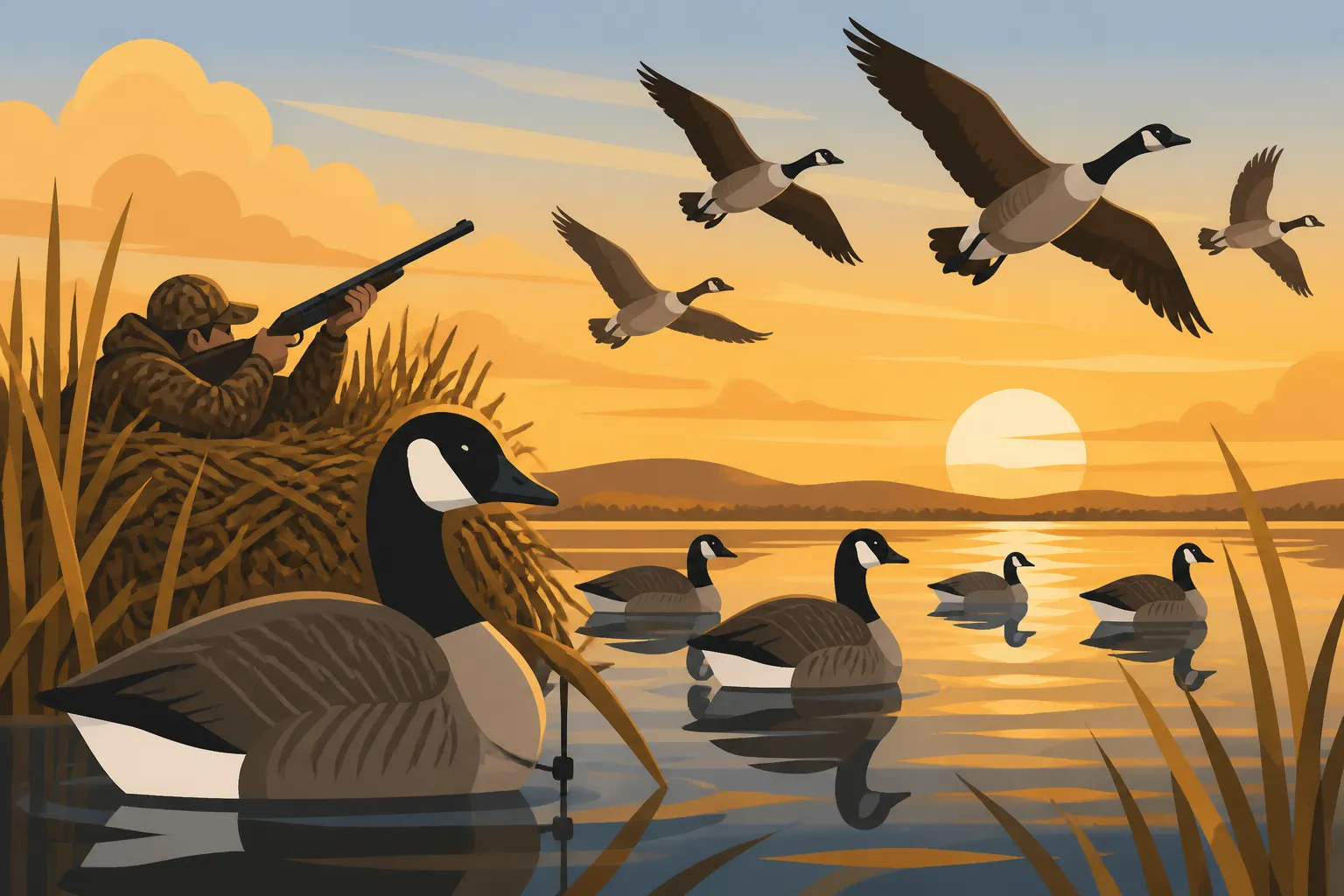
For water sets, individual decoys need to float naturally. Full-body floaters are excellent, as they present a three-dimensional profile. You can also use traditional shell decoys with stakes or bases that keep them just above the water level, simulating birds standing in shallow water. A common water spread involves creating several "rafts" or clusters of decoys, mimicking resting birds, with a large open area in the middle or to one side for a landing zone. Again, consider the wind: geese will approach and land into the wind, so position your landing zone accordingly. Incorporating some feeding or preening poses helps sell the idea of a relaxed flock. For deeper water, traditional floating decoys with keel weights work best. For very shallow sheet water, stake-style full bodies or shells are often preferred, as they look more like geese standing on the bottom. Remember that water can reflect light, so dull, non-glossy decoys are often more effective, especially on sunny days. Ensure your blinds are well camouflaged with natural vegetation from the area.
Numbers Game: How Many Decoys Do You Really Need?
The question of "how many decoys" is one that plagues every goose hunter, and in the Rainwater Basin, it's often a balance between desirability and practicality. There's a common saying in goose hunting: "You can never have too many decoys." While that might be true for attracting birds from a great distance, for committing wary birds, quality often trumps sheer quantity, especially when factoring in the effort of deployment and retrieval.
For small, informal hunts or highly pressured areas, a compact spread of 2-3 dozen ultra-realistic full-bodies might be more effective than 100 mediocre shells. These smaller, high-quality spreads focus on creating an undeniable illusion of safety. However, for open field hunting where you need to grab the attention of birds a mile away, a larger spread of 50-100+ decoys, often a mix of full-bodies, shells, and silhouettes, can be crucial. The "magic number" often depends on the specific scenario, the pressure the birds are under, and your personal hunting style. A good starting point for many Rainwater Basin hunters might be 4-6 dozen, with a strong emphasis on full-bodies and some motion. When planning your spread, consider how many hands you have to set up and tear down, as well as the size of your vehicle. A strong back and a good trailer can allow for much larger spreads, which can be an advantage when trying to entice Canada Geese in Nebraska.
Here's a quick comparison of decoy types:
| Decoy Type | Realism | Portability | Cost (Relative) | Ideal Use Case |
|---|---|---|---|---|
| Full-Body | High | Low | High | Close-in attraction, primary spread, field & shallow water |
| Shell Decoys | Medium | Medium | Medium | Adding volume, secondary spread, field & shallow water |
| Silhouettes | Low | High | Low | Adding bulk, subtle motion, distant visibility, field |
| Motion Decoys | N/A | Variable | Medium-High | Enhancing realism, attracting attention, all scenarios |
The Art of Concealment and Scouting
You can have the most realistic decoy spread in the world, but if the geese spot you or your blinds, the hunt is over before it begins. In the open landscapes of the Rainwater Basin, concealment is not just important; it's absolutely critical. Coupled with meticulous scouting, it forms the backbone of successful goose hunting.
Blending Your Blinds into the Landscape
Layout blinds are the workhorses of Rainwater Basin field hunting, allowing you to lie prone and pop up for a shot. However, their rectangular shape can stick out like a sore thumb in a flat field if not properly concealed. The key is to make your blind disappear into the surroundings, mimicking natural features or blending with the ground cover.
Start by choosing a blind that matches the general color of the field you're hunting—stubble patterns for cornfields, tan for dry grass. Then, brush in your blind. This isn't just throwing a few stalks on top; it means weaving natural vegetation into the stubble straps and netting of your blind. If you're in a cornfield, use cornstalks. In a bean field, use bean stubble. Take the time to break up the hard lines of the blind's profile, making it look like a natural mound of dirt or a pile of crop residue. Pay particular attention to the edges and the head portion, as these are often the most visible from above. Some hunters even spread a light layer of dirt or mud on their blinds to dull any synthetic sheen. Remember that geese have incredible eyesight, and even a slight shimmer or an unnatural shape can cause them to flare. For tips on specific blind techniques, check out Ground Blinds in Open Nebraska Country.
The Role of Scouting in Decoy Placement
Scouting is, without exaggeration, the single most important factor in consistent goose hunting success in the Rainwater Basin. You can have the best decoys and blinds, but if you're not where the geese want to be, you're just sightseeing. Scouting tells you precisely where the birds are feeding, where they're resting, and crucially, their flight paths.
Start by driving the area at dawn and dusk, looking for large flocks of geese feeding in fields or resting on water. Pay attention to the specific field corners they prefer, the type of crop they're in, and the direction they approach and depart. Tools like GoHunt or other mapping apps can help you identify land ownership and potential access points, though direct observation is irreplaceable. Once you've identified a hot spot, observe from a distance, noting exactly where the birds are landing within the field. This "X" marks the spot for your decoy spread. Note the wind direction on the day you scout; geese will land into the wind. This observation informs your spread's orientation. Without proper scouting, you're guessing, and guessing rarely works on these educated birds. A little extra time spent observing the previous day can save you hours of fruitless hunting and setup.
Advanced Decoy Tactics and Considerations
Once you've mastered the basics of decoy selection and placement, there are always more advanced techniques to consider that can further elevate your success in the demanding Rainwater Basin. These tactics often involve fine-tuning your spread, understanding goose behavior, and adapting to changing conditions.
Adding Movement Beyond Flags
While flags are effective, integrating other forms of motion can add layers of realism to your spread. Consider decoys that utilize wind-activated movement, such as those with spinning heads or subtly swaying bodies. These provide continuous, natural movement without requiring constant human interaction. Some hunters even employ remote-controlled full-body decoys that can pivot or "feed" with the flick of a switch, mimicking subtle shifts in a real flock.
Another often-overlooked form of movement comes from within your spread. If you're hunting with multiple people, assigning one or two hunters to "jiggle" a few nearby full-body decoys from inside their blinds can be incredibly effective. A slight shake of a decoy stake can create a ripple effect, making the entire spread appear more alive. Be subtle and realistic with this movement; frantic shaking will look unnatural. The goal is to make your spread look like a dynamic, living entity, not a collection of static plastic. Remember, geese are constantly moving, even subtly, when feeding or resting. Replicating this inherent restlessness is key to pulling in wary birds.
Calling and Decoy Synergy
Decoys and calling are two halves of a complete goose hunting strategy; they work best when used in synergy. Your calling should complement your decoy spread, telling a story to incoming birds. If your decoys are set up as a feeding flock, your calling should reflect feeding chatter—soft clucks, murmurs, and contented honks. If you're trying to attract high-flying birds, louder greeting calls might be in order, followed by softer, more inviting sounds as they approach.
Avoid over-calling, especially when birds are locked on and committed to your spread. Once they've decided to come in, let the decoys do the heavy lifting. Aggressive, loud calling can sometimes spook birds that are already convinced. Watch the birds' reactions closely. If they start to flare or pull away, reassess your calling. Perhaps a softer approach or even complete silence is needed. The goal is to sound like a natural, relaxed flock, not a desperate group of birds trying to lure them in. Some hunters even incorporate calls into their scouting, using the GoHunt platform to log observations about how geese respond to different calling patterns in various fields, helping them fine-tune their approach.
Adapting to Weather and Pressure
The weather in the Rainwater Basin can be unpredictable, and both weather and hunting pressure significantly impact goose behavior and your decoy strategy. On calm, clear days, geese have excellent visibility, making them even warier of unnatural spreads. On these days, focus on hyper-realism, ample spacing between decoys, and impeccable concealment. You might even consider reducing your spread size for a more intimate, less "busy" look that might appeal to small family groups.
Conversely, on windy or cloudy days, visibility is reduced, and geese might be more forgiving. They may fly lower and commit more readily. On these days, adding more motion decoys, like wind-activated flippers or flags, can be highly effective because the wind will naturally enhance their movement. Heavy winds can also make it harder for geese to approach a spread, so ensuring a clear, unobstructed landing zone is even more important. As the season progresses and hunting pressure mounts, geese become increasingly educated. This means smaller spreads, maximum realism, and flawless concealment become paramount. Late-season geese in the Rainwater Basin are arguably some of the toughest birds to decoy anywhere, requiring every trick in your arsenal. Don't be afraid to experiment and adjust your strategy based on the conditions you face on any given day. You'll also want to consider the overall Nebraska Waterfowl Seasons and Zones as pressure increases or decreases.
Maintaining and Transporting Your Decoys
Decoys are an investment, and proper care and transport are essential to ensure they remain effective and last for many seasons in the rugged conditions of the Rainwater Basin. Neglecting maintenance can quickly degrade their realism, while poor transport can lead to damage and frustration.
Keeping Your Decoys Lifelike
The biggest enemy of a realistic decoy is glare and chipped paint. Over time, decoys can accumulate dust, dirt, and mud, dulling their finish. Sunlight can cause plastic to fade and become shiny. Regularly clean your decoys with a damp cloth to remove grime. If paint starts to chip or fade, consider touching them up with matte, non-reflective paint specifically designed for decoys. A glossy decoy will catch the sun and immediately signal "fake" to wary geese.
Another aspect of keeping them lifelike is ensuring all components are intact. Broken head attachments, missing bases, or tangled motion mechanisms can render a decoy useless. Before each season, and periodically throughout, inspect all your decoys. Replace broken stakes, tighten screws, and ensure all motion parts are functioning smoothly. Proper storage also plays a role. Keep decoys in a cool, dry place out of direct sunlight during the off-season to prevent fading and material degradation. This simple routine will help your spread maintain its allure for those sharp-eyed Rainwater Basin geese.
Efficient Transport and Setup
Hauling dozens, or even hundreds, of decoys across muddy fields or through shallow water in the Rainwater Basin is no small feat. Efficient transport methods can save you significant time and effort, making the entire hunting experience more enjoyable. Decoy bags are essential for protecting your investment and making transport manageable. Look for bags specifically designed for full-body or shell decoys, offering individual slots or generous compartments to prevent rubbing and paint chips. Backpack-style bags are great for walking into more remote areas, while larger sleds or trailers are necessary for big spreads.
When setting up, establish a system. Many experienced hunters sort their decoys by pose (feeders, sentries, resting) before heading out. This allows for quicker deployment and a more organized spread. On arrival, start by dropping your primary full-body decoys first to establish the core of your spread, then fill in with shells and silhouettes. Designate roles within your hunting party: one person for full-bodies, another for shells, another for motion, and one for blinds. A systematic approach to setup not only saves time but also ensures that your spread is deployed thoughtfully and effectively, rather than in a rushed, haphazard manner that might look unnatural to incoming geese. For larger operations, using an ATV or UTV with a trailer designed for hauling large quantities of gear can be a lifesaver, especially on long hauls across vast agricultural fields.
Disclaimer
This article is for general informational purposes only and does not constitute professional advice. Laws, prices and regulations vary by location and change over time. Consult a qualified professional for guidance on your specific situation.