Nebraska’s Posted-Land and Trespass Rules
One of the biggest anxieties for any hunter in Nebraska, especially those venturing out into unfamiliar territory, is the constant worry about where public land ends and private land begins. It’s easy to feel lost in a sea of changing landscapes, and the last thing anyone wants is to inadvertently cross a line and find themselves on the wrong side of the law. This guide is here to untangle the complexities of Nebraska's posted-land and trespass rules, helping you hunt confidently and legally.
Understanding Nebraska's Posted Land Law: What "Posted" Really Means
When you're out in the field, it's easy to assume that if you don't see a "No Trespassing" sign every fifty feet, the land is fair game. But in Nebraska, the rules around posted land and trespass are a bit more nuanced than just prominent signage. It's crucial to understand what legally constitutes "posted" land, because ignorance of the law is never an excuse.
The Legal Definition of Posted Land in Nebraska
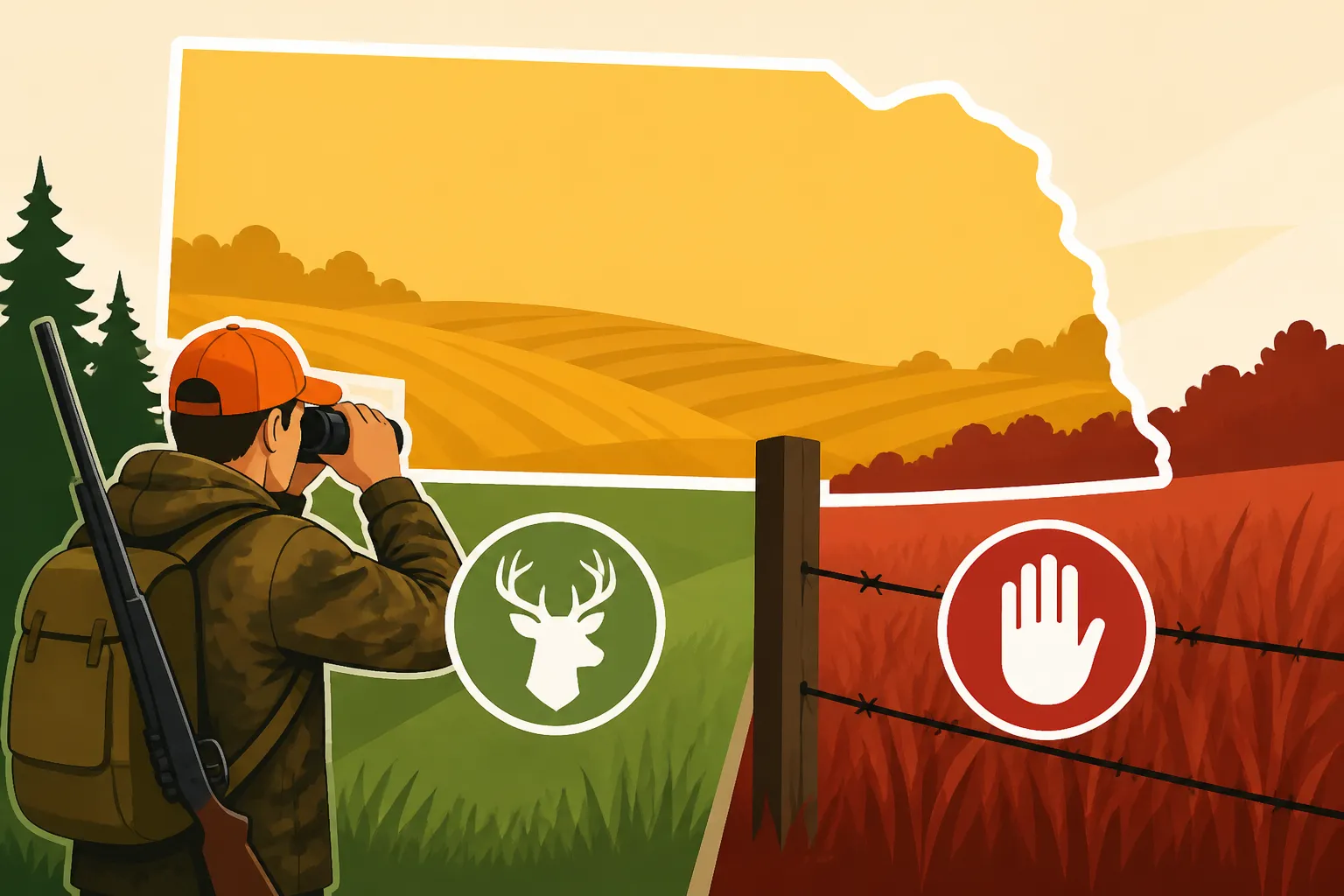
Nebraska law is quite specific about what makes land legally "posted" and thus off-limits without permission. Essentially, any private land that is used for agricultural purposes, whether cultivated fields, pasture, or timber, is considered "posted" by default. This means if you see crops, cattle, or managed timber, you should assume it's private and requires permission, even if there isn't a single sign in sight. This applies to river bottom ground, Sandhills range, and even small woodlots tucked away on farmland. It's a broad interpretation designed to protect landowners' property, and it places the onus squarely on the hunter to know who owns the ground they intend to hunt. This can feel daunting, especially when driving through vast stretches of mixed-use land, but it’s the reality we operate in.
Beyond Just a Sign: Other Forms of Notification
While physical signs are definitely a form of posting, they're not the only way a landowner can notify you that land is private. A fence, especially a well-maintained one, often implies private ownership. The actual act of farming or grazing livestock is a clear indicator. Even a verbal warning from a landowner or their representative can establish the boundary. Imagine you're walking a fence line, thinking you're on public ground, and a farmer drives up to politely inform you that his property starts just on the other side. That immediate notification means you're now fully aware of the boundary. The key takeaway here is that "posted" isn't just about a sign with a specific legal phrase; it's about clear communication, whether implicit or explicit, that the land is private. Always err on the side of caution.
Common Misconceptions About Public Land Markings
Many hunters, especially those new to Nebraska, often get confused by what constitutes public versus private land. A common misconception is that any land adjacent to a public road or highway is fair game, or that certain types of natural features, like creek beds or river banks, are automatically public. This is rarely the case in Nebraska. Road ditches are often part of private property, and even small waterways can have private land right up to their banks.
Another myth is that if you don't see purple paint on fence posts, the land must be open. While some states use purple paint as a "No Trespassing" marker, Nebraska primarily relies on the "agricultural use" standard for implicit posting. So, relying solely on the absence of specific markings can lead you astray. The Nebraska Public Access Atlas is an indispensable tool for clarifying these boundaries, highlighting tracts of public and Walk-in Access (WIA) lands that are legally open to hunters. However, even with this tool, understanding the legal framework behind private land remains paramount.
The Crucial Role of Landowner Permission: Verbal vs. Written
Once you've identified private land, obtaining permission from the landowner is not just a polite gesture; it's a legal requirement. Disregarding this fundamental step can lead to serious consequences, not just for you, but for the reputation of all hunters. Respecting private property is the bedrock of ethical hunting.
Why Permission is Non-Negotiable on Private Property
In Nebraska, hunting on private land without explicit permission is considered trespass, plain and simple. It doesn't matter if you meant to, if you thought it looked abandoned, or if you were just "passing through." The land belongs to someone else, and they have the right to control who accesses it and for what purpose. Failing to obtain permission can damage relationships between hunters and landowners, potentially closing off future access for everyone. Landowners open their property to hunters out of generosity and trust, and that trust is easily broken. Just a single negative incident can lead to "No Hunting" signs going up on acres of prime habitat. It’s a collective responsibility to uphold this respect.
When Verbal Permission is Enough, and When It's Not
Nebraska law states that permission can be given verbally. This is often how many successful hunting relationships begin – a friendly knock on the door, a conversation, and a handshake. For a quick afternoon hunt on a familiar property, verbal permission might suffice. You chat with Farmer John, he says "Sure, go ahead, just be careful around the cattle," and off you go. This feels natural and personal, which is great.
However, relying solely on verbal permission can sometimes put you in a precarious position, especially if misunderstandings arise or if a new landowner takes over. Imagine having verbal permission from one family member, only to encounter another who claims you're trespassing. Or, what if the landowner's memory of the conversation differs from yours, or they forget they gave you permission at all? While legally permissible, verbal agreements can be tough to prove if a dispute ever arises. This is where the depth of your relationship with the landowner really comes into play. If you've hunted there for years and they know you well, a verbal agreement might hold strong. For new relationships, or for longer, multi-day hunts, you might want something more concrete.
The Benefits of Getting Written Permission
While not always required, obtaining written permission offers a layer of protection and clarity for both the hunter and the landowner. A simple note outlining the dates, areas, and conditions of your hunt can prevent misunderstandings and provide legal proof if needed. This is particularly valuable for nonresident hunters or when hunting on unfamiliar private ground. Written permission can cover specifics like vehicle access, where you can park, what game species you’re allowed to pursue, and any other unique rules the landowner might have.
Consider a situation where you're hunting during Nebraska's Nine-Day November Firearm Deer Season. Emotions can run high, and having a signed document clearly stating your permission to be there can prevent awkward or even confrontational encounters with other hunters or curious neighbors. Many landowners appreciate the formality of a written agreement as it shows you respect their property and their rules. It also provides a clear record, especially if the property changes hands or if there's an unforeseen incident. This simple step can solidify trust and ensure a smooth hunting experience.
Here’s a quick comparison:
| Feature | Verbal Permission | Written Permission |
|---|---|---|
| Legally Valid | Yes, in Nebraska | Yes, in Nebraska |
| Ease of Obtaining | Often quicker and more informal | Requires more effort, sometimes a formal document |
| Proof in Dispute | Difficult to prove if challenged | Provides clear, tangible evidence |
| Clarity of Terms | Prone to misunderstanding or forgotten details | Explicitly outlines rules, dates, and areas |
| Landowner Comfort | Depends on existing relationship/trust | Often preferred by landowners for clarity and record |
| Hunter Protection | Lower protection against misunderstandings/accusations | Higher protection, less anxiety |
As outlined in Do You Need Written Permission in Nebraska?, while not always mandated, it's a strongly recommended practice for serious hunters looking to cultivate long-term access.
Navigating Public and Private Boundaries: Tools and Tactics
Knowing where you can and cannot hunt can feel like deciphering a secret code. Thankfully, modern technology and diligent scouting have made it easier than ever to avoid accidental trespass. No matter how much experience you have, staying informed about property lines is an ongoing process.
Using the Nebraska Public Access Atlas for Clarity
The Nebraska Game and Parks Commission (NGPC) publishes the Nebraska Public Access Atlas annually, a truly invaluable resource for hunters. This comprehensive guide maps out all publicly accessible land, including state wildlife management areas (WMAs), federal lands like national forests and grasslands, and private lands enrolled in the Open Fields and Waters (OFW) program. It's available online and often in print, and it's your first line of defense against mistakenly trespassing.
The atlas clearly distinguishes between different types of public access. For instance, some OFW tracts are "Walk-in Only," meaning no vehicles beyond designated parking areas. Others might have specific restrictions or open/close dates. Taking the time to study the atlas for your intended hunting area can prevent wasted trips and legal headaches. It’s also crucial for understanding Reading a Nebraska Deer Unit Boundary if you're targeting specific management areas. Don't just glance at it; immerse yourself in the maps and the accompanying text descriptions.
Advanced Mapping Apps: Your Digital Compass
In today's hunting world, digital mapping apps have become almost as essential as a good pair of binoculars. Tools like onX Hunt and GoHunt have revolutionized how hunters navigate property lines. These apps use GPS technology to show your exact location in real-time, overlaid on property ownership maps. This means you can literally see where you are in relation to public, private, and even specific landowner parcels.
Imagine you're Still-Hunting Nebraska Cedar Draws in an area with a checkerboard of public and private land. With onX Hunt open on your phone, you can confidently follow a game trail right up to a private property boundary, knowing exactly when to turn back or if you need to seek permission. These apps also show various land features, topo lines, and aerial imagery, allowing you to scout from your couch before you ever step foot in the field. They are incredibly useful for Finding Nebraska Property Lines and making sure you don't inadvertently cross into someone else's space, especially in thick cover or rolling terrain where physical markers might be sparse.
On-the-Ground Scouting and Physical Boundary Markers
While digital tools are fantastic, nothing replaces good old-fashioned on-the-ground scouting. Before opening day, take the time to physically walk the boundaries of your hunting area. Look for fence lines, changes in vegetation, distinct features like tree lines or creek beds, and official public land signage. Sometimes, private landowners might mark their property with specific signs or colored posts. Understanding Nebraska Posted Land Signage Rules can help you interpret what you see.
Even if you're using a mapping app, visual confirmation is key. Technology can fail – batteries die, signals drop – and having a mental map of the actual landscape can save you. Pay attention to how the property lines look from different angles, and note any subtle changes that might indicate a boundary, like a shift from native prairie to cultivated ground. This also helps you find good entry and exit points, and identify potential bedding or feeding areas without having to guess if you're on legal ground.
Accidental Trespass and Game Retrieval: What Happens If You Cross the Line
Even the most conscientious hunters can make an honest mistake and accidentally cross a boundary. It's a frustrating situation, made even worse if you've got a downed animal on the other side. Knowing how to handle these moments can minimize legal trouble and maintain your reputation.
Inadvertent Crossing: When You Don't Mean To Trespass
It happens to the best of us. You're focused on a game trail, following a ridge line, or simply misread a map, and suddenly you realize you've walked onto private property without permission. The immediate key is to acknowledge the mistake and act responsibly. Do not continue hunting. Turn around and retrace your steps to public or permitted land. If you encounter a landowner, be polite, apologetic, and explain the situation calmly. Most people are reasonable if you are honest and show respect for their property. Trying to sneak away or argue will only escalate the situation and solidify a negative impression of hunters.
The best defense against inadvertent crossing is thorough pre-hunt scouting, both with tools like onX Hunt and on foot, so you have a solid understanding of the terrain and boundaries. Despite your best efforts, sometimes nature or game can lead you astray, but your reaction in that moment is what truly matters.
Retrieving Downed Game from Private Property
This is perhaps one of the most stressful scenarios a hunter can face: you make a great shot, but your deer or pheasant crosses onto private land where you don't have permission. In Nebraska, the law is clear: you absolutely cannot retrieve game from private property without first obtaining permission from the landowner. Your hunting license does not grant you automatic access to private land, even for recovery purposes. This is explicitly covered in Retrieving Game From Private Land.
The responsible course of action is to immediately cease pursuit at the property line. Do not cross it. Instead, make every effort to contact the landowner. This might mean knocking on their door, calling a number if you have it, or asking nearby residents if they know how to reach them. Be prepared to explain exactly where your animal went down and respectfully request permission to retrieve it. Some landowners are understanding and will grant permission; others might deny it or offer to retrieve it themselves. It's their prerogative. If permission is denied, or you simply cannot contact the landowner, you must unfortunately abandon the animal. It's a tough pill to swallow, but it's the legal and ethical choice.
Immediate Steps to Take if You Realize You've Trespassed
If you suddenly find yourself on private land without permission, or you're confronted by a landowner, here’s what you should do:
- Stop immediately: Do not continue hunting, walking, or tracking.
- Remain calm and respectful: Don't argue, get defensive, or become agitated.
- Apologize sincerely: Acknowledge your mistake. "I'm so sorry, I must have misread my map/missed the boundary. My apologies."
- Explain the situation: Briefly and honestly state what happened. "I was following a game trail and didn't realize I crossed over."
- Ask for direction: Inquire how to best exit their property.
- Offer to leave immediately: Show your willingness to rectify the situation.
- If game is down: Respectfully ask for permission to retrieve it, explaining the situation. Do not demand.
Your demeanor in these moments can significantly influence the outcome. A respectful, apologetic approach is far more likely to lead to a positive resolution than an entitled or confrontational one.
Consequences of Hunting Without Permission: Penalties and Repercussions
Hunting without permission isn't just a minor inconvenience; it's a serious legal offense with significant personal and financial repercussions. Nebraska takes its property laws seriously, and violators can expect to face the full weight of the law.
Legal Ramifications: Fines, Jail Time, and License Suspension
In Nebraska, hunting on private property without permission is considered criminal trespass. The penalties can vary depending on the specific circumstances and whether it's a first offense or repeat violation. Typically, it starts as a misdemeanor offense, which can carry substantial fines. These fines are not trivial; they can easily climb into the hundreds or even thousands of dollars.
Beyond financial penalties, there is the potential for jail time, especially for repeat offenders or in cases where property damage occurs. Furthermore, and perhaps most impacting for a hunter, is the risk of having your hunting privileges suspended or revoked. This means you could lose the ability to purchase hunting permits for a period of time, effectively taking you out of the field. This also might trigger Nebraska Hunting Violation Penalties that are shared across state lines, meaning you could lose hunting privileges in other states as well. The hassle of court appearances, legal fees, and a criminal record is simply not worth the risk of bypassing permission.
The Ethical and Reputational Costs
Beyond the legal penalties, hunting without permission carries a heavy ethical cost. It directly undermines the foundation of trust between landowners and the hunting community. Each instance of trespass feeds the negative stereotype of hunters as disrespectful and careless, making it harder for all of us to gain access to private land. This can lead to more "No Hunting" signs, increased restrictions, and a general decline in opportunities for ethical hunters.
Your reputation as an individual hunter can also suffer. Word travels fast in rural communities. If you're known as someone who trespasses, you'll find doors quickly closing on potential hunting spots. Landowners talk, and a bad reputation can follow you, making it nearly impossible to gain permission on other properties in the future.
Impact on Future Hunting Opportunities in Nebraska
The ripple effect of trespassing can extend far beyond a single incident. If enough hunters disregard private property rights, it can influence policy decisions regarding public access and landowner incentives. Programs like Open Fields and Waters, which rely on landowner goodwill, could be jeopardized if trust is eroded.
Moreover, if your license is suspended, you're out of luck for legal hunting in Nebraska for that period. This means missing out on seasons you've looked forward to, permits you've drawn, and time spent in nature. The desire for immediate gratification by ignoring property lines can result in long-term exclusion from the very activity you love. It’s a harsh but real consequence that underscores the importance of adhering to the rules and building good relationships.
Building Relationships: The Key to More Hunting Opportunities
While the laws and penalties are important, the most effective way to ensure abundant hunting opportunities on private land is to foster positive relationships with landowners. It's an investment of time and effort that pays dividends in access and goodwill.
The Art of Asking for Permission Respectfully
Asking for permission is often daunting, but it's a skill that can be honed. Start by being polite and well-groomed, especially for a first impression. Approach landowners during appropriate hours, not too early or too late, and avoid busy times like meal hours or during harvest. Introduce yourself clearly, explain why you're interested in hunting their property (e.g., "I saw some great deer sign down by your creek," or "I'm looking for pheasants in that milo stubble").
Be specific about what you want to hunt, when, and with how many people. Always offer to share your contact information and respect their answer, whether it’s yes or no. A "no" today doesn't mean "no" forever; a respectful approach leaves the door open for future requests. Sometimes, even if they say no, they might suggest another landowner to try. This respectful approach is key to Getting Private Land Permission in Nebraska.
Being a Good Steward of the Land
Once you've been granted permission, your responsibility truly begins. Treat the land as if it were your own, or even better. Drive only on designated trails or roads, close all gates, and respect any specific rules the landowner might have (e.g., no hunting near the house, stay out of certain fields). Pick up any trash you see, even if it's not yours. Report any damage, poaching, or other issues you observe on their property.
If you harvest an animal, make sure to clean up any gut piles discreetly and away from main travel routes or public view. If you promised to share some wild game meat, follow through. A small gesture of gratitude, like offering to help with a chore, bringing a gift of fresh produce, or simply sending a thank you card, can go a long way in strengthening the relationship. Showing genuine care for their property demonstrates your trustworthiness. This ties directly into the advice on Asking a Nebraska Farmer for Permission.
How to Build Trust Over Time with Landowners
Building a lasting relationship with a landowner is like any other friendship – it requires consistent effort and mutual respect. Don't just show up once a year for hunting season. A quick phone call or visit outside of hunting season to check in, offer help, or just say hello can reinforce your commitment. Some hunters even offer to help with fence mending, checking on livestock, or other tasks, not expecting anything in return, but simply to be a good neighbor.
This ongoing communication builds trust and reliability, which are priceless commodities in the world of private land access. When a landowner knows you and trusts you, they'll be far more likely to grant permission year after year, and might even open up additional opportunities. It transforms a transactional request into a reciprocal relationship, securing valuable hunting ground for years to come. Remember, public land is only one piece of the puzzle; fostering positive private land access through respect and relationship building is truly where many Nebraska hunting dreams are realized.
Disclaimer
This article is for general informational purposes only and does not constitute professional advice. Laws, prices and regulations vary by location and change over time. Consult a qualified professional for guidance on your specific situation.