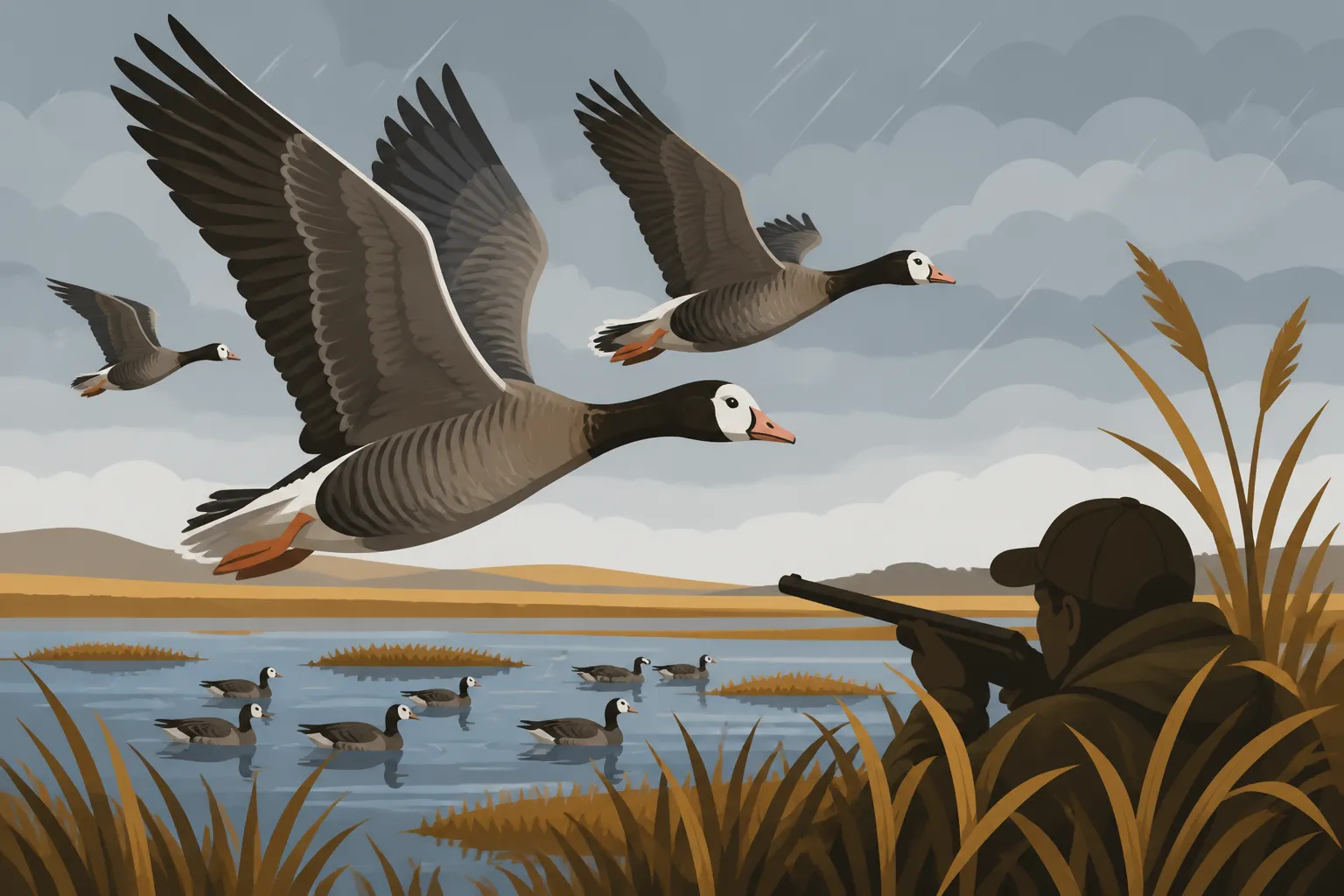
White-Fronted Geese in the Rainwater Basin
For many hunters, chasing geese across the vast Nebraska landscape is a passion, but there's a particular kind of pursuit that stands apart: the elusive, notoriously wary white-fronted goose in the unique wetlands of the Rainwater Basin. Unlike their larger, more common Canada goose cousins, white-fronts present a distinct challenge, often frustrating hunters with their uncanny ability to spot a flaw in even the most meticulous setup. If you've ever spent hours freezing in a blind, watching wave after wave of white-fronts veer off at the last second, you know the particular brand of heartbreak they can deliver. This guide is here to shed light on why these birds are so special to hunt in this region and how you can increase your odds of bringing home a prized "specklebelly."
The Allure of White-Fronted Geese in Nebraska
White-fronted geese, affectionately known as "specklebellies" for the distinctive black bars on their bellies, are a truly magnificent game bird. Their shrill, high-pitched call, often described as a "laugh," is unmistakable and adds a wild soundtrack to the vast Nebraska skies. Unlike many other waterfowl, white-fronts tend to be extremely wary, possessing a level of suspicion that can make even seasoned goose hunters pull their hair out. This wariness isn't just a quirk; it's a survival mechanism refined over generations of migration and hunting pressure. Their intelligence and flight patterns are what make them such a challenging, yet ultimately rewarding, target.
Why the Rainwater Basin is a White-Front Magnet
The Rainwater Basin is not just another wetland complex; it's a critical stopover point for millions of migratory birds along the Central Flyway, and white-fronted geese are no exception. This unique region, characterized by its shallow, playa wetlands, provides essential staging and feeding grounds. As temperatures drop further north, these birds push south, finding refuge and sustenance in the Basin's diverse agricultural fields and ephemeral water bodies. The sheer number of wetlands, even in dry years when many are just damp depressions, offers dispersed sanctuary, making it harder for predators – including hunters – to pinpoint their exact locations. This ecological importance translates directly into hunting opportunities that are both abundant and challenging.
Imagine flying thousands of miles from the Arctic, knowing instinctively that this mosaic of shallow water and harvested grain fields is a lifeline. That's the Rainwater Basin for white-fronts. They use these wetlands to rest and socialize, but often feed in adjacent agricultural fields, primarily feasting on waste grain left after the corn or soybean harvest. The intermittent nature of these wetlands means their preferred roosting and feeding sites can shift rapidly with weather and water levels, forcing hunters to constantly adapt and scout. Understanding this dynamic relationship between the birds and the Basin is the first step to successful hunting.
Distinguishing White-Fronts from Other Geese
While often mistaken for smaller Canada geese at a distance, white-fronts have several key characteristics that set them apart. Their most obvious field mark, for which they are named, is the white band at the base of their bill, which becomes more pronounced with age. Their bellies develop those irregular black bars, giving them the "specklebelly" moniker. In flight, their rapid wingbeat is generally quicker than a Canada goose, and their unique laughing call is a dead giveaway.
| Feature | White-Fronted Goose | Canada Goose |
|---|---|---|
| Size | Medium-sized, smaller than most Canada geese | Large, diverse in size (Giant Canadas to Cackling Geese) |
| Bill Color | Pinkish-orange, often with a distinctive white patch at base | Black |
| Belly Markings | Irregular black bars (specklebelly) | Generally uniform gray/brown, no prominent bars |
| Head Markings | No chinstrap; brown head with white bill base | Distinctive black neck and white chinstrap |
| Voice | High-pitched, two-note "laughing" call | Deep "honk" or "hiss" |
| Flight Pattern | Generally faster wingbeat, often fly in loose V or groups | Slower, deliberate wingbeat, strong V-formations |
| Diet Preference | Waste grain, grasses, sedges | Wide variety: grasses, grains, aquatic vegetation |
| Hunting Challenge | Extremely wary, require meticulous concealment, advanced calling | Wary, but often less sensitive to decoy/calling flaws than white-fronts |
Understanding these distinctions isn't just for identification; it informs your hunting strategy. A setup that might fool a less discerning Canada goose often won't even get a second glance from a flock of white-fronts. They read body language, decoy spreads, and calling patterns with an almost supernatural precision.
The Unique Challenges of Hunting White-Fronts in the Rainwater Basin
Hunting white-fronted geese in the Rainwater Basin is a challenge that many waterfowlers eagerly embrace. It's not simply a matter of finding birds; it's about outsmarting them in a landscape that can be as unpredictable as the weather itself. The Basin's extensive network of public and private lands, combined with the birds' inherent wariness, creates a complex hunting environment where success is earned through meticulous effort and a deep understanding of their behavior.
High Hunting Pressure and Educated Birds
The Rainwater Basin is a popular destination for waterfowl hunters, especially during peak migration. This popularity means that white-fronted geese arriving in the Basin have often been "shot at" from Saskatchewan to South Dakota. They quickly become educated, meaning they've learned to associate certain sights and sounds with danger. A perfectly placed decoy spread can be ruined by a single hunter standing up too soon, or a poorly brushed blind that sticks out like a sore thumb. These birds see everything, and they remember.
This high pressure means that simply being "in the right spot" isn't enough. You need to be better than the last five groups of hunters they encountered. This often translates to venturing further into less accessible areas, waking up earlier, and dedicating more time to scouting and setting up your spread. The GoHunt platform can be incredibly useful for pinpointing public access points and understanding land ownership boundaries, which helps in finding those less pressured corners of the Basin. Tools like GoHunt can help you visualize the landscape and potential access points, allowing you to plan your hunt around areas that might see less traffic.
Water Conditions and Their Impact on Roosting
The Rainwater Basin's wetlands are primarily rain-fed, meaning water levels can fluctuate dramatically depending on recent precipitation and snowmelt. A basin that was full and holding birds last week might be bone-dry this week, forcing white-fronts to relocate. This constant flux is a major challenge for hunters who rely on consistent bird patterns. White-fronts prefer shallow water for roosting, often wading rather than swimming, making these ephemeral basins ideal.
Scouting becomes paramount when dealing with unpredictable water conditions. You need to be on the ground, observing which basins are holding water and, more importantly, which ones the geese are actively using. Satellite imagery and historical data, sometimes available through mapping apps, can offer clues about typical water retention, but there's no substitute for seeing it with your own eyes. Remember, a dry basin means no geese, no matter how good your calling. These conditions also heavily influence Rainwater Basin Wetland Access, as some areas become impassable when wet, while others thrive.
Field Feeding Patterns and Scouting Importance
While white-fronts roost on water, they primarily feed in agricultural fields, much like Canada geese. However, their feeding preferences can be subtle. They often favor harvested cornfields with ample waste grain, but they can also be found in soybean stubble, wheat fields, or even short grass pastures. Identifying their current feeding fields is crucial, and it's almost always a moving target.
This is where dedicated, daily scouting truly pays off. You need to locate not just where they're feeding, but when they're feeding and, if possible, their entry and exit routes. They often fly a specific line from their roost to their feeding grounds, which can be exploited with a well-placed spread. Look for fresh droppings, tracks, and disturbed stubble – clear signs of recent feeding. Pay close attention to the wind direction, as birds will almost always land into the wind, regardless of where your decoys are. Using a mapping application like GoHunt can help you mark these hot spots, track bird movement, and plan access to fields. Understanding Reading Roost-to-Field Flight Lines is a skill honed by spending hours observing, which is essential for success with these birds.
Tactics for Targeting White-Fronted Geese in the Rainwater Basin
Successfully hunting white-fronted geese in the Rainwater Basin demands a refined approach that goes beyond standard goose hunting tactics. Their notorious wariness means every detail matters, from your decoy spread to your calling, and especially your concealment. It's a game of patience, precision, and adapting to their intelligence.
Mastering Decoy Spreads for Wary Birds
When it comes to white-fronts, less is often more, but precision is everything. You don't necessarily need hundreds of decoys, but the ones you use must be realistic, and your spread must look natural. Full-body decoys are highly recommended, especially those with natural postures that mimic feeding or resting birds. Shells can work, but full-bodies offer a much more convincing profile.
The spread itself should avoid rigid patterns. White-fronts typically feed in tighter, more spread-out groups than Canada geese. Think "family units" rather than one massive blob. Leave landing zones open, ensuring they are directly into the prevailing wind. Position your blinds downwind of the landing zone, allowing the geese to fly directly over your setup as they approach. Many hunters find success by mixing a few Canada goose decoys with their white-front spread, as white-fronts will sometimes associate with Canadas, but the majority should be white-fronts. Spacing is key: don't cram them together. Give them room to look natural. For more specific insights into various setups, consult guides on Decoy Spreads for Rainwater Basin Geese.
Calling Strategies That Close the Deal
White-front calling is an art form distinct from Canada goose calling. While Canada geese respond to deep honks and clucks, white-fronts are captivated by their unique, high-pitched "laughing" call. Mastering this call takes practice, but it's an indispensable tool for pulling in wary birds. The call is typically a series of two or three high-pitched notes, often described as "ka-lee, ka-lee" or "yodels."
Start with softer, contented calls to grab their attention from a distance, escalating to more excited, rapid sequences as they approach. Pay close attention to their reactions; if they start to flare or pull away, back off the calling. Don't overcall. Sometimes, a subtle murmur from the spread, or a single, well-timed "laugh," is all it takes to convince them. Group calling can also be highly effective, mimicking a contented flock on the ground. However, one caller who is off-key can ruin the whole setup, so ensure your team is synchronized.
The Art of Concealment: Hiding from Sharp Eyes
This cannot be stressed enough: concealment is king when hunting white-fronted geese. Their eyesight is legendary, and they will spot anything that looks out of place from hundreds of yards away. Layout blinds are the go-to choice for field hunting in the Rainwater Basin, but they must be meticulously brushed in. Don't just throw a few handfuls of stubble on your blind; make it disappear. Use local vegetation, whether it's cornstalks, milo, or even native grasses, to blend your blind seamlessly into the surrounding field.
Pay attention to shadows and sun angle. A blind that's perfectly hidden in the morning might stick out like a sore thumb when the sun shifts. Wear dark, earth-toned clothing, and minimize any movement inside the blind. Even a subtle head tilt or a gleam off your face can be enough to send a flock spiraling away. Some hunters even dig shallow depressions for their blinds to sit lower, reducing their profile even further. This extreme attention to detail is often the difference between a successful hunt and watching birds land in the next county. Think about it like this: if you can spot your blind from 100 yards away, a white-front can spot it from 1,000.
Field Etiquette and Safety Considerations
Hunting in the Rainwater Basin, especially on public lands or Open Fields and Waters Tracts Best for Deer, often means sharing the landscape with other hunters. Good field etiquette is not just polite; it's crucial for everyone's success and safety. Respect other hunters' space. If you see a group already set up in a field, find another spot. Don't try to sneak in on their birds or set up too close. A general rule of thumb is to give other groups at least a half-mile, preferably more, especially when hunting such wary birds.
Safety is paramount. Always know your shooting lanes and what's beyond your target. Ensure all guns are unloaded and actions open when traversing fields, especially when crossing fences or moving between locations. Be mindful of property boundaries. Utilize mapping tools like GoHunt to clearly identify public and private land lines, ensuring you don't inadvertently trespass. Remember, retrieving a downed bird from private property without permission is trespassing, which can swiftly sour landowner relations. Always have a plan for retrieving birds, especially in wetlands or dense cover.
Conservation and the Future of White-Fronts in Nebraska
The opportunity to hunt white-fronted geese in Nebraska, particularly in the Rainwater Basin, is a testament to ongoing conservation efforts. These efforts are vital for maintaining healthy populations and ensuring that future generations can experience the thrill of chasing "specklebellies" across the prairie sky. Understanding the factors that influence white-front populations and supporting conservation initiatives is part of a hunter's responsibility.
Population Trends and Management
White-fronted goose populations are generally considered stable or increasing across North America, thanks to effective management strategies and habitat conservation. Annual surveys track breeding populations on their arctic nesting grounds and wintering populations in the southern states. Nebraska, as a critical migration corridor, plays a significant role in their journey. The state's management goals focus on providing quality habitat during migration and ensuring sustainable harvest limits that don't jeopardize population health.
While overall numbers are healthy, local conditions can impact hunter success. Factors like drought, severe weather during migration, or disease outbreaks (such as avian influenza) can temporarily reduce local concentrations or alter migration patterns. Organizations like Nebraska Game and Parks continually monitor these factors to adapt regulations and management practices. Hunters can contribute to these efforts by accurately reporting their harvests and supporting habitat conservation initiatives through license and stamp purchases. This contributes directly to the overall health of Waterfowl of the Central Flyway in Nebraska.
Habitat Preservation in the Rainwater Basin
The Rainwater Basin is arguably the most vital wetland complex for migratory birds in Nebraska, but it's also a highly altered landscape dominated by agriculture. Decades of drainage and conversion have significantly reduced the number and quality of these ephemeral wetlands. Preserving and restoring remaining basins is critical for white-fronts and countless other species. Efforts by conservation groups and state agencies focus on acquiring and restoring wetlands, improving water quality, and working with private landowners to implement beneficial farming practices.
These habitat projects are not just about water; they're about the entire ecosystem. Healthy wetlands provide food, cover, and safe roosting sites, while adjacent upland habitats offer nesting opportunities for other species and act as buffer zones. Hunters play a direct role by purchasing Nebraska Habitat Stamp Requirements, which fund these vital programs. Without these protected and restored wetlands, the Rainwater Basin simply wouldn't be the white-front magnet it is today. Duck Production in the Rainwater Basin is also heavily reliant on these same habitat preservation efforts.
The Hunter's Role in White-Front Conservation
Every hunter who pursues white-fronted geese has a responsibility to contribute to their conservation. This goes beyond simply following regulations; it involves active participation and advocacy. Here are a few ways hunters contribute:
- Financial Support: Your hunting licenses, state habitat stamps, and federal duck stamps directly fund critical research, habitat acquisition, and management programs.
- Ethical Hunting: Adhering to fair chase principles, practicing good sportsmanship, and making ethical shot choices minimizes wounding loss and promotes respect for the resource.
- Data Collection: Reporting your harvest accurately helps biologists gather essential data for population assessments and setting sustainable season frameworks.
- Advocacy: Supporting conservation organizations and advocating for policies that protect wetlands and wildlife habitat ensures that future generations will also have opportunities to hunt.
- Education: Sharing your knowledge and passion for white-fronts and their habitat with new hunters helps instill a conservation ethic.
By understanding the ecology of these magnificent birds and embracing the challenges of hunting them in a unique place like the Rainwater Basin, hunters become essential stewards of this valuable resource. It's about more than just filling a strap; it's about connecting with nature and ensuring a vibrant future for white-fronted geese in Nebraska.
Disclaimer
This article is for general informational purposes only and does not constitute professional advice. Laws, prices and regulations vary by location and change over time. Consult a qualified professional for guidance on your specific situation.