Hunting Near Chadron and Crawford
Hunting in the rugged beauty of Nebraska's Pine Ridge, particularly around Chadron and Crawford, presents a truly unique challenge and immense reward, but it can feel incredibly daunting trying to figure out where to even begin. Unlike the vast, rolling Sandhills or the dense river bottoms of eastern Nebraska, this corner of the state is a world unto itself, and many hunters struggle to unlock its secrets. This guide aims to demystify hunting public land in this breathtaking region, helping you understand the terrain, find access, and strategize for success against the backdrop of its dramatic landscapes.
Understanding the Pine Ridge Region: Unique Terrain and Wildlife
The Pine Ridge, stretching across northwestern Nebraska, is a geographic anomaly within the state, offering a stark contrast to the prairie and farmland that defines much of the Cornhusker State. This isn't your typical flat-ground hunting; here, you're navigating steep buttes, deep canyons, and expansive forests of Ponderosa pine. It’s a landscape that demands a different approach and rewards those willing to put in the effort.
The Dramatic Landscape of Buttes, Canyons, and Pines
When you drive into the Pine Ridge near Chadron or Crawford, the first thing you notice is the change in scenery. Gone are the endless corn and bean fields, replaced by towering pine trees clinging to steep slopes, sandstone outcroppings, and deep, shadowed ravines. This is a region shaped by ancient rivers and wind, creating a diverse mosaic of habitats. The elevation changes can be significant, leading to microclimates and varying vegetation. Valleys might hold lush riparian areas, while ridge tops are wind-swept and drier. Understanding these features is crucial because they dictate animal movement, bedding areas, and feeding patterns. Don't underestimate the physical demands; a casual stroll quickly turns into a strenuous climb in these parts.
Moreover, the density of the Ponderosa pine can be surprising. While it provides excellent cover for game, it can also make visibility challenging, especially in the thickest stands. This means your hunting tactics need to adapt from long-range glassing to more deliberate still-hunting or methodical tracking. The cooler, shaded canyons often hold moisture longer, providing critical water sources even during dry spells, which is a major draw for game. Pay attention to how the wind swirls through these canyons, as thermals can be tricky to predict, especially during morning and evening transitions.
Key Game Species of the Pine Ridge
The diverse habitat of the Pine Ridge supports a fantastic array of game species, making it a prime destination for various hunts. Mule deer are often the stars of the show here, thriving in the rugged, open-country environment. You'll find them using the steep slopes and timbered draws for bedding, especially favoring south-facing slopes in colder weather for warmth. Whitetails are also present, often preferring the lower, brushier creek bottoms and the edges of agricultural fields, though they'll certainly use the pine cover too. Telling them apart at a distance, especially in varying light, becomes a key skill you'll develop here.
Beyond deer, the Pine Ridge is renowned for its Merriam's turkeys. These magnificent birds roam the Ponderosa forests, offering a unique spring and fall hunting experience. Their calls echo beautifully through the canyons, and chasing them through the pines is an unforgettable adventure. While elk permits are incredibly difficult to draw for non-residents and even for many residents, the Pine Ridge does harbor Nebraska's largest elk herds. Drawing an elk tag here is a true once-in-a-lifetime opportunity for those lucky enough. Lastly, sharp-tailed grouse can be found in the more open, grassy areas between the pine stands, providing a challenging upland bird hunt for those willing to walk.
Public Hunting Opportunities Near Chadron and Crawford
One of the biggest advantages of hunting near Chadron and Crawford is the substantial amount of public land available. This isn't always the case in other parts of Nebraska, where private land dominates. However, even with abundant public ground, understanding where it is and how to access it effectively is paramount. You need to do your homework before you arrive.
Oglala National Grassland: Vast Access and Diverse Terrain
The Oglala National Grassland is a jewel in Nebraska's public land crown, offering hundreds of thousands of acres for hunters. Much of it lies north of Crawford, extending right up to the South Dakota border. This is truly expansive country, characterized by rolling grasslands, interspersed badlands, and pockets of pine. It's a fantastic place for Hunting Nebraska National Forest and Grasslands Hunting. This vastness can be overwhelming, but it also means there's room to roam and find unpressured areas, especially if you're willing to walk a bit further than the next hunter.
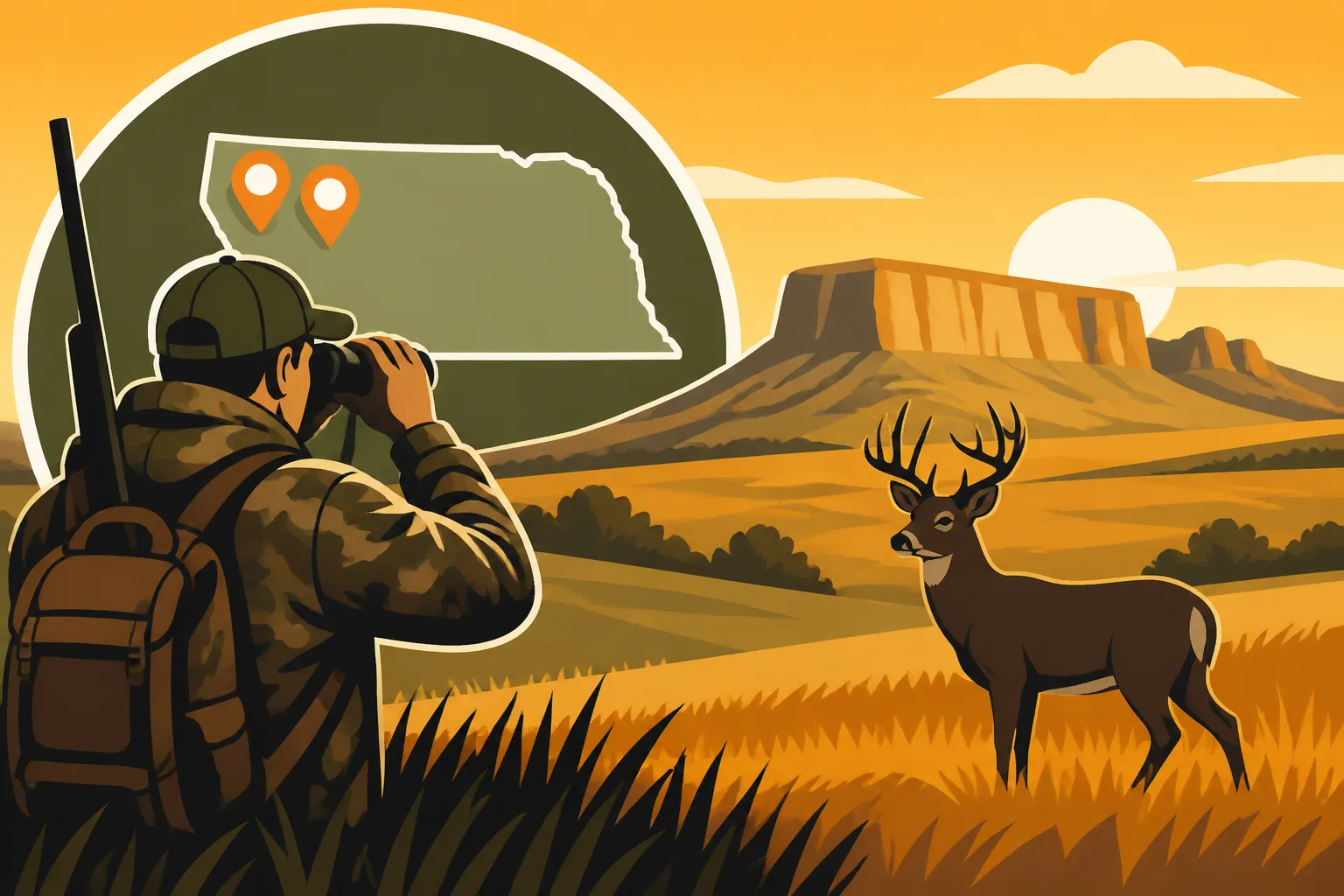
Hunting on the Oglala National Grassland often involves long-range glassing. A good pair of binoculars and a spotting scope are indispensable here for spotting mule deer on distant ridges or pronghorn across wide-open flats. Don't be afraid to utilize elevated positions, like the tops of buttes, to scan vast swaths of land. While predominantly grassland, the badland formations provide incredible cover and thermal sinks for deer. Access roads, often primitive two-tracks, crisscross the grassland, but many areas require foot access. Be prepared for varied terrain, from solid ground to loose sand, and always know your location. Companies like onX Hunt are invaluable for clearly delineating the boundaries of the Grassland and identifying specific access points.
State Wildlife Management Areas and Open Fields and Waters
Beyond the Oglala National Grassland, the Nebraska Game and Parks Commission manages several Wildlife Management Areas (WMAs) in the Pine Ridge region, offering additional public hunting opportunities. These WMAs are typically smaller than the national grassland but are often managed specifically for wildlife, meaning they can hold higher concentrations of game, particularly whitetails and Merriam's turkeys. Examples might include areas like Metcalf WMA or Peterson WMA, though you should always check the most current Nebraska Public Access Atlas for detailed maps and rules. These areas might offer different habitat mixes, sometimes including agricultural components or denser riparian zones, which can be deer magnets.
Additionally, Nebraska's Open Fields and Waters (OFW) program plays a vital role in providing access to private land for public hunting. While many OFW tracts are found in the more agricultural parts of the state, some are scattered through the Pine Ridge, often providing access to critical habitat corridors or field edges that might otherwise be locked up. These tracts are signed, making them easy to identify, but they can change from year to year. Always consult the most recent Public Access Atlas, available online or via their mobile app, to see which OFW areas are available. This program is a fantastic resource for Public Hunting Land in Nebraska and can sometimes offer less pressured spots compared to larger WMAs, especially if you're targeting deer or pheasants in fringe areas.
Navigating the Land: Tools and Tactics for the Pine Ridge
Hunting in the Pine Ridge is an exercise in preparation and adaptability. The terrain can be unforgiving, and knowing where you are and where you can go is not just helpful, it’s critical for safety and success. Relying solely on memory or paper maps can leave you in a bind, especially in areas with mixed ownership.
Essential Mapping and Navigation Tools
In a region like the Pine Ridge, a reliable mapping system is your best friend. Modern hunting apps have revolutionized how hunters approach these complex landscapes. onX Hunt is perhaps the most widely used and for good reason. It provides incredibly detailed satellite imagery overlaid with property boundaries, clearly showing public versus private land. This is absolutely crucial when you're hunting areas like the Oglala National Grassland or state WMAs, which can be checker-boarded with private ground. Imagine spotting a great buck on a distant ridge, only to realize, with a quick glance at your phone, that it's just over the fence on private property. The app saves you wasted time, effort, and potential trespassing issues. It also allows you to mark waypoints, track your movements, and download maps for offline use, which is vital in areas with spotty cell service.
Another excellent resource for research and planning is GoHunt. While perhaps more focused on draw odds and permit applications, its mapping tools and insights can supplement your planning, especially if you're looking at specific units or public land tracts. Beyond digital tools, always carry a physical compass and a paper map as a backup, especially if you’re venturing deep into the canyons or thick timber where GPS signals can be weak or batteries can die. Knowing how to use them is a skill that could literally save your hunt, or even your hide. Don't forget a powerful power bank for your phone, as constant GPS use drains batteries quickly.
Scouting and Access Strategies
Scouting in the Pine Ridge, whether in person or remotely, is paramount. Before you even set foot in the field, use tools like Google Earth or the satellite imagery on onX Hunt to identify potential access points, water sources, natural funnels (like narrow canyon bottoms), and likely bedding areas (often on steep, shaded slopes or dense pine stands). Look for areas that are harder to access, as these often hold less pressured game. A long walk uphill might deter many, but it can lead you to undisturbed pockets of deer. Remember, the Pine Ridge is a popular destination, and competition for prime spots, especially during rifle season, can be intense.
When you're boots-on-the-ground scouting, pay close attention to recent sign: fresh tracks, droppings, rubs, and scrapes. In the Pine Ridge, mule deer often leave distinct tracks in the sandy soil, and their droppings are typically larger than a whitetail's. Look for natural draws or benches that animals might use to traverse steep terrain. Consider the time of year and weather; early season might mean deer are near water, while late season could find them sunning themselves on south-facing slopes. Always consider wind direction in your approach, especially in the swirly canyons. For turkeys, listen for gobblers off the roost in the morning and look for dusting bowls or strut zones in more open pine stands. Don't overlook the importance of Scouting Nebraska Public Ground Before Opening Day.
Tactics for Hunting Deer and Turkey in the Pine Ridge
Hunting deer and turkeys in the Pine Ridge requires specific tactics tailored to its unique environment. It’s a place where adaptability and perseverance pay off in spades. Understanding how game uses this varied terrain is the key to success.
Mule Deer and Whitetail Tactics in the Rugged Terrain
When it comes to mule deer in the Pine Ridge, glassing is king. Spend time on high vantage points, patiently scanning distant slopes, draws, and openings. Mule deer often bed high on the ridges or in deep, secluded canyons, blending perfectly with the landscape. A quality spotting scope is vital for discerning antlers from dead branches or rocks. Once you spot a buck, planning your stalk is critical. The undulating terrain can offer excellent cover, but it can also reveal you quickly if you’re not careful. Always use the terrain to your advantage, staying out of sight and paying close attention to wind direction. A common mistake is rushing the stalk; take your time and make sure every step is deliberate and quiet. Hunting Mule Deer in the Nebraska Pine Ridge can be incredibly rewarding, but it demands patience and physical exertion.
Whitetails, while present throughout the Pine Ridge, are often found in the denser cover along creek bottoms, brushy draws, or the fringes of agricultural fields bordering the pine forests. For whitetails, still-hunting through the timber or setting up a ground blind or treestand in a strategic location near food sources or travel corridors can be effective. Consider how the deer move between bedding areas (often in thick pines or secluded canyons) and feeding areas (lower elevation browse or crop fields). In thick pines, visibility can be limited to mere yards, so moving slowly and quietly, stopping often to listen and scan, is essential. During the rut, rattling and grunting can be surprisingly effective, especially in areas where bucks are cruising for does. Knowing how to utilize natural cover for Using a Ground Blind on Nebraska Public Ground can be particularly useful in this open-yet-rugged country.
Merriam's Turkey Strategies in the Ponderosa Pines
Hunting Merriam's turkeys in the Pine Ridge offers a truly distinct experience compared to hunting Easterns or Rios in other states. These birds are often found scattered throughout the Ponderosa pine forests, preferring higher elevations and more open pine stands than their eastern cousins. The rolling hills and deep canyons provide fantastic opportunities for "run-and-gun" tactics, but also require patience. Early morning, listen for gobblers on the roost, then make your move to get as close as possible without spooking them. Setting up against a large pine or rock formation for cover, then using a variety of calls – purrs, clucks, yelps – can draw them in.
Merriam's turkeys can be more responsive to calls than other subspecies, but they can also be wary. Sometimes, a subtle approach works best, using light calling to pique their interest and encourage them to come looking. If a bird hangs up, don't be afraid to try relocating and setting up again, or even circling to get ahead of its probable travel route. The key is understanding how they use the terrain. They often roost in tall pines and will pitch down into draws or open areas to feed. Look for open patches where they might strut or dust. During the spring, hens will lead gobblers around, so identifying these patterns can lead to success. Calling Spring Gobblers in Nebraska Timber takes on a special flavor in this unique habitat.
| Game Species | Preferred Habitat in Pine Ridge | Common Tactics | Key Gear Considerations |
|---|---|---|---|
| Mule Deer | Steep slopes, open pine stands, badlands, canyons | Long-range glassing, spot-and-stalk | High-power binoculars/spotting scope, rangefinder, sturdy hiking boots |
| Whitetail Deer | Lower creek bottoms, brushy draws, agricultural edges | Still-hunting, ground blinds, treestands | Quality optics, scent control, quiet clothing, comfortable pack |
| Merriam's Turkey | Ponderosa pine forests, open timber, ridge tops | Run-and-gun, patient calling, ambushing travel routes | Decoy (optional), slate or diaphragm calls, camouflage, comfortable boots |
| Sharp-tailed Grouse | Open grasslands, interspersed with short pine | Walking extensive cover, flushing birds | Good bird dog (optional), upland vest, comfortable walking boots, shotgun |
The Pine Ridge, around Chadron and Crawford, offers an adventure for the prepared hunter. It's a land of stunning beauty and challenging hunting, a place where the work you put in directly correlates to the rewards you reap. Take the time to understand its unique character, utilize the tools available, and immerse yourself in the experience.
Disclaimer
This article is for general informational purposes only and does not constitute professional advice. Laws, prices and regulations vary by location and change over time. Consult a qualified professional for guidance on your specific situation.