Nebraska Trespass and Permission Law
Navigating private land in Nebraska can feel like walking on eggshells, especially when you're geared up for a hunt and the property lines aren't always crystal clear. Many of us have faced that gut-wrenching moment of uncertainty, wondering if we're truly on public ground or if we've unknowingly stepped onto someone else's turf. This comprehensive guide is here to untangle Nebraska's trespass and permission laws, offering practical, realistic advice to help you hunt confidently and legally.
Understanding Nebraska's Basic Trespass Laws for Hunters
Let's face it, nobody wants to be "that guy" who gets a knock on the door from a game warden or, worse, a property owner who's had enough. Nebraska's trespass laws, particularly for hunters, are designed to protect private property rights, and it’s our responsibility to know them inside and out. It’s not just about avoiding legal trouble; it’s about respecting landowners and ensuring hunting remains a privilege, not a point of contention.
The Legal Definition of Trespass in Nebraska
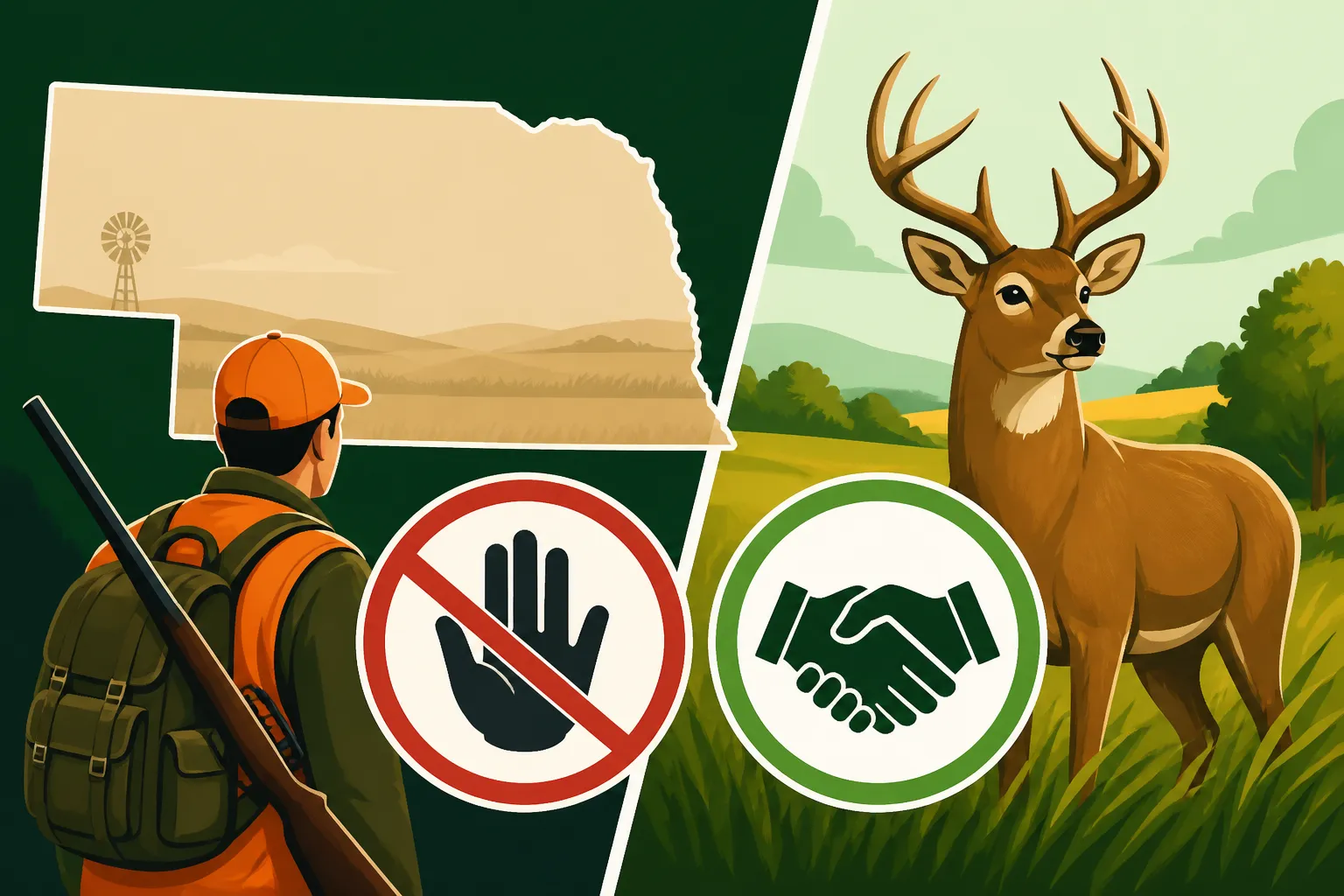
In Nebraska, trespass isn't just about ignoring a "No Trespassing" sign. Generally speaking, a person commits criminal trespass if they enter or remain on private land without permission from the owner or person in lawful possession, after having been notified not to do so. This notification can come in various forms, not just physical signs. It could be an oral warning, fencing that clearly indicates private property, or crops that are obviously being cultivated. For hunters, specifically, the law states that entering private land for hunting, fishing, or trapping purposes requires permission. Even if the land isn't posted with signs, a hunter still needs permission. This is a crucial distinction that often surprises folks who are used to implied consent laws in other states or even just "common courtesy" assumptions. The burden is on you, the hunter, to ensure you have that explicit permission.
Types of Land and Required Permission
Nebraska law differentiates somewhat between various types of land, which affects how permission is sought and proven. While the overarching rule is "get permission," understanding these nuances can prevent headaches.
| Land Type | Permission Requirement | Key Considerations |
|---|---|---|
| Posted or Fenced Land | Explicit Permission Required (Verbal or Written) | If land is clearly posted with "No Trespassing" signs or enclosed by a fence, permission is mandatory. Entering without it is a clear violation. Landowners who post their property are making a clear statement about their desire for privacy and control. |
| Unposted, Unfenced Land | Explicit Permission Required (Verbal or Written) | This is where many hunters get tripped up. Unlike some states where unposted land might imply public access, in Nebraska, entering any private land for hunting, fishing, or trapping, regardless of posting or fencing, requires permission. Do not assume. |
| Cultivated Fields | Explicit Permission Required (Verbal or Written) | Any land that is being farmed, whether it's standing corn, harvested milo stubble, or a freshly tilled field, is considered private and requires permission. Even walking along the edge of a field to access other public ground can be seen as trespass if you don't have permission for that field. |
| Timber or Pastureland | Explicit Permission Required (Verbal or Written) | Again, the same rule applies. Whether it's a dense river bottom timber or wide-open Sandhills pasture, if it's private, you need permission. Respecting these boundaries helps foster good relationships with landowners, which is vital for the future of hunting in our state. |
| Public Land (WMA, OFW) | No Specific Landowner Permission (Follow specific area rules) | While these are technically "open" to public hunting, always check the Nebraska Public Access Atlas or specific area rules for any restrictions. Some areas might have walk-in only rules, specific entry points, or temporary closures. It's still good practice to know the nuances of Scouting Nebraska Public Ground Before Opening Day. |
When you're out there, it's easy to look at a vast, unposted pasture that seems to stretch forever and think, "Surely no one would mind if I just…" But that's precisely the mindset that can lead to problems. Always err on the side of caution. If you're unsure if a parcel is public or private, or who owns it, don't step foot on it until you've confirmed. Tools like GoHunt can be incredibly helpful for quickly verifying property lines and identifying landowners right from your phone, saving you a lot of guesswork and potential grief. This kind of technology has changed the game, making it much easier to be a responsible hunter.
Getting Permission: The Golden Rule of Nebraska Hunting
There's no substitute for getting permission. It's the cornerstone of ethical and legal hunting on private land in Nebraska, and honestly, it's often your best pathway to some fantastic opportunities. Landowners are the gatekeepers to a vast amount of hunting acreage, and building those relationships is key.
How to Ask for Permission Effectively
Asking for permission can feel intimidating, but a respectful, prepared approach goes a long way. Think of it as an interview, where you're trying to earn trust.
First, identify the landowner. This is where tools like GoHunt or the Nebraska Public Access Atlas can be invaluable. You can use their mapping features to zoom in on a parcel, see property boundaries, and often get ownership details. Once you have a name, try to find a contact number or address. Showing up unexpectedly on a busy Saturday morning might not be the best first impression.
When you do make contact, be polite, articulate, and direct. Introduce yourself clearly, state your purpose, and be ready to answer questions. Here’s a little script I've found useful: "Hello, my name is [Your Name], and I'm a hunter. I was looking at your land on [mention how you identified it, e.g., 'your quarter section south of town'] and was wondering if you ever allow hunting for [deer/pheasants/etc.] on your property?"
Be prepared for a "no." It's not personal; landowners have many reasons for declining permission, from prior bad experiences to simply wanting their property to themselves. Thank them for their time regardless. If they say "yes," clarify the specifics:
- What species can you hunt?
- What areas of their property are off-limits?
- Are there any specific dates or times you can hunt?
- Can you bring a friend?
- Where should you park?
- Should you check in or out?
Offer to help them with something in return, like fixing a fence, moving cattle, or even sharing some of your harvest. These gestures can turn a one-time permission into a long-term hunting friendship. Remember, you're building a relationship, not just getting a pass. This kind of mutual respect is what keeps doors open for future generations of hunters.
Verbal vs. Written Permission: What's Best?
While Nebraska law allows for verbal permission, having something in writing is always, always better. It eliminates ambiguity and provides a clear record for both you and the landowner. A simple written note stating:
"I, [Landowner Name], grant permission to [Hunter Name] to hunt [Species] on my property located at [Legal Description or Address] from [Start Date] to [End Date]. Any specific restrictions are as follows: [List restrictions]."
…and then signed and dated by both parties, can save a world of trouble. You can even create a small card or template to carry with you.
If you only have verbal permission, make sure you understand the terms completely. If a game warden asks, you need to be able to articulate who gave you permission, when, and what the scope of that permission was. Keep that person's phone number handy. While a text message or email confirming permission isn't as formal as a signed document, it's certainly better than nothing and could serve as evidence of communication. It's about being diligent and responsible.
Specific Scenarios and Common Questions
Even with a clear understanding of the law, hunters often encounter unique situations that blur the lines. Let's delve into some of these common dilemmas.
Retrieving Game from Private Land
This is perhaps one of the most stressful situations a hunter can face: you make a great shot, but the animal crosses onto private land where you don't have permission. The ethical hunter wants to recover their game, but the legal hunter knows they can't trespass.
In Nebraska, even if you’ve legally shot an animal, you do not have the right to trespass onto private land to retrieve it without permission. Your only legal recourse is to contact the landowner and request permission to enter their property. Be prepared to explain the situation clearly, offer to show them where the animal went, and even offer to track it with them if they prefer. This is a moment where that pre-hunt scouting and identifying landowners pays off. If you know who owns the adjacent properties, you can approach them before you ever take a shot, asking if you might be able to retrieve an animal should it cross.
If you cannot locate the landowner or they deny permission, you are in a tough spot. Legally, you cannot cross the fence. This is a frustrating reality, but it underscores the importance of knowing your hunting area and having a solid understanding of the terrain and adjacent land ownership. Sometimes, the best shot isn't the one that takes down the animal, but the one that ensures a safe and legal recovery. For more on this, you might find the article on Blood Trailing After Dark in Nebraska helpful, but always remember the permission rule applies.
Road Right-of-Way Hunting in Nebraska
Hunting from public roads or road rights-of-way is another area ripe for misunderstanding. In Nebraska, it is generally illegal to discharge a firearm or bow from or across a public road, highway, or railway right-of-way. This rule is primarily for safety, protecting motorists and bystanders.
Furthermore, even if you are on the road right-of-way, if it's adjacent to private land, you need to be extremely careful not to trespass visually or by shooting onto private property. Many county roads in Nebraska have a certain width of public right-of-way on either side of the paved or gravel surface. However, this public strip can often be very narrow, sometimes only a few feet from the center line. Beyond that, it's private land. You need to be acutely aware of property lines, which can be challenging in open country.
While you might be able to "road hunt" for certain species like coyotes if you have permission to shoot onto adjacent private land and are not discharging from the road itself, it's a very murky area best avoided for deer and other big game. Always refer to local ordinances as well, as some counties may have stricter rules regarding discharging firearms near roads or residences. Generally, it's best to stay off the roads for hunting activity and rely on legal access points. For a deeper dive, check out Road Right-of-Way Hunting in Nebraska.
Corner Crossing Rules and Access
The "corner crossing" issue has gained significant attention, particularly in Western states, and it's something Nebraska hunters navigating vast landscapes should be aware of. This refers to the act of stepping from one piece of public land to another at the common corner point where four sections of land meet, often requiring stepping over the corner of private land.
In Nebraska, like many other states, land ownership typically extends to the vertical plane. This means that even if you only "touch" the corner of private property while moving from one public section to another, you could technically be trespassing. While specific laws and court interpretations vary, the safest approach in Nebraska is to assume that corner crossing is trespass unless you have explicit permission from the landowners whose corners you would be traversing.
This is a huge frustration for hunters, especially in the Sandhills where vast tracts of public ground are often checkerboarded with private holdings. It can effectively "landlock" public land, making it impossible to access without landowner cooperation. This is another situation where detailed maps, like those available through GoHunt or the Public Access Atlas, become indispensable for identifying true access points and avoiding potential legal issues. Always respect those boundaries, no matter how frustrating they might be.
Consequences of Trespassing: What Hunters Need to Know
Ignorance of the law is never an excuse, and when it comes to trespassing, the consequences in Nebraska can range from a slap on the wrist to serious legal trouble, impacting your hunting privileges for years to come. It’s not a risk worth taking.
Legal Penalties and Fines
Trespassing in Nebraska for hunting, fishing, or trapping purposes without permission is generally considered a Class II misdemeanor. This might not sound too bad, but it carries some significant penalties.
- Fines: Expect fines that can be substantial. A Class II misdemeanor can result in a fine of up to $1,000, and sometimes additional court costs.
- Imprisonment: While rare for a first-time, non-aggressive trespass, a Class II misdemeanor also carries a potential jail sentence of up to six months.
- Property Damage: If your trespass results in any damage to the private property (e.g., cutting a fence, damaging crops, driving off-road), you could face additional charges for property damage, which can increase the severity of the misdemeanor or even elevate it to a felony depending on the value of the damage.
- Confiscation of Equipment: In some cases, a game warden may confiscate hunting equipment used during the trespass, including firearms, bows, or even vehicles, depending on the circumstances. This is particularly true if the trespass is coupled with other violations.
Beyond the immediate legal penalties, a trespass conviction creates a criminal record, which can have long-lasting implications for employment, travel, and other aspects of your life. It’s far more than just a hunting infraction.
Loss of Hunting Privileges
Perhaps the most significant consequence for a dedicated hunter is the potential loss of hunting privileges. In Nebraska, a conviction for hunting trespass can lead to the revocation of your hunting, fishing, and trapping permits. This revocation isn't just for a single season; it can be for a period of one year or more, depending on the severity and whether it's a repeat offense.
Furthermore, Nebraska is part of the Interstate Wildlife Violator Compact. This means that if your hunting privileges are revoked in Nebraska, those revocations are likely to be recognized and enforced by other member states across the country. So, a trespass conviction in Nebraska could mean you can't hunt anywhere in the majority of the U.S. for an extended period. Imagine sitting out prime deer season or missing out on a long-planned trip because of an avoidable mistake. It's a heavy price to pay for not taking the time to secure permission.
Landowners also talk. A reputation as someone who doesn't respect property rights can spread quickly in rural communities, making it even harder to secure permission in the future. The trust between hunters and landowners is fragile, and it’s something we all need to actively work to maintain. Understanding Nebraska Hunting Violation Penalties in detail can help underscore the gravity of these situations.
Disclaimer
The information provided in this guide is for general informational purposes only and does not constitute legal advice. While we strive to be accurate, laws can change, and interpretations may vary. Always consult with the Nebraska Game and Parks Commission or a legal professional for the most current and specific legal advice regarding Nebraska's trespass and hunting laws.