Which Nebraska Units Have Mule Deer Restrictions
Navigating Nebraska's deer hunting regulations can feel like trying to read a map drawn in the dark, especially when you're specifically hoping to chase a mule deer. It's not always as simple as picking a unit and buying an "any deer" tag, and many hunters get frustrated realizing too late that their coveted permit doesn't allow them to harvest the mule deer buck they've been dreaming of. This guide will shine a light on the specific Nebraska units that have mule deer restrictions, helping you understand the rules and plan your hunt effectively.
The Nuance of Nebraska's Deer Management
Before we dive into the nitty-gritty of specific units, it's really important to grasp why these restrictions exist. Nebraska's deer herd isn't a monolith; it's a dynamic mix of whitetails and mule deer, each with their own ecological needs, population trends, and management challenges.
Why Mule Deer Need Special Attention
Mule deer populations across much of the West, including parts of Nebraska, have faced significant challenges over the past few decades. While there's been some encouraging Mule Deer Harvest Recovery in recent years, their numbers can fluctuate more dramatically than whitetails, and they're more sensitive to habitat loss, severe winters, and diseases like Chronic Wasting Disease (CWD). Because of this, the Nebraska Game and Parks Commission (NGPC) has implemented targeted strategies to protect and grow these iconic animals, particularly focusing on mature bucks.
Mule deer are primarily found in the western half of the state, especially within the vast Mule Deer in the Nebraska Sandhills and Panhandle regions. They're creatures of open country, often frequenting the rangelands, canyons, and badlands. Whitetails, on the other hand, are highly adaptable and thrive in river bottoms, agricultural fields, and timbered areas across almost the entire state. This difference in preferred habitat means that a management plan that works for whitetails in the eastern river corridors might not be suitable for mule deer roaming the Panhandle. These distinct habits are a big reason why regulations differ.
Understanding "Any-Deer" vs. "Mule Deer Specific" Permits
This is perhaps the biggest source of confusion for many hunters, especially those new to Nebraska or non-residents. An "Any-Deer" permit sounds exactly like what it implies: you can harvest any deer. And for many units, this is true – you can take either a whitetail or a mule deer.
However, here's the critical caveat: for many units, especially in central and eastern Nebraska, while an "Any-Deer" permit is available, the mule deer population is so low that the permit is effectively for a whitetail. More importantly, in several western units with robust mule deer populations, the "Any-Deer" designation often comes with a very specific, silent-but-deadly asterisk when it comes to mule deer bucks.
In some units, even with an "Any-Deer" permit, you might be restricted to harvesting only a whitetail buck, while still being able to take an antlerless deer of either species. Or, to harvest a mule deer buck, you might need a permit from a specific draw-only pool, separate from the general "Any-Deer" permits. The statewide rule also limits each hunter to one mule deer buck per calendar year, regardless of how many deer permits you might hold. This single regulation ensures that even if you manage to draw multiple "Any-Deer" permits across different units, you can only fill one of them with a mule deer buck. This nuance is precisely why reading the current hunting guide published by NGPC is non-negotiable every single year.
Key Units with Specific Mule Deer Restrictions
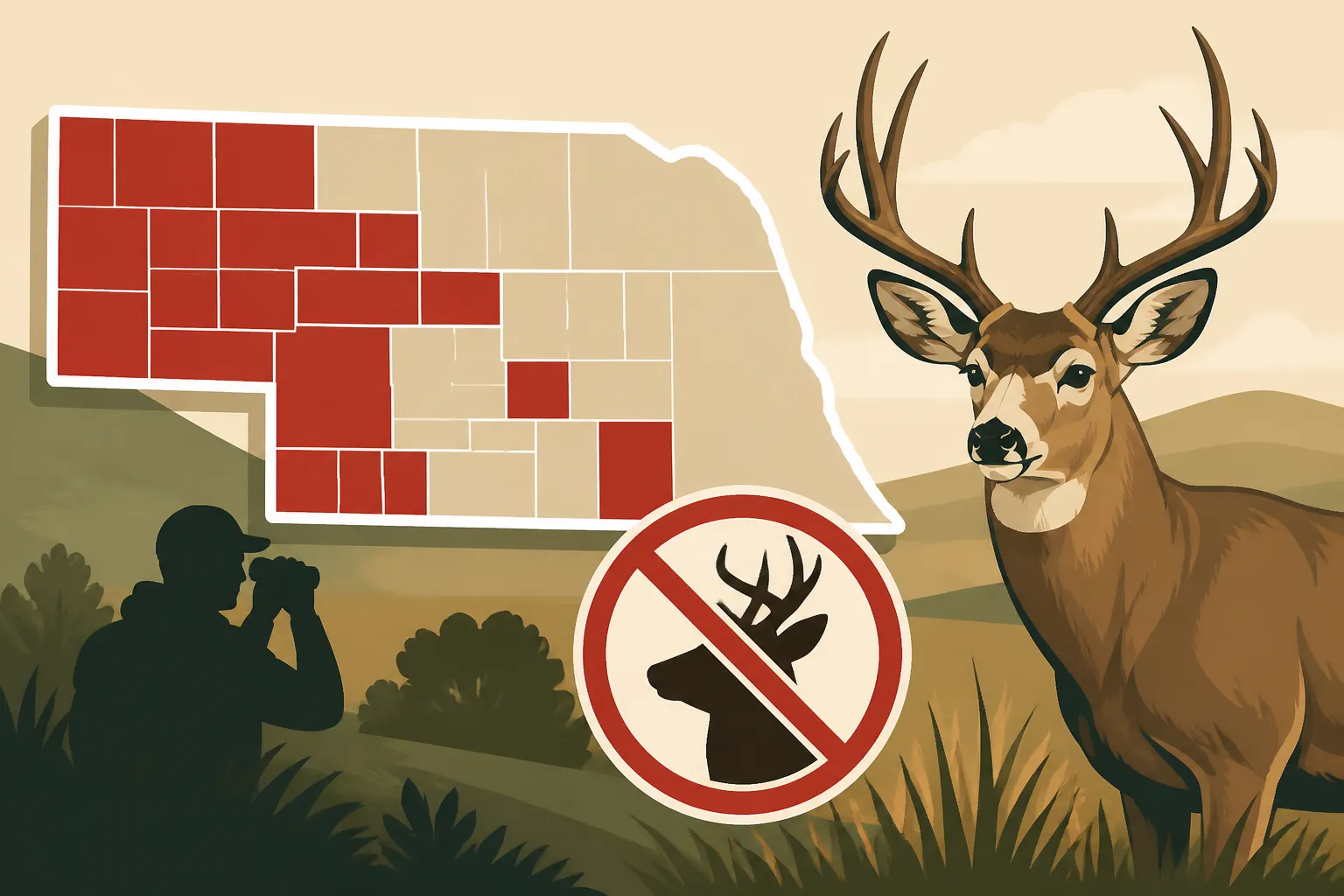
When hunters talk about "mule deer restrictions" in Nebraska, they're generally referring to units where drawing a permit for a mule deer buck is either highly competitive, requires a specialized tag, or is simply not allowed with a general "Any Deer" permit. These restrictions are most prominent in the primary mule deer strongholds.
The Panhandle Powerhouses: Hat Creek, Bordeaux, and Plains Units
These units in the Nebraska Panhandle are arguably the most renowned for quality mule deer hunting, and consequently, they are also the most tightly regulated. The Hat Creek Unit and Bordeaux Unit, in particular, are highly sought after by hunters looking for a mature mule deer buck. These units typically operate on a draw-only basis for specific "Any-Deer" permits, and often, the only way to get a mule deer buck tag is through this competitive draw. The number of permits is severely limited, especially for non-residents, ensuring that harvest pressure remains sustainable for the local mule deer population.
For instance, if you're targeting a mule deer buck in the Hat Creek unit, you'll almost certainly need to apply through the draw for one of their specific "Any Deer" tags, which typically allow for a mule deer buck. Success in this draw often requires accumulated preference points, making it a multi-year effort for many dedicated hunters. The rugged terrain and beautiful landscapes of the Panhandle, like those found when Hunting the Wildcat Hills Rimrock, make these units incredibly appealing, but the permit system reflects that high demand. Similarly, the Plains Unit—which extends eastward from the Panhandle into the Sandhills—also holds significant mule deer numbers and carries similar draw restrictions for buck harvest, requiring specific permits or making a mule deer buck a highly coveted draw tag.
Central and Western Sandhills Units: Sandhills, Calamus West, Frenchman, and Buffalo
Moving east from the Panhandle, the vastness of the Nebraska Sandhills is another key mule deer habitat. Units like the Sandhills Unit itself, Calamus West, Frenchman, and Buffalo also implement various restrictions, though sometimes with a bit more flexibility than the Panhandle's most competitive units.
In the enormous Sandhills Unit, "Any Deer" permits are available, but drawing a tag that allows for a mule deer buck can still be a challenge, particularly for non-residents. Sometimes, specific draw permits are allocated solely for mule deer bucks in certain seasons (e.g., archery). It’s crucial to check the specific details for archery, firearm, and muzzleloader seasons, as mule deer buck harvest might be restricted to a smaller portion of the overall "Any Deer" permit pool, or require a separate draw entirely. For instance, the general "Any Deer" rifle permit might primarily be for whitetail bucks in some parts of the Sandhills, with specific, limited draw opportunities for mule deer bucks.
The Calamus West Unit, located on the eastern edge of the Sandhills, and units like Frenchman and Buffalo further south, typically offer "Any Deer" permits. While mule deer are present in these areas, especially in the canyons and breaks, the regulations often aim to protect mule deer bucks. This can mean that while an "Any Deer" permit allows you to take a deer of either species, the buck portion of that tag may be restricted to whitetails or have very limited mule deer buck harvest quotas. For example, some general "Any Deer" tags might only allow a whitetail buck or an antlerless deer of either species, explicitly excluding a mule deer buck.
Units Where Antlerless Mule Deer Are Restricted
It's not just about bucks! Many "Antlerless-Only" deer permits across the state, even in areas with some mule deer presence, are explicitly designated as "Antlerless Whitetail Only." This means that even if you have an antlerless tag and a beautiful doe mule deer walks out, you legally cannot harvest her. This is a deliberate management choice to help mule deer populations grow, protecting the breeding females.
Hunters often encounter this in transitional zones or units that might have a few mule deer but are primarily whitetail country. Always double-check the exact wording of your antlerless permit. If you're on a public tract in the Pine Ridge, for example, and draw an "Antlerless Deer" permit, it might still specify "Whitetail Only," preventing you from taking an antlerless mule deer even in prime Hunting Mule Deer in the Nebraska Pine Ridge territory.
Here's a simplified table summarizing key units and their typical mule deer buck restrictions:
| Unit Name | Primary Location | Typical Mule Deer Buck Restriction | Notes |
|---|---|---|---|
| Hat Creek | Panhandle (NW) | Draw-only for specific "Any Deer" permits allowing mule deer bucks. | Highly competitive, often requires preference points. Focus on quality mule deer. |
| Bordeaux | Panhandle (NW) | Draw-only for specific "Any Deer" permits allowing mule deer bucks. | Very competitive, similar to Hat Creek. |
| Plains | Panhandle/W. Central | Draw-only for specific "Any Deer" permits allowing mule deer bucks. | Strong mule deer presence, but tags for bucks are limited and highly sought. |
| Sandhills | North Central | "Any Deer" permits available, but mule deer buck harvest often limited/draw-only within this. | Large unit; some general "Any Deer" tags are effectively whitetail buck or antlerless; specific draw tags exist for mule deer bucks. |
| Calamus West | Central | "Any Deer" permits may be whitetail buck only, or have limited mule deer buck harvest quotas. | Mule deer present, but buck harvest is usually highly managed to conserve populations. |
| Frenchman | Southwest | "Any Deer" permits may be whitetail buck only, or have limited mule deer buck harvest quotas. | Similar to Calamus West; check specific regulations annually. |
| Buffalo | South Central | "Any Deer" permits may be whitetail buck only, or have limited mule deer buck harvest quotas. | While mule deer occur here, buck harvest is usually restricted to specific draw tags or generally limited. |
| Most Eastern/Central Units | Eastern/Central | "Any Deer" permits are primarily for whitetails; mule deer rare/prohibited. | If mule deer are present, antlerless tags are typically "Antlerless Whitetail Only." No dedicated mule deer buck harvest opportunities. |
Note: Always verify current regulations with the Nebraska Game and Parks Commission annual hunting guide as rules can change each year.
Navigating the Nebraska Permit Draw for Mule Deer
Understanding the units with restrictions is one thing, but actually securing a permit for a mule deer buck in Nebraska is another adventure entirely. It requires foresight, patience, and a bit of strategic planning.
Applying for Restricted Tags
The journey to a mule deer buck tag often starts with the annual Nebraska Big Game Draw. It’s vital to understand How the Nebraska Big Game Lottery Works. This is where most of the highly coveted permits, especially for mule deer bucks in units like Hat Creek, Bordeaux, and Plains, are allocated. The draw typically opens in June, so mark your calendars for Nebraska Draw Application Dates in June. Don't miss these deadlines, as there's no going back once they pass.
When applying, you'll select your preferred units and permit types. For mule deer, this will likely mean focusing on those specific "Any Deer" permits in the western units that explicitly allow for a mule deer buck. It's crucial to ensure you're applying for the correct permit type, as an "Antlerless-Only" permit might not give you the buck opportunity you're seeking, even if you’re in mule deer country.
The Role of Preference Points
For non-residents, and even for residents targeting the hardest-to-draw units, building up preference points is often the name of the game. Nebraska offers a system where you can Buying a Nebraska Preference Point each year you don't draw your first choice. These points increase your odds in subsequent draws, giving you a better chance to land that elusive mule deer tag.
If your primary goal is a mule deer buck in a trophy unit, and you're not successful in the draw, seriously consider purchasing a preference point. It’s a long-term investment, but it’s often the only realistic path to drawing a permit in a unit like Hat Creek. Think of it as putting money in the bank for a future hunt – it compounds over time. While not directly mule deer specific, studying Nebraska Antelope Draw Odds can give you an idea of how competitive the draw can be for highly sought-after species in the state, offering context for mule deer draws.
Researching Your Chances with Tools like GoHunt
In today's connected world, there's no excuse not to do your homework. Resources like GoHunt provide invaluable data and insights into draw odds, harvest statistics, and permit availability that can dramatically improve your application strategy. GoHunt's detailed analytics can show you historical draw odds for specific units and permit types, allowing you to gauge how many preference points you might need or which units offer a slightly better chance of success.
For example, by using data from a service like GoHunt, you can look at the "Any Deer" permits in the Sandhills Unit and see what the historical success rate has been for mule deer bucks versus whitetails, or how many points were typically needed for non-residents to draw a specific mule deer tag in the Plains Unit. This kind of granular data is gold when you're trying to make an informed decision on where to spend your application fee and points.
Strategic Permit Selection
Beyond just accumulating points, a smart strategy involves choosing your first and second choices wisely. Sometimes, a unit that's slightly less popular than the absolute top-tier units might offer better draw odds for an "Any Deer" tag that does allow a mule deer buck, especially if you have a few preference points. You might also consider applying for an "Any Deer" archery permit in some western units, as archery draw odds can sometimes be more favorable than firearm seasons.
If drawing a specific mule deer buck tag proves too difficult, don't despair! Many general "Any Deer" permits in units like the Sandhills, while competitive for mule deer bucks, can still offer an incredible hunting experience. You might focus on scouting for whitetails but remain opportunistic for a mule deer buck if the opportunity arises and your tag allows it. Always know Reading a Nebraska Deer Unit Boundary to ensure you're hunting within the correct regulations for your permit. Reviewing the full list of Nebraska Deer Permit Types by Unit will also give you a broader understanding of all your options. Securing Nebraska Big Game Permits and How to Get One is always the first step.
Disclaimer
Please remember that hunting regulations, permit availability, and unit boundaries can change annually. It is your responsibility as a hunter to consult the most current Nebraska Game and Parks Commission hunting guide and regulations before planning and undertaking any hunt. The information provided here is for general guidance and informational purposes only.