Telling a Mule Deer From a Whitetail at Distance
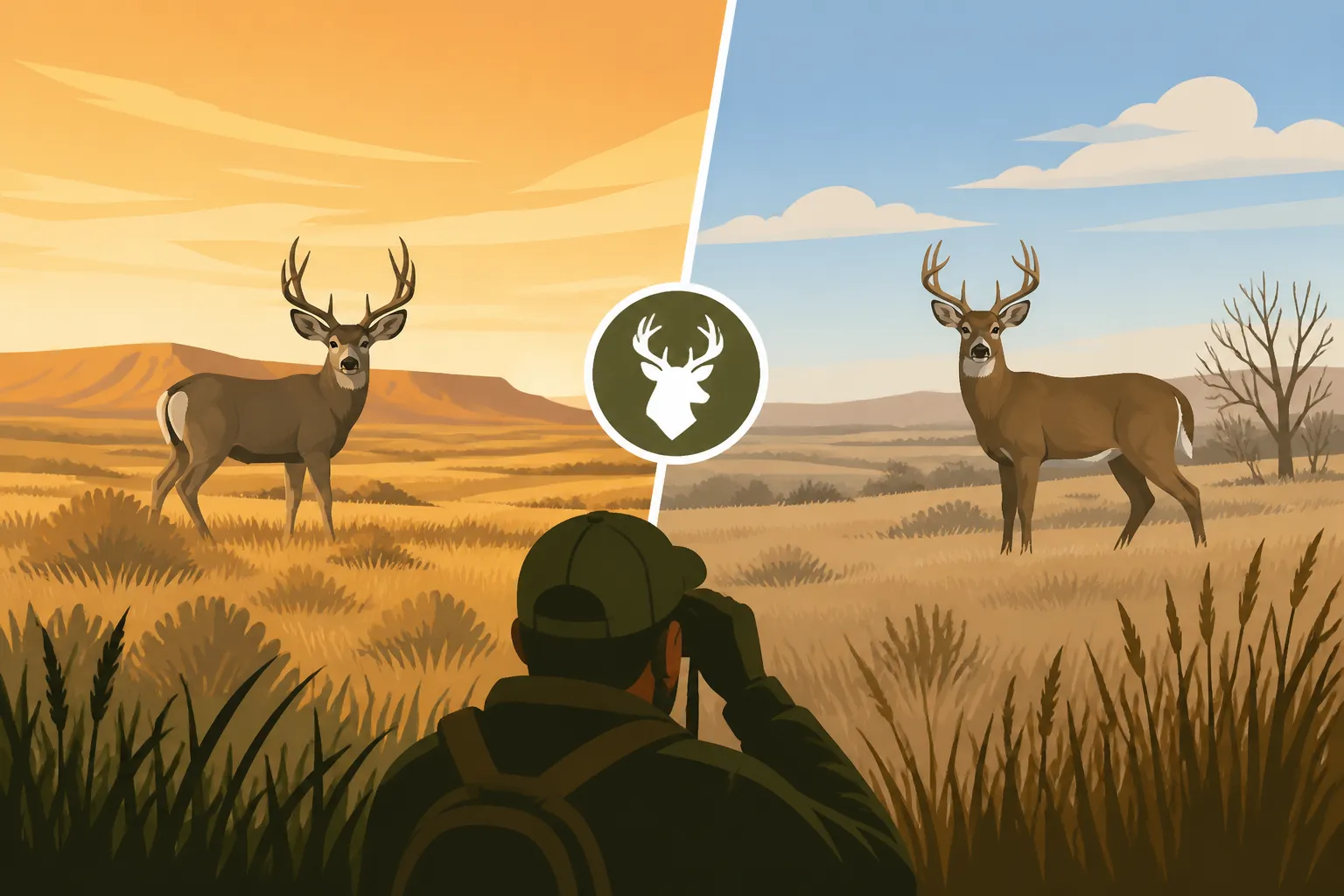
There are few moments in the Nebraska hunting woods or prairies more exciting—and sometimes, more frustrating—than when you finally spot a deer at a distance. But that excitement can quickly turn to anxiety, especially if you're not sure if the animal you're looking at is a mule deer or a whitetail. In many parts of our beautiful state, their ranges overlap, making accurate identification crucial for ethical hunting and staying on the right side of the law. This guide is here to help you confidently tell the difference, even when they're just a speck on the horizon.
The Challenge of Distant Identification
We've all been there: peering through binoculars across a vast Sandhills pasture or down a river bottom, trying to make out details on a deer that’s hundreds of yards away. The light might be low, a heat shimmer might be distorting the view, or the animal might be partially obscured by cedars or tall grass. Your heart pounds, and the pressure is on. Is that a mule deer buck, which might require a specific permit in certain units, or is it a whitetail, which your tag might cover more broadly? Making a mistake can mean a missed opportunity, an illegal harvest, or worse, stressing an animal unnecessarily.
Overlapping Habitats Make It Tricky in Nebraska
Nebraska is unique in that both white-tailed deer and mule deer thrive here, often in close proximity. While whitetails generally prefer the timbered river bottoms and agricultural areas of eastern Nebraska, and mule deer dominate the wide-open spaces of the Sandhills and the rugged canyons of the Pine Ridge, there's a significant overlap. You can find both species along the Niobrara River, in certain sections of the Platte River Valley, and extensively throughout the central and western Sandhills. This means you can’t simply rely on the habitat type to tell them apart, especially in these transition zones. For instance, an area might look like classic whitetail country with thickets and creek bottoms, but a mule deer might still wander through, looking for new forage or just passing through. Knowing Where Whitetails and Mule Deer Overlap is a great first step, but field identification is still paramount.
Why Accurate Identification Is Absolutely Critical
Beyond the thrill of identifying your target, there are very real, practical, and legal reasons why knowing the difference between a mule deer and a whitetail is vital in Nebraska. Many deer permits in Nebraska are specific to either whitetail or any-deer (which includes mule deer). Some units have antler point restrictions for mule deer bucks. Attempting to harvest a mule deer when you only possess a whitetail-specific tag for that unit, or harvesting a mule deer buck that doesn't meet the antler restrictions, can lead to serious legal repercussions, including fines, license revocation, and equipment confiscation. It’s not just about the law, though. It's about respecting the animal and the hunting tradition. Taking an animal you're not legally authorized to harvest, or one you misidentified, isn't ethical. Take your time, verify your target, and only take a shot when you are 100% certain.
Definitive Visual Cues for Deer Identification
When you've got a distant deer in your sights, you need a mental checklist. Forget relying on a single trait. Instead, look for a combination of these characteristics. Over time, with practice, these cues will become second nature, allowing for quick and accurate assessments.
Ear Size and Shape: The Giveaway
The ears are often the most obvious differentiator, even at considerable distances. Mule deer get their name for a reason! Their ears are significantly larger and longer than a whitetail's.
- Mule Deer: Think of a mule's ears – long, broad, and somewhat rounded at the tip. They can seem disproportionately large compared to their head, often extending beyond the deer's eye level or even past the back of its jaw when relaxed. When a mule deer turns its head, those big ears are incredibly noticeable, almost like satellite dishes swiveling to pick up sound. They are also often held erect and pointed slightly outwards. If you can clearly make out big, prominent ears that seem to almost "flag" away from the head, you're likely looking at a mule deer.
- Whitetail Deer: In contrast, whitetail ears are smaller, more pointed, and typically appear proportionate to their head size. They rarely extend much beyond the eye. They are less conspicuous and tend to blend more with the head, especially from a distance.
Antler Configuration: Forked vs. Tined
Antlers are another crucial identifying feature, especially for bucks. This is where the difference is usually very clear, although young bucks can sometimes be deceptive.
- Mule Deer Antlers: The classic mule deer antler pattern is bifurcated, meaning the main beam forks, and then each fork divides again. This creates a "Y" shape, or often multiple "Y"s, rather than a single main beam with tines coming off it. A mature mule deer buck will typically have a main beam that forks into two, and each of those two forks will fork again, creating a beautiful, symmetrical appearance. Even a small two-point mule deer will show this distinct forking. You can learn more about Antler Growth on the Sandhills to understand how these patterns develop.
- Whitetail Deer Antlers: Whitetail antlers, on the other hand, usually grow from a single main beam that sweeps forward and then inward. Individual tines, or points, then grow upwards off this main beam. Think of it like a candelabra, with points rising from a central structure. Even an atypical whitetail will typically have this fundamental main beam structure.
Important Note: Young bucks of both species can sometimes have simpler racks that might confuse identification. A young mule deer might only have two simple forks on each side, while a young whitetail might have only spike or fork antlers. However, the direction of the growth—bifurcated for mule deer, tines off a main beam for whitetails—usually holds true. Always consider this feature in conjunction with other cues.
Tail Color and Movement: The Definitive Flag
This is perhaps the most reliable field identifier, especially when the animal is alarmed or moving away. The tail alone can often seal the deal.
- Mule Deer Tail: Mule deer have a narrow, rope-like tail that is typically white with a distinct black tip. It’s relatively short and tends to be carried down, or only slightly raised, even when the deer is spooked. When a mule deer bolts, it often holds its tail down or uses it as a small, twitching signal. Some western mule deer can have a shorter, all-white "flag" tail, but in Nebraska, the black tip is very common and a key indicator.
- Whitetail Deer Tail: Whitetails are famous for their "flag." Their tail is broader, longer, and brown on top, but brilliant white underneath. When a whitetail is spooked or running, it typically raises its tail high, fanning it out to display that bright white underside. This is an unmistakable signal, flashing like a white flag as they bound away. It’s a truly iconic sight for anyone hunting White-Tailed Deer Across Nebraska.
So, if you see a broad, white flag waving as it disappears, it's a whitetail. If you see a narrower, rope-like tail with a black tip that stays mostly down, it's a mule deer. For more nuanced differences, check out Ear Size and Tail Colour at Distance.
Body Posture and Gait: The Stot vs. The Bolt
Beyond static appearance, how a deer carries itself and moves can offer strong clues.
- Mule Deer Posture and Gait: Mule deer often appear stockier and more robust than whitetails, with a broader chest and heavier build. Their preferred mode of escape when spooked is a distinctive four-legged bounding jump called "stotting" or "pronking." All four feet push off the ground simultaneously, and all four land together. It’s a very bouncy, often high-jumping motion, designed to give them a better view over tall sagebrush or uneven terrain. Their head is usually held high while stotting.
- Whitetail Posture and Gait: Whitetails, by contrast, tend to appear more streamlined and agile. When running, they typically run in a more fluid, galloping fashion, with their hind legs coming forward independently of their front legs. They can be incredibly fast and graceful, often dodging and weaving through cover. When spooked, they will often lower their head and neck to navigate dense timber and underbrush, while their tail flags high.
Leveraging Your Gear for Better Identification
Having the right tools and knowing how to use them is paramount when trying to identify distant deer. Good optics can be the difference between a confident identification and an educated guess.
Optimizing Your Optics for Clarity
When you're trying to distinguish between a mule deer and a whitetail at hundreds of yards, the quality of your optics matters immensely.
- Binoculars: A good pair of 10×42 or 12×50 binoculars are your first line of defense. They offer a wide field of view and are quick to bring to your eyes. Look for clear glass, good light transmission, and steady focus. Brands like Vortex, Leupold, and Zeiss are popular among serious hunters. When glassing open country, having powerful, stable binoculars is key. For advice on power and stability, you might find useful tips in Binocular Magnification for the Sandhills. When scanning, try to brace yourself against a tree or use trekking poles to minimize shake, which can really blur distant images.
- Spotting Scopes: For truly distant animals, especially across vast areas like the Oglala National Grassland or the Sandhills, a spotting scope is invaluable. A 15-45x or 20-60x scope on a stable tripod will allow you to zoom in and pick out fine details like antler configuration, ear size, and tail characteristics that even the best binoculars can't resolve. It allows you to study the animal for extended periods without arm fatigue. While the reference to Spotting Scope Magnification for Antelope might be for a different species, the principles of using high-quality spotting scopes for distant game apply universally.
- Rangefinders: While not directly for identification, knowing the exact distance to the animal helps you manage your expectations of clarity. A deer at 500 yards will always be harder to identify than one at 200 yards, even with the best optics. Many modern rangefinders also offer ballistic compensation, which helps with shot placement if you do decide to shoot.
Many hunters also use mapping applications like those offered by GoHunt to understand the terrain and typical habitat zones before even stepping foot in the field. This can give you an educated guess about which species you're more likely to encounter, although it should never replace direct observation.
Patience and Observation Are Your Best Allies
The most common mistake hunters make is rushing the identification process. Excitement can get the better of us. Instead, take a deep breath and settle in.
- Wait for Movement: Deer rarely stand perfectly still for long. Wait for the animal to turn its head, allowing you to get a better look at its ears. Wait for it to lift its tail, or even better, spook and run. That's often when the tail and gait become unmistakably clear.
- Utilize Natural Breaks: Deer will often pause at the crest of a ridge, before entering a draw, or crossing an open patch. These brief moments can provide the clearest views.
- Use the Terrain: Position yourself to have a clear view with a good backdrop if possible. Glassing against a dark timber patch can make a light-colored tail stand out. When Hunting Mule Deer in the Nebraska Pine Ridge, utilize the contours of the landscape for better angles and concealment. If you're struggling to see details, try to slowly and carefully reposition yourself for a better angle, always mindful of the wind and thermals, especially relevant when considering Wind and Thermals in the Sandhills.
Common Pitfalls and Misconceptions to Avoid
Even experienced hunters can make mistakes, especially when the conditions aren't ideal. Being aware of these common traps can help you avoid misidentification.
The "Big Body" Trap
It’s tempting to assume that any deer with a large body is a mule deer, as they generally average larger in size than whitetails. However, a mature, well-fed whitetail buck can grow to be a substantial animal, easily rivaling the body size of a smaller or younger mule deer. Especially in the rich agricultural areas of eastern Nebraska, whitetails can grow quite large. Never rely solely on body size for identification. Always look for the combination of ear size, antler structure, and tail characteristics. Remember, you're looking for Nebraska Mule Deer Harvest Recovery or understanding Why Nebraska Whitetail Buck Harvest Hit a 30-Year Low through accurate field data, and that starts with proper identification.
Environmental and Lighting Factors
The conditions under which you're glassing can significantly impact your ability to identify deer accurately.
- Low Light: At dawn or dusk, details become muted, and colors blend. A black tail tip on a mule deer might disappear against a shadowy backdrop, or a whitetail's flag might seem less pronounced. This is when good optics that gather light well are critical.
- Heat Shimmer: On a warm, sunny day, especially across a long distance on the open prairie, heat rising from the ground can create a shimmering effect that distorts images, making it incredibly difficult to pick out fine details. In these conditions, patience is even more important, and waiting for a momentary lull in the shimmer can reveal the necessary clues.
- Partial Obstruction: A deer partially hidden by tall grass, a cedar tree, or a ridge can conceal key features. Never assume. If you can only see the head, you might be able to tell by the ears and antlers. If only the body and tail, the tail is your best bet. If you can't see enough of the animal, don't guess.
Age and Antler Variability Can Be Deceiving
As mentioned earlier, young bucks of both species can have racks that don't fit the classic mold. A spike mule deer or a non-typical whitetail can throw you for a loop. Always prioritize the ear and tail characteristics, as these are typically consistent regardless of age or antler development.
Comparison Table: Mule Deer vs. Whitetail at a Glance
| Feature | Mule Deer | White-Tailed Deer |
|---|---|---|
| Ears | Large, long, mule-like; often extend past eye level | Smaller, more pointed; proportionate to head |
| Antlers (Bucks) | Bifurcated (forks and re-forks); "Y" shape | Main beam with tines growing upwards |
| Tail | Narrow, rope-like, white with black tip; held down | Broad, flat, brown top, white underside; flags high |
| Gait (Running) | Stotting/Pronking (all four feet push/land together) | Fluid, galloping; hind legs independent of front |
| Body Shape | Stockier, broader chest, often appears heavier | More streamlined, agile |
| Coloration | Generally lighter brown/tan; face often lighter | Reddish-brown in summer, grayish-brown in winter |
By diligently applying these identification methods, you'll be well on your way to confidently distinguishing between a mule deer and a whitetail in the field, making your Nebraska hunting experience more informed and ethical.
Disclaimer
The information provided in this guide is for general informational purposes only and is not intended as legal advice. Hunting regulations, permit requirements, and species identification rules can change, and it is the hunter's sole responsibility to know and abide by all current federal, state, and local laws. Always consult the most recent Nebraska Game and Parks Commission regulations and guidelines before planning or engaging in any hunting activity.