Judging a Mule Deer Buck in the Field
Hunting Nebraska's vast and often unforgiving landscapes for mule deer can be an incredible experience, but nothing quite prepares you for the heart-pounding moment a buck steps out, and you have mere seconds to decide if he's the one you've been searching for. The pressure is immense, and it’s all too easy to let excitement or an optical illusion lead you astray. This comprehensive guide will arm you with practical strategies and specific insights to confidently judge mule deer bucks in the field, helping you make those crucial decisions count.
The Unique Challenges of Mule Deer Judging
Let's face it, picking out a mature mule deer buck and accurately assessing his rack size on the fly is a skill that takes years to hone. It's not just about looking at antlers; it's about understanding the animal, the environment, and the limitations of your own perception.
Distance and Deceptive Prairie Landscapes
The sheer scale of places like the Nebraska Sandhills, with its rolling hills, expansive grasslands, and subtle draws, can be incredibly deceptive. What looks like a monster buck through your binos at 800 yards can suddenly shrink when you close the distance. This "ground shrinkage" phenomenon is a real head-scratcher for even seasoned hunters. The open country offers fewer visual references, making it tough to gauge an animal's true size. A buck standing alone in a wide-open blowout might appear colossal, only to reveal a modest frame once you get a better look or compare him to a fence post.
Add to this the ever-changing light conditions – the golden hour that can make antlers glow, or the harsh midday sun that washes out detail. These factors conspire to make accurate judgment a constant battle against optical illusions. You might be glassing a distant ridge, convinced you see a wide, heavy rack, only to realize later it was an optical trick of shadows and perspective. This is why having quality optics is paramount when Glassing the Nebraska Sandhills for Mule Deer.
Mule Deer Antler Characteristics vs. Whitetails
One of the biggest hurdles for hunters, especially those more accustomed to whitetails, is understanding how mule deer antlers grow. Unlike whitetails, which typically have a main beam with tines growing off it, mule deer antlers are primarily "bifurcated." This means the main beam forks, and then each of those forks typically forks again, creating a distinctive "Y" shape.
This unique growth pattern means a "four-point" mule deer buck (referring to the number of points on one side, excluding the brow tine) is often considered mature and desirable, whereas a four-point whitetail might be just a young buck. The emphasis shifts from tine length on a single beam to the overall width, depth, and symmetry of those bifurcations. You'll often find that even with impressive mass, mule deer racks don't have the same overall width or height as a whitetail that scores similarly, because their unique growth pattern distributes antler material differently. Understanding these nuances is key to appreciating a mule deer's true score potential and avoiding a case of mistaken identity when Telling a Mule Deer From a Whitetail at Distance.
Practical Field Judging Techniques for Nebraska Bucks
So, how do you cut through the visual clutter and make a solid call when a buck you’ve been chasing appears? It boils down to a systematic approach, using reference points, and knowing what to look for on a mature animal.
Using Body Size as a Reference
The antlers aren't the only clue to a buck's age and potential. A mature mule deer buck carries a significantly different body profile than a young two-year-old. This is your first, and often most reliable, indicator.
- Yearling (1.5 years old): Small, slender body. Head and neck look disproportionately large compared to their body. Their antlers, even if they have some length, will look "too big" for their frame.
- Young Buck (2.5-3.5 years old): Still fairly athletic build, but starting to fill out. Neck will be thicker than a yearling but still distinct from their shoulders. They'll show more muscle definition. Antlers might be respectable but often lack the mass and depth of a truly mature buck.
- Mature Buck (4.5+ years old): This is where body size really shines as a judging tool. Look for a thick, heavy neck that blends smoothly into their shoulders, giving them a "bull-necked" appearance, especially during the rut. Their chest will be deep, and their belly will often sag slightly. Their legs might even look shorter in comparison to their bulk. They'll move with a more deliberate, heavy gait. When Mule Deer Antler Growth on the Sandhills peaks, it's almost always on a mature body. Pay attention to how their antlers sit on this larger frame – they should look proportional, not overly dominant.
| Characteristic | Young Buck (2.5-3.5 years) | Mature Buck (4.5+ years) |
|---|---|---|
| Body Shape | Lean, athletic, often leggy | Stocky, deep chest, thicker midsection |
| Neck | Visible transition from head to shoulders | Thick, blends into shoulders, "bull-necked" especially pre-rut/rut |
| Back | Straight, flat, defined muscle | Often a slight sag, heavier musculature |
| Antler Mass | Typically thinner, less consistent mass | Heavy, noticeable mass throughout beams and forks |
| Antler Width | Often inside or just outside ears | Can extend well beyond ear tips (20-24" is typical) |
| Behavior | More nervous, skittish, reacts quickly | Confident, deliberate, less easily spooked |
Estimating Width and Height
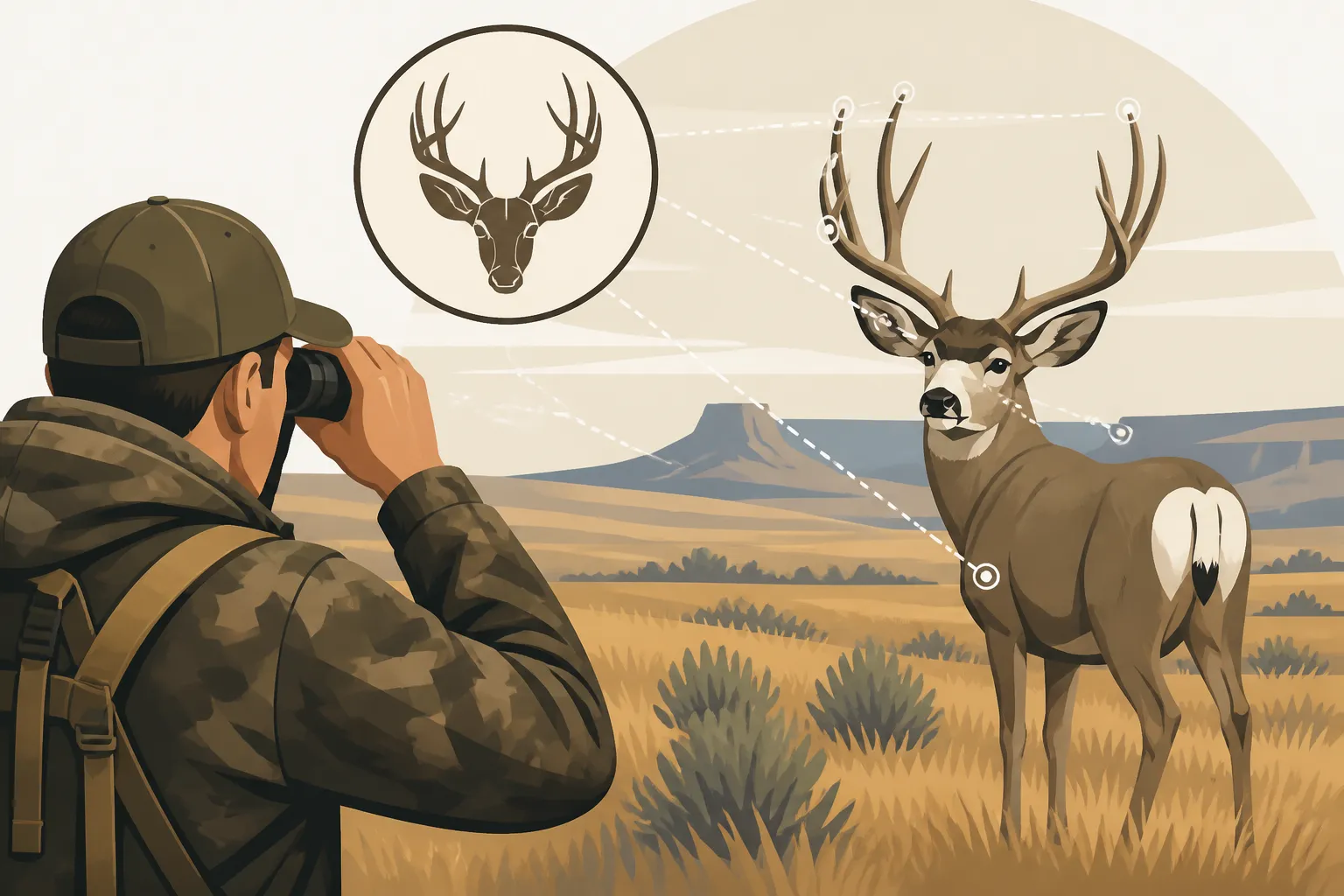
Once you've gauged the body, shift your focus to the antlers themselves. Width is often the first thing people look for, and a good rule of thumb for mule deer is to use their ear tips as a reference.
- Ear-Tip-to-Ear-Tip Width: A mature mule deer buck's ears, when alert, typically span about 20-24 inches from tip to tip. If the outside of his main beams extend noticeably past his ear tips, you're looking at a buck with good width. If they barely reach the tips, or are inside, he’s probably not as wide as you might hope. Remember, this is for alert ears; if the ears are relaxed or laid back, they'll appear narrower.
- Height and Depth: Estimating the height of the rack can be tricky. Use the buck's head as a unit of measure. How many "heads tall" is his rack? Look for the overall depth of the antler structure, meaning how far back the forks extend from the main beam, and the length of the tines themselves. Mule deer often have impressive depth and spread on their forks, contributing to their score.
- Mass: This is often overlooked but contributes significantly to a buck's score and visual appeal. Look for how thick the antlers are, especially at the bases. Do they maintain that thickness throughout the main beam before they begin to fork? A truly heavy-horned buck will have thick bases and good mass carried throughout, not just at the ends. Thin, spindly antlers, even if wide, suggest a younger buck or one that isn't reaching his full potential.
Counting Tines and Understanding Forking
This is where the unique mule deer antler structure really comes into play. You’re not just counting points; you're looking at the forks.
- The Bifurcation Rule: A typical mule deer antler forks once, and then each of those main forks typically forks again. So, if you see a main beam, it splits into two, and then each of those two points splits again, you have what's commonly called a "four-point" on that side (excluding the brow tines, which are usually single points originating from the main beam). This is often described as a 4×4 if both sides are symmetrical.
- Quick Count Method: When a buck is moving, or you have limited time, try to quickly count the major forks. Can you clearly see the double fork on each side? Are the tines long and well-defined? Don't get hung up on tiny "cheaters" or non-typical points in your initial assessment; focus on the main structure. For a quick assessment, a "good" buck will usually be a solid 4×4 or better.
- Brow Tines: Don't forget the brow tines (G1s). While sometimes small or even absent on mule deer, well-developed brow tines add to the overall score and visual appeal. Make sure to factor them into your overall point count, but remember the main "score" comes from the bifurcated main beam.
Situational Awareness and Technology Aids
Even with a sharp eye and a systematic approach, external factors and the tools at your disposal can dramatically influence your judging success.
Patience and Observing Behavior
It's tempting to want to immediately pull the trigger when a buck appears. But if time and conditions allow, a moment of patience can save you from regret.
- Let Him Present Himself: If possible, let the buck stand up, turn, and move naturally. This allows you to see him from different angles, which is critical for assessing width, mass, and the full extent of his points. A buck standing head-on can look massive but turn out to be narrow. A quartering-away buck might hide the full length of his tines.
- Observe Interactions: Pay attention to how the buck interacts with other deer, especially during the rut. A truly dominant, mature buck will often carry himself differently, showing less nervousness and more authority. If he's a younger buck, he might be more skittish or deferential to larger deer. These subtle cues provide context to your antler assessment.
- Make Your Call When Ready: The moment you feel confident is the right time. Sometimes you only get a brief window, and you have to make a quick decision. But if you have the luxury, take a breath, use your optics, and confirm what you’re seeing. Remember, there's no prize for shooting the first buck you see if he's not the one you want. This patience is especially important when you're hunting in areas known for larger animals, like those mentioned in Hunting Mule Deer in the Nebraska Pine Ridge.
Leveraging Optics and Digital Tools
Modern hunting demands modern tools. Your eyes are powerful, but they can be dramatically enhanced by the right gear.
- High-Quality Optics: This cannot be stressed enough. Good binoculars are your primary tool for scanning the landscape and initially locating deer. For detailed judging, a quality spotting scope with a stable tripod is indispensable, especially in open country like the Oglala National Grassland. Brands like Vortex, Leupold, and Swarovski offer excellent clarity and magnification that can make a huge difference. You'll want to read up on Binocular Magnification for the Sandhills and Spotting Scopes for Judging Antelope for more depth on this.
- Rangefinders: A rangefinder not only gives you the exact distance for your shot but can also help put the buck's size into perspective. Knowing the distance helps you mentally calibrate for "ground shrinkage." If a buck looks great at 500 yards and your rangefinder confirms it, you can make a more informed decision.
- Digital Scouting and Planning: Before you even hit the field, tools like GoHunt can provide invaluable insights into typical antler growth for specific units or regions. They offer data on harvest success, age structures, and even past photos of bucks from an area, helping you set realistic expectations and understand what a "good" buck looks like in your hunting zone. This pre-season research, combined with scouting for Reading Sign on a Nebraska Sandhills Two-Track, can make a significant difference.
- Phone Camera (with discretion): In some situations, if the buck is calm and you have time, quickly snapping a photo or video through your spotting scope with your phone can allow for a rapid review. The ability to zoom in on the image and discuss it quickly with a hunting partner can confirm suspicions or reveal details you missed in the heat of the moment. This is a last-ditch effort if you're truly on the fence, and always prioritize the shot if it's "the one."
Common Mistakes and How to Avoid Them
Even with the best intentions and tools, we all make mistakes. Recognizing these common pitfalls can help you avoid them in the future.
The "Ground Shrinkage" Phenomenon
This is perhaps the most universal frustration among deer hunters. You walk up to what you were sure was a behemoth, only to find the antlers seem to have magically shrunk. It's not magic, it's often a combination of factors:
- Excitement and Adrenaline: The rush of the hunt can magnify what you're seeing. Your brain wants to see a big buck, and it can override objective judgment.
- Lack of Reference Points: As discussed earlier, open country lacks trees, fences, or other objects to compare size against. A buck looks bigger in a void.
- Perspective and Angle: You might have only seen the buck from an angle that exaggerated his width or tine length. Once he's down, and you're standing over him, the perspective changes entirely.
How to combat it: Always try to underestimate slightly. If you think he's 24 inches wide, tell yourself he's 22. If you think he has massive bases, consider them just "heavy." Use your optics to confirm and re-confirm. Take a deep breath. And if you’re still unsure, and your tag allows, maybe pass and wait for one you’re absolutely certain about. Remember to consider the conditions, as Wind and Thermals in the Sandhills can influence both deer behavior and your ability to get a clear, calm view.
Misjudging Antler Mass and Symmetry
Mass and symmetry are key components of a mule deer's score and overall aesthetic, but they are incredibly difficult to judge accurately from a distance.
- Light and Shadow: Sunlight can create illusions. A buck standing with the sun behind him might have his antlers backlit, making them appear thinner. Conversely, shadows in the forks can make them seem deeper or heavier than they are. Overcast days often provide the most honest view of antler characteristics.
- Asymmetry: Very few deer racks are perfectly symmetrical. You might get a great look at one side and assume the other side is identical. However, environmental factors, injuries, or genetics can cause significant differences. If possible, try to view the buck from both sides, or at least from a quartering angle that allows you to see both main beams and their forks. Don't let one impressive side carry your judgment for the entire rack. When using Rifle Scopes for Long Nebraska Shots, high-quality glass can help resolve these details even at extended ranges.
Ultimately, judging a mule deer buck in the field is a blend of science, experience, and a little bit of gut feeling. By understanding the unique challenges of mule deer, employing systematic judging techniques, and leveraging your tools wisely, you'll be well on your way to making confident decisions and truly enjoying the fruits of your labor in Nebraska's amazing hunting grounds.
Disclaimer
The information provided in this article is for general guidance and educational purposes only. Hunting regulations, seasons, and requirements can change. Always consult the most current Nebraska Game and Parks Commission regulations and official sources before planning any hunt. Safe hunting practices and ethical considerations are the responsibility of each individual hunter.