Nebraska’s Top Deer Units by Buck Harvest
It's no secret that every deer hunter in Nebraska dreams of a successful season, especially when it comes to tagging a mature buck. But with so many deer management units stretching across our diverse landscape, knowing where to focus your efforts can feel like trying to find a needle in a haystack. This guide is here to cut through the confusion, offering a deep dive into the units that consistently produce the best buck harvests, helping you pinpoint where your next trophy might be waiting.
Understanding Nebraska's Deer Management Units
Nebraska's deer hunting landscape is carefully managed through a system of Deer Management Units (DMUs), each with its own specific regulations, permit quotas, and season structures. This isn't just bureaucratic red tape; it's a strategic approach by the Nebraska Game and Parks Commission (NGPC) to maintain healthy deer populations, balance harvests, and provide quality hunting opportunities across the state. Understanding how these units are designated and the types of permits available is your first step toward a successful hunt.
How Units Are Designated
Each DMU is essentially a geographically defined area, often delineated by highways, county lines, or natural features like major rivers. The boundaries aren't arbitrary; they're established based on habitat types, deer population densities, and land use patterns. For instance, an eastern unit might encompass rolling farmland and river bottoms, while a western unit could stretch across vast expanses of Sandhills prairie and rugged canyons. These distinctions are crucial because they dictate the primary deer species found there (whitetail, mule deer, or a mix) and the types of hunting experiences you can expect. The NGPC regularly monitors harvest data, population trends, and habitat conditions within each unit to make informed decisions about permit numbers and regulations for the upcoming seasons. This dynamic approach means what was a top unit five years ago might have changed due to factors like EHD outbreaks or shifts in agricultural practices.
Permit Types and Availability
Navigating Nebraska's permit system can sometimes feel like solving a puzzle, but it's essential for accessing these prime units. Hunters typically apply for permits during the annual draw, which usually happens in June. Depending on the unit, you might be applying for an "Any Deer" permit, which allows you to harvest either a whitetail or a mule deer, or a "Whitetail Buck Only" permit. There are also "Antlerless-Only" permits that become available later in the season, often used for herd control and filling freezers.
It's important to remember that some of the most sought-after units, particularly those with a reputation for producing large bucks, can be highly competitive, especially for non-residents. The state has specific rules about how Nebraska's 85 Percent Resident Permit Split works, favoring resident hunters, which means non-residents often face tougher draw odds for premium permits. However, knowing which permits target specific units, like the Statewide Whitetail Buck Permits Explained, can help you strategize your application. Leftover permits, which become available over-the-counter after the draw, can also be an option, but these tend to be in less popular units or for antlerless deer. Tools like GoHunt can be incredibly useful here, providing historical draw odds and permit availability data to help you make smart choices during the application period.
Key Factors Influencing Buck Harvest in Nebraska
Understanding which units consistently produce high buck harvests isn't just about looking at a list of numbers; it's about delving into the underlying ecological and human factors that shape these outcomes. Deer populations are incredibly sensitive to their environment, and everything from the quality of the local cornfields to the number of hunters stomping through the timber can impact your chances of success.
Habitat Quality and Food Sources
At the heart of any thriving deer population is excellent habitat, and Nebraska offers a stunning diversity of it. Whitetail deer, for example, absolutely thrive in areas with a mix of dense cover for bedding, water sources, and abundant food. Think about the rich river bottomlands in eastern Nebraska, where vast fields of corn and soybeans meet tangled cedars and cottonwood forests. These areas provide everything a buck needs to grow big antlers and maintain a healthy body weight. The sheer caloric intake from agricultural crops, combined with natural browse and acorns, fuels impressive antler growth.
Mule deer, on the other hand, are creatures of more open, rugged landscapes. The Sandhills, with its rolling grasslands, interspersed with occasional cedar pockets and wet meadows, provides ideal conditions for them. Here, their diet might consist more of forbs, browse, and native grasses. Areas with diverse forage, particularly those that offer consistent food sources even during harsh winters or dry summers, are critical. When you see a unit with consistently high buck harvests, it's often a direct reflection of superior habitat that allows deer to reach their full genetic potential. For a deeper dive into these populations, you might want to read up on Nebraska Whitetail Population Trends and Nebraska Mule Deer Harvest Recovery.
Population Density and Herd Health
It stands to reason that where there are more deer, there's a higher chance of encountering a buck. However, it's not just about raw numbers; herd health is paramount. A unit might have a high deer density, but if the herd is struggling with disease (like EHD outbreaks) or poor nutrition due to overpopulation, the quality of bucks might decline. The NGPC aims to manage deer populations within "social carrying capacity," meaning a balance between deer numbers and what the habitat can sustainably support, while also considering local landowner tolerance for crop damage.
Units with a balanced buck-to-doe ratio and a good age structure (meaning a healthy percentage of older bucks) are generally more desirable. These conditions promote a more natural rutting cycle and allow bucks to mature, leading to larger antlers. Conversely, units with excessive hunting pressure or unbalanced harvests can see a decline in the number of mature bucks. Factors like harsh winters can also significantly impact herd health and subsequent buck harvests. The goal is a healthy, robust herd where bucks have the opportunity to grow old and express their full potential.
Hunting Pressure and Access
Even the best habitat and healthiest herd won't guarantee a top buck harvest if the hunting pressure is overwhelming. In areas with high hunter density, bucks quickly become nocturnal and savvy, making them incredibly difficult to pattern and harvest. This is especially true on smaller parcels of public land or in units where access is relatively easy.
Units that offer a balance of good habitat and reasonable hunter numbers often shine. This might mean units with a lot of private land where access is managed, or large expanses of public ground that require more effort to access, naturally spreading out hunters. Hunters willing to put in the work to scout remote corners of public land or secure private land permission often find themselves in units that appear "average" on paper but offer exceptional experiences due to lower pressure. Utilizing resources like the Nebraska Public Access Atlas can help identify areas that might see less pressure simply because they require more effort to reach. Furthermore, understanding the rules for Nebraska's Nine-Day November Firearm Deer Season compared to the more spread-out archery season gives insight into when and where pressure might peak.
Top Performing Units for Whitetail Buck Harvest
When it comes to putting a whitetail buck in the back of your truck, some areas of Nebraska consistently outperform others. These aren't just places with high deer numbers; they're regions where the combination of rich habitat, careful management, and a bit of hunter savvy can lead to truly memorable hunts.
Eastern Nebraska River Bottoms
The eastern portion of Nebraska is a whitetail paradise, largely thanks to the extensive river systems and the fertile agricultural land that borders them. Rivers like the Missouri, Platte, Elkhorn, and Big Blue create vast corridors of prime whitetail habitat. These river bottoms often feature dense stands of cottonwoods, willows, and cedars, providing crucial bedding cover, while the adjacent farm fields offer an endless buffet of corn and soybeans. This rich food source, coupled with excellent cover, allows bucks to grow to impressive sizes.
Units in this region, such as those along the Missouri River, often show up on the list of Nebraska's Top Deer Units by Buck Harvest. The challenge here isn't necessarily finding deer, but finding access and navigating the often thick, challenging terrain. Private land dominates, so securing permission is key, but public access points along the Missouri River and associated Wildlife Management Areas can provide opportunities for those willing to scout diligently. Hunters often find success by focusing on transition areas where timber meets agriculture, using tactics like those discussed in River-Bottom Whitetail Hunting in Eastern Nebraska. The consistent food and cover in these areas lead to high deer densities and the potential for older, larger-racked bucks.
Southeastern Farmland Pockets
Beyond the immediate river corridors, the rolling farmlands of southeastern Nebraska also hold some truly exceptional whitetail hunting. This area is characterized by a patchwork of row crops, small timber blocks, and brushy draws that provide incredible habitat. Bucks in these units often utilize the cover offered by shelterbelts, creek bottoms, and CRP fields for bedding, venturing out into the corn and bean fields under the cover of darkness. The consistent availability of high-energy food sources here is a major driver of antler growth.
Units in counties like Gage, Jefferson, and Pawnee, while perhaps not as widely known as some Sandhills mule deer units, quietly produce some of the state's largest whitetails. The key here is often identifying those overlooked pockets of cover on private land. Hunters who build relationships with landowners or meticulously scout smaller public parcels can find fantastic opportunities. It's not uncommon to find very large-bodied, heavy-antlered bucks in these areas, as highlighted in "Why Blue Southeast Produces Big Whitetails." Persistence and attention to detail, perhaps even using a mapping tool from GoHunt to identify potential bedding areas and travel corridors, are rewarded in these rich farmland pockets.
Central Nebraska River Corridors
Moving west into central Nebraska, the Platte and Loup river systems continue to provide significant whitetail habitat, though the landscape starts to transition towards more open prairie. These river corridors act as green arteries, offering crucial cover and food in a predominantly agricultural and grassland environment. Bucks use the timbered banks and islands for security, moving into adjacent fields, pivot corners, and even rangeland to feed.
Units encompassing these central river systems often boast respectable buck harvest numbers. While not always producing the sheer volume of eastern units, the opportunities for a quality whitetail buck are certainly there. Access can be a mix of private land and various public parcels, including State Recreation Areas and Wildlife Management Areas near the rivers. Understanding how deer utilize these linear habitats, particularly entry and exit routes on flat farm ground, becomes paramount. Scouting for well-worn trails leading from river timber to feeding areas is a classic tactic that continues to pay off. The hunting experience here often feels like a blend of eastern timber hunting and the more open country stalking found further west.
Prime Units for Mule Deer Buck Harvest
For many hunters, the image of a wide-racked mule deer silhouetted against a vast horizon is the epitome of a western hunt. Nebraska might not be the first state that comes to mind for mule deer, but our western and north-central regions offer some fantastic opportunities, with certain units consistently standing out for their mule deer buck harvests.
The Iconic Sandhills Region
Without a doubt, the Nebraska Sandhills are the heart of mule deer country in the state. This unique landscape, a mosaic of rolling grass-covered dunes, wet meadows, and occasional cedar pockets, provides ideal habitat for these big-eared deer. The sheer vastness of the Sandhills means deer have plenty of room to roam and mature, and hunters willing to put in the miles and effort can be handsomely rewarded. Units like the Sandhills Unit and Calamus West Unit often rank high for mule deer buck harvests.
Hunting the Nebraska Sandhills is an experience unlike any other. It's often a spot-and-stalk affair, requiring keen optics and a lot of patience. Mule deer bucks in the Sandhills can grow truly impressive racks, feeding on native grasses and forbs. The challenge lies in glassing vast expanses of ground, identifying bucks, and then planning an effective stalk across terrain that can be surprisingly steep and deceptive. If you're considering a hunt here, reading about Spot-and-Stalk Mule Deer in the Nebraska Sandhills can be incredibly helpful. Using a reliable mapping system, perhaps through a GoHunt subscription, to mark glassing points and potential bedding areas, can greatly aid in your strategy across this immense landscape.
Panhandle's Rugged Pine Ridge
Up in the extreme northwestern corner of Nebraska, the Pine Ridge escarpment offers a stark contrast to the Sandhills. This rugged landscape of ponderosa pine forests, sandstone canyons, and buttes provides excellent, albeit challenging, mule deer habitat. The steep terrain and dense timber can make for tough hunting, but also offers great security for mature bucks. Units such as the Pine Ridge Unit are consistently on the radar for trophy mule deer.
Hunting the Pine Ridge requires a different approach. While glassing is still important, especially from high vantage points overlooking canyons, much of the hunting here involves still-hunting through the pines or covering ground to jump deer out of bedding areas. Deer here often seek refuge in the dense Ponderosa stands and deep draws, especially during periods of heavy hunting pressure. Understanding the nuances of Hunting Mule Deer in the Nebraska Pine Ridge is crucial. The solitude and rugged beauty of the Pine Ridge make for an unforgettable hunt, and for those who embrace the challenge, the reward can be a magnificent Pine Ridge mule deer buck.
Western Plains Units
Beyond the Sandhills and Pine Ridge, other units in western Nebraska, particularly those that incorporate breaks, canyons, and mixed-grass prairie, also offer solid mule deer opportunities. These "Plains" units, often bordering the Sandhills or areas with rougher topography, provide transitional habitat where mule deer can thrive. While the densities might not be as high as in the core Sandhills, these areas can still produce quality bucks, often with less pressure than some of the more renowned units.
These units present a mix of hunting styles, from glassing vast distances to walking drainages and creek beds. Access can be a blend of private ranch land and public ground, including portions of national grasslands or smaller WMAs. For hunters seeking a mule deer experience without the intense competition of some prime units, exploring the harvest data for these western plains units can be very worthwhile. The key is finding those overlooked corners where sufficient cover and food keep mule deer present. For insights into which units might be best for these animals, checking out Best Nebraska Units for Mule Deer Bucks can be an excellent starting point.
Navigating the Annual Harvest Data
Understanding Nebraska's top deer units isn't just about knowing the names; it's about interpreting the data. The Nebraska Game and Parks Commission (NGPC) compiles and publishes extensive harvest statistics each year, offering a treasure trove of information for the diligent hunter. Learning how to read and apply this data is a crucial skill for maximizing your success.
Interpreting Success Rates
When you look at the annual harvest reports, you'll see various metrics, but one of the most commonly discussed is "success rate." This number represents the percentage of hunters who successfully harvested a deer in a particular unit. A high success rate might initially seem like the ultimate indicator of a great unit, but it's important to dig a little deeper. For instance, a unit might have a very high success rate, but if a large portion of those permits are for antlerless deer, it doesn't necessarily mean it's a top buck unit.
Conversely, a unit with a lower overall success rate for "Any Deer" permits might still have excellent potential for a trophy buck if a significant percentage of those harvested deer are mature bucks. You'll want to look for data that breaks down harvests by species (whitetail vs. mule deer) and by sex/age class (adult buck, fawn, doe). A unit that consistently shows a good number of older bucks in its harvest statistics is often a better indicator of quality buck hunting than one with just a high overall success rate. Remember, the goal is often a quality buck hunt, not just any deer.
Looking Beyond Raw Numbers
While raw numbers provide a valuable snapshot, they don't tell the whole story. Several nuances need to be considered when evaluating a unit's potential for buck harvest. For example, hunter numbers can dramatically influence reported success rates. A unit with fewer permits might have a high success rate simply because there are fewer hunters to dilute the average, even if the absolute number of bucks harvested isn't the highest. Conversely, a unit with a massive amount of permits might have a lower success rate but still produce a significant number of mature bucks.
Another crucial aspect is understanding Nebraska Deer Management Unit Permits and how they are structured. Some units are geared towards providing high opportunity for general deer harvest, while others are managed more for quality. Pay attention to trends over multiple years rather than just focusing on a single season's data. Has a unit's buck harvest been consistently strong? Has it shown a decline, possibly due to a recent EHD outbreak or habitat loss? Websites like GoHunt often aggregate and visualize this kind of historical data, making it much easier to spot long-term trends and make informed decisions about where to apply. Also consider factors like CWD Prevalence by Deer Unit; while not directly affecting harvest numbers, it's an important aspect of herd health to monitor.
Strategic Considerations for Your Next Hunt
Once you've poured over the data and identified a few promising units, the real work of planning your hunt begins. It's not just about drawing a permit; it's about setting yourself up for success by understanding the odds and preparing thoroughly for the specific challenges and opportunities that each unit presents.
Balancing Opportunity with Draw Odds
This is where the rubber meets the road. You've identified units that are Nebraska's Top Deer Units by Buck Harvest, but how do you actually get a permit for them? The reality is that many of the very best units, especially for mule deer and trophy whitetails, are often highly sought after, leading to challenging draw odds. For non-residents, this can be even more pronounced due to the resident permit split.
You have a few strategies. One is to apply for your absolute top-choice unit, knowing the odds might be slim, and simultaneously buy a Nebraska Preference Point. Building preference points over several years can significantly increase your chances of drawing a coveted permit in the future. Another approach is to look for "sweet spot" units—those that offer solid buck hunting opportunities without being so popular that the draw odds are abysmal. This might mean selecting a second-tier unit or a unit that has strong whitetail numbers even if its mule deer numbers are lower.
It's also worth considering how Over-the-Counter Big Game Permits in July might factor into your plan. Sometimes, good quality antlerless or even general deer permits can be picked up after the main draw, providing a backup plan or an opportunity to hunt a different part of the state. Every hunter needs to weigh the desire for a trophy unit against the practicalities of permit acquisition. Sometimes, it's better to hunt a "good" unit with higher draw odds than to continually strike out in the "great" units.
Scouting and Planning for Success
Drawing a permit for a top unit is just the beginning. The next, and arguably most critical, step is thorough scouting and meticulous planning. Nebraska's diverse landscapes mean that tactics that work in one unit might be completely ineffective in another. For instance, if you've drawn a permit in a Pine Ridge unit, your approach will be vastly different from hunting a river bottom in eastern Nebraska.
Start your scouting long before the season opens. This includes digital scouting using satellite imagery, topo maps, and tools like the GoHunt mapping features to identify potential bedding areas, food sources, travel corridors, and water. Pay close attention to terrain features like elevation changes, pinch points, and natural funnels. If you're hunting public land, utilize the Nebraska Public Access Atlas to understand boundaries and access points. Then, if possible, do some boots-on-the-ground scouting. Walk those creek bottoms, glass those Sandhills basins, and look for fresh sign, rubs, scrapes, and bedding areas.
Consider your hunting method too. If you're bowhunting, are there good trees for choosing a treestand site on Nebraska farmland, or will you need to rely on ground blinds in open Nebraska country? Understand the nuances of the season you're hunting, such as When the Whitetail Rut Peaks in Nebraska, as this dictates deer behavior and the most effective tactics. Every detail, from your entry and exit routes on flat farm ground to understanding wind and thermals in the Sandhills, contributes to a successful outcome. Planning also includes preparing your gear; ensure you have the right rifle set up for Nebraska's open country or the appropriate bow setup for Nebraska whitetails. The more prepared you are, the better your chances, regardless of which unit you ultimately hunt.
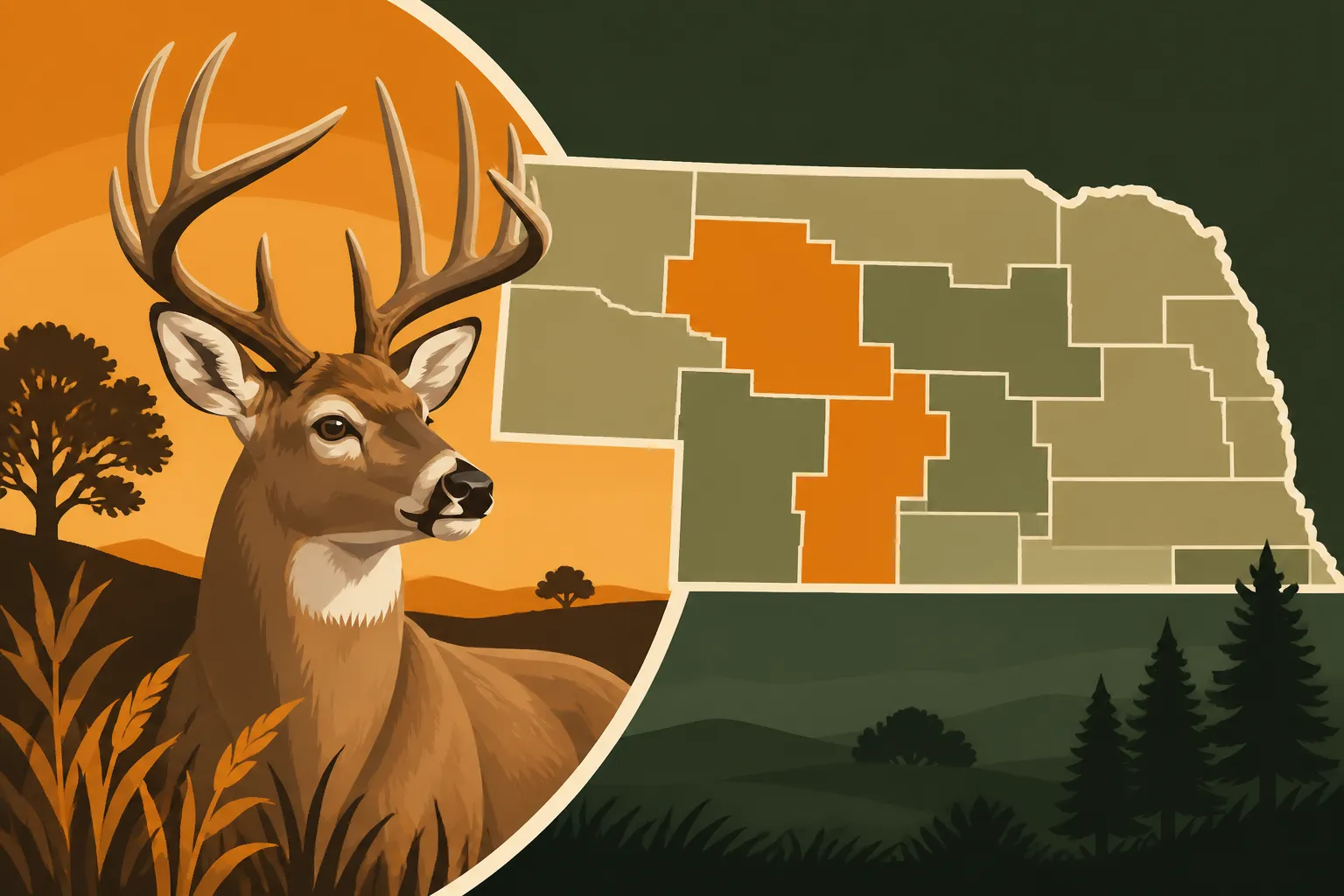
Nebraska's Top Deer Units by Buck Harvest: A Snapshot
While specific unit performance can fluctuate year-to-year, the following table provides a general overview of units that have historically performed well for buck harvest. This isn't an exhaustive list, but it highlights areas known for either high buck numbers or the potential for larger deer.
| Unit Name | Primary Deer Species | General Location | Key Habitat Types | Noteworthy for | Typical Challenges |
|---|---|---|---|---|---|
| Sandhills | Mule Deer | North-Central | Rolling prairie, wet meadows, cedars | Large mule deer, spot-and-stalk | Vastness, few trees, rugged terrain, limited access |
| Pine Ridge | Mule Deer | Northwest | Ponderosa pine forests, canyons, buttes | Mature mule deer, rugged hunt | Steep terrain, dense cover, physical demand |
| Platte (East/Central) | Whitetail | Central | River bottoms, ag fields, timber | High whitetail density | Private land dominance, pressure near access |
| Missouri River | Whitetail | East | River bottoms, ag fields, heavy timber | Large whitetails | Access can be tough, thick cover, high pressure |
| Blue Southeast | Whitetail | Southeast | Farmland, timber belts, creek bottoms | Quality whitetails, big bodies | Primarily private land, patchwork of cover |
| Calamus West | Mule Deer/Whitetail | North-Central (W. Edge) | Sandhills, transition areas | Good mixed-bag potential | Similar to Sandhills, but with more whitetails |
This table is a generalized guide; actual performance and permit availability vary annually.
Disclaimer
The information provided in this guide is for informational purposes only and is based on general knowledge and publicly available data concerning Nebraska hunting. Regulations, permit availability, and deer populations can change frequently. Always consult the most current Nebraska Game and Parks Commission regulations and official publications before planning any hunting trip. Hunting involves inherent risks, and hunters are responsible for their own safety and for complying with all applicable laws and regulations.