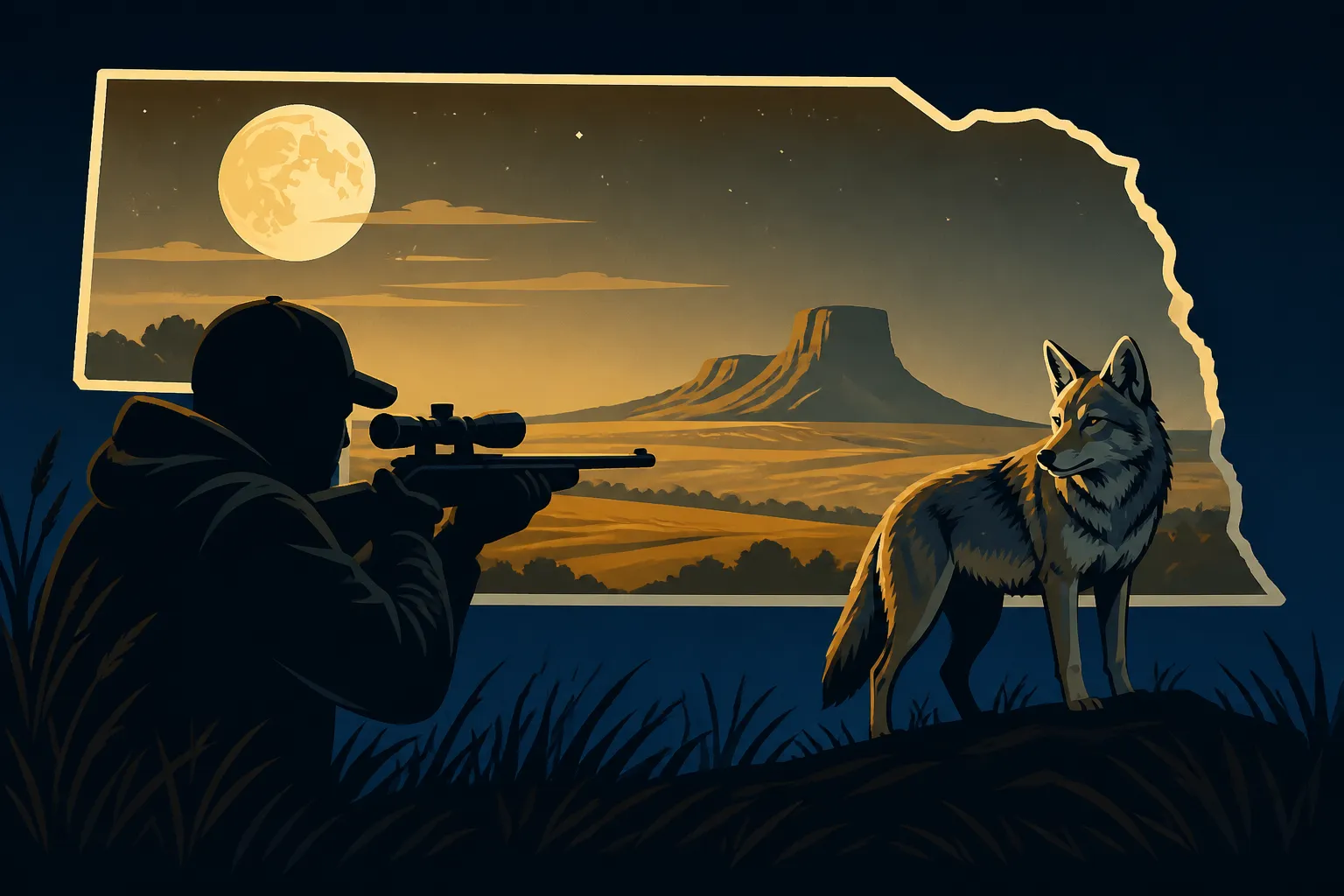
Night Hunting Rules for Predators in Nebraska
The frustration of predators impacting livestock or simply wanting to manage populations can lead many hunters to consider venturing out after dark. While deer and turkey seasons typically wrap up at sunset, predator hunting offers a unique, challenging, and often more effective opportunity under the cloak of night. This guide will meticulously break down Nebraska's specific rules and best practices for night hunting predators, ensuring you stay legal, safe, and successful.
Understanding What Qualifies as a "Predator" for Night Hunting in Nebraska
When we talk about "predators" in the context of night hunting in Nebraska, it’s important to distinguish them from big game like deer, elk, or antelope, which are strictly off-limits after dark. Nebraska law is quite specific about which species can be hunted at night with artificial light. This clarity is crucial to avoid serious legal trouble.
Primary Furbearers Targeted at Night
The Nebraska Game and Parks Commission (NGPC) designates a specific list of furbearers that can be hunted at night. These are generally species that are active after sunset and whose populations can benefit from management. The main targets for most night hunters in Nebraska include coyotes, bobcats, and various foxes. Coyotes, in particular, are a popular species for night hunting due to their widespread presence and potential impact on livestock or smaller game species. While often seen as pests, they are also a challenging and rewarding quarry.
Other furbearers that fall under these night hunting provisions include raccoons, badgers, opossums, skunks, and civet cats. While not as commonly pursued by specialized night hunters as coyotes or bobcats, these animals can still be legally hunted at night under the same general rules. Knowing the specific species you are targeting is the first step in ensuring you're operating within the legal framework. It’s never a bad idea to double-check the latest Nebraska hunting guide each year, as regulations can sometimes see minor tweaks.
Species Excluded from Night Hunting
It cannot be stressed enough: big game animals like deer, elk, and pronghorn are absolutely not legal to hunt with artificial light at night in Nebraska. The use of spotlights or any artificial illumination to locate, spot, or shoot these animals is a serious violation, carrying stiff penalties. While you might be out calling coyotes and a deer walks into your light beam, you must refrain from any action that could be construed as hunting that deer. Your focus must remain solely on legal furbearers. This distinction is paramount for responsible and legal hunting. Understanding the specific legal definition of "furbearer" versus "big game" in Nebraska is a foundational element for any hunter.
Legal Hours and Approved Methods for Night Hunting Predators
Stepping into the night for a hunt requires a different set of rules and considerations than your typical daylight pursuits. Nebraska has clear guidelines on when and how you can hunt furbearers after the sun goes down, largely centered around the use of artificial lights.
Permitted Hours for Using Artificial Light
For most game animals in Nebraska, hunting hours conclude one-half hour after sunset and begin one-half hour before sunrise. However, for those specific furbearers we just discussed – coyotes, bobcats, foxes, raccoons, badgers, opossums, skunks, and civet cats – the rules are different. You are permitted to hunt these animals using artificial light from sunset to sunrise. This is the critical window for night hunting predators. This specific exemption allows hunters to leverage the nocturnal habits of these animals.
It’s important to note that these extended hours apply specifically to the use of artificial light. Even if you're not using a light, the general furbearer hunting season dates still apply. So, while the hours are expanded, you still need to be hunting within the open season for the species you are targeting. You'll find specific dates for these seasons in the annual Nebraska hunting regulations, so always make sure your planned outing falls within those dates.
Approved Firearms, Archery, and Electronic Calls
When it comes to the tools of the trade for night hunting, Nebraska offers a fair bit of flexibility, especially compared to some other states.
Firearms: Most common hunting firearms are permissible for furbearers, provided they are legal for hunting in general. This includes shotguns, rifles, and handguns. For hunters pursuing coyotes in the wide-open spaces of the Nebraska Plains, a flatter-shooting rifle setup can be incredibly effective, especially when shots might extend beyond typical timber ranges. Considerations for a Rifle Setups for Nebraska's Open Country might include calibers like .223 Rem, .204 Ruger, or .22-250 Rem, chosen for their velocity and flat trajectories, which are beneficial when trying to hit a moving target under less-than-ideal lighting conditions. Many hunters also opt for suppressed firearms, which are legal in Nebraska. A suppressor can significantly reduce the noise signature, making follow-up shots or hunting in areas closer to residences more feasible and less disruptive. It also protects your hearing, which is a huge plus.
Archery: While less common for dedicated night predator hunting with lights due to the challenge of aiming effectively in low light, archery equipment is legal for furbearers. If you choose this route, you'll need specialized lighted nocks and perhaps a bow sight with illuminated pins to compensate for the darkness.
Electronic Calls: These are perfectly legal and incredibly effective for predator hunting in Nebraska, day or night. From the piercing distress calls of a rabbit to the alluring howls of a coyote, electronic calls can bring predators in close. Pairing these calls with artificial light is a common and successful tactic. Many modern electronic calls come with remote controls, allowing you to place the caller away from your position, drawing the predator's attention away from you. This can be especially useful for keeping your exact location concealed when a coyote comes charging in. Learning about Coyote Calling in Nebraska Winter can give you an edge, as winter conditions often concentrate coyotes around specific food sources and make them more responsive to calls.
| Method Type | Legality for Night Hunting Furbearers | Notes |
|---|---|---|
| Artificial Light | Permitted (Sunset to Sunrise) | Only for designated furbearers (coyotes, bobcats, foxes, raccoons, badgers, opossums, skunks, civet cats). Absolutely prohibited for big game. |
| Rifles | Permitted | Common calibers like .223, .204, .22-250 are popular. Suppressors are legal. |
| Shotguns | Permitted | Effective at closer ranges. Good for dense cover or when animals commit quickly. |
| Handguns | Permitted | Requires precision and practice in low light. |
| Archery Equipment | Permitted | Requires specialized low-light accessories (lighted nocks, illuminated sights). Less common for dedicated night hunting due to visibility challenges. |
| Electronic Calls | Permitted | Highly effective for luring predators. Can be remote-controlled to divert attention. |
| Thermal/Night Vision | Permitted | Legal for hunting furbearers at night. Offers a significant advantage in detection and engagement. |
| Hunting from Vehicle | Restricted | Prohibited on public roads/rights-of-way. Permitted on private land with landowner permission, but generally not from a moving vehicle. |
Specific Regulations and Restrictions for Night Hunting in Nebraska
While Nebraska offers opportunities for night hunting predators, it’s not a free-for-all. There are specific rules regarding where you can hunt, how you can use lights, and other important considerations to keep you on the right side of the law and maintain ethical hunting practices. These nuances are often where hunters can inadvertently run into trouble if they haven't done their homework.
Public Versus Private Land Access
This is perhaps the most critical distinction for any hunting in Nebraska, and it becomes even more pronounced when hunting after dark.
Private Land: On private land, with explicit landowner permission, you have the most flexibility regarding night hunting. Always secure Nebraska Trespass and Permission Law in writing. This not only protects you legally but also clearly communicates your intentions to the landowner. Many landowners, especially those with livestock, are eager for responsible predator control. When seeking permission, clearly explain your intent to hunt at night with lights and clarify your methods. This transparency builds trust and avoids misunderstandings. Remember, even on private land, you must abide by all statewide furbearer hunting regulations, including season dates and species limits.
Public Land: Hunting on public lands – such as Wildlife Management Areas (WMAs), National Forests, or National Grasslands – can be significantly more restrictive. Many public areas, particularly WMAs, have specific rules against night hunting or the use of artificial lights after normal hunting hours. It is absolutely essential to check the specific regulations for each public area you intend to hunt. The Nebraska Public Access Atlas, provided by the NGPC, is an invaluable resource for identifying public lands, but it’s crucial to then delve into the specific rules for that particular WMA or federal property. Sometimes, a quick call to the local Game and Parks office or the land manager can save you a lot of grief. Don't assume that if it's legal statewide, it's legal on every piece of public ground.
Rules for Using Artificial Lights
The permission to use artificial light for night hunting furbearers comes with responsibilities and limitations. You can use spotlights, weapon-mounted lights, or headlamps. The intent is to allow you to locate and identify your target safely and effectively. However, you cannot use any artificial light to hunt big game. If you’re sweeping fields with a powerful spotlight, you need to be constantly aware of what you’re illuminating. If you see deer, you must immediately cease any activity that could be perceived as hunting them.
It's also generally prohibited to shine artificial lights from a vehicle onto roadways or private property without permission. Even if you're not hunting, doing so can be misinterpreted as poaching or spotlighting game. Always be mindful of your surroundings and avoid creating any appearance of unlawful activity. Many night hunters use red or green filters on their lights, as these colors are less disruptive to human night vision and some believe they are less alarming to certain animals. While not a legal requirement, it's a practical consideration.
Hunter Permits and Other Requirements
To hunt predators in Nebraska, day or night, you must possess a valid Nebraska Hunt Permit and a Nebraska Habitat Stamp. These are standard requirements for nearly all hunting activities in the state. If you're a resident, these are typically straightforward purchases. For non-residents, the costs are higher, but the process is similar. You can purchase these permits online through the Nebraska Game and Parks Commission website. It's also worth noting that if you were born on or after January 1, 1977, you must have successfully completed a certified Hunter Education Course, or possess an Apprentice Hunter Exemption Certificate. This applies to all hunting, including predators. You can learn more about Nebraska Habitat Stamp Requirements on the NGPC website.
Safety and Ethical Hunting Practices
Night hunting introduces unique challenges and significantly elevates safety concerns. Reduced visibility means you must be hyper-aware of your surroundings, your shooting lanes, and what lies beyond your target.
Positive Target Identification: This is paramount. Never shoot at a sound or a vague shape. Use your artificial light to clearly identify your target and confirm it's a legal furbearer before taking a shot. Mistaking a coyote for a domestic animal or even another hunter in the dark is a nightmare scenario. High-quality optics and powerful lights are your best friends here. Thermal and night vision optics, which are legal for furbearer hunting, offer a distinct advantage in target identification and ethical shot placement at night.
Backstop Awareness: Just because it's dark doesn't mean bullets stop in mid-air. Always ensure you have a safe and clear backstop for every shot. The wide-open fields of Nebraska might seem to offer endless backstops, but you need to be certain there are no farmsteads, roads, or other structures far in the distance. When hunting Coyote Calling in Nebraska Winter, remember that frozen ground can cause ricochets, so understanding your bullet's trajectory and potential hazards is even more critical.
Communication and Teamwork: If you're hunting with a partner, establish clear communication protocols before heading out. Know each other's positions at all times. Use hand signals or low-power radios, especially if you're splitting up to set up ambushes or block escape routes. Many hunters utilize apps like GoHunt for mapping and communication, allowing them to share locations in real-time and mark potential hazards or property lines. This kind of technology can be a game-changer for safety and coordination.
Respecting Landowners and Neighbors: Even with permission, be a good neighbor. Avoid shining bright lights directly at homes or disturbing livestock more than necessary. Retrieve your game quickly and leave the area cleaner than you found it. Ethical behavior ensures future access and maintains a positive image for hunters. A good reputation with landowners is invaluable, and securing private land access can often be the key to successful night predator hunting. Before you even head out, ensure you're crystal clear on Nebraska's Posted-Land and Trespass Rules.
Essential Gear and Planning for a Successful Night Hunt
Effective night hunting isn't just about knowing the rules; it's about being prepared with the right equipment and a solid plan. The darkness magnifies every detail, making your gear choices and preparation even more critical for success and safety.
Lighting Solutions and Optics
Your lighting setup is arguably the most crucial component of night hunting. Beyond basic headlamps for moving around, you'll need powerful lights for spotting and engaging targets.
Spotlights: A high-candela handheld spotlight is essential for scanning fields and locating incoming predators. Look for models with adjustable beams, allowing you to quickly switch from a wide scan to a tighter, more intense beam for identification. Many hunters prefer lights that can cycle through different colors (red, green, white), as some believe red and green lights are less startling to animals.
Weapon-Mounted Lights: Once a predator is spotted, a weapon-mounted light allows for hands-free illumination and aiming. These lights should be bright enough to clearly illuminate your target at shooting distances and durable enough to withstand recoil. Consider models with remote pressure switches for easy activation without shifting your grip.
Thermal and Night Vision Devices: For the serious night hunter, thermal imagers and night vision scopes are game-changers. Thermal devices detect heat signatures, allowing you to spot animals hiding in dense cover or across vast distances that would be impossible with traditional spotlights. Night vision amplifies ambient light, offering a clear view of the nocturnal landscape. Both significantly enhance detection and positive identification, making for safer and more effective hunting, especially when combined with electronic calls, as discussed in Predator Calling on the Nebraska Plains. While these can be a significant investment, their effectiveness is unmatched.
Calls, Decoys, and Concealment
Bringing predators into range at night often relies heavily on mimicking their prey or rivals.
Electronic Calls: As mentioned, these are legal and highly effective. Invest in a quality caller with a good library of sounds, from distress cries to barks and howls. The ability to place the caller away from your position, via remote, is a huge advantage, drawing attention away from you. This allows you to set up in a more concealed position and have the animal approach the sound source, not your location.
Visual Decoys: While less effective than sound at long distances in total darkness, a simple visual decoy like a rabbit silhouette or a small spinning-wing decoy (often with a glow feature) can provide an additional focal point for an incoming predator. Once the animal commits to the sound, seeing a subtle visual element can seal the deal, making them focus less on your concealed position.
Concealment: Even at night, concealment matters. While camouflage patterns might seem less critical, breaking up your silhouette is still important, especially if you're using white light or if there's ambient moonlight. A simple ground blind or natural cover can help break up your outline. Often, finding a good setup involves using the terrain to your advantage, such as a fenceline, a small rise, or the edge of a cedar draw. When Using a Ground Blind on Nebraska Public Ground, ensure it's well-brushed in and stable enough to withstand any Nebraska wind. GoHunt's mapping tools can also help you scout ideal locations with good cover during daylight hours.
Safety Equipment and Contingency Planning
The remote nature of many night hunting spots, combined with the inherent risks of hunting in darkness, demands thorough safety planning.
First Aid Kit: Always carry a well-stocked first aid kit, especially one with trauma dressings. Accidents can happen, and you need to be prepared for minor injuries or more serious emergencies, especially when help might be a long way off.
Navigation and Communication: A reliable GPS unit or a smartphone with robust mapping applications like GoHunt is essential. Download offline maps of your hunting area before you go, as cell service can be spotty in rural Nebraska. Carry a portable power bank to keep your devices charged. Inform someone of your hunting location and estimated return time. Consider carrying a satellite messenger for true off-grid communication in emergencies. This is paramount, as getting lost or injured in the dark on unfamiliar terrain can quickly turn dangerous. When you’re Reading Sign on a Nebraska Sandhills Two-Track, knowing exactly where you are and how to get out is invaluable.
Appropriate Clothing: Dress in layers to accommodate fluctuating temperatures. Night air can get chilly, even after a warm day. Choose quiet fabrics that won't rustle loudly when you move. While hunter orange isn't required for night hunting furbearers, it's wise to carry a blaze orange vest or hat to wear if you need to walk out at dawn or if another hunter might be in the area, particularly when combined with daytime predator hunting tactics.
Vehicle Preparedness: Many night hunts involve driving on rural, unmaintained roads. Ensure your vehicle is in good working order. Carry essential recovery gear like a shovel, tow strap, and jumper cables. Getting stuck miles from civilization in the middle of the night is a bad situation you want to avoid.
By thoroughly understanding Nebraska's regulations, selecting appropriate gear, and meticulously planning for every contingency, you can enjoy a safe, ethical, and successful night hunt for predators on the Nebraska plains.
Disclaimer
The information provided in this guide is for general informational purposes only and does not constitute legal advice. Hunting regulations can change, and it is the hunter's responsibility to review and comply with all current Nebraska Game and Parks Commission regulations and local ordinances before engaging in any hunting activity. Always confirm specific rules for any public or private land you intend to hunt.